



Wilier vs Trek Endurance Road Bikes Comparison: Which Delivers True Long-Distance Performance?
The conventional wisdom surrounding endurance cycling has quietly turned on its head. For years, riders assumed American engineering favoured intricate mechanical decouplers whilst Italian marques stuck strictly to rigid, unforgiving carbon. In any modern Wilier vs Trek endurance road bikes comparison, that familiar script is completely rewritten. You shouldn't have to settle for a sluggish, overweight chassis just to isolate rough chip-seal, nor should you sacrifice the lively cornering feedback that makes long weekend rides thrilling.
We understand the challenge of finding that sweet spot between all-day compliance and aggressive hill-climbing agility. Discover how Wilier and Trek approach endurance geometry, ride damping, and chassis responsiveness so you can choose the ideal machine for your riding style. In this technical comparison, we break down real-world frame compliance, tyre clearance flexibility, and long-term workshop practicalities, giving you the clarity to select your next long-distance partner with absolute confidence.
Key Takeaways
- Understand how modern endurance engineering tackles rough road surfaces, contrasting targeted frame compliance with high-volume tyre damping.
- See how geometry nuances in this Wilier vs Trek endurance road bikes comparison impact out-of-the-saddle climbing acceleration and high-speed descending stability.
- Evaluate tyre clearance flexibility across broken tarmac and coarse chip-seal to balance low rolling resistance with plush ride comfort.
- Uncover the weight and power transfer trade-offs between racing-inspired Italian engineering and all-road endurance platforms.
- Gain clarity on long-term workshop maintenance, cockpit integration, and flexible ownership options before making your investment.
Endurance Road Bike Philosophy: Italian Heritage vs American Engineering
Modern endurance cycling is no longer about sitting bolt upright on an uninspiring frame. Today, high-performance long-distance riding demands a meticulous compromise between all-day muscular preservation and raw aerodynamic efficiency. In this Wilier vs Trek endurance road bikes comparison, examining each manufacturer's foundational design ethos shows how distinct their engineering principles really are.
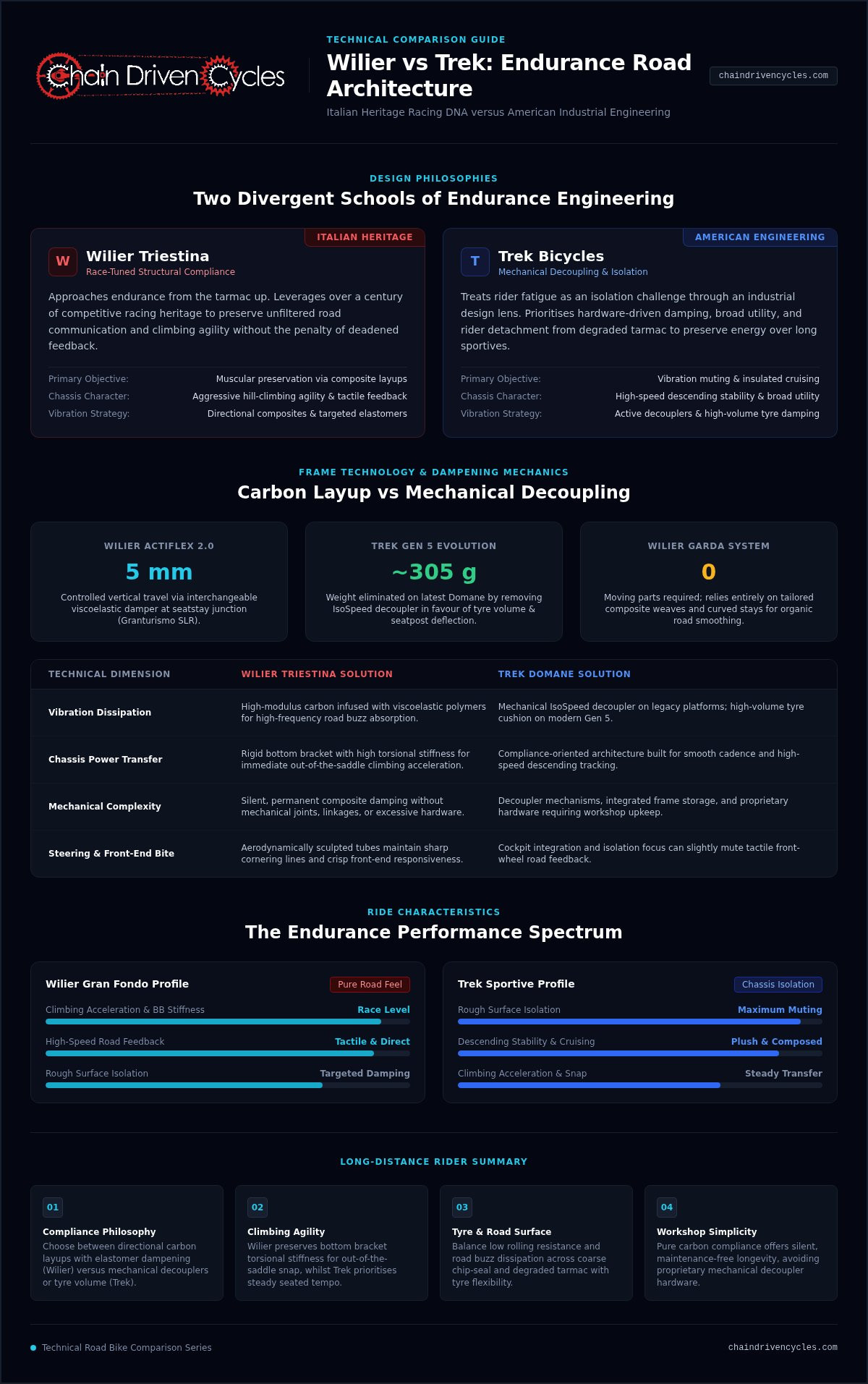
Italian marques approach the endurance problem from the tarmac up. Drawing on more than a century of competitive racing history, documented throughout Wilier Triestina's racing heritage, the Venetian brand refuses to dilute the tactile sensation of speed. They view an endurance platform as a machine that must carve descents and attack climbs like a thoroughbred, utilising directional composite layups rather than bulky hardware to dissipate fatigue-inducing high-frequency vibrations.
Conversely, American engineering tradition often approaches road buzz through an industrial design lens. Trek's long-standing philosophy has treated rider fatigue as an isolation challenge, relying heavily on mechanical intervention, generous chassis compliance, and dedicated utility. These contrasting schools of thought fundamentally shape how a bike tracks through a corner, climbs out of the saddle, and delivers road feedback to your contact points.
The Wilier Design DNA: Race-Tuned Comfort
Wilier views comfort as the natural byproduct of structural efficiency. By deploying high-modulus carbon fibre weaves infused with visco-elastic polymers, the Italian engineers engineer vertical deflection directly into the rear triangle. You retain complete torsional stiffness through the bottom bracket while the frame dissipates surface chatter. The result is pure road communication without the punishing harshness, wrapped in aerodynamically sculpted tube profiles that feel right at home at the sharp end of an undulating gran fondo.
The Trek Design Blueprint: Isolation and Utility
Trek's development trajectory has historically centred on active decoupling and rider detachment from degraded tarmac. Their design language embraces extensive integration, focusing on broad utility and maximum vibration dampening to keep riders fresh across long sportives. However, prioritising mechanical compliance mechanisms and integrated storage features often introduces structural trade-offs, particularly regarding complete system weight, cockpit complexity, and front-end steering bite when pushing hard on steep gradients.
When running a detailed Wilier vs Trek endurance road bikes comparison, your choice hinges on how you define endurance: do you seek the unfiltered, responsive agility of Italian racing lineage, or the insulated stability of an engineered American endurance cruiser?
Frame Technology and Compliance: Carbon Layup vs Mechanical Decoupling
Damping road vibration is the central technical challenge of any long-distance endurance chassis. Over four or five hours in the saddle, high-frequency buzz travelling from coarse chip-seal directly into your palms, shoulders, and lower back accelerates systemic muscular fatigue. In this Wilier vs Trek endurance road bikes comparison, the engineering divergence is stark: one prioritises structural carbon mechanics, whilst the other has historically leaned on physical decoupling hardware.
Wilier tackles road chatter through structural carbon engineering and targeted elastomer damping. On machines like the Granturismo SLR, Wilier integrates its Actiflex 2.0 system at the seatstay junction. This setup delivers up to 5 mm of controlled vertical travel using an interchangeable viscoelastic damper, keeping the front triangle exceptionally stiff and responsive. Lower down the range, models like the Garda utilise tailored carbon weaves and curved stays to soak up road noise without moving parts, preserving an organic road feel that keeps you connected to the asphalt.
Trek's legacy in this category was built around IsoSpeed, a mechanical decoupler separating the seat tube from the top tube to promote flex. While effective at muting big hits, mechanical isolators add frame complexity, mass, and proprietary hardware. Interestingly, modern endurance trends have pushed Trek to eliminate IsoSpeed on its latest Gen 5 Domane to save roughly 305 grams, relying instead on high-volume tyres and standard seatpost deflection. Still, thousands of riders actively compare IsoSpeed-equipped generations against Wilier's refined platforms.
Pure carbon compliance engineering offers permanent, silent damping without weight penalties, whereas mechanical isolation provides distinct vertical deflection at the cost of long-term mechanical maintenance.
Vibration Dampening and Rider Fatigue
Micro-vibrations sap energy continuously. Wilier controls this acoustic chatter by blending Liquid Crystal Polymer into high-modulus carbon sheets, stopping vibrations before they reach the rider. By contrast, mechanical decouplers absorb larger vertical shocks brilliantly, but can leave the saddle feeling slightly isolated or springy under heavy seated pedalling efforts.
Mechanical Complexity and Long-Term Maintenance
Workshop upkeep often separates a great bike from a frustrating one. Mechanical decouplers feature internal pivot bolts, elastomer bumpers, and protective seals that inevitably face dirt, sweat, and road spray. Over wet seasons, neglected pivots can develop stubborn creaks or play, requiring precise torque checks and replacement parts.
A unified composite frame or a simple micro-linkage drastically reduces maintenance headaches. You get silent running year after year without proprietary pivot overhauls. When routine servicing is required for bottom brackets, integrated cockpits, or headset bearings, booking professional support through specialised bicycle repair services ensures your endurance machine remains smooth, creak-free, and road-ready. If you are weighing up your next high-performance build, exploring genuine options through Chain Driven Cycles gives you access to expert setup advice tailored to your riding goals.
Geometry, Handling, and Tyre Clearance Comparison
Geometry defines how an endurance machine interacts with the rider, translating body English into tarmac trajectory. While both brands engineer bikes for long-distance stability, they interpret steering angles and weight distribution quite differently. A close Wilier vs Trek endurance road bikes comparison shows that Trek leans towards high-stack stability and multi-surface capability, whilst Wilier stays committed to agile cornering and crisp handling.
Trek's Domane geometry incorporates a relatively long wheelbase, a generous bottom bracket drop of roughly 80 mm, and a slacker head angle. This setup creates a planted, self-centring feel on straight descents and broken chip-seal. Wilier, on the other hand, keeps the rear triangle compact with 412 mm chainstays and steeper 72 to 72.5-degree head tube angles across core sizes. The result is rapid turn-in response, allowing you to flick the bike around road debris or carve through technical Alpine hairpins without the sluggishness often associated with relaxed endurance frames.
Cockpit Ergonomics: Stack, Reach, and All-Day Posture
Positioning at the controls dictates whether your neck and lower back survive the fourth hour of a sportive. Trek uses a noticeably tall stack height, accentuated on the latest Gen 5 Domane by a Bontrager Riser Bar offering +20 mm of front-end elevation. It allows an upright silhouette without an unsightly tower of headset spacers. Wilier balances comfort and aerodynamics more aggressively. Cockpits like the integrated monocoque Stemma or Zero-Bar system provide clean aesthetic lines and direct front-end feedback, supporting a flat-back posture that cuts through head-on valley winds. To ensure your integrated cockpit and contact points are dialled in precisely to your posture, visit Foundation Bike Fit for specialist studio assessment.
Tyre Clearance and All-Road Capabilities
Rubber volume heavily influences compliance, traction, and rolling resistance across unpredictable back roads. Both manufacturers have expanded clearances, but their upper limits reflect distinct riding environments:
- Trek Domane Gen 5: Officially clears tyres up to 40 mm wide (supplied stock with 35 mm rubber), enabling genuine crossover into light gravel exploration, forestry paths, and rugged winter tarmac.
- Wilier Granturismo SLR: Delivers pure road performance capped at a 32 mm tyre clearance, perfectly matched to modern high-volume tubeless tyres on wide rims for low rolling resistance.
- Wilier Granturismo SL: Expands versatility with up to 38 mm tyre clearance and a universal derailleur hanger, bridging the gap for riders demanding mixed-surface capability without shedding Italian race geometry.
- Wilier Garda: Accommodates up to 32 mm tyres, providing ample room for standard rough-road setups alongside fully concealed cable routing.
If your long-distance routes involve muddy lanes and loose canal paths, Trek's 40 mm threshold holds a practical advantage. However, for fast-paced tarmac endurance where snappy changes of pace matter, Wilier pairs ample 32 to 38 mm tyre envelopes with sharp, reactive front-end steering.
Climbing Efficiency and Power Transfer: The Performance Spectrum
Endurance routes are rarely flat. When a 100-mile sportive points upward into double-digit gradients, an endurance bike must transform from a shock-absorbing cruiser into a firm, reactive climbing tool. In this Wilier vs Trek endurance road bikes comparison, how each frame converts leg torque into forward momentum reveals a crucial performance divide.
Lateral rigidity through the bottom bracket shell dictates whether your effort propels you up the ascent or dissipates through bottom bracket twist. Wilier addresses this by moulding oversized, asymmetric chainstays directly into the bottom bracket junction across its carbon monocoque lineup. Stand on the pedals to punch over a steep kicker, and the chassis surges instantly without hesitation. Trek models deliver reliable, planted power through their T47 shells, though their longer wheelbases naturally favour a steady, rhythmic seated cadence over snappy out-of-the-saddle accelerations.
Torsional Stiffness vs Vertical Compliance
Balancing lateral snap with vertical compliance remains composite engineering's ultimate challenge. Wilier isolates compliance strictly to the vertical plane. By retaining a one-piece carbon front triangle and stiff lower spine, the frame experiences zero torsional wag under heavy sprinting. Conversely, older mechanical decoupling mechanisms can occasionally exhibit subtle lateral squirm when an aggressive rider wrenches on the bars, diluting that razor-sharp connection between pedal stroke and rear-wheel bite.
Climbing on Varied Terrain and Gradients
Chassis weight becomes impossible to ignore on prolonged ascents. Wilier builds its endurance platforms to mirror racing responsiveness, keeping complete bike weights impressively low so you don't feel penalised on mountain passes. Tracking your functional threshold power across these sustained efforts provides objective insight into this efficiency. Equipping your build with Assioma power meter pedals allows you to monitor left-right balance and pedal smoothness as gradients steepen, ensuring you meter out your energy across several hours of climbing.
Descending off the summit requires equal poise. Predictable disc braking and stable steering geometry keep your heart rate controlled on rain-soaked technical switchbacks. Dialling in your fitness before tackling these mountain targets starts with structured winter training; pairing your machine to an efficient smart indoor trainer setup ensures you build the torque required for gruelling summer sportives. If you want to experience the climbing snap of an Italian endurance build firsthand, explore our authorised Wilier road bikes at Chain Driven Cycles to find the ideal spec for your sporting goals.
Making the Right Choice: Rider Profile, Ownership, and Value
Selecting the right platform in this Wilier vs Trek endurance road bikes comparison comes down to your personal biomechanics, preferred terrain, and performance goals. Both brands engineer exceptional long-distance machines, but they solve endurance fatigue from fundamentally different angles. Clarifying how you ride helps identify which engineering philosophy aligns with your ambitions.
Which Rider Are You? Matching Machine to Ambition
Choose Wilier if your ideal weekend involves fast-paced sportives, high-tempo chain gangs, and demanding mountain ascents. Riders who appreciate communicative steering, lightweight climbing snap, and purposeful Italian design will thrive aboard a Wilier chassis. It absorbs road harshness without isolating you from the tarmac, preserving that unmistakable race-bike feel. If you appreciate heritage and want to explore other celebrated alternatives from northern Italy, take a look at our Bottecchia vs Wilier road bike analysis.
Conversely, choose Trek if your priorities lean toward an upright riding posture, bulletproof straight-line stability, and multi-surface touring. If your routes regularly include fractured backroads, light gravel, and gritty cycleways where wide rubber and isolated damping are paramount, the Domane platform offers a calm, secure haven.
Purchasing Confidence and Ongoing Workshop Care
Investing in a high-end endurance bike requires more than just choosing a frame size from a chart. A proper bike fitting ensures dialled-in handlebar reach, exact saddle setback, and optimal crank arm length to prevent repetitive strain over multi-hour rides. Equally important is authorised aftercare; modern internal routing and precision bottom brackets require professional maintenance to keep everything running silently and smoothly across long seasons.
Ownership should also be financially straightforward. Spreading your investment through a structured 10-month payment plan allows you to step onto top-tier groupsets and carbon wheel systems without compromising on specification. Take the next step toward your ultimate long-distance companion by browsing our curated selection of premium Wilier road bikes, and let our dedicated workshop team help you achieve the perfect setup.
Choosing Your Next Endurance Partner
Finding the right balance between road smoothing and dynamic efficiency transforms your time in the saddle. As this Wilier vs Trek endurance road bikes comparison shows, the ultimate choice rests on your riding style. Trek offers an upright haven built for mixed-surface touring and cushioned isolation. Wilier, meanwhile, answers the call for cyclists who crave sharp acceleration, reactive climbing snap, and purposeful Italian handling over triple-digit sportive miles.
As an authorised dealer, Chain Driven Cycles provides genuine Wilier road bikes backed by full manufacturer warranty support. Our professional workshop handles precision custom fit and comprehensive bicycle repair services to ensure flawless long-distance reliability, whilst our flexible 10-month payment plan lets you manage your investment effortlessly. Explore our range of premium Wilier road bikes today, and take to the open road on a machine tailored to your highest ambitions.
Frequently Asked Questions
Is an endurance road bike noticeably slower on climbs than a pure race bike?
No, modern endurance bikes are barely distinguishable from dedicated climbing frames on all but the steepest gradients. Lateral bottom bracket stiffness matches race-level benchmarks, ensuring immediate power transfer when stamping on the pedals. The slight weight difference, usually just a few hundred grams for wider rims and rubber, is easily offset over long rides by reduced muscular fatigue. In any real-world Wilier vs Trek endurance road bikes comparison, you climb faster late in the day because your core remains fresh.
How do Wilier endurance bikes achieve frame compliance without mechanical pivots?
Wilier engineers compliance into the carbon structure itself using directional fibre layups and specialised resin matrices. On models like the Garda, flattened seatstays and curved tube profiles deflect vertically under road impact whilst resisting lateral twisting. Flagship frames integrate Liquid Crystal Polymer within high-modulus sheets to deaden high-frequency road buzz before it reaches the cockpit, delivering smooth all-day comfort without introducing the extra weight or maintenance demands of traditional mechanical frame pivots.
What tyre width is optimal for riding endurance road bikes on coarse tarmac?
Running 30 mm to 32 mm tubeless tyres provides the ideal balance between rolling speed, cornering grip, and road vibration absorption on coarse chip-seal surfaces. Modern wide-internal rims allow these widths to run at lower pressures without tyre squirm. This setup expands your contact patch across broken bitumen and significantly lowers rolling resistance over rough roads compared to older 25 mm setups, making long distances substantially less punishing on your upper body.
Can I fit full-length mudguards to modern carbon endurance road bikes?
Yes, though guard compatibility depends heavily on the specific model and tyre volume chosen. Trek builds hidden mudguard eyelets into Domane frames, typically accommodating full guards with up to 35 mm tyres. Wilier models focus more tightly on aerodynamic performance and clean road lines, meaning full fixed mudguards are best replaced with dedicated clip-on road guards. These clip-on options protect you during wet winter training without requiring permanent frame mounting hardware.
Does Trek IsoSpeed require regular mechanical maintenance and lubrication?
Yes, mechanical IsoSpeed decouplers require periodic workshop inspection, cleaning, and torque verification to prevent squeaks and play. Road grime, sweat, and surface water penetrate the pivot covers over time, degrading internal elastomer spacers and bearings. By contrast, Trek removed IsoSpeed on the Gen 5 Domane, aligning closer to Wilier’s low-maintenance philosophy. If you ride an IsoSpeed frame, regular disassembly and greasing by experienced mechanics ensures quiet, reliable operation across wet seasons.
Which bike provides a more aggressive riding position between Wilier and Trek?
Wilier consistently provides a more aggressive, aerodynamic riding position across its endurance range. While Trek designs the Domane with a tall stack, short reach, and riser drop bars for upright cruising, Wilier maintains tighter racing geometry. Its shorter head tubes, steeper steering angles, and integrated one-piece cockpits allow riders to tuck into an efficient, wind-cheating posture that mirrors WorldTour race machines while still preserving essential vertical compliance.
Can I spread the cost of a premium endurance bike with a payment plan?
Yes, you can spread your purchase over time by taking advantage of our flexible 10-month payment plan. Rather than paying a large upfront sum, qualifying customers can divide the total investment into manageable, predictable monthly instalments. This financing route makes stepping onto high-performance carbon frames, electronic groupsets, and carbon wheelsets much more accessible, backed by our professional workshop setup and comprehensive manufacturer warranty support from day one.