



Power meter pedals for road bikes: choosing single or dual sided
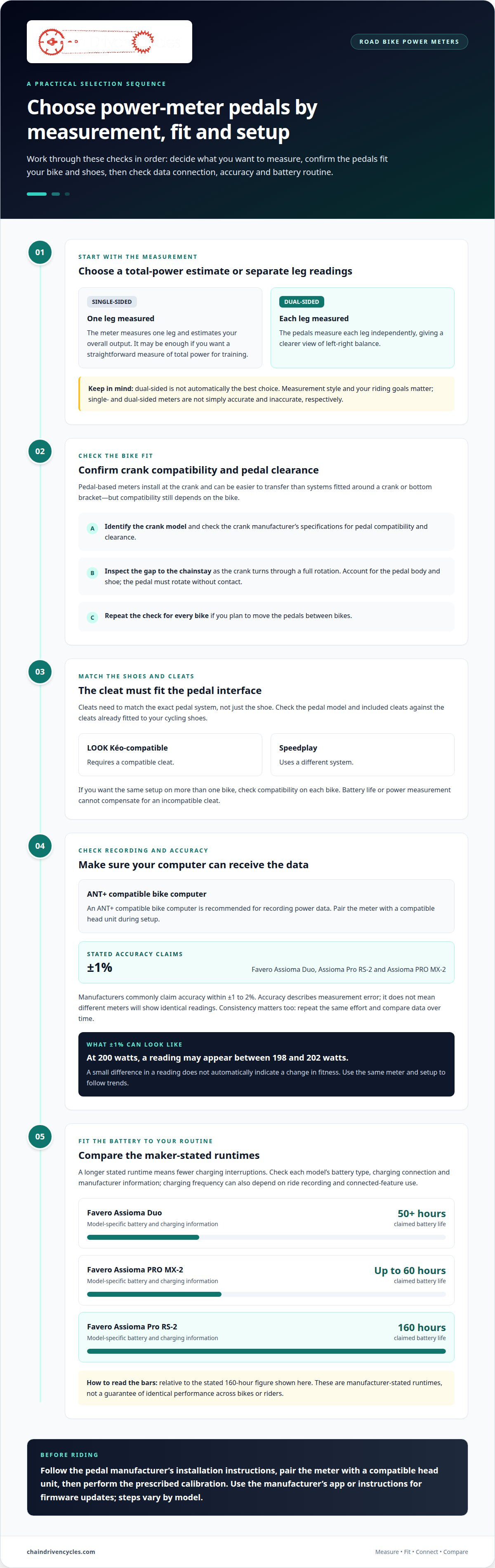
Dual-sided pedals aren’t automatically the best power meter pedals for road bikes. If you want a consistent measure of total power for training, a single-sided model may be enough: it measures one leg and estimates your overall output. Choose dual-sided if you want each leg measured separately and a clearer view of left-right balance.
It’s understandable to focus first on the number of sensors, but the right choice also depends on your riding goals and equipment. Compatibility affects whether the pedals work with your shoes and bike computer, while fit and correct setup influence how confidently you can use the data. Accuracy matters too, though single- and dual-sided meters aren’t simply accurate and inaccurate, respectively.
This guide explains what each format measures, how to assess compatibility, fit and accuracy, and what to consider before choosing. You’ll also find a practical comparison to help narrow down the options for your road bike and training.
Key Takeaways
- Choose single-sided measurement for a straightforward estimate of total power; dual-sided pedals measure each leg independently.
- Compare battery life and charging arrangements with your training routine so power data is ready when you ride.
- Match the pedal system to your shoes and check that your bike computer can receive its data.
- Use stated accuracy as one comparison point, then weigh measurement style and fit to find the right option for your riding.
What is a power meter?
A cycling power meter measures the force you apply to the pedals and reports your output in watts. One watt equals one joule per second. Unlike speed, power reflects the effort you produce, helping you compare intervals even when wind, gradient or road surface changes.
Pedal-based meters measure force at the pedals. Other systems place sensors around the crank arm, spider or bottom bracket. Each position affects installation and compatibility, but the aim is the same: convert pedalling force and cadence into power data. An ANT+ compatible bike computer is recommended for recording that data.
Battery life and charging are practical considerations. A longer stated runtime means fewer charging interruptions, while the battery type determines the charging method and routine. Before choosing, check the manufacturer’s information for battery type, charging connection and stated runtime. The figures below are manufacturer-stated runtimes for these models.
| Pedal option | Battery type and charging | Claimed battery life |
|---|---|---|
| Favero Assioma Duo | Model-specific; follow the maker’s charging information | 50+ hours |
| Favero Assioma PRO MX-2 | Model-specific; follow the maker’s charging information | Up to 60 hours |
| Favero Assioma Pro RS-2 | Model-specific; follow the maker’s charging information | 160 hours |
These figures describe stated battery life, not a guarantee of identical performance across bikes or riders. Charging frequency can also depend on how often you record rides and use connected features. A longer runtime may suit frequent training, while a shorter stated runtime can work for occasional cycling if charging fits your routine.
Power data can help you pace efforts, track training changes and compare output across rides. The meter’s placement and fit still matter: pedal systems can move between compatible bikes, while crank-based systems are fitted elsewhere. For a substantial purchase, compare measurement location, battery details and computer connection together.
Choose a mounting position that suits your bike setup and a battery routine that fits your riding.
Pedal compatibility and adjustability
Pedal fit depends on the crank interface, shoe cleat and available clearance. Check these before choosing a power-meter pedal, especially if you plan to move it between bikes.
Pedal Compatibility
Power-meter pedals install at the crank and can be easier to transfer than systems fitted around a crank or bottom bracket. That advantage only helps if the pedal thread and crank clearance suit each bike. Before buying, check the crank manufacturer’s specifications and inspect clearance around the chainstay through a full crank rotation.
Fit also depends on the pedal design. Favero Assioma models use a pedal-based system, but the specific pedal and cleat interfaces still matter. Consider the pedal body, shoe position and whether you need the same setup on another bike. Don’t assume every road pedal system will fit every crank.
Cleat Options
Cleats must match the pedal interface, not just the shoe. A LOOK Kéo-compatible pedal, for example, requires a compatible cleat; Speedplay uses a different system. Check the exact pedal model and included cleats, then compare them with those already fitted to your cycling shoes.
Cleat choice affects whether you can keep using your familiar shoes and riding position. If you plan to use the pedals on more than one bike, check that they are compatible with each bike. A Favero pedal’s battery life or power measurement can’t compensate for an incompatible cleat. Match the interface first, then weigh measurement and battery features.
In Ireland, compare the seller’s final total in euros, including VAT and delivery, as charges can vary by seller and destination. The price also depends on the pedal model and what the package includes.
To check clearance, identify the crank model, inspect the pedal-to-chainstay gap as the crank turns, and account for the pedal body and shoe. The crank manufacturer’s clearance specifications can help establish whether the pedal will rotate without contact.
For installation, follow the pedal manufacturer’s instructions, pair the meter with a compatible head unit, then perform the prescribed calibration. Use the manufacturer’s app or instructions for firmware updates, as the steps vary by model.
Warranty and replacement are subject to the pedal manufacturer’s applicable terms. Bicycle repair services can address repair needs, while warranty coverage and replacement are handled under the product’s terms.
Power meter accuracy
Accuracy describes how closely a meter’s reading reflects your actual power. Consistency matters too: repeatable readings make training comparisons more useful.
Accuracy and Consistency
Power meter manufacturers commonly claim accuracy within plus or minus 1 to 2 per cent. That range describes measurement error, not whether two different meters will show identical readings. A stable meter should give comparable results when you repeat an effort under similar conditions.
For useful testing, repeat the same effort and compare the data over time, rather than judging a meter from one ride. Short sprints, such as 10 efforts lasting 10 seconds each, can help assess responsiveness. Garmin head units display recorded data, while Shimano cranks are an example of a different measurement location.
Power Accuracy Claims
Favero Assioma Duo road pedals have a claimed accuracy of ±1%. The Assioma Pro RS-2 and Assioma PRO MX-2 also have stated accuracy of ±1%. These claims make the models directly comparable on stated accuracy, but don’t describe their sided measurement or show how readings compare across different systems.
At ±1% accuracy, a 200-watt performance may appear between 198 and 202 watts. That example shows why a small difference in a reading doesn’t automatically indicate a change in fitness. Use the same meter and setup to follow trends, and interpret results alongside the conditions of each ride.
Single-sided measurement estimates total output from one leg, so left-right balance can affect the result if your contribution changes between legs. Dual-sided measurement records each leg independently, providing more detail about balance. Neither format removes the need to interpret readings consistently.
Calibrate the meter as its manufacturer directs, then use the same device and recording setup for comparisons. When considering the best power meter pedals for road bikes, weigh the accuracy figure alongside measurement style and repeatability, rather than treating it as a complete measure of training value.
Dual- or Single-Sided?
Single-sided pedals measure power from one leg and estimate total output; dual-sided pedals measure both legs independently. Favero Assioma Duo is a dual-sided example, with stated accuracy of ±1%.
Single-Sided Measurement
A single-sided meter measures force from one pedal, then doubles that reading to estimate the combined power of both legs. It gives a useful overall training figure, but the estimate depends on your left-right contribution staying similar. If that balance shifts during hard riding or fatigue, the displayed total may not reflect the change precisely.
There’s no universal accuracy figure for every single-sided model. Compare the accuracy stated for the specific meter, remembering that its reading estimates total power rather than measuring both legs separately.
Dual-Sided Measurement
A dual-sided meter measures each leg, then combines the readings for total power. It can also show left-right balance, making it useful if you want to examine how each side contributes during training. The Favero Assioma Duo has stated accuracy of ±1%, as do the Assioma Pro RS-2 and PRO MX-2.
Dual-sided measurement provides more detail, but that doesn’t automatically make its total-power reading more accurate than a single-sided meter. Compare the manufacturer’s accuracy claim and consider whether separate leg data will help your riding.
Cadence is the rate at which you turn the cranks. A power meter combines force, or torque, with cadence to calculate power, so changes in either can alter the reading. For example, maintaining the same force while increasing cadence raises the calculated output.
Choose based on the training information you’ll use. A single-sided option suits riders who want an overall power figure; dual-sided suits riders who value leg-by-leg data. Your needs may differ between road and gravel riding, so consider where you’ll use the meter and whether balance data will guide your training.
To compare pedal measurement options for your training, explore available cycling equipment.
Chain Driven Cycles: Assioma Power Meter Pedals
Chain Driven Cycles sells Favero Assioma power-meter pedals, including single-sided and dual-sided options. The right choice depends on whether an overall power estimate is enough or you want to see each leg’s contribution. Pedal and cleat compatibility, crank clearance and head-unit connection also shape the decision, particularly if you plan to use the pedals on more than one bike.
Use the criteria in this guide to clarify your priorities before choosing a setup. If you’re weighing measurement style against fit and compatibility, Chain Driven Cycles can help you consider Assioma pedals for your road-bike requirements.
Contact Chain Driven Cycles to discuss your power meter pedal choice.
Plan your next step with confidence
Choosing the best power meter pedals for road bikes is a starting point, not the end of your training plan. Think about how you’ll use the numbers: to pace structured sessions, review progress over time or add context to everyday rides. That purpose can help you choose a setup you’ll keep using, rather than collecting data you won’t act on.
Chain Driven Cycles sells Favero Assioma power-meter pedals alongside Bottecchia bicycles and premium road bikes. Match your intended training use with the pedal system and bike you ride, then build a routine around the information that matters to you.
Get advice from Chain Driven Cycles as you decide what will support your next stage of riding. A thoughtful setup can make each session more purposeful and help you ride with greater confidence.
Frequently Asked Questions
What are the best power meter pedals for road bikes in 2026?
The right choice depends on whether you want single-sided or dual-sided measurement, plus a pedal system that suits your shoes and riding setup. Favero Assioma UNO measures power at the left pedal, while Assioma DUO measures both sides. Both have a stated accuracy of ±1%. Compare the information you’ll use in training, rather than choosing by model name alone.
How do Garmin Rally, Favero Assioma, Wahoo POWRLINK and Look power meter pedals compare?
Compare specific models by measurement format, stated accuracy, cleat interface and connection protocols, since a brand name alone doesn’t identify those details. Assioma UNO is single-sided, while Assioma DUO is dual-sided; both have stated accuracy of ±1%. For Garmin Rally, Wahoo POWRLINK and Look options, use the exact model’s specifications to assess the same criteria before comparing them.
Are power meter pedals compatible with Shimano SPD-SL, Look Keo and other road cleats?
Compatibility depends on the pedal model and its cleat system. Favero Assioma UNO is compatible with original LOOK Kéo and Favero cleats, making it suitable for riders using those interfaces. Don’t assume a Shimano SPD-SL cleat or another road cleat will fit; match the cleat to the exact pedal model. This determines whether you can keep using your current shoes and cleats.
How long do power meter pedal batteries last, and are they rechargeable or replaceable?
Runtime and battery type vary by model. Favero Assioma UNO has a rechargeable lithium battery rated for at least 50 hours per charge; Assioma Duo is claimed to last 50+ hours. Assioma PRO MX-2 is rated for up to 60 hours, while Pro RS-2 is listed at 160 hours. Check the chosen model’s charging method, rather than assuming it uses replaceable cells.
Can power meter pedals connect to Garmin, Wahoo, Apple devices and cycling apps via ANT+ or Bluetooth?
An ANT+ compatible bike computer is recommended for recording power-meter data. Compatibility with a Garmin or Wahoo computer, Apple device or cycling app depends on the meter’s supported connection protocols and the receiving device. Before pairing, check that both support the same protocol. This is especially useful if you plan to record rides on a phone rather than a dedicated cycling computer.
What are the main drawbacks and risks of power meter pedals compared with crank-based power meters?
Pedal-based meters require compatible cleats and a suitable pedal fit, and the pedals may need to be moved when you change bikes. Crank-based systems stay installed on the crank, but fit depends on the bike’s crank and frame setup. For riders sharing one meter across bikes, pedals may be easier to transfer; for a permanent setup, the installation location may matter more.