



Smart bike trainers in Ireland for different bikes and setups
What if your bike fits a smart trainer only with the right mounting kit? A bike can work with a modern turbo trainer when its rear axle and the trainer’s fitting system are compatible. Choosing smart bike trainers in Ireland starts with understanding the two main types: direct-drive trainers require removing the rear wheel, while wheel-on models press a roller against the rear tyre.
Check compatibility before choosing a setup, particularly if your bike has a thru-axle rather than a quick-release skewer. With a wheel-on trainer, a dedicated trainer tyre may help reduce heat and premature wear on a standard tyre.
This guide explains how trainer types fit different bikes, how connectivity and power output affect indoor sessions, and what simulated inclines mean in practice. It also covers space and setup considerations to help you choose equipment that suits your bike and training goals.
Key Takeaways
- Choose between a smart bike and a trainer based on whether you want to ride your own bike indoors or keep a dedicated indoor setup.
- Connected trainers can work with cycling apps to record rides and adjust resistance for virtual routes or group sessions.
- Compare power output and simulated incline with the type of training you want to do; some basic smart trainers simulate gradients of only 6%.
- Understand the setup options before choosing, then explore the article’s guidance on local indoor cycling and bike hire.
Can I use any bike with modern bike turbo trainers?
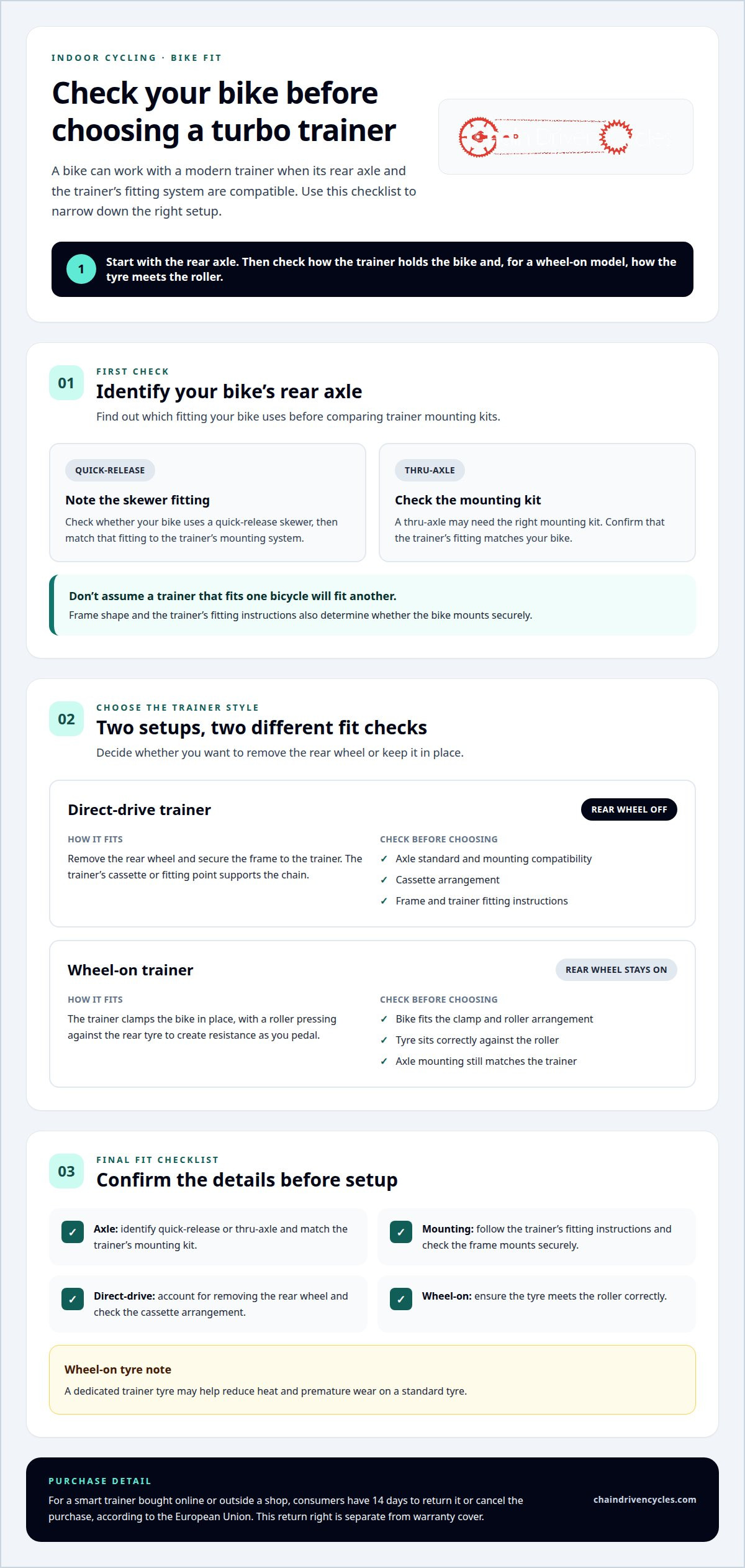
Not every bike fits every turbo trainer, but many setups work when the axle and mounting system match. A direct-drive trainer replaces the bike’s rear wheel: remove the wheel, then secure the frame to the trainer. The trainer’s cassette or fitting point supports the chain, while controlled resistance creates the pedalling load. This design can suit riders who want to use their own bike indoors, provided the frame and axle are compatible.
A wheel-on trainer keeps the rear wheel in place. Its roller presses against the rear tyre to create resistance as you pedal. This can be a straightforward option if the bike fits the trainer’s clamp and roller arrangement. A road bike may fit, for example, but tyre contact and axle mounting still matter. A dedicated trainer tyre may help prevent a standard tyre from overheating and wearing prematurely.
First, identify whether the rear wheel uses a quick-release skewer or a thru-axle. Then match that fitting to the trainer’s mounting kit. Direct-drive models require removing the rear wheel, so the axle standard and cassette arrangement affect compatibility. Wheel-on models instead need the tyre to sit correctly against the roller. In both cases, the frame’s shape and the trainer’s fitting instructions determine whether the bike mounts securely. Don’t assume a trainer that fits one bicycle will fit another.
For a smart trainer bought online or outside a shop, consumers have 14 days to return it or cancel the purchase, according to the European Union. Keep this rule in mind when buying a setup that depends on axle compatibility. Before choosing, note your bike’s axle type and whether you prefer to remove its rear wheel for indoor riding. These details help narrow down suitable smart bike trainers in Ireland and reduce the chance of choosing the wrong mounting style.
How do indoor smart bikes differ from traditional setups?
A smart bike is a dedicated indoor machine; a smart trainer lets you ride a compatible outdoor bike indoors. Choose based on whether you want a permanent setup or prefer to use your own bicycle.
Training through poor weather and winter
Indoor training is an option when rain, wind or darker winter evenings make an outdoor ride less practical. A smart bike stays set up for indoor sessions, while a trainer can be moved or stored to free up floor space. Consider where the equipment will go, how easily you can start a session, and whether you want to ride your usual bike.
Irish riders can choose from different indoor equipment: an Irish directory lists 58 bicycle trainer offers. A smart bike combines the riding position and resistance system in one unit. A trainer instead supports a separate bicycle, so your familiar saddle, handlebars and riding position come indoors. Smart trainers can connect to devices and cycling simulator apps, while traditional setups may provide a simpler, non-connected ride. Your preferred riding experience and available space help distinguish them.
Indoor training can support structured work towards improving functional threshold power (FTP), but progress depends on your training plan and consistent effort, not the equipment alone. Rollers are another traditional option: the bicycle rests on rotating drums, and the rider balances while pedalling. Unlike a fixed trainer, rollers require active balance. They can suit riders who want to practise a steady cadence and bike control indoors.
Setup and calibration steps
For a smart bike, place the unit on a stable surface and adjust the saddle and handlebars to suit your riding position. For a trainer, mount the bicycle securely, then connect the trainer to your smart device or cycling app. Follow the setup prompts for calibration, repeating the process if the app requests it. A fan positioned in front can help keep you cool during a session.
For online or outside-shop purchases, the consumer return and cancellation right described above is separate from warranty cover. Warranty terms depend on the product’s stated coverage, so treat them as distinct from the return period.
What are the benefits of using indoor bike trainers?
A smart trainer can connect to a smart device to record rides and track performance. With a cycling simulator app, resistance can respond to virtual terrain or group riding.
Interactive training and app connectivity
A connected session can turn an indoor ride into a structured workout or virtual route. In a simulator app, changing resistance can make pedalling harder on a virtual climb and easier on a descent. Group-riding modes provide a shared session format, while ride records help you review each workout’s effort and performance.
Use ride records to make sessions purposeful. For example, choose a steady endurance ride for controlled effort, or follow an app workout that varies intensity. Afterwards, compare the ride data with previous sessions to see how your effort changes. Repeatability is useful: the same app and trainer can provide a consistent indoor setting for planned training.
Sensors and ANT+ connectivity
ANT+ is a wireless connection standard used by cycling sensors and receiving devices. Sensors can provide ride data such as cadence or power, while a compatible device or app displays it. Before a session, pair the sensor with the device you plan to use, then check that its readings appear during a short test ride.
Keep the role of each component clear. A trainer can provide resistance and connect to an app, while a separate sensor can add another stream of data. If you’re tracking power, for instance, distinguish the power reading from general ride duration or speed. Where possible, use the same source for a metric across sessions so comparisons remain meaningful. Connection options vary between sensors, trainers and devices, so compatibility determines which data reaches the app.
Trainer power output and simulated incline
Power output and gradient simulation describe different aspects of a smart trainer. Power, measured in watts, indicates the effort applied at the pedals; simulated incline describes how steep a virtual climb the trainer can reproduce. Compare both specifications with the sessions you plan to ride, rather than treating either as a complete measure of trainer quality.
Maximum power output matters most for training that includes hard efforts. A trainer with a lower ceiling may still suit steady endurance rides, while repeated sprint work places greater demand on its resistance system. Consider your intended sessions: a controlled aerobic ride and a short, high-effort interval have different power demands. The trainer’s stated maximum helps you judge whether its capacity suits your training, but it doesn’t tell you how steep a climb it can simulate.
Gradient simulation is a separate specification. Basic smart trainers may simulate gradients of only 6%. That figure describes the incline the trainer can reproduce, not the rider’s maximum power. For example, a virtual route with steeper climbs may feel less demanding if the trainer cannot match its full gradient. Apps can adjust resistance for virtual terrain, but the trainer’s own incline limit still shapes the sensation.
To compare options, note each trainer’s maximum power, maximum simulated gradient and the type of sessions you expect to ride. A rider focused on steady training may prioritise suitable power capacity, while someone seeking realistic virtual climbs may give more weight to gradient range. Keep power readings consistent across sessions if you’re tracking progress, and distinguish trainer output from readings supplied by a separate power-measuring device. This makes each specification easier to assess against your training needs.
Chain Driven Cycles: Bike Hire
Chain Driven Cycles offers Bike Hire for riders who want to try a different bicycle before settling on an indoor training setup. If you’re deciding whether to train on your own bike or use a dedicated indoor option, consider how you’ll use the bicycle and which position feels comfortable.
For a home setup, Chain Driven Cycles offers ThinkRider Smart Trainers, alongside Bottecchia bicycles and Assioma Power Meter Pedals. Each serves a different purpose: a trainer lets you ride a compatible bicycle indoors, while power meter pedals measure cycling effort. Choose according to whether you’re setting up for indoor sessions, building a bike setup or tracking power.
Contact Chain Driven Cycles to discuss which option suits your riding plans.
Make your indoor setup work for your riding
Choose equipment that supports the riding you want to do, rather than chasing the highest specification. Consider whether you’ll train on your own bike, use a dedicated indoor option, or track your effort. That decision will help narrow down your options among smart bike trainers in Ireland.
Chain Driven Cycles offers Bottecchia bicycles and Assioma Power Meter Pedals for riders building a road-bike and performance-tracking setup. Consider how each item fits your riding plans and whether you want to measure power alongside indoor training.
Contact Chain Driven Cycles to discuss your next step. With a setup suited to your goals, you can approach indoor sessions with confidence and keep your training moving forward.
Frequently Asked Questions
How can I make indoor cycling feel more realistic?
Use a cycling simulator app with a route that reflects the terrain you want to ride, then let its changing resistance shape your effort. A cadence sensor can help you follow a target rhythm, while a fan and a familiar riding position can make longer sessions more comfortable. For varied effort, choose a rolling route rather than a constant-resistance workout.
How does a turbo trainer work for indoor cycling?
A turbo trainer supports a bicycle while you pedal indoors, converting your pedalling into resistance and training load. On a smart model, a connected app can adjust that load during a workout. This lets you follow intervals without manually changing gears to create every effort. A basic trainer provides resistance without interactive app control, so the ride depends more on your own adjustments.
What is a smart trainer?
A smart trainer is an indoor trainer that communicates with a compatible device or cycling app. The connection can send ride data and, with interactive training, let an app change resistance. For example, the ThinkRider X7 Pro v3 Smart Trainer supports Bluetooth and ANT+ FE-C connections. Check that the trainer and the device you intend to use share a suitable connection method.
What smart bike trainers are available to buy in Ireland?
Options available through Chain Driven Cycles include the ThinkRider X7 Pro v3 Smart Trainer and the Elite Rivo FE-C mag trainer with Wi-Fi and Zwift Cog and Click. These are named trainer models, not a ranking. Compare their stated features with your bike, preferred app and indoor training routine to identify which setup suits your needs.
What are the best smart bike trainers for different budgets in Ireland?
There isn’t one best trainer for every budget or training style. Start by deciding which features matter most, such as app connectivity, interactive resistance or the type of indoor setup you prefer. Then compare suitable models’ specifications and included accessories. The ThinkRider X7 Pro v3 and Elite Rivo FE-C are examples to consider, but suitability depends on your requirements.
How much do smart bike trainers cost in Ireland, including delivery?
The delivered total depends on the trainer selected and the applicable delivery conditions. Heavy goods can incur a delivery charge, so don’t treat the product price alone as the full cost. Review the current product listing and delivery terms together before ordering to see the relevant total for your chosen trainer and destination.