



Smart bike trainer buying guide: Compare trainer types
The most connected trainer isn’t automatically the best fit. A smart bike trainer buying guide should distinguish between non-smart trainers, one-way smart trainers that share ride data, and interactive smart trainers that adjust resistance in response to a training app. The right choice depends on how much control and feedback you want from your indoor setup.
It’s easy to focus on app compatibility, but the trainer’s design, power accuracy and fit with your bike matter just as much. This guide explains how wheel-on and direct-drive models compare, what accuracy and control options mean in practice, and which compatibility details affect your setup. You’ll come away with a clearer way to compare around six trainer types and choose one that suits your riding, training goals and space.
Key Takeaways
- Choose between wheel-on convenience and direct-drive performance by weighing portability, noise and the cassette your setup requires.
- Use power accuracy and maximum resistance to judge whether a trainer can support your training goals, not just its app features.
- Match the trainer to your bike’s axle, cassette, freehub, tyre and wheel setup to avoid compatibility surprises.
- Decide how much interaction you want: basic ride data, app-connected control, or resistance that responds to virtual terrain and workouts.
Wheel-on or direct drive?
Direct-drive and wheel-on trainers both let you ride indoors, but they connect to your bike differently. That affects setup, drivetrain compatibility and how realistic indoor training feels.
Direct-drive trainers
A direct-drive trainer replaces the rear wheel: remove it, then connect the chain to the trainer’s cassette. The cassette must suit your bike’s drivetrain, so check compatibility before buying. Unlike a wheel-on design, the tyre doesn’t press against a roller. Direct-drive models are generally quieter and can provide more accurate power readings, making them a strong option for regular riding and structured sessions where power data matters.
Some trainers include a cassette; others require you to supply one. A Wahoo KICKR is an example of a direct-drive trainer. This design can make indoor efforts feel more realistic, though road feel varies between models. If you already train with a power meter, compare its readings with the trainer’s data before relying on one source for every session.
Wheel-on trainers
A wheel-on trainer holds the bike by its rear skewer, with the rear tyre pressing against a roller. It avoids removing the wheel or fitting a trainer cassette, so setup can be straightforward. The trade-off is tyre-to-roller contact, which can create more noise and less accurate power readings than direct drive. A dedicated turbo trainer tyre can reduce wear on a regular road tyre.
For occasional indoor training, wheel-on models are often less expensive and more portable. They can suit riders who want to store the trainer between sessions or keep the bike ready for outdoor riding. Tyre pressure and roller contact affect the ride, so follow the trainer’s setup instructions for consistent resistance.
| Trainer type | Bike connection | Key consideration | Best suited to |
|---|---|---|---|
| Direct drive | Chain engages trainer cassette | Rear wheel removal and cassette fit | Regular, quieter training |
| Wheel-on | Rear tyre contacts roller | Tyre condition and roller contact | Occasional riding and portability |
| Classic trainer | Bike drives a resistance unit | Typically lacks smart control | Basic indoor sessions |
Classic trainers provide resistance without the connected control of a smart model. Consider direct drive for regular sessions, wheel-on for simpler storage, or a classic trainer for basic indoor riding. Start by deciding how often you’ll use it.
How accurate does my trainer need to be?
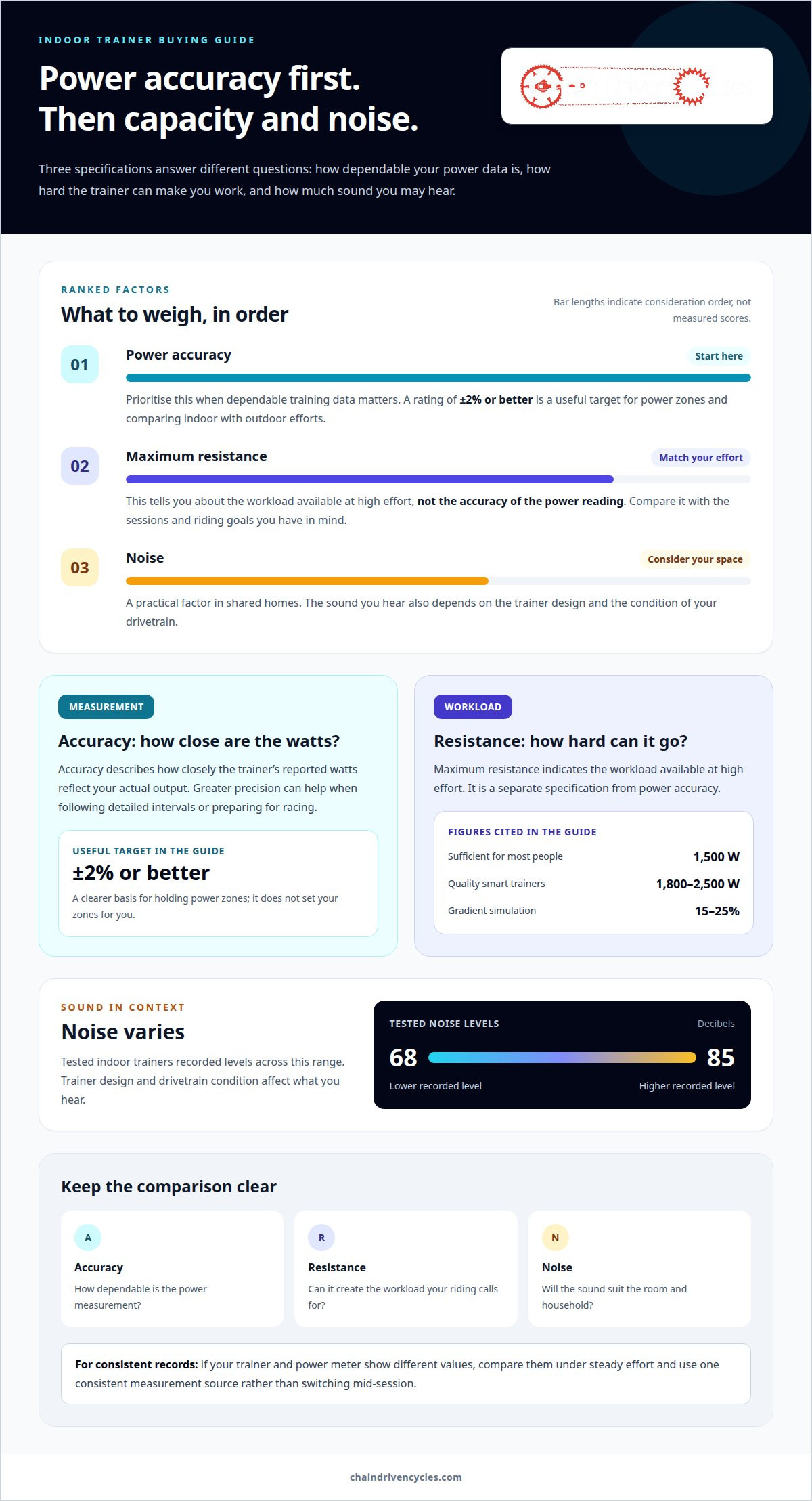
Prioritise power accuracy if you need dependable training data, then compare maximum resistance with your riding goals. These specifications describe different things: measurement consistency and the workload the trainer can create.
Power accuracy
Power accuracy describes how closely a trainer’s reported watts reflect your actual output. A rating of ±2% or better is a useful target for riders who train to power zones or compare indoor and outdoor efforts. Trainer accuracy can vary with price, so consider the specification alongside the sessions you plan to ride.
For example, a displayed 200 watts can differ from actual output within the trainer’s stated accuracy range. That variation matters more when you need precise power measurement for structured intervals or racing preparation. Riders who already use a power meter can compare readings from both devices under steady effort, then use one consistent source for training records.
Training-zone precision
Training zones rely on power targets, so measurement accuracy affects how closely your effort matches each prescribed interval. A trainer rated to ±2% or better gives a clearer basis for holding a zone than one with a wider stated tolerance. It won’t set your zones for you, but it can make target power easier to interpret.
Think about how you train. A rider using broad effort levels for general fitness may not need the same precision as someone following detailed intervals. If your power meter and trainer show different values, avoid switching between them mid-session. Using the same measurement source makes progress easier to assess.
Resistance, power and noise
Maximum resistance indicates the workload available at high effort, not the accuracy of the power reading. A trainer rated at 1,500 watts should provide enough power for most people. Quality smart trainers typically handle 1,800 to 2,500 watts and simulate gradients of 15 to 25 per cent, which can suit demanding climbs or sprint efforts.
Noise is another practical specification, particularly in shared homes. Tested indoor trainers recorded levels from 68 to 85 decibels, although drivetrain condition and trainer design affect what you hear. Compare stated power accuracy, resistance and noise together, then explore smart training equipment suited to your sessions.
How do I find a trainer that's compatible with my bike?
Start with your bike’s rear axle, drivetrain and wheel setup, then compare these with the trainer’s compatibility information. Check the cassette or roller connection, app connectivity, resistance control, power measurement and the space needed to ride indoors.
With a direct-drive trainer, the rear wheel comes off and the chain engages a cassette on the trainer. Match that cassette to your drivetrain, including its speed and freehub fit; a mismatch can prevent smooth shifting. A wheel-on trainer attaches at the rear skewer, with the tyre pressing against a roller. Check that its axle connection, wheel size and tyre dimensions are compatible.
Before buying, identify your axle type, cassette and freehub, wheel size and tyre width. Compare those details with the trainer’s compatibility guide rather than assuming a cheaper model will fit every bike. With wheel-on designs, a dedicated turbo trainer tyre can reduce wear on a regular road tyre. Direct-drive models avoid tyre-to-roller contact but need the right cassette.
Some trainers connect to cycling apps through ANT+ or Bluetooth. Check that the trainer’s connection works with your chosen app and device. Bluetooth Low Energy is commonly available on phones and computers without extra equipment. Allow space for the bike, trainer and safe access around them. A trainer mat can reduce vibration, particularly on wooden floors.
Noise, tyre wear and setup demands are practical drawbacks; tested trainers measured 68 to 85 decibels. For safer sessions, secure the bike firmly, place the trainer on a stable floor and keep cables clear of the riding area.
Smart trainers are available from Irish cycle retailers. Before purchase, read the seller’s written warranty and returns terms, including coverage, conditions and the process for a faulty item.
Non-smart, one-way smart and interactive smart trainers
“Smart” can describe different levels of trainer connectivity. The key distinction is whether a trainer only provides resistance, sends ride data, or also changes resistance in response to a virtual route or workout.
A non-smart trainer uses a resistance unit, such as a roller, without sending power or speed data to a training platform. You control effort through your gears or the trainer’s resistance settings. It can suit simple indoor riding, though connected app features may be limited. Connectivity isn’t part of this setup.
A one-way smart trainer sends ride information to a compatible platform, often through Bluetooth or ANT+. The app can display metrics such as speed or power, while you adjust effort through your gears or trainer controls. This provides connected feedback without automatically changing resistance. It’s useful if you want workout data or virtual ride information but prefer to manage effort yourself.
An interactive smart trainer both sends data and responds to compatible app commands. For example, a training platform can increase resistance for a virtual climb or set a target for an interval. Automatic control makes structured sessions easier to follow, but the trainer and app need compatible connectivity. The platform’s features also shape the experience, from workout control to virtual riding.
Compare the three by asking what you want the trainer to do during a session:
- Non-smart: provides resistance, with no app-based data exchange.
- One-way smart: shares ride data, while you control effort.
- Interactive smart: shares data and adjusts resistance through compatible software.
A more connected setup isn’t automatically the right choice, and extra features can make a trainer more expensive. Choose non-smart for straightforward resistance, one-way smart for app feedback, or interactive for automatic control during virtual rides and workouts. Explore connected indoor training options to compare setups.
Chain Driven Cycles: Bike Hire
Chain Driven Cycles offers ThinkRider Smart Trainers for riders choosing an indoor setup, alongside Bike Hire for cycling outside. If you’re still weighing trainer type, bike compatibility and power measurement, consider how you plan to ride and what equipment you need.
ThinkRider Smart Trainers are the relevant option for a connected indoor setup. Assioma Power Meter Pedals can also support power-based riding, while Bottecchia bicycles provide another cycling option. Bike Hire suits a different need: getting out on a bike rather than training indoors. These offerings give you a practical starting point, whether you’re comparing indoor equipment or considering a separate ride.
For help choosing between these options, contact Chain Driven Cycles.
Make your next ride count
Use this smart bike trainer buying guide as a starting point, then consider how indoor riding fits into your wider cycling routine. A setup that suits your available space and preferred training style is more useful than paying for features you won’t use. You can also build around the equipment you already own rather than treating an indoor trainer as a separate system.
Chain Driven Cycles stocks Assioma power meter pedals for power-focused riding, alongside quality bicycles to complement your training. Consider how these options fit your plans, whether you’re refining indoor sessions or preparing for more time on the road. Choose equipment that supports the way you want to ride.
Explore indoor training equipment and move towards a setup that keeps your training practical and enjoyable.
Frequently Asked Questions
What is a smart trainer?
A smart trainer communicates with a compatible device or training app to share ride information, control resistance, or both. A useful smart bike trainer buying guide distinguishes data sharing from app-controlled resistance, since they offer different levels of interaction. For example, an app might record your power as you ride or direct the trainer to change resistance during an interval. Decide which function you want before comparing models.
What are the different types of turbo trainer?
Turbo trainers include wheel-on, direct-drive and classic resistance models, while rollers are another indoor option. Rollers support the bike beneath its wheels rather than holding it in a fixed trainer frame, so riding them involves balancing. Turbo models provide a more stable base. The right format depends on whether you value a familiar, supported riding position or want to practise balance indoors.
Non-smart, one-way smart or smart interactive?
Choose based on how much you want your training app to control. A one-way model can suit a rider who wants session records but prefers changing effort manually. Interactive control helps you follow app-led intervals without adjusting resistance yourself. A non-smart trainer keeps the setup simple. Think first about whether you’ll use app-directed workouts regularly rather than choosing connectivity for its own sake.
What are the alternatives?
A classic trainer or rollers can provide indoor riding without interactive smart control. Rollers may appeal if you want to practise balance and smooth pedalling, while a classic trainer provides a more supported setup. Outdoor rides are another alternative when conditions and schedule allow. If your main goal is power data rather than virtual resistance, power meter pedals can measure your riding on compatible bikes.
What types of smart bike trainers are available, and how do direct-drive and wheel-on models compare?
Smart models come in direct-drive and wheel-on designs, with different levels of app control. As a specific example, the ThinkRider X7 Pro v3 is direct drive and supports 130, 135, 142 and 148 mm rear axles. Its cassette compatibility covers Shimano or SRAM 9-, 10-, 11- and 12-speed systems; 12-speed use requires a special freehub. Wheel-on trainers keep the rear wheel fitted.
How accurate are smart bike trainers, and what power accuracy should I expect?
Accuracy depends on the trainer model, so use its stated power measurement tolerance when comparing options. For a smart bike trainer buying guide, compare the tolerance with your training needs: the ThinkRider X7 Pro v3 lists power-meter error of ±2%. Keep the same power source for session comparisons. Maximum output and accuracy are separate specifications, so consider both for your intended efforts.