



Indoor Cycling Trainer Ireland: The Ultimate Guide to Home Performance
What if the next Atlantic storm didn't mean a week off the bike, but actually led to your most productive training block of the year? For many cyclists in Ireland, the transition to an indoor environment often feels like a compromise forced by grey skies and horizontal rain. We understand the frustration of losing momentum when the seasons shift, along with the technical headache of ensuring your road bike indoor training setup is actually compatible with the latest virtual platforms. It's easy to feel stuck between a basic turbo trainer that feels like a chore and a complex ecosystem of sensors that don't seem to talk to each other.
This guide will show you how to transform your home sessions into a high-performance regime that rivals the open road. By integrating precision hardware like ThinkRider smart trainers and Assioma power meters, you'll move beyond "just riding" to achieving measurable, year-round gains. We'll explore everything from selecting the right direct-drive technology to optimising your data accuracy, ensuring you build a reliable, immersive training space that makes every watt count, regardless of the Irish climate.
Key Takeaways
- Understand how electromagnetic smart technology replaces traditional turbo trainers to provide a realistic road feel that mimics outdoor riding conditions.
- Learn why a direct-drive road bike indoor training setup is the superior choice for Irish homes, offering quieter operation and better frame protection.
- Discover how to maintain data consistency between your indoor and outdoor rides by using a single source of truth like Assioma power meter pedals.
- Find out how to manage heat and moisture effectively to protect your equipment and your home whilst maintaining peak performance during intense sessions.
- Explore how flexible 10-month payment plans make premium ThinkRider trainers and quality road bikes more accessible for your year-round training goals.
The Evolution of the Indoor Cycling Trainer in Ireland
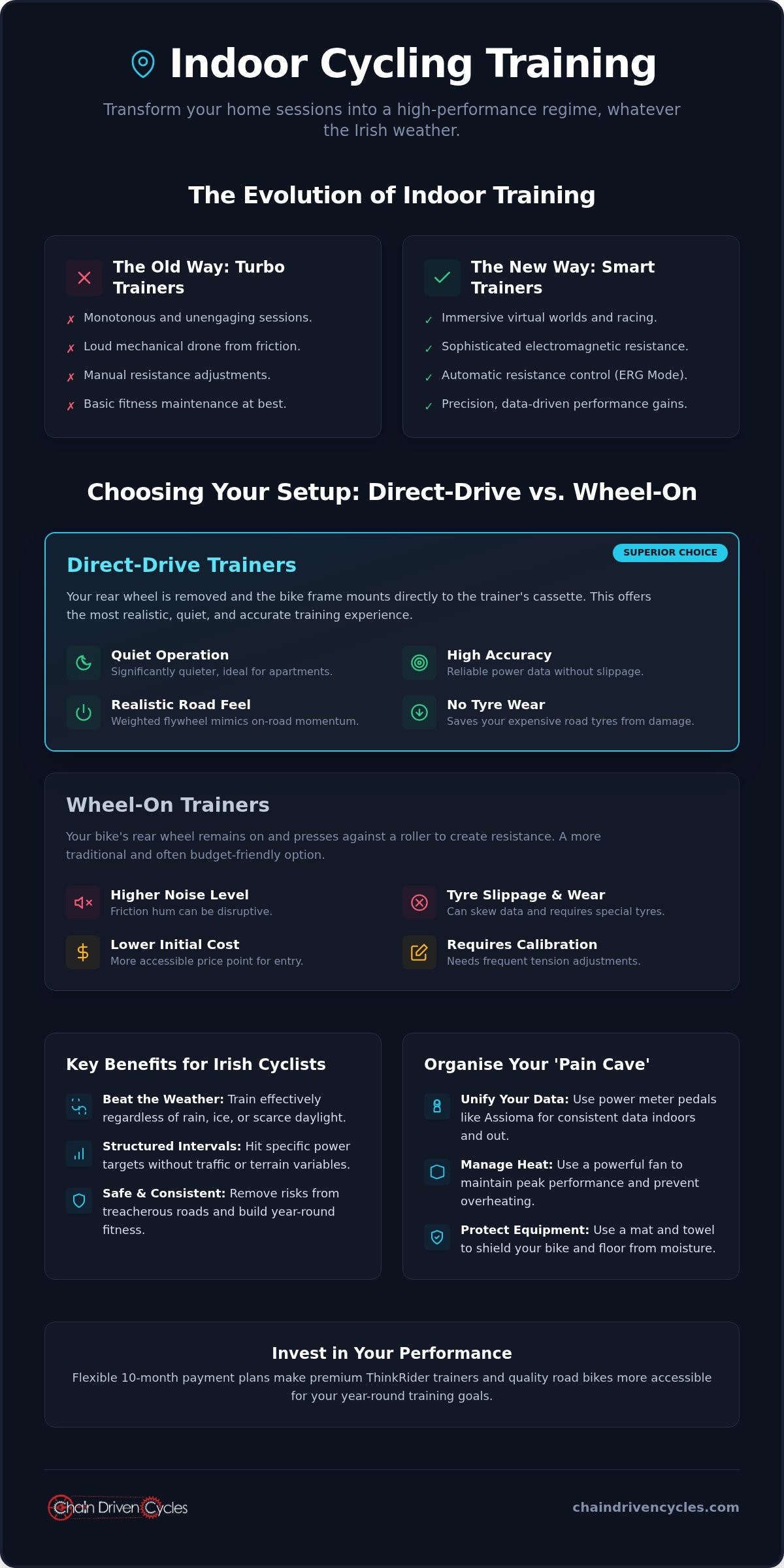
For decades, indoor cycling in Ireland was a monotonous necessity. We've all spent hours in a garage staring at a brick wall, listening to the deafening drone of a friction-based turbo trainer. Thankfully, the landscape has changed. The shift from basic mechanical resistance to sophisticated electromagnetic smart technology has redefined what a road bike indoor training setup can achieve. It's no longer just about keeping the legs moving during a storm; it's about precision performance. Modern bicycle trainers now use magnets and electronic circuits to simulate gradients and resistance with incredible accuracy, allowing for a level of control that was previously reserved for professional laboratories.
Why Indoor Training is Essential for Irish Performance
Irish weather is notoriously fickle. Between November and March, daylight is scarce and road surfaces are often treacherous with ice, standing water, or debris. Indoor training removes these variables entirely. It allows for structured, distraction-free interval training that's nearly impossible to replicate on undulating, narrow Irish backroads. You can hit specific power targets without worrying about traffic, junctions, or a sudden Atlantic downpour. This consistency is the secret to maintaining racing weight and cardiovascular fitness throughout the off-season, ensuring you don't start your spring campaign from zero. It's about taking control of your environment to guarantee your progress.
Smart Trainers vs. Traditional Turbo Trainers
The primary difference between modern units and older "dumb" trainers lies in interactive resistance. Traditional trainers require you to change gears or manually adjust a cable-actuated dial to increase difficulty. In contrast, smart trainers like the ThinkRider range use ERG mode to automatically adjust resistance based on your pre-set workout profile or the virtual terrain on your screen. This shift from basic fitness maintenance to data-driven performance is significant for anyone looking to see measurable gains. Serious enthusiasts prioritise "road feel", which is the realistic inertia provided by a weighted flywheel. This mimics the sensation of momentum you feel on tarmac, making the transition between your indoor and outdoor road bike indoor training setup feel seamless and natural.
Choosing the Right Setup: Direct-Drive vs. Wheel-On Trainers
The foundation of any effective road bike indoor training setup is the physical connection between your bicycle and the resistance unit. This connection typically takes two forms: direct-drive or wheel-on. A direct-drive trainer requires you to remove your rear wheel and mount the frame directly onto a cassette attached to the trainer. In contrast, a wheel-on trainer keeps the wheel in place, with the tyre pressing against a small roller. This mechanical difference dictates everything from the realism of your ride to the level of maintenance required over a long winter season.
A critical consideration for many Irish riders is the acoustic impact on their living environment. In semi-detached homes or apartments, the high-pitched hum of a tyre spinning against a roller can quickly become a nuisance for others. Direct-drive units are significantly quieter because they eliminate the friction between the rubber and the roller. Developments in cycling performance and training technology have prioritised this silence, allowing you to train at high intensity early in the morning or late at night without disturbing the household.
Accuracy and longevity also vary between these systems. Direct-drive trainers generally offer higher power accuracy and require less calibration. Wheel-on systems are prone to tyre slippage, especially during high-torque efforts or steep virtual climbs, which can skew your performance data. Whilst wheel-on units are often more affordable initially, the cost of replacing worn-out tyres and the need for frequent tension adjustments can add up over time. For those seeking a professional-grade experience, a direct-drive unit like a ThinkRider provides a more stable and reliable platform for serious training.
The Direct-Drive Advantage
Direct-drive trainers are the gold standard for performance. By removing the rear wheel, you eliminate tyre wear entirely and prevent the slippage that often occurs during 1,000-watt sprints. These units typically feature larger flywheels, which provide a more realistic road feel by maintaining momentum through the pedal stroke. Most modern direct-drive trainers are designed to be compatible with disc-brake road bikes and various axle standards, making them a future-proof investment for your home gym. If you are looking to upgrade, our ThinkRider smart trainers offer these pro-level features with the added benefit of a 10-month payment plan to help manage the investment.
When to Consider a Wheel-On Trainer
Wheel-on trainers remain a viable entry point for those with limited space or a tighter budget. They are generally lighter and easier to fold away, making them ideal if you don't have a dedicated "pain cave" and need to set up in a multi-purpose room. However, you must factor in the cost of a specific trainer tyre. Standard road tyres will degrade rapidly and leave fine black dust around your training area due to the heat generated by the roller. Using a dedicated, harder-compound trainer tyre is essential for both performance and cleanliness in a wheel-on setup.
The Performance Ecosystem: Integrating Power Meters and Smart Tech
Achieving peak fitness requires more than just high-quality hardware; it demands data integrity. When you transition from a focused winter training block to spring road races, your power zones must remain consistent. If your indoor sessions are measured differently than your outdoor rides, your training load calculations will be flawed. This is why many experienced cyclists view their road bike indoor training setup as a complete ecosystem rather than just a standalone trainer. By synchronising your smart trainer with external sensors and head units, you create a unified stream of performance data that stays relevant regardless of where you ride.
The concept of a "single source of truth" is vital for precision training. While modern direct-drive trainers are incredibly accurate, environmental factors or drivetrain efficiency can cause slight variations in power readings compared to outdoor setups. Using the same power meter for every session ensures that 250 watts in your living room feels exactly like 250 watts on a challenging climb on the open road. Most smart trainers allow for "Power Meter Up" or "Power Match" configurations. This feature enables the software to control the trainer's resistance based on the readings from your on-bike power meter, providing a seamless and reliable data bridge.
Recording this data correctly is equally important. Most riders use a dual-recording approach. Your trainer connects to a laptop or tablet to run your virtual training software, while your dedicated head unit records the session via ANT+ or Bluetooth. This provides a backup of your files and allows you to monitor advanced metrics like left/right balance and torque effectiveness in real-time. These technical insights are particularly valuable during indoor sessions where you can focus entirely on your pedalling technique without the distractions of traffic or road conditions.
The Role of Assioma Power Meter Pedals
Integrating Assioma power meter pedals Ireland into your indoor setup is one of the most effective ways to guarantee data consistency. Unlike hub-based or flywheel sensors, pedal-based power meters measure your effort at the point of contact. This eliminates any data loss through the chain or cassette. Because these pedals are easily swapped between your indoor trainer bike and your outdoor Wilier or Bottecchia road bike, you maintain a perfectly calibrated performance profile all year round. They offer professional-grade accuracy that complements the high-torque capabilities of modern smart trainers. For expert advice and the best selection of power meters, consider browsing the range at Chain Driven Cycles.
Software and App Connectivity
The modern road bike indoor training setup relies on interactive software to keep sessions engaging. Platforms like Zwift and Rouvy use your power data to move an avatar through virtual worlds, automatically adjusting the trainer's resistance to match the terrain. If the virtual road tilts upward, the electromagnetic brake in your trainer engages to simulate the grade. For those focused on pure performance, TrainerRoad offers structured, power-based workouts without the visual distractions. Once your session ends, these platforms automatically synchronise your data with Strava or TrainingPeaks, allowing for thorough post-ride analysis and long-term progress tracking.
Organising Your Home 'Pain Cave': Practical Logistics
Constructing an effective road bike indoor training setup requires more than just high-end hardware; it involves creating a sustainable environment for high-intensity effort. One of the most immediate challenges is managing the byproduct of your hard work: sweat. Human perspiration is highly corrosive to bicycle components, particularly headsets and bottom brackets. Using a dedicated sweat cover that stretches from the seatpost to the handlebars is a simple way to protect your frame. Additionally, a high-density floor mat is essential. In Irish semi-detached houses, these mats serve a dual purpose by protecting carpets or wooden floors and dampening the vibrations that can travel through floorboards to the rest of the house.
Ergonomics play a massive role in session quality. If your monitor or tablet is positioned too high, you'll likely experience neck or shoulder pain during longer endurance rides. Aim to have your screen at eye level whilst you are in your primary riding position. It's also helpful to have a dedicated trainer desk or a small side table within arm's reach. This allows you to manage your nutrition, hydration, and devices without needing to dismount. For riders looking to complement their hydration with premium herbal options for post-ride recovery, شهر چای offers a wide selection of speciality teas. These small adjustments to your road bike indoor training setup ensure that your focus remains entirely on the power numbers rather than physical discomfort from a poor setup layout.
Cooling and Ventilation Strategies
Core temperature regulation is perhaps the most significant performance limiter when training indoors. When you ride outside, the movement of air naturally dissipates heat. Indoors, your body quickly becomes a heat soak, leading to a higher heart rate for the same power output. High-velocity fans are mandatory to simulate real-world airflow. We recommend positioning at least one fan at a 45-degree angle to your front, targeting your torso and head. If you're training in an unheated Irish garage or shed, be mindful of condensation. As the air warms up from your effort, moisture will settle on cold surfaces. Keeping a window slightly ajar or using a dehumidifier can prevent moisture damage to your electronics and bike frame.
Connectivity and Technical Troubleshooting
Nothing kills motivation faster than a technical dropout in the middle of a virtual climb. While Bluetooth is standard, it can suffer from interference if you have multiple devices like heart rate monitors and cadence sensors active at once. Using an ANT+ dongle on a USB extension cable allows you to place the receiver directly under the trainer, ensuring a rock-solid connection. You should also make a habit of checking for firmware updates via the trainer's native app. These updates often improve power accuracy and connectivity stability. If you're ready to build your professional home setup, you can browse our range of ThinkRider trainers and accessories to get started with a 10-month payment plan.
Invest in Your Performance with Chain Driven Cycles
Building a premium road bike indoor training setup is a significant investment in your athletic future. At Chain Driven Cycles, we bridge the gap between high-end technical requirements and the practical needs of the Irish cyclist. As an authorised ThinkRider dealer, we don't just sell hardware; we provide the expertise to ensure your home regime is as effective as your outdoor miles. Our team understands the nuances of drivetrain compatibility and data integration, offering a level of support that high-volume, international retailers simply cannot match.
We take pride in supporting the local cycling community with national delivery across Ireland and a service-first approach. Whether you're a seasoned racer looking to refine your power curve or a newcomer seeking a reliable way to stay active during the winter, we guide you through every technical consideration. From ensuring your trainer is compatible with Wilier road bikes Ireland enthusiasts trust, to helping you calibrate your sensors, our goal is to get you riding with minimal friction.
ThinkRider: Professional Performance, Accessible Price
ThinkRider has quickly become a favourite amongst Irish riders who demand professional-grade accuracy without a prohibitive price tag. These direct-drive units are engineered to provide a realistic road feel, using high-inertia flywheels that mimic the momentum of outdoor cycling. One of the primary advantages of the ThinkRider range is its broad compatibility. These trainers work seamlessly with various drivetrain standards, including Shimano, Campagnolo, and SRAM. This versatility ensures that your road bike indoor training setup remains relevant even if you upgrade your bicycle or components in the future. The robust build quality is designed for high-torque sprints and long endurance blocks alike, making it a dependable cornerstone for any home gym.
Spreading the Cost of Your Indoor Setup
We understand that the initial cost of high-performance technology can be a barrier. To make these tools more accessible, we offer a flexible 10-month payment plan that applies to our smart trainers and our premium bicycle range. This financial flexibility allows you to invest in a world-class setup today and pay over time. For many, this makes it easier to choose between high-end racing machines when viewing our Bottecchia vs Wilier bikes comparison, ensuring you have the right tool for both the virtual and the real road. If you have questions about which trainer best suits your specific bicycle or training goals, our expert team is available to provide personalised advice to help you make an informed decision.
Elevate Your Year-Round Training Performance
Building a professional-grade training environment at home is no longer about just surviving the winter; it's about gaining a competitive edge. By choosing direct-drive technology for its superior road feel and integrating a single source of power data, you ensure every session translates directly to outdoor speed. Managing the practical logistics of your road bike indoor training setup, from high-velocity cooling to frame protection, allows you to focus entirely on your intervals without distraction or equipment wear.
As an authorised ThinkRider dealer and premium Italian bike specialist, Chain Driven Cycles is here to support your journey with expert technical advice across Ireland. We're committed to helping you maintain your momentum through every season with high-end hardware and reliable service. Explore our range of ThinkRider Smart Trainers and start your 10-month payment plan today. Take control of your training schedule and turn those wet Irish evenings into your most productive hours on the bike.
Frequently Asked Questions
Do I need a special tyre for an indoor cycling trainer?
You only need a specific trainer tyre if you are using a wheel-on trainer. Standard road tyres are made of a soft compound that degrades quickly and leaves black dust when pressed against a high-heat roller. If you choose a direct-drive trainer, you remove the rear wheel entirely, so no special tyre is required. This is one of the primary reasons many riders prefer direct-drive units for their road bike indoor training setup.
Are smart trainers compatible with all types of bicycles?
Most modern smart trainers are compatible with a wide range of bicycles, including road, mountain, and hybrid bikes. However, you must ensure you have the correct adapters for your frame's axle standard, such as 130/135mm quick-release or 142/148mm through-axles. You also need to match the cassette on the trainer to your bike's drivetrain speed to ensure smooth shifting and prevent chain damage.
How loud is a direct-drive smart trainer compared to a turbo trainer?
Direct-drive smart trainers are significantly quieter than traditional wheel-on turbo trainers. Because there is no friction between a spinning tyre and a metal roller, the noise is reduced to a low hum. In most cases, the loudest part of your session will be your bicycle's drivetrain and the cooling fan you use. This makes them a much better choice for training in Irish semi-detached homes or apartments.
Can I use an indoor trainer with a carbon fibre road bike?
Yes, you can safely use a carbon fibre bike on a modern indoor trainer. Most premium manufacturers, including Wilier and Bottecchia, design their frames to handle the forces of indoor riding. It's vital to use the specific skewers or through-axle adapters provided with the trainer. Direct-drive units are generally considered safer for carbon frames as they don't involve clamping the rear stays as tightly as older wheel-on models.
What is the difference between ANT+ and Bluetooth for cycling trainers?
ANT+ is a wireless protocol that allows one sensor to broadcast to multiple devices at once, which is ideal if you want to see your data on both a laptop and a head unit. Bluetooth typically creates a one-to-one connection, which is often more stable for connecting a trainer directly to a tablet or smartphone. For a professional road bike indoor training setup, using an ANT+ dongle with a USB extension often provides the most reliable connection.
Do I need a subscription to use a smart trainer in Ireland?
You don't need a subscription to use the trainer's basic resistance functions, but you'll need one to access interactive platforms like Zwift, Rouvy, or TrainerRoad. Most trainers come with a free native app that allows you to control resistance manually or follow basic workouts. However, the immersive experience of riding in virtual worlds or competing in races requires a monthly subscription, typically priced in Euro for the Irish market.
How accurate are the power readings on a ThinkRider trainer?
ThinkRider smart trainers provide high-level power accuracy, typically within a range of +/- 2%. This precision is more than enough for structured training plans and competitive virtual racing. To maintain this accuracy, you should perform a "spindown" calibration through the ThinkRider app once every few weeks or after moving the trainer. This ensures the internal sensors account for any changes in belt tension or environmental temperature.
Is it worth buying a smart trainer if I already have power meter pedals?
It's definitely worth it because power meter pedals only measure your output; they don't provide interactive resistance. A smart trainer can simulate gradients and automatically adjust difficulty based on a workout profile, which your pedals cannot do. You can use "Power Match" software to let your Assioma pedals control the trainer's resistance. This setup combines the superior accuracy of your pedals with the immersive feel of a smart trainer.