



How to Improve Cycling Power Indoors: A Step-by-Step Performance Guide
Did you know that inadequate cooling alone can lead to a 15-20% reduction in your indoor power output? It's a frustrating reality for many Irish cyclists who find their numbers dipping the moment they swap the open road for the trainer. If you've been wondering how to improve cycling power indoors without the usual struggle against overheating and mental fatigue, you aren't alone. You've likely felt that heavy-legged sensation or the confusion of why your outdoor efforts don't seem to translate to the screen in front of you.
This guide will show you how to bridge that gap by mastering your environment and your training strategy. We'll share the professional secrets to building raw strength from the comfort of your home using structured intervals and precision hardware. Whether you want to see a measurable increase in your FTP or simply want to understand your data better, we're here to provide the expertise you need to progress.
We'll walk through everything from managing thermal stress to choosing reliable tools like ThinkRider smart trainers and Assioma power meter pedals. You'll learn how to eliminate "junk miles" and create a professional-grade training space that keeps you motivated whilst you build serious fitness. Let's transform your indoor sessions into a genuine performance advantage that delivers results on the road.
Key Takeaways
- Understand why thermal management is critical and how to use industrial-grade fans to mimic road-speed cooling.
- Learn how to improve cycling power indoors by using precision hardware like ThinkRider trainers and Assioma power meters for accurate tracking.
- Replace "junk miles" with a structured 5-step interval process that targets specific power-building goals.
- Discover the hydration and electrolyte strategies needed to maintain high-intensity efforts in a high-sweat environment.
- See how a professional home setup remains accessible through expert maintenance and flexible 10-month payment plans.
Optimising Your Environment for Maximum Indoor Power
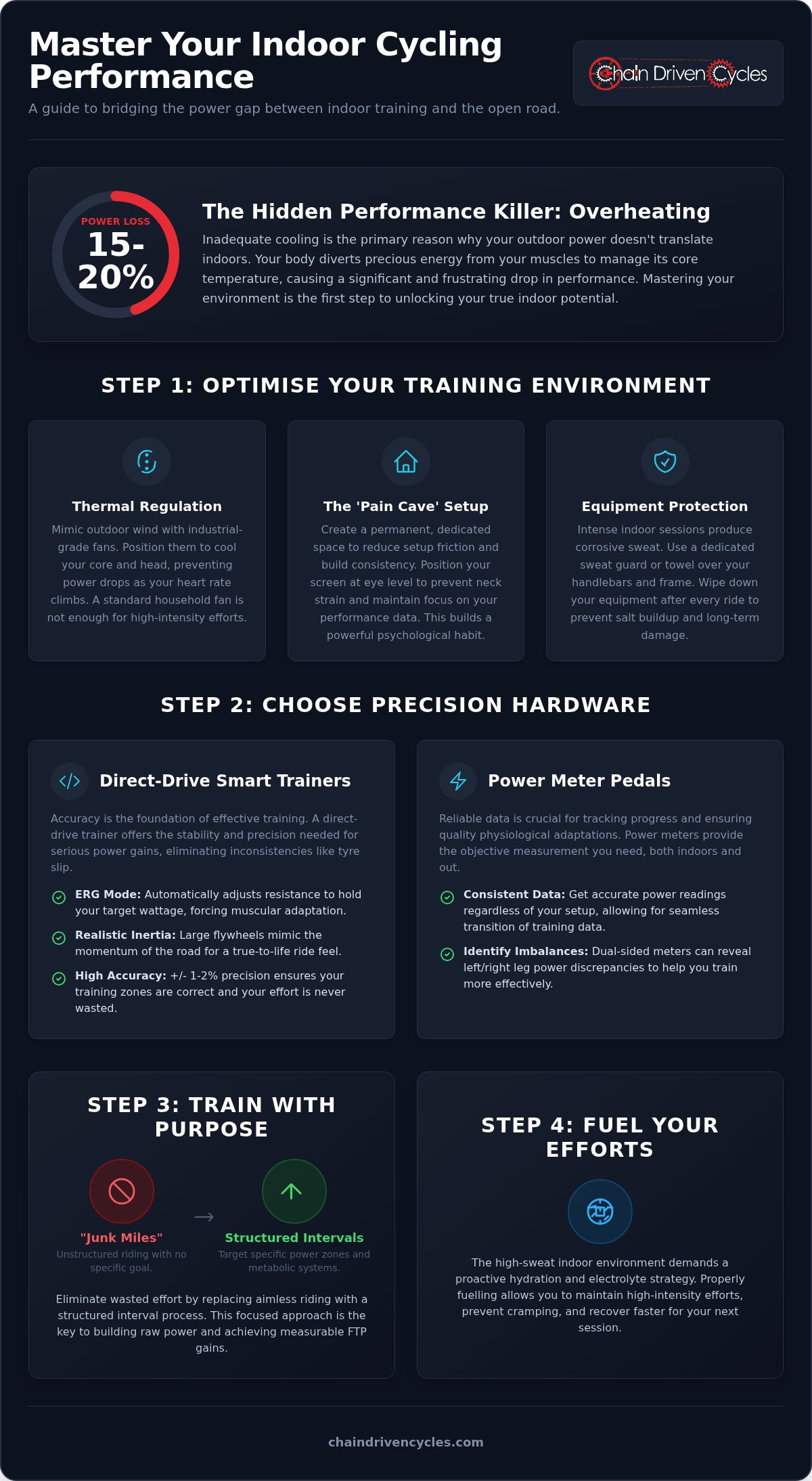
The environment you train in is often the most overlooked variable when learning how to improve cycling power indoors. Many riders focus solely on their training plan or their bike's weight, yet they ignore the fact that indoor conditions can actively sabotage their performance. Research indicates that inadequate cooling can lead to a 15-20% reduction in power output. This isn't because your fitness has disappeared; it's because your body is diverting energy away from your muscles to manage rising core temperatures. To see genuine gains, you must treat your training space with the same precision as your intervals.
Thermal Regulation and Airflow Strategies
When you ride outdoors, the wind provides constant convective cooling. Indoors, you sit in a stagnant bubble of hot air. An open window or a standard household fan won't suffice during a 20-minute threshold test. You need industrial-grade fans capable of mimicking high wind speeds. Position these to target your core and head, as these are the primary areas where your body sheds heat. Keeping your core temperature stable allows you to maintain higher intensities for longer, which is the foundation of building raw power. If you find your heart rate soaring whilst your power numbers drop, your cooling strategy is likely the culprit.
Psychological Priming: The Pain Cave Setup
The "Pain Cave" isn't just a catchy name; it's a dedicated performance centre. Reducing friction is key to consistency. If you have to spend 15 minutes setting up your Bicycle trainer and clearing space every time you want to ride, you're less likely to stick to your schedule. Choose a permanent spot where your bike and hardware are always ready to go. This is a vital part of how to improve cycling power indoors because it builds a psychological habit. Ensure your data, whether on a tablet or a TV, is at eye level to prevent neck strain and keep you focused on your power numbers. High-tempo music can also lower your perceived exertion, making those final sprints feel slightly more manageable.
Managing Sweat and Protecting Your Equipment
Intense indoor sessions result in significant perspiration. Without the wind to evaporate it, sweat pools on your frame, handlebars, and headset. Over time, this salt-rich liquid causes severe corrosion. Use a dedicated "sweat guard" or a large towel over your bars to protect your investment. Regularly wiping down your bike after every session ensures it remains quiet and efficient. This prevents salt buildup from seizing your bolts or damaging the finish on your bike's frame. A clean, well-maintained setup is not just about aesthetics; it's about ensuring your equipment doesn't fail when you're pushing for a new personal best.
Choosing Precision Hardware: Trainers and Power Meters
Accuracy isn't just a luxury; it's the foundation of effective training. When you're researching how to improve cycling power indoors, the reliability of your data determines the quality of your physiological adaptations. If your equipment provides inconsistent readings, your training zones will be incorrect, leading to either overtraining or wasted effort. Whilst a wheel-on trainer might suffice for casual fitness, serious power gains require the stability and precision of a direct-drive system. These units eliminate tyre slip and provide the +/- 1-2% accuracy required to ensure your intervals are hitting the exact metabolic systems intended.
The ThinkRider Advantage for Performance Training
ThinkRider smart trainers offer a professional-grade solution for cyclists who want a realistic road feel without leaving their home. The most significant benefit for power development is ERG mode. This feature automatically adjusts resistance to keep you at a specific wattage regardless of your cadence. It removes the ability to "coast" through a difficult set, forcing your muscles to adapt to the load. Additionally, these trainers can simulate steep gradients, allowing you to build climbing-specific torque and strength that translates directly to the Irish hills.
- Consistent Resistance: ERG mode ensures you never drop below your target wattage during high-intensity blocks.
- Realistic Inertia: Large flywheels mimic the momentum of the road, engaging the same muscle groups used outdoors.
- Seamless Connectivity: ANT+ and Bluetooth protocols allow for instant pairing with platforms like Zwift or TrainerRoad.
Assioma Power Meter Pedals: Precision Everywhere
Whilst a smart trainer is excellent, many data-driven riders prefer a dedicated power source that moves with them. Assioma power meter pedals are a favourite amongst the local cycling community because they provide total consistency. By using the same pedals on your indoor setup and your outdoor road bike, you eliminate the "power gap" caused by using different sensors. This is vital because Indoor vs. Outdoor Functional Threshold Power can vary based on cooling and flywheel inertia. Using a single, reliable meter helps you normalise your data across all environments.
Dual-sided pedals like the Assioma Duo also allow you to identify leg imbalances. If one leg is consistently weaker, you can use your indoor sessions to focus on single-leg drills and smoother pedalling technique. This level of insight is a core part of how to improve cycling power indoors, as it turns a simple workout into a technical coaching session. If you're looking to invest in your performance, our team can help you find the perfect match for your bike and even help you spread the cost with a 10-month payment plan.
Structured Training: How to Execute Power-Building Intervals
Indoor riding without a plan often leads to "junk miles", which are efforts that are too hard for active recovery but too easy for genuine physiological adaptation. If you want to know how to improve cycling power indoors, you must embrace structure. Every minute on the trainer should serve a purpose. By focusing on Functional Threshold Power (FTP) as your primary metric, you can ensure your body is receiving the exact stimulus required to force change. This methodical approach turns the trainer from a tool of boredom into a precision instrument for performance.
A perfect indoor interval session follows a five-step process to maximise results and prevent injury. You should always begin with a progressive 15-minute warm-up, followed by two or three short "priming" efforts to open up your aerobic system. The main set is where the real work happens, followed by a dedicated period of active recovery between intervals. Finally, a five-minute cool-down helps flush metabolic by-products from your legs. Skipping these steps often results in poor data and increased fatigue.
The 2x20 Threshold Session: Building the Engine
The 2x20 minute session is a staple for a reason. Aim for 95-100% of your FTP during these blocks. This intensity increases your ability to clear lactate whilst maintaining a high aerobic output. Recovery periods between the two sets should be roughly five to ten minutes; this allows your heart rate to settle without losing the "primed" state of your muscles. Sweet Spot training is the most efficient zone for power gains because it balances high intensity with manageable fatigue. Incorporating high-torque, low-cadence drills (50-60 RPM) during these blocks also builds the muscular strength needed to turn bigger gears on the road.
VO2 Max and Sprint Intervals for Explosive Gains
To increase your performance ceiling, you need VO2 Max work. Sessions like 30/30s (30 seconds at 120% FTP followed by 30 seconds of rest) or 4x4 minute blocks push your aerobic capacity to its limit. Using your smart trainer's resistance to mimic the sudden torque of a real-world attack is a vital part of how to improve cycling power indoors. These explosive efforts recruit fast-twitch muscle fibres that are often neglected during longer, steady rides.
Tracking your "Power Duration Curve" across these various sessions allows you to see exactly where you are getting stronger. You might notice your five-second sprint power increasing before your 20-minute threshold improves. This data-driven insight ensures you stay motivated whilst you work through a difficult training block. By varying your sessions between threshold endurance and high-intensity sprints, you build a well-rounded power profile that is ready for any race or weekend sportive.
Bridging the Gap: Why Indoor Power Feels Harder
It is a common frustration for cyclists to find that their outdoor numbers don't always translate to the trainer. If you've wondered how to improve cycling power indoors whilst struggling to hold your usual zones, the reason is often biomechanical rather than a loss of fitness. On the road, your bike moves underneath you, allowing for micro-movements that engage different muscle groups and relieve pressure. Indoors, the bike is fixed. This lack of lateral movement increases the load on specific muscles and can lead to earlier fatigue. Calibrating your expectations is vital; many professionals maintain separate indoor and outdoor FTP profiles to account for these differences in inertia and cooling.
Cadence also plays a significant role in how you perceive effort. Outdoors, you might prefer a lower cadence for climbing, but indoors, spinning faster often feels easier. A higher cadence shifts the load from your muscles to your cardiovascular system, which is often more efficient when the flywheel of a trainer doesn't perfectly replicate the momentum of a moving bike. Experimenting with a cadence 5-10 RPM higher than your outdoor average can be an effective strategy when learning how to improve cycling power indoors without hitting a wall.
Nutritional Support for High-Intensity Indoor Sessions
High-sweat environments demand a specific approach to hydration. The standard recommendation is to drink at least 750ml of water per hour during indoor sessions to offset the lack of convective cooling. It isn't just about volume; you must include electrolytes to replace the sodium lost through heavy perspiration. Without this, your blood volume drops, your heart rate rises, and your power output will inevitably sag. Ensure you fuel with fast-acting carbohydrates 30-60 minutes before your session to ensure your glycogen stores are ready for the high-intensity intervals discussed in the previous section.
Biomechanical Differences and Saddle Comfort
Because a stationary trainer creates more static friction between you and the saddle, high-quality bib shorts are non-negotiable. You should also make a conscious effort to stand up for 30 seconds every 10-15 minutes to restore blood flow and change the muscular load. If you are using your primary road bike, ensure the geometry matches your outdoor setup perfectly. Whether you are training on a high-performance Bottecchia or Wilier road bike, even a few millimetres of difference in saddle height can be magnified during the static nature of indoor riding. For those looking to fine-tune their setup or explore new hardware, our team at Chain Driven Cycles can provide expert advice on matching your indoor environment to your outdoor goals.
Investing in Performance with Chain Driven Cycles
Building a high-performance training environment is an investment in your long-term health and athletic potential. Whilst the previous sections have covered the technical aspects of how to improve cycling power indoors, the hardware itself requires professional attention to remain efficient. At Chain Driven Cycles, we don't just supply the equipment; we provide the ongoing expertise required to keep your setup running quietly and accurately. Whether you're pushing through a threshold session on a ThinkRider trainer or fine-tuning your position on a premium road bike, our team is here to support every watt of your progress.
Maintaining Your Setup for Longevity
Indoor training is notoriously hard on a bicycle's drivetrain. Without the movement of the road, sweat tends to settle in places it shouldn't, leading to accelerated chain wear and potential corrosion of the headset and bottom bracket. We recommend booking a professional tune-up through our Bicycle Repair Services before the winter training season begins in earnest. Our technicians can check for drivetrain grime and ensure your gear indexing is precise, which is crucial for maintaining a smooth cadence during high-intensity intervals. Keeping your smart trainer firmware up to date is also essential for data accuracy. A well-maintained bike isn't just more enjoyable to ride; it's a vital component of how to improve cycling power indoors by ensuring no energy is lost to mechanical friction.
Finance Options for the Serious Cyclist
We believe that professional-grade hardware should be accessible to every dedicated rider in Ireland. High-end tools like the Assioma Duo pedals or a Wilier road bike represent a significant commitment to your sport. To help you manage this investment, we offer a flexible 10-month payment plan. This allows you to spread the cost of your new performance setup over nearly a year, making it easier to acquire the precision equipment needed for measurable FTP gains. This plan applies to our full range of smart trainers and Italian racing machines, ensuring you don't have to compromise on quality.
Our team is always available to provide a bespoke quote for an indoor training package tailored to your specific goals. By joining our national community of performance-focused riders, you gain access to a wealth of local knowledge and technical support. We're proud to be a trusted specialist in the Irish cycling scene, offering the precision and service required to turn your home into a world-class training centre. Contact us today to discuss how we can help you reach your next performance milestone.
Elevate Your Performance with Precision Training
Mastering your indoor environment and hardware is the first step toward genuine performance gains. By managing your core temperature and committing to structured, data-driven intervals, you eliminate the guesswork that often leads to plateauing. We've explored how a dedicated setup, combined with precision tools like ThinkRider trainers and Assioma pedals, allows you to replicate the intensity of the road whilst maintaining total control over your training zones. Every watt counts when you're training with purpose.
Learning how to improve cycling power indoors is a journey of consistency and technical refinement. As an authorised retailer for ThinkRider and Assioma, we provide the expert support and national delivery you need to build a professional-grade pain cave. You can even spread the cost of your high-end setup with our flexible 10-month payment plan. Explore our range of ThinkRider Smart Trainers and start building power today. With the right strategy and the precision of professional-grade hardware, your strongest season yet is just a few sessions away.
Frequently Asked Questions
Why is my indoor power lower than my outdoor power?
Indoor power is often lower due to heat accumulation and the lack of bike movement. When your core temperature rises, your body redirects blood flow to the skin for cooling rather than to your muscles. Additionally, the static nature of a trainer prevents the micro-movements used outdoors to relieve muscle fatigue. Using industrial fans and learning how to improve cycling power indoors through thermal management can help close this performance gap.
How many days a week should I train indoors to see power improvements?
Most cyclists see significant gains with three to four structured sessions per week. Quality is more important than volume when training inside. Because there is no coasting or traffic, an hour on a smart trainer provides a much higher training stimulus than an hour on the road. Balancing high-intensity intervals with adequate recovery ensures you don't burn out whilst chasing new power targets.
Do I really need a smart trainer to improve my cycling power?
You don't strictly need a smart trainer, but it is the most effective tool for precision training. A smart trainer allows for ERG mode, which holds you at a specific wattage regardless of your cadence. If you use a basic trainer, you must have a reliable power meter like Assioma pedals to track your efforts. Without accurate data, it's difficult to measure progress or identify specific areas for physiological improvement.
What is the best way to cool down during an indoor cycling session?
Effective cooling requires high-velocity airflow and proper hydration. Position at least one powerful fan to target your torso and head to facilitate convective cooling. You should also aim to consume roughly 750ml of fluid per hour, ideally with added electrolytes to replace sodium lost through sweat. Keeping your body temperature stable is a fundamental part of how to improve cycling power indoors during long threshold blocks.
Can I use a mountain bike on a smart trainer for power training?
Yes, most modern smart trainers are compatible with mountain bikes using the correct adapters. Direct-drive trainers usually include spacers for 142mm or 148mm thru-axles. If you're using a wheel-on trainer, you'll need a slick trainer tyre to prevent noise and excessive wear on your knobby off-road tyres. Just ensure your drivetrain is clean before mounting the bike to prevent grit from damaging the trainer.
How do I perform an FTP test on my indoor trainer?
The most common methods are the 20-minute steady-state test or a progressive ramp test. A ramp test is often preferred indoors as it is easier to execute and less mentally taxing. Before starting, ensure your trainer is calibrated and you've completed a thorough warm-up. Your FTP is typically calculated as 95% of your best 20-minute average or 75% of your peak one-minute power from a ramp test.
Is it better to do long rides or short intervals indoors?
Short, high-intensity intervals are generally better suited for the indoor environment. Long, steady rides can become mentally fatiguing and often lead to "junk miles" without a specific focus. Because indoor sessions are highly efficient, you can achieve the same aerobic stimulus in 60 to 90 minutes of structured work as you would in a much longer outdoor ride. Save the long endurance blocks for the weekend.
How do I protect my bike from sweat damage whilst training inside?
Use a dedicated sweat guard and keep a large towel draped over your handlebars. Sweat is highly corrosive and can quickly damage your headset bearings, shifters, and bottom bracket. After every session, wipe down your frame with a damp cloth to remove salt residue. Regularly checking your bike's bolts for signs of rust will ensure your high-performance Wilier or Bottecchia remains in top condition for the road.