



Bicycle Pumps: Choosing the Right Tool for Every Ride
The most significant performance upgrade for your bike isn't a carbon wheelset or a ceramic bearing; it's the air inside your tyres. Whether you're riding a high-end Wilier road machine or a Bottecchia gravel bike, the quality of your bicycle pumps determines your speed, grip, and comfort on the road. We've all experienced the frustration of a valve that won't seat or a gauge that feels more like guesswork than science. Struggling with a mini pump that takes far too much effort to reach a rideable pressure is a hurdle no cyclist should face.
You likely understand that maintaining the correct pressure is the simplest way to prevent punctures and improve rolling resistance. This guide helps you select the perfect bicycle pump for your specific setup, ranging from high-pressure track pumps for the home workshop to emergency CO2 inflators for roadside repairs. We'll examine the relationship between tyre volume and pressure whilst explaining how to avoid common pitfalls like valve incompatibility and inaccurate readings. By the end, you'll have the knowledge to ensure effortless inflation before every journey, keeping your equipment in peak condition.
Key Takeaways
- Learn why maintaining precise tyre pressure is the most cost-effective way to improve ride quality and prevent punctures.
- Understand the functional differences between Presta and Schrader valves to ensure your bicycle pumps are always compatible with your setup.
- Discover why a high-pressure track pump is a workshop essential for high-performance bikes like Wilier or Bottecchia models.
- Compare the speed of CO2 inflators against the reliability of mini pumps to find your ideal roadside repair strategy.
- Identify the correct cartridge sizes and pump features needed to handle the higher volumes of electric hybrid tyres.
Understanding the Essentials: Why Every Cyclist Needs a Quality Pump
Tyre pressure is the most influential variable in how your bike handles on the road. It dictates everything from rolling resistance to vibration damping. For owners of high-performance Wilier road bikes or Bottecchia models, maintaining precise pressure isn't just about comfort; it's about protecting a significant investment. A reliable bicycle pump ensures your tyres perform exactly as the engineers intended, extending the life of the rubber and reducing the frequency of professional bicycle repair services.
Many beginners make the mistake of using a portable mini pump for their weekly maintenance. These compact tools are designed for roadside emergencies, not for the regular high-pressure demands of a home workshop. Reaching 100 PSI with a mini pump is an exhausting task that often leads to inaccurate readings and damaged valve stems. Using the wrong tool for the job makes maintenance feel like a chore rather than a quick pre-ride check. Investing in a dedicated floor pump is a fundamental step for any serious cyclist looking to maintain their equipment properly.
Presta vs Schrader: Identifying Your Valve Type
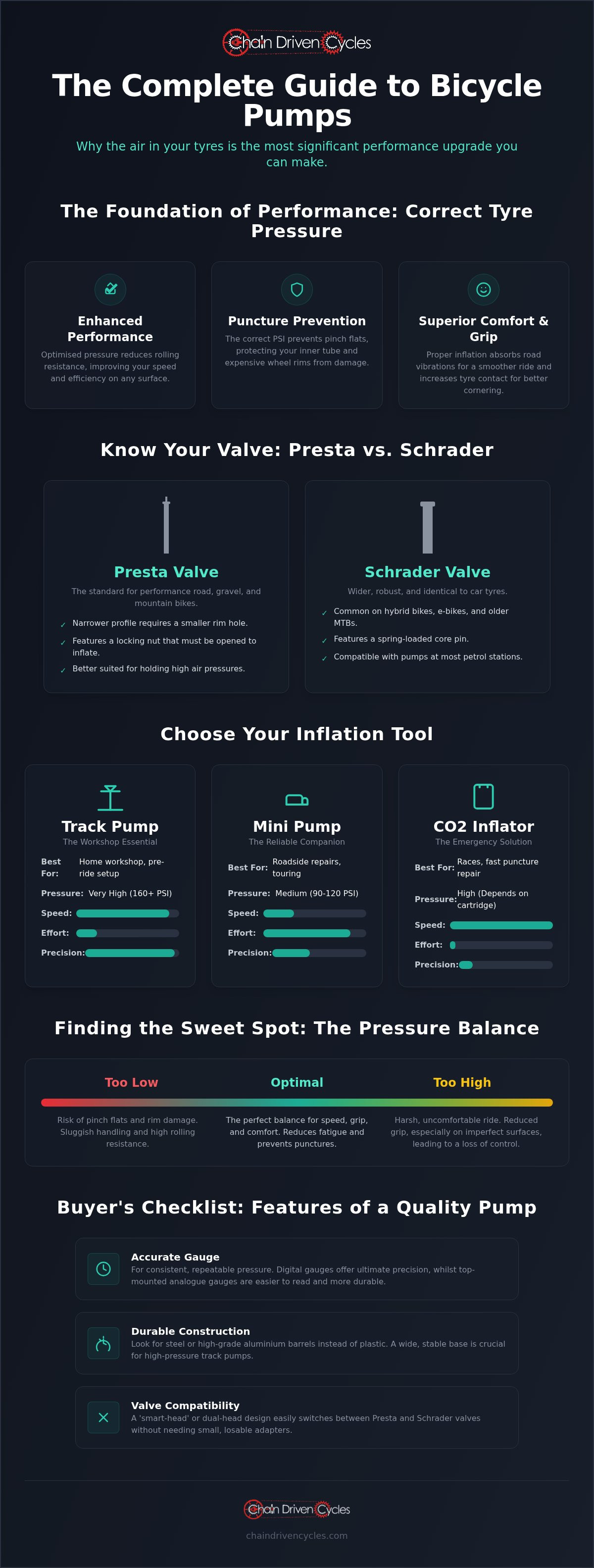
Before selecting from various bicycle pumps, you must identify your valve. Presta valves are narrow and feature a small locking nut at the tip; these are the standard on performance road and gravel bikes. Schrader valves are wider and identical to those found on car tyres, making them a common sight on electric hybrid bikes. Whilst adapters exist, they're easy to lose. Choosing a pump with a smart-head or dual-head design allows you to switch between different bike types in your household without searching for loose parts or struggling with incompatible fittings.
The Relationship Between Pressure (PSI) and Performance
Correct inflation significantly reduces rolling resistance on coarse Irish road surfaces. If your pressure is too low, you risk pinch flats, where the inner tube is crushed against the rim after hitting a pothole or kerb. This doesn't just ruin your ride; it can also damage expensive alloy or carbon rims. Conversely, over-inflation on a stiff road frame can lead to a harsh, fatiguing ride that saps your energy. High-volume tyres on electric hybrids require lower pressures but more air volume, whilst narrow road tyres need high-pressure precision to maintain speed. A pump with a clear, accurate gauge is the only way to achieve this balance consistently every time you head out.
Track Pumps: The Workshop Essential for Precision and Power
Whilst a mini pump is a lifesaver on the road, a high-quality track pump is the cornerstone of any home workshop. These bicycle pumps are engineered for stability and volume, allowing you to reach high pressures with minimal physical effort. When you're preparing for a weekend ride on your Wilier road bike, you need a tool that offers both speed and precision. A sturdy steel barrel and a wide, weighted base ensure the pump remains upright and efficient, even when you're pushing for those final few PSI. Understanding How to Choose the Best Bike Pump involves looking beyond the price tag to consider the stroke volume and the ergonomics of the handle.
For riders using Assioma power meter pedals, gauge accuracy is non-negotiable. Power meters rely on consistent tyre pressure to provide reliable data. If your pressure fluctuates by 10 PSI between sessions because of an inaccurate gauge, your performance metrics will suffer. A track pump with a reliable, calibrated gauge ensures that every training session starts from a known baseline. This level of consistency is what separates a casual ride from a structured training programme.
The Importance of Gauge Accuracy
Analogue gauges are traditional and durable, but digital versions offer a level of precision that is hard to beat for performance cycling. Top-mounted gauges are particularly beneficial as they're situated closer to your eyes, making them easier to read whilst you're standing. This position also protects the delicate internal components from the vibrations and impacts that occur at ground level. Correct pressure isn't a set and forget metric; it needs to be adjusted based on the day's temperature and the specific road textures you expect to encounter.
Durability and Serviceability
A professional-grade pump is an investment that should last for years. Steel and high-grade aluminium barrels are far superior to plastic alternatives, which can flex or crack under high pressure. Look for models with replaceable seals and heads; being able to service your equipment is a hallmark of quality. Integrating this check into your professional maintenance routine prevents premature tyre wear and keeps your bike running smoothly. If you're building out a full workshop, our 10-month payment plan makes it easier to invest in high-end tools at Chain Driven Cycles.
Hand Pumps and Mini Pumps: Compact Solutions for the Road
A mini pump is the ultimate insurance policy for any cyclist venturing beyond the city limits. Whilst track pumps handle the heavy lifting at home, these portable bicycle pumps ensure you aren't left stranded during a national tour or a remote weekend spin. The market for The Best Bike Pumps often pits weight against efficiency. It's easy to be seduced by the smallest, lightest model available, but a tiny barrel means more strokes and significant physical effort to reach a rideable pressure. If you're trying to hit high PSI on a cold, rainy roadside, a slightly larger pump with a more efficient stroke is worth every extra gram.
One often overlooked feature is the inclusion of a flexible hose. Direct-head pumps, which attach the barrel directly to the valve, place immense stress on the valve stem as you pump. This movement can easily bend or snap a Presta core, turning a simple puncture into a ruined wheel. A flexible hose decouples the movement of the pump from the valve, significantly reducing the risk of damage whilst you're working to get back on the road. It's a small technical detail that makes a massive difference in high-stress repair situations.
High-Pressure vs High-Volume Hand Pumps
Riders on Wilier road bikes need high-pressure (HP) specific pumps. These feature narrower barrels designed to overcome the resistance of high-PSI tyres with less force. Conversely, electric hybrid bikes benefit from high-volume (HV) pumps. These push more air per stroke into wider tyres where reaching the target volume quickly is more important than achieving extreme pressure. Telescoping designs are an excellent middle ground, offering a compact footprint that expands to move significant air volume when deployed.
Mounting and Aesthetics
Where you carry your pump is a matter of personal preference and riding style. Frame mounts that sit securely alongside your bottle cage are a standard choice for long-distance touring. Modern mounts are designed to be aerodynamic and unobtrusive, ensuring they don't catch the wind or interfere with your pedalling. A common complaint on rougher Irish secondary roads is "pump rattle," which can be solved by choosing a mount with a secondary silicone strap. Keeping your pump internals protected from road grit and rain is vital; look for models with integrated rubber caps to ensure the mechanism remains clean and functional throughout the winter months.
CO2 Inflators and Emergency Repair: Speed vs Reliability
CO2 inflators represent the high-speed alternative to traditional manual bicycle pumps. For competitive road racers or those on a fast-paced group ride, the ability to re-inflate a tyre in seconds is invaluable. You don't have to spend several minutes at the side of the road with a mini pump whilst your training partners wait in the rain. However, this speed comes with technical nuances that every rider must understand. Cartridge choice is your first consideration; a standard 16g cartridge is usually sufficient for narrow road tyres, whilst larger 25g versions are required to provide enough volume for electric hybrid tyres or mountain bikes.
The most critical trade-off is that CO2 is a temporary solution. Carbon dioxide molecules are smaller than those in regular air, meaning they permeate through the rubber of your inner tube much faster. If you use an inflator in the morning, your tyre will likely be soft by the following day. You must deflate the tyre completely once you get home and use one of your workshop bicycle pumps to refill it with standard air. This ensures the pressure remains stable for your next outing and prevents the tyre from bottoming out on the rim during storage.
How to Use a CO2 Inflator Correctly
Before discharging the gas, ensure the tyre bead is properly seated within the rim. If it isn't, the sudden burst of pressure can blow the tyre off the rim or pinch the tube. Trigger-operated inflators are generally superior to simple twist-to-pierce heads because they allow you to modulate the flow of gas. This lets you put a small amount of air in first to check the seating before committing the full cartridge. Safety is paramount; always use an insulated sleeve or gloves during discharge. The endothermic reaction as the gas expands causes the cartridge to drop to sub-zero temperatures instantly, which can cause severe freeze-burns to unprotected skin.
CO2 vs Hand Pumps: Which is Right for You?
Many experienced cyclists opt for redundancy by carrying both a CO2 head and a small hand pump. This provides the speed for a quick fix whilst ensuring you aren't stranded if you waste your last cartridge or suffer multiple punctures. From an environmental perspective, cartridges are single-use items. They shouldn't be your primary inflation method for routine maintenance. Commuters often prefer the reliability of a pump, whilst racers prioritise the weight savings and speed of CO2. If you are looking to upgrade your emergency kit, you can browse our professional inflation range to find the best fit for your riding style.
Choosing Your Perfect Pump: A Buyer’s Checklist
Selecting the right bicycle pumps is the final step in professionalising your cycling setup. It isn't merely about finding a tool that fits your budget; it's about matching the pump's capabilities to the specific requirements of your fleet. A Wilier road bike with carbon rims and narrow tyres demands high-pressure precision that a generic, high-volume pump simply cannot provide. Conversely, the high-capacity tyres on electric hybrid bikes require a pump that moves significant air volume quickly to avoid a tedious pre-ride routine. Before making your choice, verify that the pump's maximum PSI rating exceeds your highest required pressure by at least 20% to ensure the longevity of the internal seals.
Storage is another practical consideration. If you have a dedicated garage or workshop, a heavy-duty track pump with a long hose and stable base is the superior choice. For those with limited space or who travel for sport, a more compact floor pump that fits easily in a car boot might be more appropriate. Many of our customers choose to invest in a professional-level combo, pairing a workshop track pump with a high-performance mini pump. Our flexible 10-month payment plan makes it easier to secure this complete inflation solution without compromising on the quality of your tools.
Standout Products from the Collection
Within our curated range, professional track pumps with oversized, top-mounted gauges are the preferred choice for enthusiasts. These provide the readability needed to dial in exact pressures, which is vital if you're using Assioma power meter pedals to track your training data accurately. For the weight-conscious climber, ultra-lightweight carbon mini pumps offer a sleek profile that disappears into a jersey pocket whilst still providing the pressure needed for a roadside repair. If you only want one pump to handle everything in your garage, look for a versatile all-rounder with a smart-head that automatically adapts to both Presta and Schrader valves.
Final Maintenance Tips for Your New Pump
To keep your equipment operating smoothly, periodic maintenance is required. Occasionally clean the pump piston and apply a light coating of silicone-based lubricant to ensure a perfect seal and effortless stroke. Avoid using heavy oils, as these can attract grit and degrade the internal rubber components over time. Store your pump in a cool, dry place away from direct sunlight to prevent the seals from drying out and the gauge from losing calibration. Taking these small steps ensures your pump remains a reliable partner for years to come. Browse our full range of 45+ bicycle pumps and accessories here to find the perfect addition to your workshop.
Ready for Every Road Ahead
Your choice of equipment directly impacts your confidence on the bike. Maintaining the correct tyre pressure isn't just about comfort; it's about ensuring your Wilier or Bottecchia performs at its absolute peak whilst minimising the risk of punctures. Investing in high-quality bicycle pumps allows you to transition from precise workshop maintenance to reliable roadside repairs without hesitation. Whether you prefer the speed of CO2 inflators or the robust accuracy of a professional track pump, the right tool ensures you spend more time riding and less time troubleshooting.
As an authorised premium bike dealer, Chain Driven Cycles provides the expert technical support you need to find the perfect fit for your setup. You can also take advantage of our 10-month flexible payment plan to build the ultimate home workshop. Shop the full Bicycle Pump collection at Chain Driven Cycles and prepare for your next journey. With the correct pressure under you, every mile becomes more efficient and enjoyable.
Frequently Asked Questions
What is the difference between a track pump and a floor pump?
In the cycling world, track pump and floor pump are two names for the same essential tool. These bicycle pumps feature a large air barrel, a foot-stabilised base, and a long hose for easy valve access. They are designed for high-volume inflation and maximum accuracy. Whether you are prepping a Wilier road bike for a weekend spin or maintaining an electric hybrid, a track pump provides the leverage needed to reach target pressures without strain.
Do I need a different pump for my electric hybrid bike?
Electric hybrid bikes often utilise wider tyres that require high-volume (HV) pumps rather than high-pressure (HP) road specific models. Whilst a standard track pump will work, you want one that moves more air per stroke to reach the correct volume quickly. Additionally, many hybrids use Schrader valves, car-style fittings, so ensure your pump head is compatible or features a dual-head design that handles both Presta and Schrader types without needing loose adapters.
Can I use a CO2 inflator on a tubeless tyre setup?
You can use a CO2 inflator on a tubeless setup, but it should be a temporary measure. The rapid expansion of gas causes a significant temperature drop, which can cause some liquid sealants to freeze or coagulate. If you use CO2 to seat a tyre or fix a roadside puncture, it is best to deflate the tyre at home, check the sealant condition, and re-inflate using one of your workshop bicycle pumps for long-term stability.
Why is my pump head leaking air whilst I try to inflate the tyre?
Air leaks usually occur because the pump head isn't fully seated or the internal rubber seals have perished. If you have a Presta valve, ensure the small locking nut is fully unscrewed and pushed down slightly to break the seal before attaching the pump. Over time, the rubber gaskets inside the head can dry out or tear. High-quality pumps often feature replaceable seals, which is a more sustainable and professional solution than replacing the entire unit.
How often should I check my tyre pressure with a floor pump?
You should check your tyre pressure before every single ride to ensure optimal performance and safety. Tyres naturally lose air over time through the microscopic pores in the rubber and the valve interface. For performance road bikes, even a 10 PSI drop can noticeably increase rolling resistance and the risk of pinch flats. Using a floor pump once a week at a minimum keeps your tyres in peak condition and helps you spot slow punctures early.
Are digital pump gauges more accurate than analogue ones?
Digital gauges generally offer superior precision and are easier to read in low-light conditions compared to traditional analogue dials. For cyclists using Assioma power meter pedals, this accuracy is vital for maintaining consistent training data. Analogue gauges are highly durable and don't require batteries, but they can be harder to calibrate precisely. If you prioritise exact PSI measurements for performance gains, a digital gauge is the most reliable choice for your home workshop.
What PSI should I pump my road bike tyres to for Irish roads?
For standard 25mm road tyres on coarse Irish road surfaces, a range of 80 to 100 PSI is typical for most riders. If you are using wider 28mm or 32mm tyres, you can often drop the pressure to 60 or 70 PSI for improved vibration damping and grip. Lower pressures help the tyre deform over uneven tarmac rather than bouncing, which improves speed and comfort. Always check the maximum pressure rating printed on your tyre sidewall.
Can a mini pump really reach 100 PSI?
A high-pressure (HP) mini pump can reach 100 PSI, but it requires significantly more physical effort and time than a track pump. These compact tools have narrow barrels designed to make high pressures achievable through many small strokes. Whilst they are perfect for emergency roadside repairs, they aren't intended for daily inflation. If you find yourself struggling to reach a rideable pressure, consider a telescoping model or a mini pump with an integrated flexible hose.