



Electric Hybrid Bikes Ireland: The Ultimate 2026 Guide to Versatile Cycling
This guide ensures you can choose the perfect electric hybrid bike for Irish terrain whilst navigating technical details and financial incentives with absolute confidence. We will explore the nuances of pedal-assist technology, provide practical tips for protecting your battery in the wet, and explain how to utilise the 2026 Cycle to Work scheme limits to your advantage. From understanding the 250W motor regulations to managing your long-term maintenance, you'll gain the expertise needed to enjoy a seamless ownership experience.
Key Takeaways
- Learn why the upright geometry and balanced design of hybrid e-bikes make them the most versatile choice for Ireland's varied terrain and unpredictable weather.
- Understand the critical differences between mid-drive and hub-drive motors to ensure you select the right power delivery for your specific commuting needs.
- Discover practical strategies for riding in wet conditions, including how to protect your electrical components and which waterproof accessories are essential for Irish cyclists.
- Navigate the 2026 Cycle to Work scheme limits and learn how to manage your investment through flexible 10-month payment plans.
- Recognise the value of professional maintenance and authorised dealer support in extending the lifespan of electric hybrid bikes Ireland riders use for daily transport.
What are Electric Hybrid Bikes and Why are They Ideal for Ireland?
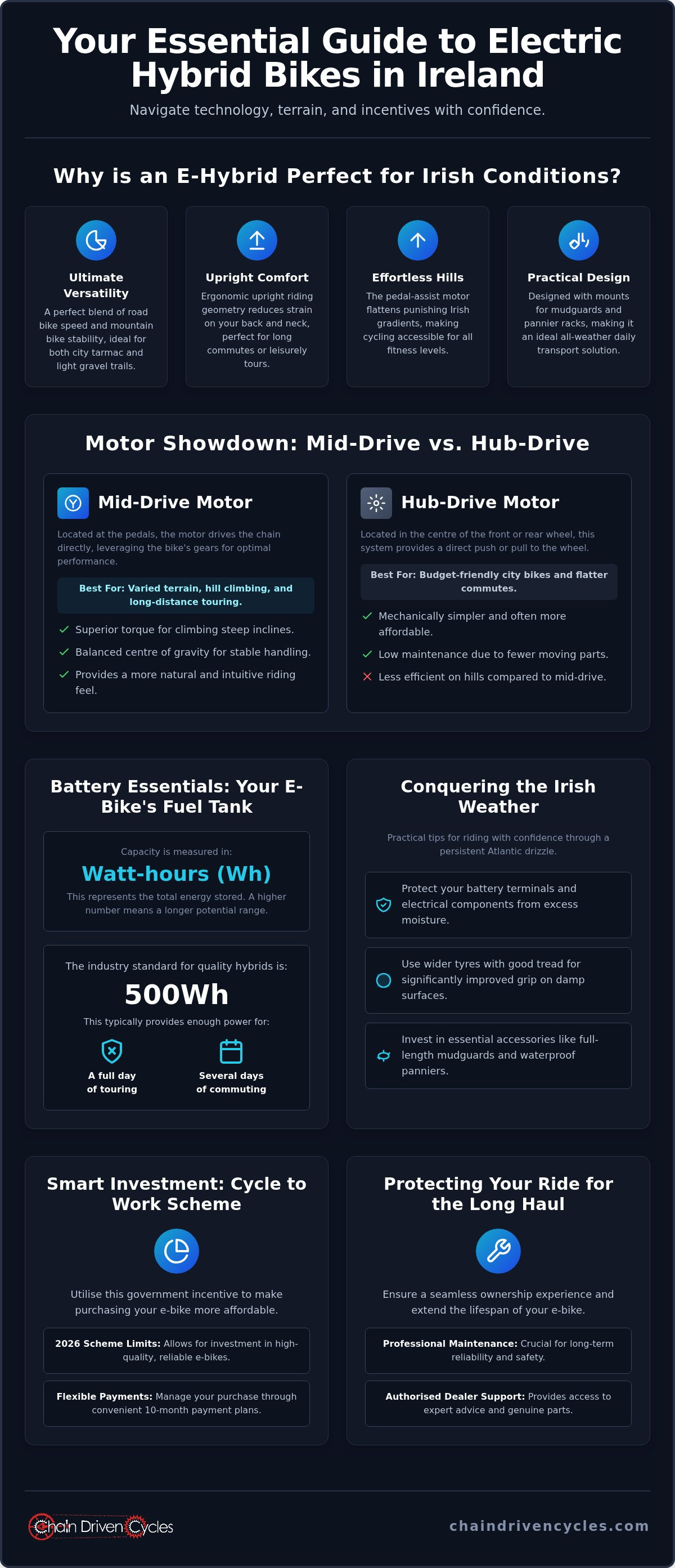
An electric hybrid bike is essentially the "Swiss Army Knife" of the cycling world. It offers a precision-engineered blend of road bike efficiency and mountain bike stability, creating a versatile platform that handles everything from smooth city tarmac to light gravel trails. For many riders, the primary question is often What is an electric bicycle? and how it differs from a standard frame. Simply put, it's a pedal-assist machine that amplifies your own power, making long distances feel shorter and steep inclines far more manageable. The surge in popularity for electric hybrid bikes Ireland has seen lately is no coincidence; these bikes are perfectly suited to our unique combination of rolling hills and unpredictable weather.
The core appeal lies in the upright riding geometry. Unlike the aggressive, tucked-over position required by dedicated road bikes, a hybrid allows you to sit comfortably with a clear view of the road ahead. This ergonomic design reduces strain on your back and neck, which is vital for long-distance Irish commutes or weekend touring. By combining this comfort with the efficiency of a motor, riders can arrive at their destination feeling fresh rather than exhausted. This shift towards e-hybrids is helping many households transition to more eco-friendly transport, often serving as a direct replacement for a second family car.
The Anatomy of a Hybrid E-Bike
Every component of a hybrid e-bike is selected to balance control with durability. Flat handlebars are a standard feature, providing superior leverage and better visibility in dense urban traffic compared to drop bars. The tyres are typically wider than those on a road bike, offering significantly improved grip on damp or greasy surfaces, which is a common occurrence on Irish roads. Most models also come equipped with integrated mounts for mudguards and pannier racks. These aren't just optional extras; they're essential for anyone cycling in a climate where rain is a frequent companion and carrying a change of clothes or groceries is a daily necessity.
Hybrid vs Traditional Bicycles
The motor assistance is the true equaliser when comparing hybrids to traditional bicycles. Irish gradients can be punishing, but the electric motor levels the playing field, allowing cyclists of all fitness levels to tackle hills that might otherwise be a deterrent. Hybrids are also far more approachable for beginners. The stable frame and intuitive handling mean you don't need years of experience to feel confident on the road. Whilst a traditional road bike prioritises pure speed, the e-hybrid prioritises utility and reliability. It's a pragmatic choice for those who need a bike that performs consistently, whether they're navigating a busy city centre or exploring a coastal greenway amongst the elements.
While the hybrid is an excellent all-rounder, some cyclists may prefer a more specialised setup. Specialists such as LariXplore provide high-performance e-Bike SUVs and eMTBs, as well as professional electrification services, offering a powerful alternative for those who want to customise their transition to electric cycling.
Understanding E-Bike Technology: Motors, Batteries, and Range
Selecting the right hardware is essential for ensuring your investment meets your specific riding needs. To get the most out of electric hybrid bikes Ireland riders must look beyond the aesthetics and focus on the motor and battery integration. The technology dictates how the bike handles a steep climb in the Wicklow Mountains or a headwind along the Wild Atlantic Way. Understanding these specifications allows you to balance performance with budget effectively.
Battery capacity is measured in Watt-hours (Wh), which represents the total energy stored. Think of this as the size of your fuel tank. Whilst manufacturers often provide a maximum range, real-world mileage is influenced by your weight, the level of assistance you select, and even your tyre pressure. A 500Wh battery is currently the industry standard for high-quality hybrids, typically providing enough power for a full day of touring or several days of urban commuting without needing a recharge.
Mid-Drive vs Hub Motors: Which is Better?
The position of the motor significantly alters the riding experience. Mid-drive motors are located at the pedals, meaning they drive the chain directly and leverage the bike's internal gears. This makes them the favourite for those tackling varied national cycling routes, as they provide superior torque for climbing and a more balanced centre of gravity. In contrast, hub motors are situated in the centre of the wheel. These systems are often found on budget-friendly or lightweight city hybrids. Whilst they are mechanically simpler, they lack the sophisticated weight distribution and climbing efficiency of a mid-drive system.
Maximising Your Battery Life in the Irish Climate
Our damp and chilly climate requires a specific approach to battery care. Lithium-ion batteries are sensitive to temperature; you might notice a slight drop in efficiency during the winter months when the mercury dips. To maintain long-term health, always store and charge your battery indoors at room temperature rather than in a cold garage or shed. Range anxiety is the persistent worry that your battery charge will deplete before you finish your journey, but modern battery management systems now provide highly accurate real-time estimates to keep you informed. If you want to see these systems in action, you can explore our range of Electric Hybrid Bikes to find a setup that suits your commute.
The way the motor delivers power is also governed by sensors. Cadence sensors act like an on-off switch, providing power as long as the pedals are turning. Torque sensors are more advanced, measuring the force you apply and matching it instantly. This creates a much more natural feel, making it feel like you have "super legs" rather than being pushed by a machine. Aerodynamics and total weight also play a role; whilst hybrid bikes are heavier than road bikes, their motor assistance more than compensates for the extra mass on every journey.
Choosing the Best Electric Hybrid Bike for Your Lifestyle
Identifying your primary use case is the first step in narrowing down the vast selection of electric hybrid bikes Ireland offers. Your choice of frame material and gearing system will dictate how the bike performs over time and how much maintenance it requires. Aluminium frames are the industry workhorse, providing a robust and cost-effective solution for daily use. Carbon fibre is lighter and better at absorbing road vibrations, but it comes at a higher price point. For most hybrid riders, high-grade aluminium offers the best balance of weight and longevity whilst remaining durable enough for Irish roads.
You must also decide between traditional derailleur systems and internal hub gears. Derailleurs are lightweight and offer a wide gear range for hilly routes, though they require more frequent cleaning to prevent wear from road grit. Internal hubs are sealed from the elements, making them incredibly reliable for damp Irish winters. For a detailed breakdown of specific models and how they fit into these categories, consult our Electric Hybrid Bikes for Commuting Ireland: The 2026 Range Reference.
Commuting vs Leisure: Finding the Balance
Commuters often prioritise low-maintenance drivetrains and comprehensive weather protection. Integrated lights and full-length mudguards are non-negotiable for those riding in all conditions. Leisure riders, however, usually seek comfort over pure speed. Front suspension forks provide essential damping on unpaved greenways or canal paths. Choosing a larger battery capacity is also wise for those planning long weekend loops amongst the Irish countryside. The hybrid remains a favourite because it bridges these two worlds effortlessly, allowing one bike to serve as both a reliable workhorse and a weekend explorer.
Sizing and Fit: The Key to Comfort
Measuring yourself correctly is the only way to avoid chronic neck or back strain. You should check your height against the manufacturer's size chart, but also consider your reach to the handlebars. Step-through frames provide easier mounting and dismounting, which is a practical benefit for many riders, regardless of their fitness level. Whilst some associate professional fitting with racing, it is just as vital for e-bike owners to ensure their posture is correct for long-term health. A professional fit is as important for e-bikes as it is for high-end Wilier road bikes Ireland enthusiasts.
Practical Considerations for Riding E-Hybrids in Ireland
A frequent hesitation regarding electric hybrid bikes Ireland riders express is the impact of our maritime climate. It's a reasonable concern. Persistent rain and damp road surfaces require a specific approach to equipment and maintenance. However, modern e-bikes are built to withstand wet conditions. Their electrical components are sealed to high Ingress Protection ratings, meaning you don't need to fear a heavy downpour whilst on your commute. The key is ensuring you have the right accessories, such as waterproof panniers to keep your belongings dry and high-visibility gear to stay seen during low-light winter mornings.
Legally, your e-bike must comply with EAPC (Electrically Power Assisted Cycle) regulations to be treated as a standard bicycle. Under the Road Traffic and Roads Act 2023, your motor must not exceed a continuous rated power of 250 watts, and the assistance must cut off once you reach 25 km/h. Crucially, the motor should only activate whilst you are pedalling. Adhering to these standards ensures you don't require a licence, tax, or insurance, keeping your transition to electric cycling as straightforward as possible. For those navigating damp, greasy roads, tyre choice is paramount. Opting for a wider tread with specific water-channelling patterns and maintaining the correct tyre pressure will provide the necessary grip to corner with confidence in the wet.
Weather-Proofing Your Ride
Full-length mudguards are perhaps the most important addition for an Irish cyclist. They protect your drivetrain from road grit and prevent the "skunk stripe" of muddy water from reaching your back. If you live near the coast, salt air can accelerate corrosion on exposed metal parts. A quick rinse with fresh water and a wipe-down after a salty ride will preserve your bike's finish. Beyond home care, booking a regular electric bike service Ireland is essential. Professional technicians can check the integrity of electrical seals and ensure that moisture hasn't compromised your motor or battery connections.
Safety and Security
Security is a major priority in urban centres like Dublin, Cork, or Galway. We recommend a "gold standard" D-lock combined with a heavy-duty chain to secure both the frame and the wheels. Integrated lighting systems are another significant safety benefit; because they run off the main e-bike battery, you'll never be caught without lights in the dark. Finally, hydraulic disc brakes are a non-negotiable feature for Irish conditions. Unlike traditional rim brakes, which lose efficiency when wet, hydraulic systems provide consistent, powerful stopping force regardless of the weather. If you're looking for a reliable partner for your daily journey, you can browse our full range of Electric Hybrid Bikes to find the right safety specifications for your needs.
Investing in Quality: The Chain Driven Cycles Advantage
Choosing a new bike is only the beginning of your journey. Investing in a high-quality machine is a decision that pays dividends over years of reliable service, especially when you have the support of a dedicated specialist. When browsing for electric hybrid bikes Ireland riders often find that the difference between a frustrating experience and a seamless one comes down to where they buy. Purchasing from an authorised dealer ensures you receive full warranty support and access to genuine parts, which is vital for the specialised components found on modern e-bikes.
The long-term savings of switching to an e-hybrid are substantial. When you replace short car journeys or expensive public transport season tickets with a hybrid, you eliminate costs related to fuel, parking, and tolls. Professional assembly is a critical part of this value. Every bike we supply undergoes a rigorous safety check to ensure that the motor, battery, and hydraulic systems are perfectly calibrated before you ever turn a pedal. This initial precision prevents premature wear and ensures your bike performs exactly as the engineers intended.
Flexible Payment Options
We understand that the upfront cost of premium technology can be a barrier. To help, our 10-month payment plan allows you to spread the investment into manageable monthly instalments, making high-end models accessible without a large initial outlay. This can be effectively combined with the Cycle to Work scheme to maximise your budget. As of 2026, the threshold for purchasing an electric bike through the scheme is €1,500, whilst electric cargo bikes have a higher limit of €3,000. For most Irish employees, using the scheme results in tax savings of between 20% and 52% depending on their income tax band, PRSI, and USC. Since you can avail of the scheme once every four years, it remains the most cost-effective way to upgrade your transport.
Support and Maintenance
E-bikes are sophisticated machines that require more than just basic mechanical knowledge. Our team of expert technicians understands complex e-bike diagnostics and firmware updates, ensuring your motor and battery system remain efficient. Having a local point of contact for bicycle repair services provides a level of peace of mind that online-only retailers simply cannot match. If a sensor needs adjustment or a battery requires testing, you have a trusted partner ready to help. We encourage you to visit us for a test ride; there is no better way to understand the hybrid difference than feeling the smooth power delivery and stable handling for yourself. Our goal is to ensure you don't just buy a bike, but gain a reliable mode of transport that you'll enjoy for years to come.
Step Into the Future of Irish Cycling
The transition to electric cycling is a fundamental shift in how you experience your daily commute and weekend adventures. By choosing a versatile hybrid, you gain a machine that masters both city streets and rural trails whilst offering the comfort of an upright riding position. Understanding the nuances of mid-drive motors and battery management ensures you can ride with confidence, regardless of the elevation or the weather. When exploring the best electric hybrid bikes Ireland has to offer, remember that the right support is as crucial as the motor itself.
As a trusted specialist and authorised dealer for premium brands, we are here to support every stage of your journey. From professional assembly to expert nationwide maintenance, we ensure your investment remains in peak condition for years to come. You can also take advantage of our flexible 10-month payment plans to make your purchase more manageable. This approach removes the financial barriers to high-quality transport and places you on a reliable path toward sustainable travel.
Ready to transform your transport? Browse our 2026 range of Electric Hybrid Bikes and spread the cost today. We look forward to helping you find the perfect match for your lifestyle and seeing you out on the road.
Frequently Asked Questions
Do I need a licence or insurance to ride an electric hybrid bike in Ireland?
No, you don't need a licence, tax, or insurance to ride an electric hybrid bike in Ireland as long as it meets EAPC standards. Under the Road Traffic and Roads Act 2023, the motor must have a maximum power of 250W and cut off at 25 km/h. If the bike meets these criteria, it is legally classified as a standard bicycle.
How long does it take to charge an electric hybrid bike battery?
Charging typically takes between 3.5 and 6 hours for a full cycle from empty, depending on the battery's Watt-hour capacity and the charger's speed. Most modern systems reach 80% capacity within the first 2 or 3 hours. You can top up the battery at any time without negatively impacting its long-term lifespan.
Can I ride an electric hybrid bike if the battery runs out?
Yes, you can pedal the bike just like a traditional bicycle if the battery depletes. The mechanical drivetrain functions independently of the motor, though you will notice the additional weight of the system, especially on inclines. It serves as a reliable backup that ensures you are never stranded during a journey.
What is the average range of an electric hybrid bike on Irish terrain?
The average range for electric hybrid bikes Ireland riders can expect is between 60km and 120km per charge. This figure varies based on the level of assistance you use, your total load, and environmental factors such as Atlantic headwinds or the rolling gradients of the Irish countryside.
Is the Cycle to Work scheme applicable to electric hybrid bikes in 2026?
Yes, the scheme remains a primary incentive for cyclists in 2026. Employees can save on tax for purchases up to €1,500 for a standard e-bike or €3,000 for an e-cargo bike. You are eligible to use the scheme again if four years have passed since your last purchase.
How do I maintain my e-bike during the winter months in Ireland?
Winter maintenance focuses on protecting the battery from cold and the frame from road salt. Store your battery indoors at room temperature to maintain its efficiency and rinse the bike regularly to prevent corrosion from gritted roads. Applying a high-quality lubricant to the chain is also essential during damp months.
Are electric hybrid bikes heavy to lift or manoeuvre?
Most hybrid e-bikes weigh between 20kg and 25kg, which is heavier than a non-electric equivalent. However, the motor and battery are positioned low in the frame to ensure a stable centre of gravity. Many models also feature a "walk-assist" mode to help you move the bike easily whilst on foot.
Can I fit a child seat or trailer to an electric hybrid bike?
Yes, most hybrid models are designed with reinforced frames that are compatible with child seats and trailers. The motor assistance is particularly beneficial here, as it compensates for the extra weight. This makes carrying passengers or groceries a practical and effortless task, even when tackling hilly terrain.