



Road Bike vs Electric Bike Ireland: The Ultimate 2026 Comparison Guide
Choosing between a road bike vs electric bike Ireland isn't a debate about laziness versus effort; it's a decision about how much of the Irish landscape you want to make accessible. While a sleek Wilier road bike offers the raw speed and lightweight performance many enthusiasts crave, a versatile electric hybrid can turn a daunting 15 per cent gradient into a manageable morning commute. With cycling trips in Dublin alone reaching 92.2 million annually, more riders are weighing up whether they prefer the 8kg agility of a traditional racer or the 250W assistance of a modern pedelec.
We understand the hesitation many feel when facing this choice. You might worry about the weight of a battery versus the perceived fragility of a high-end frame, or perhaps you're confused by 2026 e-bike regulations and the latest Cycle to Work limits. This guide will clarify those technical hurdles and help you decide which investment fits your lifestyle. We'll examine everything from battery range to the 10-month payment plans that help you manage the cost of premium Bottecchia or Wilier models, ensuring you can tackle the Irish weather with total confidence.
Key Takeaways
- Compare the fundamental design differences in a road bike vs electric bike Ireland, balancing aerodynamic speed against versatile pedal-assist stability.
- Evaluate how terrain and weather impact your ride, from choosing the right tyre width for secondary roads to protecting electrical components from rain.
- Assess the practical ownership realities, including the weight gap between an 8kg road bike and a 22kg hybrid, and the necessity of specialised software for e-bike servicing.
- Identify which bike aligns with your personal goals, whether you're training for club events or looking to replace car journeys with a sweat-free commute.
- Learn how to manage the investment in premium Wilier or Bottecchia bicycles using flexible 10-month payment plans.
Road Bike vs Electric Bike: Defining the Two Contenders
The choice between a road bike vs electric bike Ireland often begins with a simple question: do you want to be the sole engine, or do you want a silent partner? In 2026, the Irish cycling landscape has shifted. We're seeing a massive move towards electric assistance, not because riders are getting slower, but because they're getting more ambitious. Whether you're eyeing a featherweight racer or a robust commuter, understanding the fundamental DNA of these two machines is the first step toward a successful investment.
To help you navigate these options for daily travel, The Cycle Centre provides a comprehensive resource on selecting the ideal commuter bike for the Irish climate and terrain.
Legally, the distinction is now very clear in Ireland. Since May 2024, e-bikes that meet specific "pedelec" criteria are treated exactly like traditional bicycles. To stay on the right side of the law without a licence or insurance, your motor must have a maximum continuous power output of 250 watts. It must also be a pedal-assist system, meaning the motor only engages when you're actively pedalling, and it must cut off once you hit 25 km/h. For a broader look at how these systems have evolved globally, this Electric bicycle overview provides excellent context on the technology that's currently transforming Irish roads.
The Anatomy of a Performance Road Bike
A traditional road bike is a masterclass in efficiency. Built with dropped handlebars and narrow tyres, these machines are designed to cut through the wind. Brands like Wilier road bikes Ireland lead the way here, offering carbon frames that weigh as little as 7kg or 8kg. The focus is entirely on power transfer; every ounce of energy you put into the pedals moves you forward. These bikes are for the fitness enthusiast who enjoys the challenge of a climb and the weekend racer who values mechanical purity. There's a specific joy in knowing that every kilometre covered was powered entirely by your own lungs and legs.
The Rise of the Electric Hybrid
If the road bike is a precision instrument, the electric hybrid is a versatile Swiss Army knife. These bikes combine an upright, comfortable riding position with sophisticated motor technology. Most modern electric hybrid bikes Ireland utilise torque sensors. These sensors measure the pressure you apply to the pedals and provide a proportional amount of boost. It doesn't feel like a scooter; it feels like you've suddenly developed world-class cycling legs. They're perfect for commuters who want to arrive at work without needing a shower, or for explorers who want to tackle the rolling hills of the Irish countryside without the fear of hitting a "wall" of exhaustion halfway home.
Performance Comparison: Speed, Effort, and Range
When evaluating a road bike vs electric bike Ireland, the most immediate difference lies in how you perceive speed across different terrains. On a flat, well-paved stretch of road, a seasoned rider on a lightweight carbon machine can comfortably sustain speeds well above 30 km/h. By contrast, an electric hybrid provides assistance that tapers off precisely at 25 km/h due to legal regulations. While the e-bike might feel like it's holding you back on the flats, the dynamic changes the moment you hit a coastal incline or a sustained headwind, where the 250W motor allows you to maintain your pace while others struggle.
For those interested in exploring the upper tiers of electric performance, Cooneys Bike Care provides a specialised range of high-performance electric bikes that excel on more demanding Irish routes.
The "sweat factor" is perhaps the most practical performance metric for daily use. An electric hybrid allows you to maintain a steady pace with minimal physical exertion, making it the superior choice for the office commute. You can arrive at your desk in professional attire without the need for a shower or a change of clothes. For the road purist, the mechanical efficiency and direct power transfer of a Bottecchia vs Wilier bike comparison becomes essential. These premium Italian machines are engineered for those who want to feel every watt of their own effort translated into forward motion without any motorised interference.
Climbing and the Irish Headwind
Ireland's geography is defined by rolling hills and the notorious Atlantic winds that can turn a pleasant spin into a gruelling ordeal. Tackling a 10 per cent gradient on a traditional road bike requires significant leg power and cardiovascular endurance. On an electric hybrid, sophisticated torque sensors measure your input and provide a proportional boost, effectively "flattening" the hill. There's also a significant psychological benefit for long-distance riders. Knowing you have a motorised safety net if you "bonk" or run out of energy 40 kilometres from home provides a level of confidence that traditional cycling can't always match.
Range Anxiety vs Physical Endurance
Battery range is a finite reality that every e-bike owner must manage. Most modern systems offer between 60km and 100km of assistance, but factors like rider weight, tyre pressure, and even the cold Irish winter can reduce this efficiency. On a traditional road bike, your range is limited only by your own physical endurance. To build that stamina, many riders use ThinkRider smart trainers during the off-season to prepare for long summer sportives. While e-bike riders must keep an eye on their battery levels, road cyclists manage their own glycogen stores. If you're ready to start your journey, you can browse our latest cycling technology to find the perfect match for your endurance goals.
Cycling in Ireland: Terrain and Weather Considerations
The rugged beauty of the Irish landscape presents unique challenges that influence the road bike vs electric bike Ireland debate. Beyond the gradients mentioned previously, the surface quality of our secondary roads often features "chip-and-seal" textures that can be punishing on narrow tyres. Electric hybrids typically come equipped with wider 38mm to 45mm tyres, providing a significant safety advantage by absorbing vibrations and offering better grip on loose or uneven rural surfaces. While a road bike prioritises rolling resistance, the added volume of a hybrid tyre can be the difference between a confident descent and a nervous one on a damp West Cork lane.
Weatherproofing is another critical factor in our climate. High-quality electric bikes are designed with sealed units to protect motors and batteries from the inevitable Irish drizzle. However, riders must still be diligent. Integrated lighting systems are a standard feature on most modern e-bikes, drawing power directly from the main battery. This ensures you are never caught without visibility on a dark, misty evening. Road cyclists, conversely, must manage separate rechargeable units, though the simplicity of a traditional drivetrain means there are fewer electronic sensors to worry about when the rain becomes a downpour.
Commuting in Irish Cities
For those navigating urban centres like Dublin, Cork, or Galway, electric hybrid bikes for commuting Ireland have become a genuine alternative to the second family car. The ability to maintain a steady 25 km/h regardless of wind direction allows for predictable arrival times. This reliability is why many Irish families are making the switch. You must, however, consider your storage situation. An e-bike often weighs upwards of 22kg. If you live in a third-floor apartment without a lift, the 8kg weight of a Bottecchia road bike becomes a much more practical daily companion.
Rural Exploration and Fitness
In the rural heartlands, the choice often leans toward the emotional and physical rewards of the sport. There is a distinct joy in piloting a lightweight Wilier through the Wicklow Mountains on a crisp morning. Road bikes offer a level of precision handling on narrow, winding lanes that a heavier hybrid cannot match. Furthermore, if you intend to join a local cycling club, a traditional road bike is the standard entry requirement for group rides and sportives. It allows for better integration into the slipstream and fosters the technical skills required for high-speed bunch riding, making it the preferred tool for those chasing personal bests on the Wild Atlantic Way.
Ownership Realities: Maintenance, Weight, and Cost
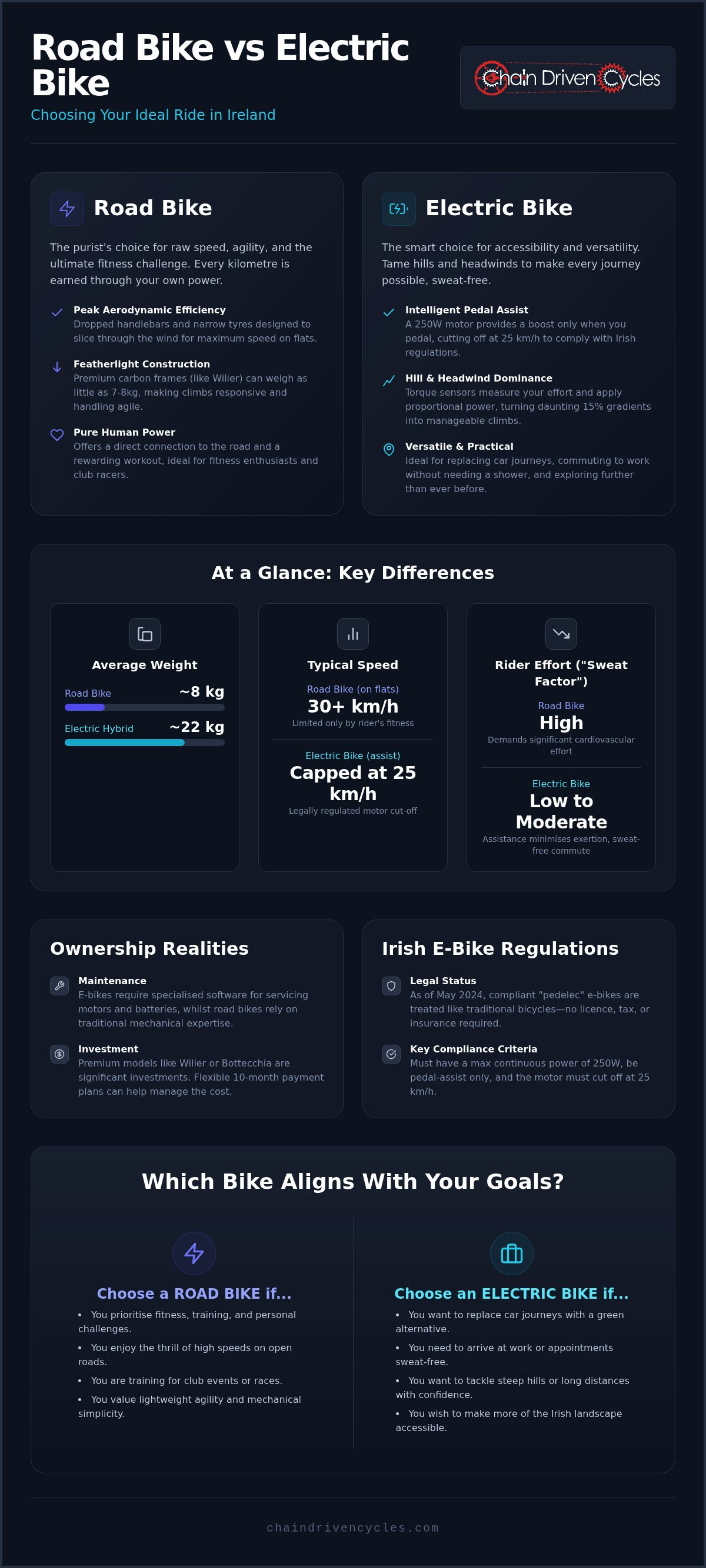
Understanding the long-term commitment of a road bike vs electric bike Ireland involves looking past the initial purchase. Weight is the most immediate factor. While a high-performance Wilier road bike might sit comfortably at 8kg, an electric hybrid often reaches 22kg. This mass affects everything from how you carry the bike into a hallway to how the components wear down over time. High-end road components are designed for longevity through mechanical simplicity, whereas e-bike batteries have a finite cycle life, typically requiring replacement after several years of consistent use.
Professional electric bike service Ireland is fundamentally different from traditional maintenance. It requires specialist diagnostic software to update firmware and check battery health. Unlike basic retail chains that offer generic "cycle care", a specialist service centre ensures the motor's torque sensors are calibrated and the internal wiring remains weatherproofed against the Irish elements. This technical expertise is vital for maintaining the manufacturer's warranty and ensuring the bike's resale value remains high.
Maintenance Schedules
The increased mass of an electric hybrid means that brake pads are under significantly more stress, especially on long descents. You'll likely find yourself replacing pads more frequently than on a road bike. Mid-drive motors apply constant torque directly to the chain and cassette. This accelerated wear means drivetrain cleaning and lubrication are even more critical. For road bikes, the focus is on mechanical precision. Keeping a Bottecchia shifting perfectly requires fine-tuning the cable tension and ensuring the lightweight derailleur hanger remains perfectly aligned.
Financing Your Passion
Investing in a premium bicycle doesn't have to be a single large transaction. We offer a professional 10-month payment plan that allows you to spread the cost of a Wilier or Bottecchia without high-pressure sales tactics. This plan is particularly useful for those looking to exceed the 2026 Cycle to Work limits, which currently stand at €1,250 for standard bicycles and €1,500 for electric bikes. By combining the tax savings of the government scheme with our flexible payment options, premium Italian engineering becomes far more accessible. If you are ready to invest in a machine built for the long haul, you can view our full range of bicycles and payment options to find the right fit for your budget.
The Final Verdict: Which Bike Should You Buy?
Deciding between a road bike vs electric bike Ireland ultimately depends on how you want to feel at the end of your ride. If your primary goal is to improve cardiovascular fitness, join local club spins, or experience the raw mechanical speed of a lightweight Wilier, a traditional road bike remains the gold standard. It offers a level of purity and physiological challenge that defines the sport for many enthusiasts. Conversely, if your priority is to replace car journeys, commute without sweating through your clothes, or tackle steep coastal inclines with total confidence, an electric hybrid is the superior investment.
For those who find themselves torn, an electric road bike offers a compelling middle ground. These machines maintain the aggressive geometry and drop-bar aesthetics of a performance racer but hide a compact motor to assist on the toughest climbs. Regardless of which path you choose, a professional fit is essential. Even the most advanced Bottecchia can cause discomfort if the saddle height or reach isn't tailored to your biomechanics. We ensure every bike is professionally assembled and adjusted to provide the most efficient riding position possible before it reaches your door.
Matching the Bike to Your Goals
There are two common myths that often cloud this decision. The first is the "fitness myth." Many believe that electric assistance provides no exercise. In reality, e-bike riders often cycle further and more frequently because the barriers to entry, such as a daunting hill or a strong headwind, are removed. You still get a significant workout; you simply have more control over the intensity. The second is the "speed myth." While e-bikes assist you up to 25 km/h, a road bike is often faster on descents and flat sections due to its superior aerodynamics and lower mass. A road bike feels more agile and responsive when cornering at high speed on winding Irish lanes.
Why Chain Driven Cycles?
As authorised dealers for Wilier and Bottecchia, we provide deep technical expertise in both performance road and electric hybrid categories. We don't just sell products; we offer a long-term partnership that includes professional servicing and national delivery across Ireland. Our 10-month payment plan makes premium Italian engineering accessible, allowing you to invest in a high-quality machine that will last for years. Whether you're chasing a personal best on a local climb or planning a car-free commute, we have the expertise and the inventory to guide your selection. Browse our full range of bikes and start your journey today.
Ready to Transform Your Irish Cycling Experience?
Whether you're chasing a personal best on a coastal climb or seeking a sweat-free commute through Dublin, your decision in the road bike vs electric bike Ireland debate rests on your specific lifestyle goals. You've seen how a lightweight Wilier or Bottecchia can offer pure mechanical speed, whilst an electric hybrid neutralises hills and headwinds with ease. Remember that your choice isn't just about the machine; it's about the support and servicing that keeps you on the road through every Irish season.
As an authorised dealer with national coverage, we're here to provide the expertise and long-term care your investment deserves. From professional assembly to expert bike repair and servicing, we ensure your machine remains in peak condition. You don't have to let the initial cost hold you back, as our flexible payment options make premium engineering accessible to everyone. Explore our 2026 range of Road and Electric Bikes with a 10-month payment plan and discover the perfect partner for your next adventure. We look forward to seeing you out on the road.
Frequently Asked Questions
Is a road bike faster than an electric bike in Ireland?
Road bikes are often faster on flat terrain and descents because they lack the 25 km/h motor cutoff found on pedelecs. A fit rider on a lightweight carbon frame can easily sustain speeds that exceed the legal assistance limit. However, when comparing a road bike vs electric bike Ireland on a 10 per cent gradient or against a stiff Atlantic headwind, the e-bike will almost always reach the destination faster with less physical strain.
Do I need a special licence for an electric bike in Ireland?
No, you don't require a licence, tax, or insurance for a standard e-bike in Ireland. Under the regulations updated in May 2024, e-bikes with a 250W motor that only provides assistance while pedalling up to 25 km/h are treated as regular bicycles. If the bike can be propelled by a throttle without pedalling, it may be classified as an e-moped, which involves different legal requirements including registration and insurance.
Can I still get fit using an electric hybrid bike?
You can certainly improve your fitness on an electric hybrid. While the motor provides a boost, you are still engaging your muscles and elevating your heart rate to keep the bike moving. Because e-bikes make cycling more enjoyable in hilly areas, many riders find they go out more frequently and stay in the saddle for longer durations than they would on a traditional road bike, leading to consistent cardiovascular gains.
How does the Irish weather affect electric bike batteries?
Irish winter temperatures can reduce your battery range by approximately 15 to 20 per cent. Lithium-ion batteries are less efficient in the cold, so it's best to store and charge them at room temperature when possible. Whilst modern e-bikes are designed to handle the inevitable Irish rain, you should avoid using high-pressure washers near the motor or battery casing during cleaning to prevent moisture from bypassing the seals.
Which is better for commuting: a road bike or an e-bike?
An e-bike is generally better for commuting if you want to arrive at your destination fresh and without needing a change of clothes. It effectively neutralises the fatigue caused by headwinds and urban hills. A road bike is the better choice if your commute is a dedicated part of your training regime or if you need to carry the bike up several flights of stairs into an apartment or office.
How much does it cost to service an electric bike in Ireland?
Servicing an electric bike is generally more expensive than a traditional road bike because it involves electronic diagnostics. Technicians must use specialised software to run firmware updates and check battery health. Additionally, the increased weight of an e-bike means that consumables like brake pads and tyres tend to wear out faster, necessitating more frequent mechanical attention compared to a lightweight road machine.
Can I use the Cycle to Work Scheme for both road and electric bikes?
Yes, the scheme applies to both types of bicycles with different price caps. For 2026, the limits are €1,250 for a standard road bike and €1,500 for an electric bike. This allows for significant tax savings, often reducing the effective cost by up to 52 per cent depending on your tax rate. You can avail of this scheme once every four years to upgrade your equipment.
What happens if my electric bike battery runs out mid-ride?
If your battery dies, the bike functions like a traditional bicycle, but it will feel significantly heavier. Most electric hybrids weigh between 20kg and 27kg, making them difficult to pedal uphill without motorised help. To prevent this, most modern displays provide a clear range estimate, allowing you to adjust your assistance level to ensure you reach your destination with power to spare.