



Choosing the Best Tyres and Tubes: A Comprehensive 2026 Buying Guide
What if the most significant performance upgrade for your bike costs less than a new jersey? It's easy to obsess over carbon frames or electronic shifting, but your tyres and tubes are the only components that actually connect you to the road or trail. We know how frustrating it is when a pinch flat ruins a Sunday morning spin, or when you're standing at the side of a rainy road struggling with a valve that doesn't match your pump. It's a common headache that even experienced cyclists face, yet it's entirely avoidable with the right knowledge.
This guide will help you master the technical details of bicycle rubber to improve your grip, speed, and puncture protection on every ride. Whether you want faster rolling resistance for road racing or better cornering grip on damp Irish trails, the right setup makes all the difference. We'll examine the shift towards wider rim compatibility, the nuances of valve types, and how 2026 e-bike trends are shaping the market. From reliable everyday options to premium performance rubber, you'll learn exactly how to choose the perfect kit for a puncture-free commuting experience.
Key Takeaways
- Match your tread pattern to your specific terrain to ensure maximum safety and rolling efficiency on Irish roads or trails.
- Understand technical specifications like TPI and bead types to find the ideal balance between weight, durability, and ride suppleness.
- Master the nuances of valve types and sizing to ensure your new tyres and tubes are perfectly compatible with your specific rim depth.
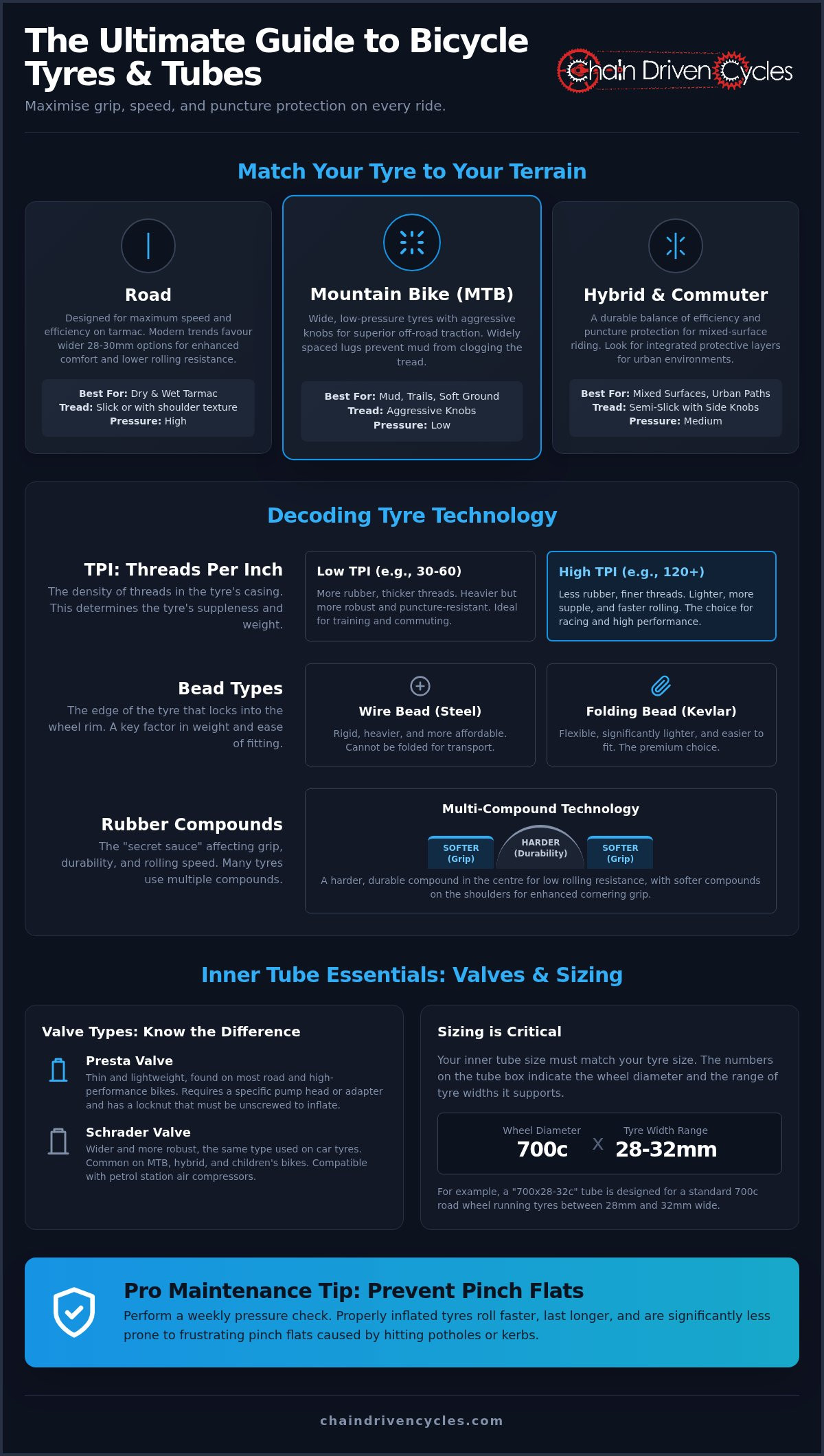
- Learn essential maintenance habits, such as weekly pressure checks, to prevent frustrating pinch flats and extend the lifespan of your equipment.
- Identify top-performing models for 2026, from high-end performance options to durable training tyres suited for all-weather conditions.
Identifying the Right Tyres and Tubes for Your Terrain
Selecting the correct tyres and tubes is the most impactful decision you'll make for your bike's handling. Whether you're navigating technical descents or commuting through urban environments, your choice of rubber dictates your safety. The modern Bicycle tyre has evolved into a highly specialised component, categorised into three main groups:
- Road: High-pressure, narrow rubber designed for tarmac speed and efficiency.
- MTB: Wide, low-pressure tyres with aggressive knobs for off-road traction and shock absorption.
- Hybrid/Commuter: A durable balance of efficiency and puncture protection for mixed-surface riding.
Matching your tread pattern to the specific surface you ride on isn't just about speed. It's about maintaining traction when the local weather turns unpredictable. If you've invested in a premium machine, fitting budget rubber is a disservice to the frame. High-end frames deserve high-performance tyres that can translate every watt of power into forward motion. We've seen a significant shift towards wider tyres in the professional peloton, with 28mm and 30mm widths now favoured over the traditional 23mm. These wider options allow for lower pressures, which increases comfort and reduces rolling resistance on real-world roads.
Road Racing vs Endurance Tyres
For pure speed, slick treads offer the maximum contact patch on dry tarmac. However, endurance tyres often feature textured shoulders to improve water displacement and cornering grip on damp surfaces. Many top-tier road tyres remain industry benchmarks, balancing low rolling resistance with reliable puncture protection. We often recommend folding beads for these applications. They use a flexible Kevlar cord instead of heavy steel wire, making them easier to fit and significantly lighter for climbing.
MTB and Hybrid Options for Local Trails
Off-road performance depends on knob height and spacing. On muddy local trails, widely spaced lugs prevent soil from clogging the tread, ensuring you keep moving. A versatile MTB tyre is a popular choice for riders who mix soft ground with road sections. For those navigating urban debris, look for Rhino Skin or Hippo Skin technologies. These integrated protective layers are essential for a reliable commute, shielding your inner tubes from the glass and thorns often found on urban cycle paths. We stock a comprehensive range of tyres and tubes, from budget-friendly options to high-end performance rubber, ensuring every rider finds a solution that fits their budget. If you're unsure about fitting these yourself, Chain Driven Cycles' professional bike repair services are available to assist with precision fitting.
Decoding Technical Specs: TPI, Compounds, and Beads
Understanding the science behind your rubber is essential for making an informed purchase. When Decoding Technical Specs, the most frequent term you'll encounter is TPI, or Threads Per Inch. This refers to the density of the nylon or cotton threads in the tyre's casing. A higher TPI count means the tyre is more supple, lighter, and faster because it requires less rubber to fill the gaps between the threads. Conversely, a lower TPI indicates a more robust, puncture-resistant tyre that's better suited for heavy-duty commuting or winter training on grit-covered Irish roads.
The bead is another critical factor that separates budget rubber from performance options. Standard tyres often use a rigid steel wire bead. These are heavy and cannot be folded, which makes them a bit more difficult to seat on the rim. Premium tyres feature a folding bead made from Aramid or Kevlar. These are significantly lighter and easier to seat, which is a major benefit when you're fixing a flat at the roadside in the rain. It's a simple weight-saving measure that noticeably improves how the bike feels when you're accelerating out of a corner.
Rubber compounds have also become incredibly sophisticated. Many modern tyres use multi-compound technology, featuring a harder rubber down the centre for long-term durability and a softer durometer on the shoulders for better cornering grip. BlackChili compound is Continental’s proprietary high-grip, low-wear material that optimises the balance between rolling resistance and traction. It's the secret behind why their top-tier tyres feel so fast yet secure in various weather conditions.
Understanding Rolling Resistance
Your choice of tyres and tubes directly impacts how much effort you expend to maintain a steady pace. Rolling resistance is the energy lost as the tyre deforms against the road surface. While a thick puncture belt offers peace of mind, it can make the tyre feel sluggish. Finding the right balance is key. The Zaffiro Pro V G2.0 is a popular choice for training because it offers a fast-rolling feel without sacrificing the durability needed for high-mileage spins on the N11 or coastal routes.
Puncture Protection Technologies
Modern manufacturers integrate protective layers directly under the tread to stop sharp objects from reaching the inner tube. These range from high-density nylon to specialised KEVLAR belts. Technologies like Rhino Skin provide a significantly thicker barrier than standard casings, making them ideal for urban riders navigating debris. It's vital to inspect these layers regularly for cuts or embedded flint. Our electric bike service Ireland includes a detailed check for casing damage to ensure your safety on every ride. If you're ready to upgrade your setup, you can explore our full range of tyres and tubes to find the perfect match for your bike.
Selecting Inner Tubes: Sizing and Valve Types
While the tyre provides the grip, the inner tube is the unsung hero that maintains your bike's structural integrity. Choosing the right tube involves more than just picking a box off the shelf. You need to consider valve type, valve length, and the specific diameter of your wheels. Most modern tyres and tubes are designed to work as a cohesive system, and getting the measurements wrong can lead to installation headaches or immediate punctures.
There are two primary valve types you'll encounter. Presta valves are thin and feature a lock nut. They're the standard for road bikes and high-performance mountain bikes because they require a smaller hole in the rim, which maintains wheel strength. Schrader valves are wider and identical to those found on car tyres. These are common on entry-level mountain bikes, hybrids, and electric scooters. Beyond the type, you must match the valve length to your rim depth. Standard rims usually require a 40mm valve, but deep-section aero wheels may need 60mm or even 80mm lengths to ensure the pump head can attach securely.
Most tubes are made from butyl rubber. This material is favoured for its excellent air retention and durability. Unlike latex alternatives, which might save a few grams but require daily topping up, butyl remains reliable for weeks at a time. When it comes to sizing, road cyclists should look for 700c tubes, usually in widths ranging from 23c to 32c. Mountain bikers will typically require 27.5-inch or 29-inch tubes. Always check the width range printed on the box to ensure the tube can expand sufficiently to fill the tyre casing without thinning out too much.
Tubes for Electric Scooters
Electric scooter owners face unique challenges due to their smaller wheel diameters, typically between 8.5 and 11 inches. In these tight hub spaces, a standard straight valve is often impossible to reach with a pump. We stock specialised 8.5-inch and 10-inch Electric Scooter Tubes featuring bent valves. These angled designs allow for much easier inflation and help prevent the valve from rubbing against the motor housing or fork legs during operation.
Budget vs Premium Tubes
For daily riding, reliability often trumps weight. Nutrak road bike tubes are a fantastic budget-friendly option at €9.50, offering dependable performance for commuters and leisure riders. Chaoyang tubes are another excellent choice, known for their consistent wall thickness and reinforced valve bases. While patch kits are useful for emergencies at home, we always recommend carrying at least one spare tube on your ride. Swapping a tube is significantly faster and more reliable than trying to find a tiny hole and applying glue whilst standing on a wet roadside in the Irish countryside.
Maintenance Tips to Extend Tyre Life
Visual inspections should be part of your pre-ride ritual. Look closely for a "squared off" profile on your rear tyre. This happens when the centre tread wears down flat, creating a distinct edge that can make cornering feel unpredictable. If you spot threads of the internal casing peeping through the rubber, replace the tyre immediately. Safety is paramount, and a compromised casing is prone to high-speed blowouts. It's also worth taking a moment to pick out small pieces of flint or glass embedded in the tread. These tiny shards eventually work their way through the protective layers and into the tube if left alone.
Finding Your Optimal Tyre Pressure
Your ideal inflation setting isn't a fixed number printed on the sidewall. It's a calculation based on your total system weight and the terrain you're tackling. Heavier riders or those carrying panniers require higher pressures to avoid bottoming out. However, over-inflation is a common mistake on wet Irish roads. A rock-hard tyre has a smaller contact patch, which significantly reduces grip on greasy tarmac. Dropping your pressure by just 5 or 10 PSI can provide a much-needed boost in confidence during a rainy coastal ride. Consistent pressure is also vital for those learning how to train with a power meter, as it ensures rolling resistance remains a constant variable in your performance data.
Professional Fitting and Alignment
Some modern setups, particularly tubeless-ready beads, can be incredibly stubborn to seat. If you find yourself struggling, seeking professional help can prevent damage to your rims or the tyre bead itself. Proper alignment is equally critical. Ensure your wheel is perfectly centred within the frame or fork. Even a slight misalignment can cause the sidewall to rub against the frame, leading to catastrophic failure. These regular checks should be a non-negotiable part of a Wilier road bikes Ireland maintenance routine to protect your investment. If your current set is showing signs of terminal wear, you can shop our full range of tyres and tubes to find a high-performance replacement.
Top Recommendations from Our Collection
Finding the perfect balance of performance and reliability requires a curated selection of rubber. Our range of tyres and tubes is specifically chosen to handle the varied conditions of Irish cycling. From the smooth tarmac of the Wicklow Mountains to the gritty urban lanes of Cork, we stock options that prioritise grip, speed, and puncture protection. Whether you're a competitive racer or a daily commuter, your setup should inspire confidence on every corner.
The Continental Grand Prix GP5000 is our top recommendation for those seeking an elite all-rounder. It offers a rare combination of low rolling resistance and high-mileage durability. For riders who spend their winter months on high-intensity training programmes, the Zaffiro Pro V Fold G2.0 provides exceptional grip on damp surfaces. If your priority is a hassle-free journey to work, the Chaoyang Kestrel Rhino Skin is the ultimate commuter choice. Its integrated protective layer is designed to resist the sharp debris common in city environments. To complete your setup, Nutrak inner tubes offer a reliable and affordable replacement that suits almost any bicycle in our shop.
Best for Road Performance
High-performance Italian frames like Wilier or Bottecchia deserve a tyre that can match their engineering. The GP5000 folding tyre is the benchmark here. It's available in our collection for €49.00 to €59.00. This tyre excels at translating power into speed whilst maintaining a supple ride quality that reduces fatigue on long spins. If you're running deep-section aero rims, remember to pair these with the correct valve length. A 60mm or 80mm Presta valve is usually required to clear the rim profile and allow for easy inflation. This combination ensures your high-end machine performs exactly as the designers intended.
Best Value for Commuters and MTB
Durability doesn't always have to come with a premium price tag. The Chaoyang 26x1.95 MTB tyre is a standout for versatility, offering reliable traction on both soft ground and road surfaces for just €18.00. It's a popular choice for riders who need a fit and forget solution for mixed-terrain weekend adventures. Mountain bikers using 27.5-inch or 29-inch wheels will find Nutrak tubes to be an essential part of their kit. They provide consistent wall thickness and dependable air retention at a price point that makes carrying a spare an easy decision. You can browse our full range of tyres and tubes here to find the exact specification for your next ride.
Elevate Your Ride with the Right Rubber
Choosing the right equipment isn't just about avoiding punctures; it's about unlocking the full potential of your bicycle. By matching your tread pattern to your specific terrain and understanding technical nuances like TPI and rubber compounds, you can significantly enhance your speed and comfort. Regular maintenance, particularly weekly pressure checks, remains the most effective way to protect your investment and ensure a smooth journey on every Irish road or trail.
Our Sligo and Boyle based team is always on hand to offer expert advice, helping you select from world-leading brands like Continental and Schwalbe. Whether you're upgrading a high-end road bike or looking for reliable commuter solutions, we have the expertise to guide you. To make your upgrades more accessible, we also offer a 10-month payment plan to help you spread the cost of larger equipment purchases.
Ready to transform your cycling experience? You can shop our full range of premium tyres and tubes today. We look forward to seeing you out on the road.
Frequently Asked Questions
What is the difference between Presta and Schrader valves?
Presta valves are the thin, threaded type commonly found on road and high-performance mountain bikes; they require a smaller rim hole which maintains wheel strength. Schrader valves are identical to those on car tyres and are wider with a spring-loaded pin. You'll usually find Schrader valves on entry-level bikes, children's bicycles, and electric scooters. Ensure your pump is compatible with the specific valve type on your wheels to avoid frustration during inflation.
How do I know what size inner tube I need for my bike?
You can find your required tube size by reading the numbers printed on your tyre's sidewall. Look for a combination like 700x28c or 29x2.10. The first number represents the diameter, while the second indicates the width. When buying replacement tyres and tubes, choose a tube that lists your tyre's width within its specified expansion range. This ensures the rubber doesn't thin out excessively when inflated or cause installation issues.
When should I replace my bicycle tyres?
Replace your tyres when the tread becomes "squared off" or when you notice the internal fabric casing showing through the rubber. Frequent punctures are another clear sign that the protective layers have thinned beyond their useful life. Also, inspect the sidewalls for deep cracks or "dry rot," which often happens if a bike is stored for long periods. Safety should always come first to avoid the risk of high-speed blowouts on descents.
Are folding tyres better than wire bead tyres?
Folding tyres use a flexible Kevlar or Aramid bead instead of the rigid steel wire found in budget versions. This makes them significantly lighter and easier to carry as a spare in a jersey pocket. While wire bead tyres are durable and cost-effective for commuters, folding versions offer a more supple ride and better performance. Most enthusiasts prefer folding beads for the weight savings and the ease of installation during roadside repairs.
Can I use a road bike tube in a hybrid bike tyre?
You should only use a road bike tube in a hybrid tyre if the tube's width range specifically includes the hybrid's tyre width. Most road tubes are designed for 23mm to 32mm widths, whereas hybrid tyres often start at 35mm or 40mm. Using a tube that is too narrow forces the rubber to stretch too thin. This significantly increases the risk of a puncture or a sudden failure because the material is overextended.
How much air pressure (PSI) should I put in my tyres?
Your ideal PSI depends on your total weight, tyre width, and the surface you're riding on. Narrower road tyres require higher pressures, often between 80 and 100 PSI, while wide MTB tyres might run as low as 20 PSI. Always stay within the minimum and maximum range embossed on your tyre's sidewall. Lowering pressure slightly on wet Irish roads can provide much-needed extra grip without sacrificing speed or increasing the risk of flats.
Do you stock inner tubes for electric scooters?
We certainly do stock specialised inner tubes for electric scooters in both 8.5-inch and 10-inch sizes. These tubes typically feature a bent or angled valve, which is essential for reaching the valve stem in the cramped space of a small hub motor. Because scooter wheels spin at much higher revolutions than bicycle wheels, maintaining the correct pressure is vital. This prevents the tube from rubbing against the tyre casing and failing prematurely.
Is it worth buying premium tyres like the Continental GP5000?
Premium tyres and tubes like the Continental GP5000 are a worthwhile investment for riders seeking the best balance of speed and protection. They use advanced rubber compounds that offer lower rolling resistance and superior grip in wet conditions. While the initial cost is higher, the performance gains and increased confidence during technical descents make them a favourite for serious road cyclists. They truly transform how a high-end bike handles on the road.