



Electric Hybrid Bikes for Commuting Ireland: The 2026 Range Reference
What if the "maximum range" printed on your e-bike’s box was never actually achievable on a typical Irish morning? If you're researching electric hybrid bikes for commuting Ireland, you've likely noticed that manufacturer claims often feel disconnected from the reality of diverse Irish weather and varied topography. It's frustrating to invest in premium technology only to find yourself constantly checking the battery percentage as you approach a steep incline or a coastal headwind. You need a commute that's predictable and reliable, not a daily test of your remaining charge.
This reference guide will help you master the technical and environmental factors that determine how far your e-bike will actually travel on Irish roads. We'll break down the relationship between Watt-hours (Wh) and motor efficiency, helping you set realistic distance expectations for our local terrain. You'll also learn professional maintenance habits to extend your battery life and ensure your investment serves you for years to come. At Chain Driven Cycles, we're here to replace range anxiety with the confidence of expert knowledge and practical, service-first advice.
Key Takeaways
- Learn how to calculate Watt-hours (Wh) to accurately measure your battery's "fuel tank" and move beyond optimistic laboratory range claims.
- Discover how the "Ireland Factor", including coastal winds and regional topography, impacts battery drain differently across the country.
- Master practical riding techniques like maintaining an efficient cadence and manual gear shifting to significantly extend the range of electric hybrid bikes for commuting Ireland.
- Apply the "20% Buffer Rule" when selecting your bicycle to ensure you always have enough power for unexpected detours or cold winter mornings.
- Understand the role of professional motor health checks and routine servicing in maintaining peak battery efficiency throughout the life of your bike.
Understanding Electric Bike Range: Why Manufacturer Estimates Vary
Defining electric bike range is simple; it is the total distance a rider can travel on a single full charge before the motor ceases to provide assistance. However, the figures you see on a showroom floor often differ from the reality of your morning route. This discrepancy, often called the "Range Gap", occurs because manufacturers typically conduct tests in controlled laboratory settings or on perfectly flat, windless tracks. When you introduce the variable nature of Irish roads, these estimates can shift significantly.
Understanding the basics of electric bicycle technology is the best way to combat "range anxiety". This fear of the battery failing mid-journey is common amongst new riders, but it is easily managed through technical education and better route planning. Whilst a manufacturer's estimate provides a helpful baseline, your personal riding behaviour and the specific environment of your commute will always be the primary drivers of your actual distance. By looking at electric hybrid bikes for commuting Ireland through a technical lens, you can move away from guesswork and towards predictable, reliable journeys.
The Impact of Pedal Assist Levels
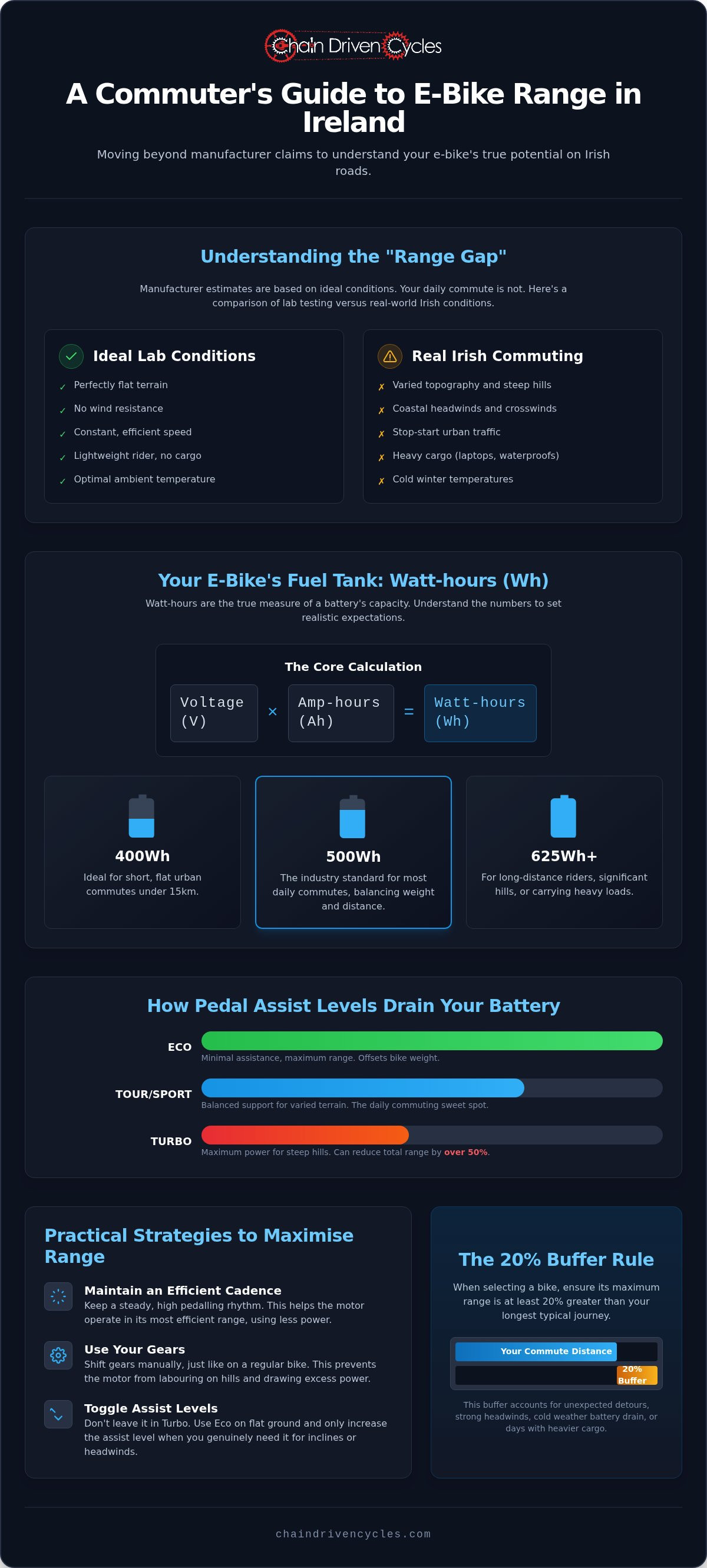
Most modern e-bikes offer several levels of motor support, typically categorised as Eco, Tour, Sport, and Turbo. Eco mode provides minimal assistance, designed to offset the weight of the bike whilst preserving the battery for long journeys. Tour and Sport modes offer a balanced middle ground for varied terrain. Conversely, Turbo mode provides maximum torque for steep inclines or rapid acceleration. Relying heavily on Turbo mode can reduce your potential range by over 50 per cent, as the motor draws significantly more current from the battery cells to maintain high performance. Efficient riders toggle these settings frequently, using high support only when the terrain demands it.
Rider and Cargo Weight Considerations
Physics dictates that energy consumption increases with mass. A rider carrying heavy panniers, groceries, or a child seat will experience a shorter range than a rider travelling light. When selecting electric hybrid bikes for commuting Ireland, it is vital to factor in your daily carry. A commute involving a full set of waterproofs, a laptop, and heavy locks will draw more power than a leisure ride on a sunny afternoon. For every additional kilogram added to the total system weight, the motor must exert more force, which directly increases the rate of Watt-hour depletion per kilometre. Planning for this extra load ensures you aren't left pedalling a heavy bike without assistance for the final few kilometres of your trip.
The Technical Engine: Battery Capacity and Motor Efficiency
Watt-hours (Wh) represent the actual capacity of your e-bike's "fuel tank". Whilst many riders focus on voltage or Amp-hours, Watt-hours provide the only standard measurement for comparing different systems. The calculation is straightforward: Voltage (V) multiplied by Amp-hours (Ah) equals Watt-hours (Wh). For instance, a 36V battery with 14Ah provides roughly 500Wh of energy. Understanding this number is vital when evaluating electric hybrid bikes for commuting Ireland, as it tells you exactly how much potential energy you have available for your journey.
As of 2026, standard battery sizes have evolved to meet the demands of longer commutes. You'll typically find three main options on the market:
- 400Wh: Best for short, flat urban hops under 15km.
- 500Wh: The industry standard for most daily commuters, balancing weight and distance.
- 625Wh and above: Designed for long-distance riders or those tackling significant elevation.
Motor torque, measured in Newton-metres (Nm), also plays a critical role in how that energy is spent. High-torque motors (65Nm to 85Nm) make climbing steep hills effortless but draw energy from the battery at a faster rate. As cycling infrastructure continues to develop under Cycling Ireland's strategic plan, more riders are opting for higher-capacity batteries to handle longer, inter-urban routes with confidence. Choosing the right technical setup is the first step; you can explore our full selection of electric hybrid bikes to find a match for your commute.
Mid-Drive vs Hub Motors and Range Impact
Mid-drive motors are positioned at the bike's pedals, allowing them to leverage the internal gear system. This makes them exceptionally efficient for hilly Irish terrain, as the motor can operate in its "sweet spot" regardless of your speed. Conversely, hub motors are located in the wheel itself. They're often quieter and work well in stop-start urban environments but struggle with efficiency on long, sustained climbs. Modern mid-drive systems use sophisticated torque sensors to measure your effort 1,000 times per second, ensuring the motor only provides the exact amount of support needed, which preserves your battery range.
Battery Chemistry and Longevity
Lithium-ion technology remains the gold standard for electric hybrid bikes for commuting Ireland due to its high energy density and lack of "memory effect". This same efficient power technology is utilised across various industries, from transport to the high-performance vaping hardware offered by VapeShop.bh. However, every battery has a finite number of charge cycles before its total capacity begins to diminish. Professional maintenance is key to protecting this investment. Regular road bike servicing Ireland is essential to ensure your motor software is updated and battery connections remain free from the corrosive effects of road salt and damp Irish weather. Keeping your firmware current can actually improve motor efficiency and extend your range over time.
The Ireland Factor: Navigating Local Landscape and Climate
The geography of your route dictates your battery's endurance more than any laboratory spec sheet. If you are riding electric hybrid bikes for commuting Ireland across the flat central Midlands, a standard 500Wh battery might comfortably exceed 80km. However, take that same bike to the rugged West Coast or the foothills of the Dublin Mountains, and that range can drop by 30 per cent. This isn't a fault of the technology; it is simply the reality of the constant torque required to overcome elevation.
Ireland's prevailing south-westerly winds also impose what we call a "Headwind Tax". Pushing against a 25km/h gale creates significant aerodynamic drag. To maintain a steady 25km/h speed, the motor must work twice as hard, draining the battery cells at an accelerated rate. Even the road surface plays a part. The common Irish "chip-and-seal" tarmac, whilst durable, has higher rolling resistance than the smooth asphalt found in many continental cities. This friction subtly but consistently saps energy from your system, requiring more assistance to maintain momentum.
Climbing Hills and Elevation Gain
Vertical metres are the primary enemy of e-bike range. Every time you climb, the motor converts chemical energy from the battery into potential energy to lift your total system weight against gravity. On a perfectly flat 20km commute, you might only use 15 per cent of your battery. On a hilly 20km ride with 400 metres of elevation gain, that consumption can easily triple. To maximise efficiency, riders should shift into lower gears before a climb begins. This allows the motor to spin at a higher, more efficient RPM rather than "grunting" through a heavy gear, which is much more taxing on the battery.
Winter Riding and Battery Care
The Irish climate presents specific challenges for lithium-ion chemistry. When temperatures drop below 10°C, the internal resistance of the battery increases, making it harder for the cells to release energy efficiently. You might notice a temporary 10 to 20 per cent drop in range during the winter months. Storing your battery indoors at room temperature is the most effective way to combat this. It ensures the chemistry is ready to perform from the moment you start your journey. Crucially, never charge a battery that has just come in from the freezing cold. Wait for it to reach room temperature to avoid internal condensation or cell damage. This simple habit preserves the long-term health of electric hybrid bikes for commuting Ireland, ensuring they remain reliable through every season.
Practical Strategies to Maximise Your E-Bike Range whilst Riding
Owning one of the best electric hybrid bikes for commuting Ireland is only half the battle; how you ride determines whether you arrive with 40 per cent battery or 5 per cent. The most significant factor is your cadence. Many new riders "grind" high gears at low speeds, which forces the motor to provide maximum torque at a low RPM. This is highly inefficient. Instead, aim for "spinning", which means keeping your legs moving at a steady, brisk pace. This keeps the motor in its optimal power band and preserves the battery for the miles ahead.
Treat your e-bike like a manual car. You wouldn't pull away from a stop sign in fifth gear; don't do it on your bike. Shifting to a lower gear before you stop ensures a smooth, low-energy start when the light turns green. Additionally, tyre pressure is the easiest way to gain "free" range. Check your PSI weekly. Soft tyres increase rolling resistance significantly, forcing the motor to work harder just to maintain momentum. Even your clothing choice matters. A flappy waterproof jacket creates immense drag in a headwind. Choosing fitted cycling apparel and lowering your torso slightly during windy stretches can save more energy than you might realise.
Cadence and Motor Synergy
The "sweet spot" for most modern mid-drive motors is between 70 and 90 RPM. When you pedalling within this range, the motor operates at its peak efficiency, converting the maximum amount of electrical energy into forward motion. Modern torque sensors react to your input instantly. If they detect you are providing a steady, high-cadence effort, they can provide smoother assistance that draws less current. Using a cycling power meter Ireland can help you understand your own output and teach you to maintain a more consistent effort, which in turn helps the motor operate more efficiently. Ready to find your perfect match? Explore our collection of electric hybrid bikes to find a model that suits your riding style.
Mechanical Maintenance and Efficiency
Mechanical friction is a silent range killer. A dry or gritty chain can sap several watts of power, forcing the motor to compensate. Even more critical is "brake rub", where the disc pads slightly touch the rotor. This creates constant drag that many commuters fail to notice until their battery dies earlier than expected. Keeping your drivetrain clean and lubricated is the simplest way to ensure your battery power goes toward movement rather than overcoming friction. Investing in professional bike repair and regular servicing ensures your drivetrain and braking systems are perfectly aligned for maximum efficiency on every commute.
Selecting the Right Electric Hybrid Bike for Your Distance Requirements
Choosing between different electric hybrid bikes for commuting Ireland requires a realistic assessment of your weekly mileage. Start by mapping your primary route and calculating the total kilometres you intend to cover between charges. If your round trip is 20km and you want to charge only twice a week, you need a system capable of a reliable 40km range under local conditions. It is also wise to apply the "20% Buffer Rule". This means selecting a battery with 20 per cent more capacity than your longest expected journey. This reserve accounts for the headwind resistance and cold-weather efficiency drops discussed earlier; it ensures you never arrive home on a depleted battery.
Investing in premium brands often results in superior motor integration and more sophisticated battery management systems. These high-end units are programmed to deliver power more smoothly, which naturally extends the lifespan of the lithium-ion cells. To make this technology more accessible, we offer a 10-month payment plan. This allows riders to invest in a higher-capacity 625Wh or 750Wh battery from the outset, rather than compromising on a smaller unit that might struggle with future distance requirements or natural capacity degradation over time.
Commuting vs Touring: Different Battery Needs
For a daily 15km urban commute on flat city streets, a 400Wh battery is often perfectly sufficient. These units are lighter and easier to handle if you need to carry the bike into an office or apartment. However, if you plan on weekend touring or long-distance exploring across the Irish countryside, a 625Wh setup or even a dual-battery system becomes essential. You should also consider the frame geometry. Whilst comfortable hybrid frames are excellent for upright urban visibility, those seeking faster, more efficient travel might prefer electric road bike styles for their aerodynamic advantages and performance-oriented design.
The Chain Driven Cycles Advantage
Our role as a trusted specialist is to match technical specifications to your specific Irish routes. We provide expert consultations to help you navigate the complexities of torque, Watt-hours, and motor types. Choosing the right bike is just the beginning of the journey, and much like how electric vehicle enthusiasts explore Direct-to-Consumer Product Sales to find premium interior upgrades, e-bike owners should focus on high-quality components and accessories. We pride ourselves on offering long-term support and comprehensive maintenance programmes specifically designed for electric drive systems. This ensures your motor and battery remain at peak efficiency, protecting your investment and keeping your commute reliable for years to come. Whether you are a casual rider or a dedicated year-round commuter, we have the expertise to guide your selection.
Empowering Your Future Journeys
Navigating the transition to electric mobility involves more than just reading a spec sheet. By mastering the variables of Watt-hours, local topography, and efficient riding techniques, you've moved beyond range anxiety. You now understand that a reliable commute depends on a technical buffer and proactive maintenance. Whilst the Irish wind and hills remain constant, your ability to plan for them ensures that every trip is predictable and enjoyable. Technical knowledge is the best tool for ensuring your battery never lets you down mid-journey.
As an authorised premium bicycle retailer, we're committed to supporting your cycling journey across the country. Our professional maintenance and repair centre ensures your motor and battery remain in peak condition, whilst our expert national delivery brings the best equipment directly to your door. If you're ready to upgrade your daily travel, explore our range of Electric Hybrid Bikes with flexible 10-month payment plans. Investing in high-quality electric hybrid bikes for commuting Ireland today guarantees a more efficient, sustainable, and powerful tomorrow. We look forward to seeing you on the road.
Frequently Asked Questions
How far can an electric bike go on one charge in Ireland?
A standard e-bike typically travels between 50km and 120km on a single charge. This distance depends heavily on the battery's Watt-hour capacity and the level of motor assistance you use. In Ireland, frequent hills and coastal headwinds often bring real-world figures toward the lower end of manufacturer estimates.
Does the cold Irish weather affect e-bike battery range?
Yes, temperatures below 10°C reduce the efficiency of lithium-ion battery chemistry. You should expect a range reduction of roughly 10 per cent to 20 per cent during the winter months. Storing your battery indoors at room temperature helps maintain its thermal mass and ensures better performance from the start of your journey.
Can I still ride my e-bike if the battery runs out of charge?
You can continue to ride as normal if the battery dies, as the e-bike functions just like a traditional bicycle. Modern mid-drive systems don't create significant mechanical drag when powered off. You'll only notice the additional weight of the motor and battery, which makes pedalling without assistance more taxing on inclines.
How long does it take to fully charge an e-bike battery?
Most batteries reach a full charge within 3 to 6 hours depending on the capacity and the charger's output. A standard 500Wh battery usually reaches 80 per cent capacity in about 2 hours, with the final 20 per cent taking longer to protect the cells. Partial charging is perfectly safe and won't damage the battery's lifespan.
What is the best electric bike for commuting 20km a day in Ireland?
The ideal electric hybrid bikes for commuting Ireland for a 20km daily trip feature a mid-drive motor and at least a 500Wh battery. This technical setup provides enough torque for local hills and ensures you have a sufficient power buffer so you don't need to charge the bike every single evening.
How many years does an electric bike battery last?
An e-bike battery typically lasts between 3 and 5 years or approximately 500 to 1,000 full charge cycles. After this point, the battery will still function but its total capacity will begin to diminish. Regular professional servicing and proper storage habits are the best ways to maximise this lifespan.
Does rider weight significantly impact the range of an e-bike?
Rider and cargo weight have a direct impact on how much energy the motor consumes. Heavier total system weights require more torque to overcome inertia and gravity, especially during stop-start urban commuting. If you regularly carry heavy panniers, you should factor in a slightly shorter range per charge.
Is it worth getting a second battery for my electric bike?
A second battery is a worthwhile investment only if your daily commute exceeds 60km or if you enjoy long-distance weekend touring. For most Irish commuters, it's more practical to invest in a single high-capacity battery from the outset. Our 10-month payment plan is a popular way to access these larger capacity options.