



Power Meter Training for Cyclists: 2026 Buying Guide
Why do so many riders own a power meter but never actually get faster? It's a common frustration for cyclists across Ireland who invest hundreds of Euro into new tech only to see their FTP remain stubbornly stagnant. We understand that power meter training for cyclists often feels like trying to decode a complex secret language, especially when you're torn between the pros and cons of pedal versus crank-based systems. It's easy to feel overwhelmed by technical jargon and the high upfront costs of modern performance hardware.
This guide simplifies the process so you can master the metrics that truly matter for your performance. You'll learn how to build a complete three-pillar system using a precise sensor, a dependable head unit, and a structured training plan. We'll explain why the Assioma DUO is the gold standard for pedal-based versatility and how the ThinkRider X7 Pro provides a high-value solution for your indoor sessions. We've organised this information to help you manage costs through a 10-month payment plan while turning confusing data into better climbing and higher speeds on the open road.
Key Takeaways
- Understand the objective advantage of tracking real-time watts over the delayed biological response of heart rate monitoring.
- Identify why the Assioma DUO is considered the gold standard for accuracy and ease of use in power meter training for cyclists.
- Learn how to select the right GPS head unit to synchronise your sensors and manage your performance data effectively during every ride.
- Follow a structured approach to testing your Functional Threshold Power (FTP) and establishing personalised training zones for better results.
- Explore flexible ways to invest in high-end hardware, such as ThinkRider smart trainers, through an interest-free 10-month payment plan.
The Science of Speed: Why Power Meter Training Beats Heart Rate
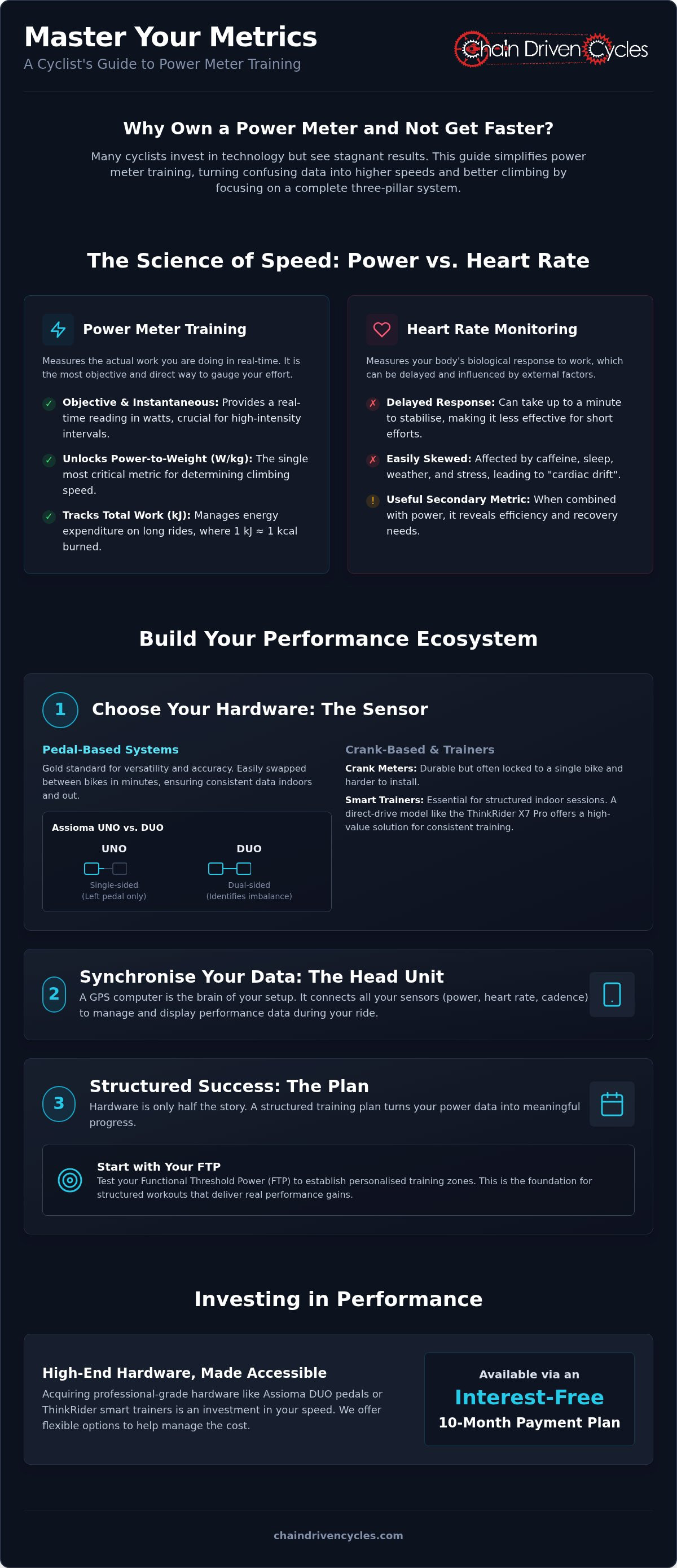
For years, cyclists relied on heart rate to gauge effort. It was the only tool available. However, heart rate is a biological response, not a direct measure of work. When you engage in power meter training for cyclists, you shift from measuring how your body feels to measuring exactly what your bike is doing. A Cycling power meter provides an instantaneous reading in watts. This is a real-time, objective measurement of the energy you're transferring through the drivetrain. Unlike heart rate, which can take up to a minute to stabilise after an increase in effort, power data is immediate. This makes it essential for short, high-intensity intervals where every second counts.
Power also unlocks the most critical metric for Irish climbers: the power-to-weight ratio. Expressed as watts per kilogram (W/kg), this number determines how fast you can ascend steep gradients. Improving this ratio is the most efficient way to get faster on the road, whether you're tackling local sportives or aiming for a personal best on a specific segment. By focusing on watts, you remove the guesswork from your performance.
Just as focusing on precise metrics removes the guesswork from your cycling performance, obtaining professional qualifications can clarify your career trajectory; click here to learn more about starting a career in human resources with CMI Communications & Management Institute.
Understanding Watts and Kilojoules
A watt represents the rate of energy flux at the pedal at any given moment. Whilst watts tell you how hard you're pushing right now, kilojoules (kJ) tell you the total work done over the course of your ride. Think of kilojoules as the "fuel tank" indicator. Because human mechanical efficiency is roughly 20 to 25 per cent, one kJ of work on the bike roughly equals one kilocalorie burned. Tracking your total kJ allows you to manage your energy expenditure on long days in the saddle, ensuring you don't exhaust your reserves before the final climb.
The Limitations of Heart Rate Monitoring
Heart rate remains a useful secondary metric, but it's easily skewed by external variables. Factors like a morning espresso, lack of sleep, or even a sudden change in Irish weather can cause your heart rate to fluctuate independently of your actual effort. This is known as "cardiac drift." Using a Wahoo TICKR Heart Rate Monitor alongside your power meter provides a complete picture of your fitness. If your power is high but your heart rate is lower than usual, it's a sign of increased efficiency. Conversely, if your heart rate is sky-high whilst your power output is low, it's time to prioritise recovery. Power provides the "what," while heart rate provides the "how," and together they offer a professional level of insight into your physical behaviour.
Choosing Your Hardware: Pedals, Trainers, or Crank-Based Meters?
Selecting the right hardware is the first hurdle in your performance journey. Many riders feel forced to choose between a sensor for their bike or a smart trainer for the shed. In reality, the most effective power meter training for cyclists involves an ecosystem where indoor and outdoor data speak the same language. While crank-based meters are often praised for their durability, they can be difficult to install and usually stay locked to a single bike. This makes them less practical for riders who own both a summer road bike and a dedicated winter machine.
Pedal-based systems offer a more versatile alternative. The Assioma DUO Dual Sided Powermeter Pedals are widely regarded as the gold standard for accuracy and ease of use. Because the electronics are housed in the pedal pods, you can swap them between bikes in under two minutes using a standard hex key. This ensures that whether you're tackling varied terrain or enjoying a steady recovery session, your power data remains consistent and reliable. If you're ready to upgrade your setup, you can explore our professional-grade sensors to find the perfect fit for your drivetrain.
Pedal-Based Systems: Assioma UNO vs DUO
The primary difference between the Assioma UNO and DUO is the scope of measurement. The UNO is a single-sided system that measures power at the left pedal and doubles the value. This is a cost-effective entry point, but it assumes your legs are perfectly balanced. The DUO features sensors in both pedals to provide true dual-sided data. Academic research into Power Assessment in Road Cycling suggests that dual-sided measurement is vital for identifying left-right imbalances. Detecting these discrepancies early allows you to adjust your technique and avoid potential overuse injuries during high-volume training blocks.
Direct-Drive Smart Trainers for Indoor Gains
Indoor consistency is the secret to a higher FTP. Direct-drive trainers like the ThinkRider X7 Pro v3 Smart Trainer provide a level of precision that wheel-on trainers simply cannot match. By removing the rear wheel and mounting the bike directly to the trainer, you eliminate tyre slip and enjoy a much smoother road feel. These units are essential for year-round progress, especially when challenging weather conditions make outdoor riding difficult. They provide built-in power data and can simulate steep gradients for virtual racing. This allows you to follow a structured plan with total accuracy, even when the winter evenings draw in and outdoor riding becomes less practical.
Building Your Ecosystem: GPS Computers and Vital Sensors
A high-quality sensor is only half the equation. To truly unlock the benefits of power meter training for cyclists, you need a reliable GPS head unit to act as the command centre for your performance data. This device does more than just record your route. It translates raw signals from your pedals and trainers into actionable insights. Without a dedicated "brain" on your handlebars, you're essentially flying blind during your most critical intervals.
Success depends on how you organise your data screens. For power-based sessions, we recommend displaying 3-second average power alongside your lap power and cadence. This prevents the "jumping" effect of instantaneous watts and helps you maintain a steady effort. Modern units also allow you to sync structured workouts directly from platforms like TrainerRoad, guiding you through every block of your plan with precise targets.
Selecting the Right GPS Computer
Choosing between the industry leaders often comes down to personal preference regarding data depth versus simplicity. The Garmin Edge 540 is a powerhouse for riders who love deep analytics. It offers advanced recovery metrics and real-time stamina tracking to help you gauge how much energy you have left for a final climb. If you prefer a larger display for complex data overlays, the Garmin Edge 1030 Plus provides an expansive screen that makes reading multiple metrics effortless at high speeds.
Conversely, the Wahoo ELEMNT BOLT V2 is celebrated for its incredibly user-friendly interface and "Perfect View" zoom buttons. Wahoo focuses on a streamlined setup via a smartphone app, making it a favourite for cyclists who want to get moving quickly without digging through deep menus. Both ecosystems support the sensors we've discussed previously, ensuring your hardware works in perfect harmony.
The Role of Cadence and Speed Sensors
While your power meter provides cadence, dedicated secondary sensors offer a layer of redundancy and precision that serious athletes require. The Wahoo RPM Cadence Sensor is vital for high-cadence drills and pedalling technique work. It's wireless and magnetless, making it easy to fit to any crank arm. These sensors ensure that your data remains clean even if your primary power unit experiences a momentary drop-out.
Indoor training and riding through tunnels or heavy tree cover can often disrupt GPS speed signals. Using the iGPSPORT SPD61 Speed Sensor solves this issue by tracking wheel revolutions directly. This is particularly useful for accurate distance tracking during winter sessions on the trainer. By building a complete ecosystem of sensors, you ensure that every kilometre is accounted for and every watt is utilised to its full potential.
Structured Success: Setting Your FTP and Training Zones
Functional Threshold Power (FTP) is the cornerstone of power meter training for cyclists. It represents the highest average power you can theoretically maintain for one hour. Without this baseline, the numbers on your screen are just data; with it, they become a precise roadmap for improvement. To find your current level, you must perform a maximal effort test whilst fresh and motivated. Most riders choose between a traditional 20-minute test or a Ramp Test. For the 20-minute version, multiply your average power by 0.95 to estimate your one-hour threshold. The Ramp Test is less mentally taxing; you simply ride until failure, and your FTP is calculated as 75 per cent of your best one-minute power.
Consistency is key to tracking progress. We recommend re-testing every 6 to 8 weeks. This ensures your training zones remain accurate as your fitness improves, preventing you from plateauing or overtraining. If you're ready to get started with professional-grade sensors, you can browse our selection of power meters and trainers to ensure your testing is as accurate as possible.
The 7 Power Zones Explained
Once you have your FTP, you can organise your sessions into seven distinct power zones. These zones allow you to target specific physiological adaptations with surgical precision. Zone 1 focuses on active recovery, whilst Zone 2 is the foundation for building long-distance endurance. Zone 4 is your threshold, which is critical for sustained climbing performance on Irish roads. For those looking for maximum results in limited time, Sweet Spot training is the most efficient way to build an aerobic engine. Higher zones, such as Zone 6 and 7, are reserved for anaerobic capacity and explosive sprinting power.
Analysing Your Ride Data
Moving beyond simple averages is essential for long-term success. Normalized Power (NP) provides a more realistic view of your effort by accounting for the surges and descents typical of outdoor riding. Intensity Factor (IF) tells you how hard a ride was relative to your current FTP, whilst Training Stress Score (TSS) quantifies the total workload. Tracking TSS helps you balance hard sessions with necessary rest, ensuring you don't burn out before your goal event. For a deeper dive into these analytics, read our guide on how to train with a power meter to optimise every minute you spend in the saddle.
Investing in Performance: The Chain Driven Cycles Training Range
Starting your journey into power meter training for cyclists requires more than just a bike; it requires a curated ecosystem of hardware that you can trust. As an independent Irish specialist, we've carefully selected a range of equipment that balances technical precision with long-term reliability. We understand that the jump from casual riding to data-driven performance is a significant investment. That's why we offer expert advice tailored to the local roads you ride and provide free national delivery across Ireland on all our high-end training gear.
Standout Products for 2026
For those taking their first steps into power measurement, the Assioma UNO serves as the best entry-point. It provides the same reliability as the dual-sided version but at a more accessible price point. If your focus is on a quiet and seamless indoor experience, the Wahoo KICKR CORE remains a staple for its smooth resistance and durability. However, the ThinkRider X7 Pro has quickly become a favourite amongst our community. It offers professional-level accuracy and a direct-drive feel that rivals much more expensive units, making it an ideal choice for riders who want pro-level performance on a more realistic budget.
The 10-Month Payment Plan Advantage
High-performance technology shouldn't be restricted to those who can afford a large one-off expense. Our 10 Month Payment Plan is designed to help Irish cyclists manage the upfront cost of their performance tech. This interest-free solution allows you to spread the cost of a Wahoo KICKR Smart Turbo Trainer or a full sensor suite over nearly a year. The process is straightforward: a simple deposit secures your gear today, and the remaining balance is divided into manageable monthly payments.
This approach has become the most popular way for our customers to upgrade their setups without the financial strain often discussed in online forums. It turns the 'dream setup' into a practical reality, allowing you to begin your power meter training for cyclists immediately rather than waiting months to save the full amount. By spreading the cost, you can invest in higher-quality hardware that will support your progress for many seasons to come.
Take Control of Your Performance
Transitioning to data-driven training is the most effective way to ensure every hour you spend in the saddle results in measurable progress. By moving beyond the biological lag of heart rate and embracing objective watts, you gain the clarity needed to conquer steep climbs and improve your anaerobic capacity. Mastering power meter training for cyclists doesn't have to be a complicated or financially overwhelming process. Our expert team provides the local knowledge and technical support you need to build a system that works for your specific goals.
As authorised retailers for Garmin, Wahoo, and Assioma, we've curated a range of hardware that stands up to the demands of Irish roads and weather. You don't have to wait to start seeing results; our interest-free options make high-end performance tech accessible right now. Browse the Full Training Collection and Start Your 10-Month Payment Plan Today. Your best season on the bike starts with the very first watt you track.
Frequently Asked Questions
Do I really need a power meter if I'm not a professional racer?
You don't need to be a professional to benefit from a power meter. These devices are the most effective way for any rider to manage their energy and track progress objectively. Whether you're training for a local sportive or just want to get faster on your weekend club run, having real-time data prevents you from riding too hard too early. It turns every ride into a purposeful session.
What is the difference between single-sided and dual-sided power meters?
Single-sided meters like the Assioma UNO measure power from the left pedal and double that figure to estimate total output. This is a cost-effective entry point for most riders. Dual-sided systems like the Assioma DUO measure both legs independently. This provides a more accurate total and helps you identify pedalling imbalances that could lead to injury over time during high-volume training blocks.
Can I use Assioma pedals with any cycling shoes?
Assioma pedals are compatible with any cycling shoes that use a standard three-bolt road cleat pattern. They use the Look Keo system, which is the most common standard for road cycling footwear in Ireland. If you currently use two-bolt mountain bike or recessed "walkable" shoes, you'll need to upgrade to a road-specific pair to use these power pedals effectively on your road bike.
How do I connect my power meter to my Garmin or Wahoo computer?
Connecting your hardware is a straightforward process using the "Sensors" menu on your Garmin or Wahoo head unit. First, wake up your power meter by spinning the cranks or pedals. On your computer, select "Add Sensor" and choose the power option via ANT+ or Bluetooth. Once paired, your device will automatically recognise the power meter for every future ride without needing a manual search.
Is a smart trainer better than a power meter for winter training?
A smart trainer like the ThinkRider X7 Pro is excellent for specific winter intervals because it can automatically control the resistance for you. However, a power meter on your bike is more versatile because it works both indoors and outdoors. For the most consistent power meter training for cyclists, many Irish riders use a smart trainer for winter sessions and a pedal-based meter for summer road riding.
What is FTP and why does it keep changing?
Functional Threshold Power (FTP) is the maximum power you can sustain for approximately one hour. It's a moving target because your aerobic fitness fluctuates based on your recent training volume and intensity. As you get stronger, your FTP will rise. If you take time off, it will naturally decrease. This is why re-testing every few months is vital for ensuring your training zones remain accurate and effective.
Do I need to calibrate my power meter before every single ride?
We recommend performing a manual "zero offset" or calibration before every ride to ensure maximum accuracy. Whilst many modern power meters have internal temperature compensation, a quick calibration via your head unit only takes a few seconds. This simple step accounts for changes in air temperature and atmospheric pressure, ensuring your 250-watt effort today is exactly the same as it was yesterday.
How does the 10-month payment plan work for training equipment?
Our 10-month payment plan allows you to spread the cost of high-end equipment through interest-free instalments. After an initial deposit, you pay the remaining balance over ten equal months. This makes professional gear like Assioma pedals or Wahoo smart trainers much more manageable for the average cyclist. It's a popular choice for Irish riders looking to upgrade their tech whilst maintaining a clear and predictable monthly budget.