



Choosing the Right Cassettes and Chains: A Complete 2026 Buying Guide
A drivetrain is only as strong as its weakest link; matching the right technical coatings and gear ratios is more vital for performance than simply sticking to a specific brand. While many cyclists obsess over the name on their rear derailleur, the real magic of a smooth ride happens at the interface of your cassettes and chains. It's incredibly frustrating to invest in a high-end bike only to suffer through clunky shifts or realise your gear range isn't quite right for tackling steep climbs or varied terrain. You likely already know that keeping these components in sync is the secret to a quiet bike, yet the sheer variety of speeds and standards can make choosing replacements feel like a minefield.
Our 2026 guide from Chain Driven Cycles simplifies this complexity so you can master the technicalities of drivetrain compatibility with confidence. We'll help you discover the best component upgrades to ensure your gear shifts remain crisp and reliable, whether you're racing on a high-performance road bike or enjoying a weekend spin on an electric hybrid. You'll learn how to select the perfect gear ratios for varied gradients and which materials offer the longest lifespan for your investment. We also explore how professional maintenance and flexible payment options can make your next major overhaul more manageable.
Key Takeaways
- Understand why the technical interface between your chain rollers and cassette teeth is the foundation of a high-performance drivetrain.
- Master the essential rules of speed compatibility and brand interoperability to ensure your gear shifts remain crisp and reliable on every ride.
- Identify the critical signs of component wear early to prevent a worn chain from prematurely destroying your cassette teeth.
- Discover premium component recommendations that offer the best balance of weight, shifting speed, and long-term value for Irish road and hybrid cyclists.
- Learn how to manage the cost of high-end cassettes and chains with flexible 10-month payment plans designed for a professional-grade overhaul.
Understanding the Drivetrain: Why Cassettes and Chains Matter
Think of your bike's drivetrain as its heart. The combined effort of your cassettes and chains acts as the engine room, translating every ounce of leg power into forward momentum. This isn't just about movement; it's about the precision of that movement. The interface where the chain rollers meet the teeth of a bicycle cogset determines how much energy is lost to friction and how much noise your bike makes. When these components match perfectly, the derailleur guides the chain seamlessly across sprocket sizes, creating that elusive silent ride. Improving drivetrain efficiency is often the most cost-effective way to gain speed. It often yields better performance gains than investing in slightly lighter wheels or a more aerodynamic helmet.
The Anatomy of a Cassette
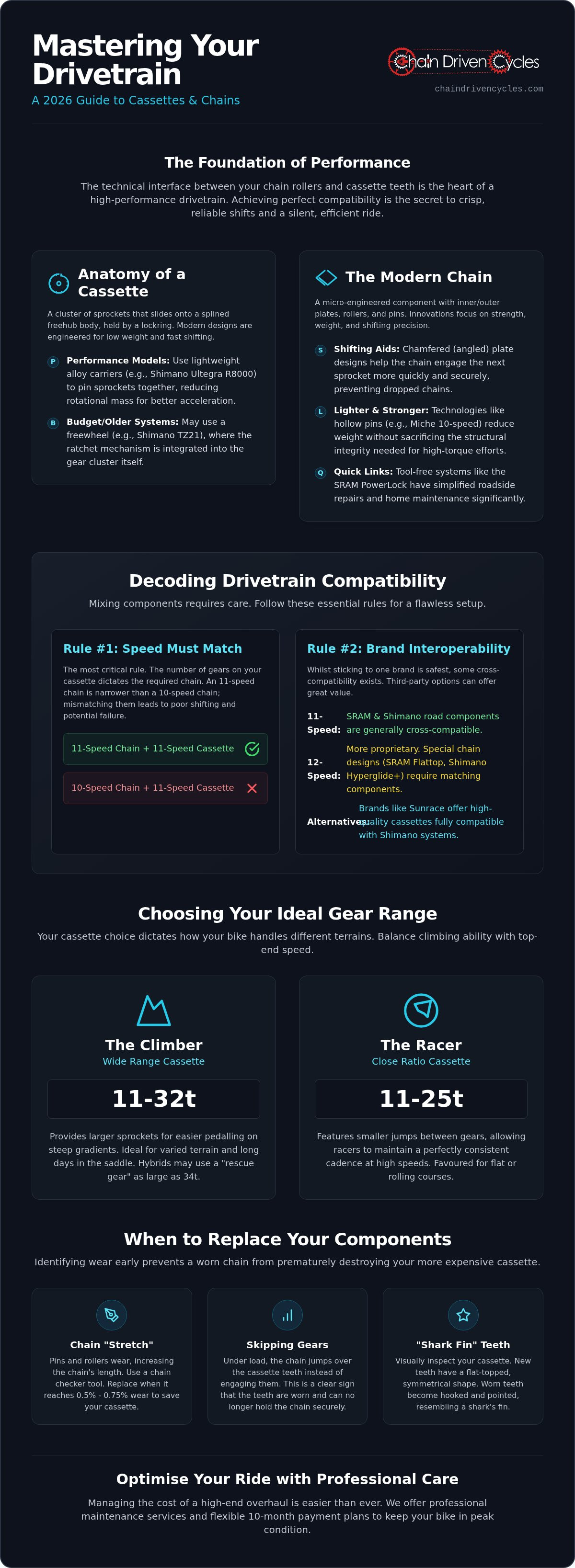
A cassette is a cluster of individual sprockets held together by a lockring. In entry-level setups or older bikes, you might find a freewheel like the Shimano TZ21, where the ratcheting mechanism is built into the gears themselves. Modern performance bikes use a cassette system where the gears slide onto a splined freehub body. High-end models, such as the Shimano Ultegra R8000, use lightweight alloy carriers to pin the largest sprockets together. This design reduces rotational mass. It makes the bike feel more responsive when you accelerate out of a corner or tackle a steep Irish incline.
The Science of the Modern Chain
Modern chains are masterpieces of micro-engineering consisting of inner and outer plates, rollers, and pins. Brands now use chamfered plate designs. These angled edges help the chain grab the next sprocket during a shift, which reduces lag and prevents dropped chains. Strength is paramount, especially for high-torque efforts. For instance, Miche 10-speed chains often utilise hollow pin technology to shed weight without sacrificing the structural integrity needed for heavy climbing. The way we join these chains has also evolved. While traditional pins required a specialised tool and extreme precision, the SRAM PowerLock system introduced a tool-free quick link. This made roadside repairs and home maintenance significantly simpler for cyclists of all levels. Reliable cassettes and chains are the foundation of any successful ride, ensuring your power isn't wasted on the road.
Decoding Compatibility: Speeds, Brands, and Ratios
The most critical rule of bicycle maintenance is ensuring your chain speed matches your cassette speed. An 11-speed chain is physically narrower than a 10-speed one; trying to mix them results in poor shifting or even mechanical failure. If you're uncertain about cassette and chain compatibility, always count the number of sprockets on your rear wheel first. Modern 11 and 12-speed systems rely on "narrow" and "super narrow" designs to fit more gears into the same space. These tighter tolerances mean precision is no longer optional.
Many riders ask if they can mix brands. Generally, SRAM and Shimano 11-speed road components are cross-compatible, which allows you to run a Shimano chain on a SRAM cassette. However, 12-speed systems have become more proprietary. This is especially true with SRAM's Flattop chains or Shimano's Hyperglide+ technology. To ensure your cassettes and chains work in perfect harmony, it's often best to stick to the manufacturer's ecosystem unless you're using proven third-party alternatives.
Choosing Your Gear Range
Gear ratios dictate how your bike handles terrain. An 11-32t cassette offers a "wider" range, providing a larger sprocket for easier climbing on steep Irish gradients. In contrast, an 11-25t Ultegra R8000 is a "close ratio" cassette. It offers smaller jumps between gears, which road racers prefer for maintaining a consistent cadence. For those on budget-friendly hybrids, the Shimano MegaRange system on the TZ21 provides a massive 34-tooth "rescue gear" to help you get home after a long day in the saddle. It's about finding the balance between top-end speed and low-end support.
Cross-Brand Compatibility Guide
You don't always have to buy the same brand as your original groupset. Sunrace cassettes provide a high-performance, cost-effective alternative that integrates perfectly with Shimano drivetrains. For roadside emergencies, carrying BBB Smartlinks is essential; these master links work across various brands to get you moving again quickly. If you're riding an electric hybrid, ensure your chain is NEN-EN 15194 compliant to handle the higher torque loads. If you're ready to upgrade, you can browse our full range of cassettes and chains to find the right fit for your bike.
Standout Components: Top Picks for Performance and Value
Selecting the right cassettes and chains involves balancing weight, shifting precision, and long-term durability. While basic models get you from A to B, premium components often feature advanced technical coatings like Shimano’s SIL-TEC. This fluorine-based surface treatment reduces friction and sheds mud more effectively, which is vital for maintaining performance in the damp Irish climate. For those seeking the pinnacle of durability, the Dura-Ace 9000 and XTR M9000 series represent the gold standard, offering unmatched longevity for elite riders through these specialised treatments.
Premium Road Upgrades
The Shimano Ultegra R8000 11-speed cassette remains a firm favourite for serious road enthusiasts. Its rigid alloy carrier reduces weight and increases stiffness, making it a worthy EUR 94.0 investment for those prioritising power transfer. When pairing this with a chain, the Shimano CN-HG701 is the logical partner. It features a symmetrical plate design and SIL-TEC treatment on both the rollers and link plates. If you are exploring Shimano-compatible cassettes for competitive racing, Miche 10-speed chains are also worth considering. They provide high tensile strength that handles the stresses of sprinting without stretching prematurely.
Reliable Everyday Replacements
You don't need a professional budget to enjoy crisp shifting. The SRAM PC-1130 is an excellent example of an affordable, lightweight 11-speed chain that delivers reliable everyday performance. For mountain bikers using older 9-speed systems, the Sunrace CSM96 is a standout choice. It offers a lightweight construction that rivals more expensive competitors. These components prove that smart material choices can enhance your ride without breaking the bank.
Commuters and leisure riders have equally robust options to keep their bikes moving. The SRAM PC 830 is a resilient 8-speed chain available for just EUR 16.0, providing great value for those who cycle in all weathers. If you're running a 9-speed Deore or Tiagra setup, the Shimano HG53 is a dependable workhorse known for its consistent behaviour. Finally, Sunrace 8-speed cassettes shouldn't be overlooked. Their "Super Fluid Drive" tooth profiles ensure smooth transitions even on entry-level bikes. Choosing high-quality cassettes and chains ensures your bike stays on the road longer between services.
Identifying Wear: When to Replace Your Cassettes and Chains
Many riders talk about "chain stretch" as if the metal plates are physically elongating under tension. In reality, this is a myth. Wear actually occurs at the internal pins and bushings. As these parts erode, the cumulative slack makes the chain appear longer. This change in pitch is disastrous for your drivetrain. A worn chain no longer sits deep in the sprocket teeth; instead, it rides high and acts like a saw. It grinds away the metal until your cassettes and chains no longer mesh correctly. If you wait until the teeth look like "shark fins", you've likely waited too long to save the cassette.
Precision measurement is the only way to avoid unnecessary costs. Use a dedicated chain checker tool to monitor wear levels. For modern 11 and 12-speed systems, you should replace the chain when it hits 0.5% wear. Older 8, 9, or 10-speed systems offer a bit more leeway, usually requiring a swap at 0.75%. Replacing a chain early is a small price to pay to protect the more expensive sprockets on your rear wheel. Once the chain passes these wear markers, it begins to permanently reshape the cassette teeth to match its own elongated pitch.
Signs of a Dying Drivetrain
Slipping gears are the most obvious symptom of a worn system. You'll feel a sudden, violent "pop" when you apply heavy pressure during a climb or a sprint. This happens because the chain is jumping over the worn teeth. You might also notice increased drivetrain noise or a "crunchy" shifting behaviour that indexing adjustments cannot fix. In extreme cases, you may experience "chain suck". This occurs when the chain fails to release from the bottom of the chainring and gets pulled up into the frame, which can cause significant damage to your bicycle's finish.
Maintenance Tips for Longevity
Consistent cleaning is the foundation of component longevity. You don't always need to remove the parts; cleaning the chain whilst it's on the bike with a high-quality degreaser is highly effective. In the Irish climate, your choice of lubricant is vital. Use a thick wet lube during the winter months to resist rain and road salt, but switch to a dry lube in the summer to prevent grit from forming an abrasive paste. For the best results, schedule a professional bike overhaul at least once a year. This ensures your drivetrain is perfectly aligned and helps catch wear before it becomes a safety issue.
If your measurements show that your components have reached the end of their life, you can shop our curated selection of replacement cassettes and chains to restore your bike's factory-fresh shifting performance.
Optimising Your Ride with Chain Driven Cycles
Chain Driven Cycles provides more than just a storefront; we offer the technical expertise required to keep your bicycle in peak condition. With a curated collection of 108 products in our cassettes and chains category, we ensure you find the exact match for your drivetrain. Whether you're restoring a classic 6-speed or upgrading to a modern 12-speed AXS system, our inventory covers the full spectrum of cycling history and innovation. We understand that a full groupset overhaul is a significant investment. To make this more accessible, we offer a 10-month payment plan, allowing you to spread the cost of premium components whilst enjoying the performance benefits immediately.
Installing these precision parts requires a delicate touch. Our service centres provide professional repair services where our mechanics ensure your new cassette is torqued correctly and your chain is sized with millimetre precision. This expert setup eliminates the risk of indexing issues or premature wear. Once your order is placed, we provide fast and reliable shipping across Ireland, ensuring your components arrive safely and ready for the road. Our goal is to get you back on your bike with total confidence in your equipment.
Why Shop with Us?
We take pride in being authorised dealers for high-performance brands like Wilier and Bottecchia. This relationship gives us direct access to the latest technical specifications and genuine replacement parts. Our team doesn't just sell these components; we ride them on the same Irish roads you do. This practical experience means we can offer advice based on real-world performance rather than just reading a catalogue. We stock everything from vintage-friendly 6-speed freewheels to the latest wireless electronic setups, ensuring no rider is left behind.
Ready to Upgrade?
A fresh drivetrain is one of the most satisfying improvements you can make to your bike. Before you buy, double-check your current speed count and consider if a different gear ratio might help you conquer those local climbs more comfortably. For peace of mind on longer spins, we recommend carrying a Sunrace Quick Link in your saddlebag for emergency repairs. It's a small addition that can save a ride from an untimely end. When you're ready to experience silky-smooth shifting again, shop our full range of cassettes and chains today and let us help you find the perfect configuration for your next adventure.
Precision Shifting for Your Next Adventure
At Chain Driven Cycles, we're here to guide you through every technical decision with quiet confidence. Our team provides expert technical support to help you navigate the complexities of modern groupsets and cross-brand compatibility. To make your next upgrade even easier, we offer a 10-month payment plan to spread the cost and free national shipping on qualifying orders across Ireland.
Upgrade your drivetrain with our premium Cassettes and Chains and experience the reliability that comes with professional-grade equipment. We're ready to help you find the perfect setup for your next great ride.
Frequently Asked Questions
Can I use a 10-speed chain on an 11-speed cassette?
No, you cannot use a 10-speed chain on an 11-speed cassette because the chain is physically too wide. The spacing between sprockets on an 11-speed system is narrower than on a 10-speed setup. Using a wider chain causes it to rub against adjacent gears or fail to drop into place. Always ensure your cassettes and chains share the same speed rating to maintain crisp shifting and prevent mechanical damage to your drivetrain.
How many miles should a bicycle chain last before needing replacement?
Most bicycle chains last between 2,000 and 3,000 kilometres, though Irish weather and road grit can shorten this significantly. Rather than relying on a distance estimate, use a chain checker tool every few weeks. Factors like your cleaning routine, the type of lubricant used, and the amount of climbing you do will all influence longevity. Replacing the chain at the first sign of wear is the best way to protect your more expensive components.
Do I need to replace my cassette every time I change my chain?
You don't need to replace the cassette with every chain change if you monitor wear levels closely. Typically, a high-quality cassette lasts through three chain replacements if chains are swapped before reaching 0.75% wear. If you ride a chain until it is significantly elongated, it quickly wears the cassette teeth to match its pitch. In these cases, a new chain will skip on the old gears, requiring both to be replaced simultaneously.
What is the difference between a freewheel and a cassette?
The primary difference lies in where the ratcheting mechanism is located. A freewheel is a single unit containing the gears and the ratchet, which screws directly onto the wheel hub. In contrast, a cassette is a cluster of sprockets that slides onto a splined freehub body. Most modern performance bikes use the cassette system because it is lighter and allows for stronger axle designs that are less prone to bending.
Can I mix Shimano and SRAM drivetrain components?
You can often mix Shimano and SRAM components in 11-speed road setups, as they share the same sprocket spacing. However, this becomes more difficult with 12-speed systems. SRAM's AXS Road chains use larger rollers, whilst Shimano's Hyperglide+ technology relies on specific tooth profiles. For the most reliable performance, it is best to keep your cassettes and chains within the same brand ecosystem, especially when using the latest electronic groupsets.
What gear ratio should I choose for a hilly cycling route?
For hilly routes, you should choose a wide-range cassette with a large maximum sprocket size, such as an 11-32t or 11-34t. The higher tooth count on the largest gear provides a lower ratio, which makes it easier to keep your legs turning on steep inclines. This prevents you from "grinding" at a low cadence, which reduces muscle fatigue and helps you stay fresh for the duration of a long, mountainous ride.
What does SIL-TEC mean on Shimano chains?
SIL-TEC is a sophisticated, fluorine-based plating process used by Shimano to reduce friction. This surface treatment is applied to the plates and rollers of premium chains to improve shifting speed and durability. It also helps the chain shed dirt and moisture more effectively, which is a major advantage for cyclists riding in typical Irish conditions. Choosing a SIL-TEC coated chain results in a quieter drivetrain and a smoother pedalling feel.
Is it difficult to change a bike cassette myself?
Changing a cassette is a manageable task if you have the correct tools. You will need a chain whip to hold the sprockets steady, a lockring tool, and a large spanner. Whilst the process is logical, it requires specific torque to ensure the assembly doesn't work loose. If you don't have these tools or prefer a guaranteed setup, our service centres provide professional installation to ensure your drivetrain is perfectly aligned.