



Bike Servicing Sligo: The 2026 Buying Guide to Professional Home Maintenance
A silent drivetrain isn't just a luxury for the professional peloton; it's the primary indicator that your premium Wilier or Bottecchia frame isn't being slowly ground down by grit and friction. When you're out on your favourite route, the last thing you want is the rhythmic crunch of a dry chain or the sinking feeling of a soft tyre with no repair kit in sight. Mastering professional bike servicing starts with understanding that peak performance doesn't always require a trip to the workshop. It requires the right chemistry and the correct tools for the specific job at hand.
You likely already know that regular cleaning is vital, but the choice between wet, dry, or wax-based lubricants can be confusing when the weather changes by the minute. This guide from Chain Driven Cycles promises to strip away that uncertainty, helping you select the exact degreasers and kits used by experts to extend component life. We'll explore how to eliminate drivetrain noise, choose the best lubricants for variable climates, and build a home maintenance setup that rivals a pro service centre. By the end, you'll have the confidence to maintain your investment and the kit to handle any roadside mechanical with ease.
Key Takeaways
- Understand how proactive home maintenance prevents premature wear on your bike's premium components and high-quality frames.
- Master the fundamentals of bike servicing Sligo by selecting the correct lubricants for Ireland's specific weather conditions.
- Learn why deep degreasing is the essential foundation for a silent drivetrain and how to avoid the common mistake of layering oil over dirt.
- Discover how to build a professional-standard workshop incrementally, starting with versatile protectants like silicone sprays for frame care.
- Identify the essential roadside tools and repair kits needed to ensure you are never stranded by a puncture or minor mechanical issue.
The ROI of Professional Bike Servicing Sligo: Why Home Care Matters
Professional-grade home servicing is best defined as the proactive management of friction and the timely replacement of wear items before they cause cascading damage. In the context of bike servicing Sligo, many riders wait for a mechanical failure before reaching for the toolkit. However, a service-first approach focuses on prevention. When you own a premium machine, such as a Wilier road bike or a race-ready Bottecchia, the goal is to maintain that factory-fresh precision for as long as possible. This mindset shifts the focus from fixing broken parts to preserving high-performance standards through methodical care and the same expertise used in our professional service centres.
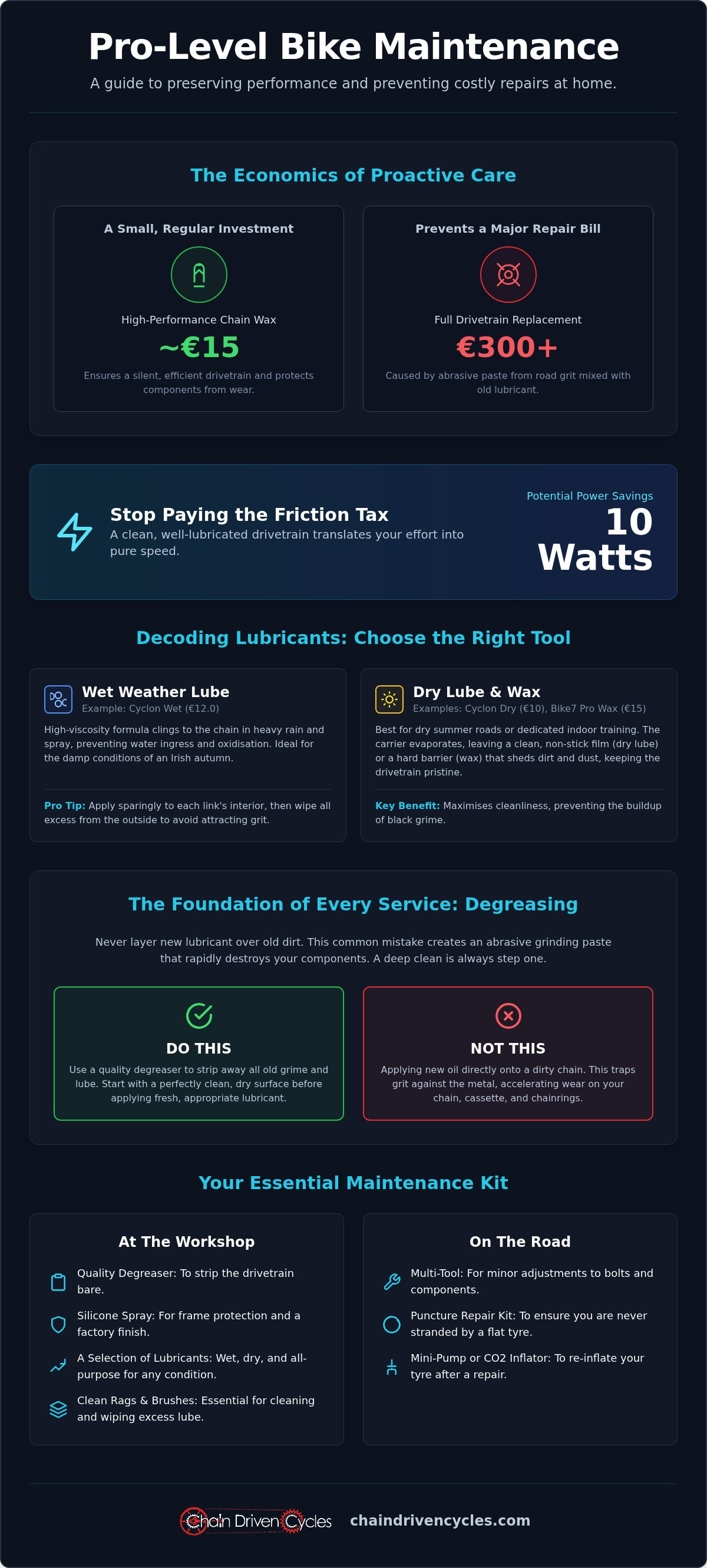
Consider the simple economics of maintenance. A bottle of high-performance chain wax might cost roughly €15, whereas a mid-to-high-tier drivetrain replacement can easily exceed €300. By investing in basic cleaning supplies, you're effectively insurance-proofing your most expensive components. Without regular intervention, road grit mixes with old lubricant to create a mechanical grinding paste. This abrasive sludge accelerates the wear on your cassette and chainrings, turning a smooth ride into a costly repair bill and potentially ruining expensive components prematurely.
Preventing Premature Component Wear
The primary enemies of any bicycle in the West of Ireland are road grit, salt air, and old, thickened grease. These elements work in tandem to corrode metal and degrade seals, particularly if you're frequently riding along the Atlantic coast. Beyond the mechanical health of the drivetrain, a clean bike is fundamentally safer. Removing layers of road grime makes it significantly easier to inspect for hairline frame cracks or cable fraying that might otherwise go unnoticed during a hasty pre-ride check. For those facing more complex mechanical overhauls or electronic shifting issues, our professional electric and road bike servicing Ireland guide provides a deeper look into advanced workshop tasks.
Performance Gains Through Reduced Friction
Every cyclist pays a wattage tax when riding with a neglected drivetrain. Friction is the silent thief of momentum. If you've invested in high-end technology like Assioma power meter pedals to track your progress, it's counterproductive to let poor maintenance skew your power data. A clean drivetrain can save up to 10 watts of effort, ensuring that every ounce of energy you put into the pedals is converted into forward motion rather than being lost to mechanical resistance. Maintaining a professional standard of bike servicing Sligo ensures your equipment remains as efficient as your training programme.
Decoding Lubricants: TF2, Cyclon, and Zefal Compared
Choosing the right lubricant is where many DIY attempts at bike servicing Sligo fall short. It isn't a case of one oil fits all. Lubricants are engineered for specific environmental interactions. Wet lubes are thick and water-resistant. Dry lubes use a carrier fluid that evaporates, leaving a thin film. Wax-based options, like Bike7 Pro Wax (€15.0), create a solid barrier that sheds dirt entirely. For general workshop tasks, the TF2 Lubricant Spray with Teflon (€10.0) remains a staple. Its ability to penetrate tight pivots and leave a protective Teflon coating makes it ideal for derailleur springs and brake calliper points. This versatile spray is often the first tool we reach for to restore movement to sticky components before a deeper service begins.
When to Reach for Wet Weather Lube
Cyclon Wet Weather Lube (€12.0) is designed for the high-saturation environments typical of an Irish autumn. Its high-viscosity formula clings to the chain even when subjected to heavy spray from the road. These moisture repellent properties are essential because they prevent water from reaching the metal surface, stopping oxidisation in its tracks. To avoid the dreaded black gunk buildup, apply it sparingly to each link and wipe away every bit of excess with a clean rag. The goal is internal lubrication, not a sticky external coating that attracts grit. Cyclon's formula is particularly effective at staying silent during long, damp rides where thinner oils would simply wash away within the first hour.
The Benefits of Dry Lube and Chain Wax
When the roads finally dry out or for those dedicated to indoor training on a smart trainer, Cyclon Dry Weather Lube (€10.0) is the superior choice. It doesn't attract dust, keeping your drivetrain looking and sounding pristine. For cyclists who prioritise a spotless setup, Bike7 Pro Wax (€15.0) offers a self-cleaning effect. As you ride, small flakes of wax carry away contaminants. However, wax is unforgiving. It requires a perfectly degreased chain before the first application, or it simply won't bond to the metal. Zefal Pro Dry Lube (€9.99) offers a middle ground, providing excellent friction reduction with a slightly more forgiving application process than full wax. You can find these specialised formulas in our professional bike care collection to ensure your setup is perfectly matched to the season.
Drivetrain Degreasing: The Foundation of Every Service
The most common error in home maintenance is the tendency to 'layer' fresh lubricant over a chain already coated in road grime and old oil. This creates a black, abrasive slurry that acts like liquid sandpaper on your expensive drivetrain components. Effective bike servicing Sligo requires a total reset. You must strip away these old contaminants entirely before applying the specialised lubricants discussed previously. This ensures the new oil reaches the internal pins and rollers where it's actually needed, rather than simply sitting on top of a layer of grit.
Wes-chem Power Blaster Degreaser (€19.0) is our preferred solution for this heavy-duty task. It's a professional-grade formula designed to break down stubborn grease without damaging the delicate finishes of premium carbon or alloy frames. Alongside drivetrain care, maintaining your stopping power is equally critical. Cyclon Brake Cleaning Fluid (€12.0) is essential for removing oil residue or road film from disc rotors, ensuring your braking remains sharp and predictable even in the wettest conditions.
The Power Blaster Method for Deep Cleans
To achieve a professional finish, apply Wes-chem Power Blaster directly to the cassette, chainrings, and chain. Allow it to dwell for several minutes to penetrate the grease, then agitate the areas with a stiff-bristled brush to lift deep-seated dirt. When rinsing, use a low-pressure stream. High-pressure water is a common enemy in bike servicing Sligo; it can force degreaser and water past the seals of your bottom bracket or wheel hubs, washing out the essential internal grease that keeps your bearings spinning smoothly. Once the grime is gone, dry the drivetrain thoroughly with a lint-free cloth. A degreased chain should be silver and dry to the touch before any lubricant is applied.
Brake Maintenance and Mineral Fluids
Brake performance often degrades so gradually that riders don't notice the loss of efficiency until it becomes a safety issue. Squealing brakes or a spongy feel at the lever are clear indicators of contaminated pads or air trapped within the hydraulic system. If your brakes require a bleed to restore that crisp response, Cyclon Mineral Brake Fluid Red (€12.0) provides the consistency needed for reliable lever feel. Always be cautious during the degreasing process. Never allow general lubricants or overspray to reach your disc rotors. Contaminated pads usually can't be saved and must be replaced to restore full stopping power. Using a dedicated brake cleaner ensures no oily residue is left behind to compromise your safety on steep descents.
Emergency Roadside Servicing: Choosing the Right Puncture Kit
Whilst deep cleaning in your workshop is the foundation of longevity, your ability to perform mobile bike servicing Sligo determines whether a puncture is a minor pause or the end of your ride. A curated roadside kit should never be an afterthought. It requires three non-negotiable essentials: high-leverage tyre levers, a reliable patch kit, and a comprehensive multi-tool. Having these items organised amongst your saddle bag essentials ensures you can handle the most common mechanical failures without needing a recovery vehicle. The goal is to mirror the professional standards of your home workshop whilst remaining lightweight and portable.
For most riders, the choice of patch kit comes down to speed versus permanence. The Nutrak Puncture Repair Kit (€8.99) is a traditional workshop favourite, offering a robust solution for standard inner tubes. In contrast, the Nutrak Glueless version is designed for those who prioritise a rapid turnaround during a commute or a race. To handle broader mechanical issues, we recommend the Biketool BT-125 Bicycle Mini Multi Tool (€19.99). Its 11-in-1 functionality provides the necessary Hex and Torx keys to tighten loose bolts or adjust derailleur limits on the fly, ensuring your bike remains indexed correctly throughout your journey.
Glueless vs. Vulcanising Patches
Glueless patches are excellent for a 'fast fix' when time is against you. They peel and stick like a plaster, allowing you to get back on the road in seconds. However, for a permanent, workshop-quality repair, the Fingo Bike Tube Repair Kit (€5.0) is the superior choice. This kit uses a vulcanising solution to create a chemical 'cold weld' between the patch and the tube. This process fuses the two pieces of rubber together, creating a bond that is often stronger than the original tube material. It's a more methodical approach that provides total peace of mind for long-distance touring.
Tyre Levers and Chain Tools
The material of your tyre levers is a critical consideration for bike servicing Sligo. Whilst metal levers are durable, they can easily gouge alloy or carbon rims. BBB Tyre Levers BTL-81 (€3.0) offer a great balance of strength and safety, but for those with premium carbon wheelsets, the Zefal DP20 levers are essential. These are crafted from a specific resin technopolymer that is significantly gentler on high-end rims whilst remaining stiff enough to pop off stubborn beads. Don't forget the drivetrain; the WB Steel Chain Splitter Tool (€5.0) is a tiny but vital addition for removing snapped links, allowing you to bypass a broken derailleur if necessary. You can find all these roadside essentials in our professional bike care collection.
The Essential Workshop Setup: Curating Your Bike Care Collection
Building a professional-standard home workshop is a methodical process rather than a single large investment. Unlike generic pre-assembled tool chests that often contain redundant equipment, the most effective approach to bike servicing Sligo is to curate your collection incrementally based on actual need. For enthusiasts who enjoy customising their workspace, high-quality 3D printer filament Europe is an excellent resource for printing bespoke tool organisers and small parts bins that fit a home workshop perfectly. Start with high-utility items that provide immediate protection for your bike's most visible and sensitive parts. A foundational item for any home workshop is the SP-90 Silicone Lubricant Spray (€11.99). It's a versatile protectant that serves as much more than a simple lubricant, acting as a shield against the elements.
By taking this proactive approach, you ensure your machine is always ready for the road, mirroring the meticulous standards we maintain in our own service centres whilst extending the life of your gear. This dedication to mechanical excellence often extends beyond the bicycle workshop; for enthusiasts who appreciate precision engineering in various forms, Darlington Diecast Models Limited offers detailed guides on high-quality scale replicas and collector equipment.
Protecting Your Frame’s Finish
The SP-90 spray is particularly effective because it leaves a 'dry' micro-film on the frame. This barrier prevents mud and road salt from sticking, making your next wash significantly faster and easier. This level of care is essential for premium road bikes where maintaining the aesthetic and structural integrity is a priority. Whether your frame has a modern matte or a traditional gloss finish, silicone-based protectants help maintain that deep colour whilst providing a layer of UV protection. Crucially, a clean, polished frame makes it much easier to spot potential structural issues, such as stress fractures or paint bubbling, which might be hidden under a layer of Irish road grime.
The 10-Month Payment Plan for High-End Maintenance
Whilst building a workshop incrementally is sensible, some riders prefer to establish a complete setup for the winter season all at once. To make these larger investments more accessible, Chain Driven Cycles offers a flexible 10-month payment plan. This allows you to combine your essential tool and cleaning purchases with high-performance equipment like a ThinkRider smart trainer for a comprehensive indoor setup. If you're unsure which tools are compatible with your specific groupset or frame type, our team is always available to help. We encourage you to contact the shop for expert advice tailored to your specific cycling goals and technical requirements.
Browse the full Bike Care collection to upgrade your home workshop today.
Elevate Your Ride Quality Today
Mastering the art of bike servicing Sligo is the most effective way to ensure your cycling investment continues to perform at its peak. By shifting from a reactive mindset to a proactive one, you protect your drivetrain from the abrasive effects of road grit and ensure every watt of energy is used efficiently. Whether you are performing a deep degrease or selecting a weather-specific lubricant from Cyclon or Zefal, using the right chemistry makes all the difference to component longevity.
We provide an expertly curated selection of over 120 maintenance products, featuring the same professional-grade fluids used in our own workshop. As authorised dealers for premium Italian brands like Wilier and Bottecchia, we understand the precision required to keep high-end machines running silently. To help you build your ideal home setup, we also offer a 10-month payment plan on all major purchases, making professional tools more accessible than ever.
Shop the Professional Bike Care Collection today and take the first step toward a more reliable, efficient ride. With the right kit in your workshop, you'll spend less time fixing problems and more time enjoying the open roads of the North West.
Frequently Asked Questions
How often should I perform a full bike service?
You should perform a full bike service every six to twelve months depending on your annual mileage and riding conditions. High-frequency riders or those training through the winter months often require a comprehensive check twice a year. Regular home maintenance can extend these intervals, but a professional inspection ensures that hidden wear in bearings or hydraulic systems is addressed before it causes a mechanical failure during a ride.
Is it better to use wet or dry lube for cycling in Ireland?
Wet lubricant is generally better for the Irish climate due to the high frequency of rain and road spray. Its high viscosity prevents it from washing off the chain during damp rides. Dry lube is excellent for the few weeks of peak summer or indoor training because it doesn't attract dust. For the most versatile results in bike servicing Sligo, consider a wax-based lubricant that sheds dirt whilst remaining water-resistant.
Can I use WD-40 to lubricate my bike chain?
You should avoid using standard WD-40 as a primary chain lubricant. It acts as a solvent and degreaser, which strips away the essential factory grease from inside the chain links. Whilst it can help loosen seized parts, it evaporates too quickly to provide lasting protection. Always follow a cleaning session with a dedicated bicycle lubricant like TF2 or Cyclon to ensure your drivetrain remains quiet and protected from friction.
What is the difference between a puncture repair kit and a glueless kit?
A standard puncture repair kit uses a vulcanising solution to create a permanent chemical bond between the patch and the tube. This process is highly reliable for long-term repairs. A glueless kit uses pre-adhesive patches that peel and stick directly onto the tube. These are faster for roadside emergencies or racing scenarios but are generally considered temporary fixes that may eventually leak if the tube expands or contracts significantly.
Do I need special tools to service an electric hybrid bike?
Most mechanical components on an electric hybrid bike require the same standard tools used for traditional bicycles. You will still need hex keys, tyre levers, and chain lubricants for daily maintenance. However, servicing the drive unit or battery system often requires brand-specific software and diagnostic tools. For complex electrical issues or mid-drive motor adjustments, it's best to consult a specialist workshop that carries the correct manufacturer-approved equipment.
How do I know if my bike chain needs replacing?
You can determine if your chain needs replacing by using a dedicated chain checker tool to measure elongation. If the tool shows 0.5% or 0.75% wear, it's time for a new chain to prevent damage to your cassette. Other signs include poor shifting performance, a noisy drivetrain that won't quieten with lubrication, or visible 'shark-finning' on the teeth of your chainrings and cassette cogs.
What should be in my basic roadside emergency kit?
Your basic roadside kit should include a set of resin tyre levers, a spare inner tube, and a puncture repair kit. A compact multi-tool with various hex keys is essential for tightening loose bolts. You should also carry a mini-pump or a CO2 inflator to reseat the tyre. Keeping these items organised in a small saddle bag ensures you're prepared for the most common mechanical issues encountered during bike servicing Sligo.
Why is my bike making a clicking noise when I pedal?
A clicking noise is usually caused by a loose component or a lack of grease at an interface. Common culprits include the bottom bracket, pedal threads, or even a dry seatpost. Start by tightening your pedals and checking your chain for stiff links. If the noise persists when you stand up to pedal, the issue is likely in the drivetrain or bottom bracket rather than the saddle or seatpost area.