



Cycling Routes Sligo: The Ultimate Apparel and Gear Buying Guide 2026
Imagine you're halfway along a challenging cycling route, cresting a hill when the mist turns into a persistent downpour. Within minutes, your old waterproof jacket has failed, and the damp chill begins to sap your focus. We've all experienced that moment where poor kit turns a breath-taking ride into a test of endurance. Exploring diverse cycling routes is an incredible experience, but varied terrains and demanding conditions require a professional approach to your apparel and safety gear.
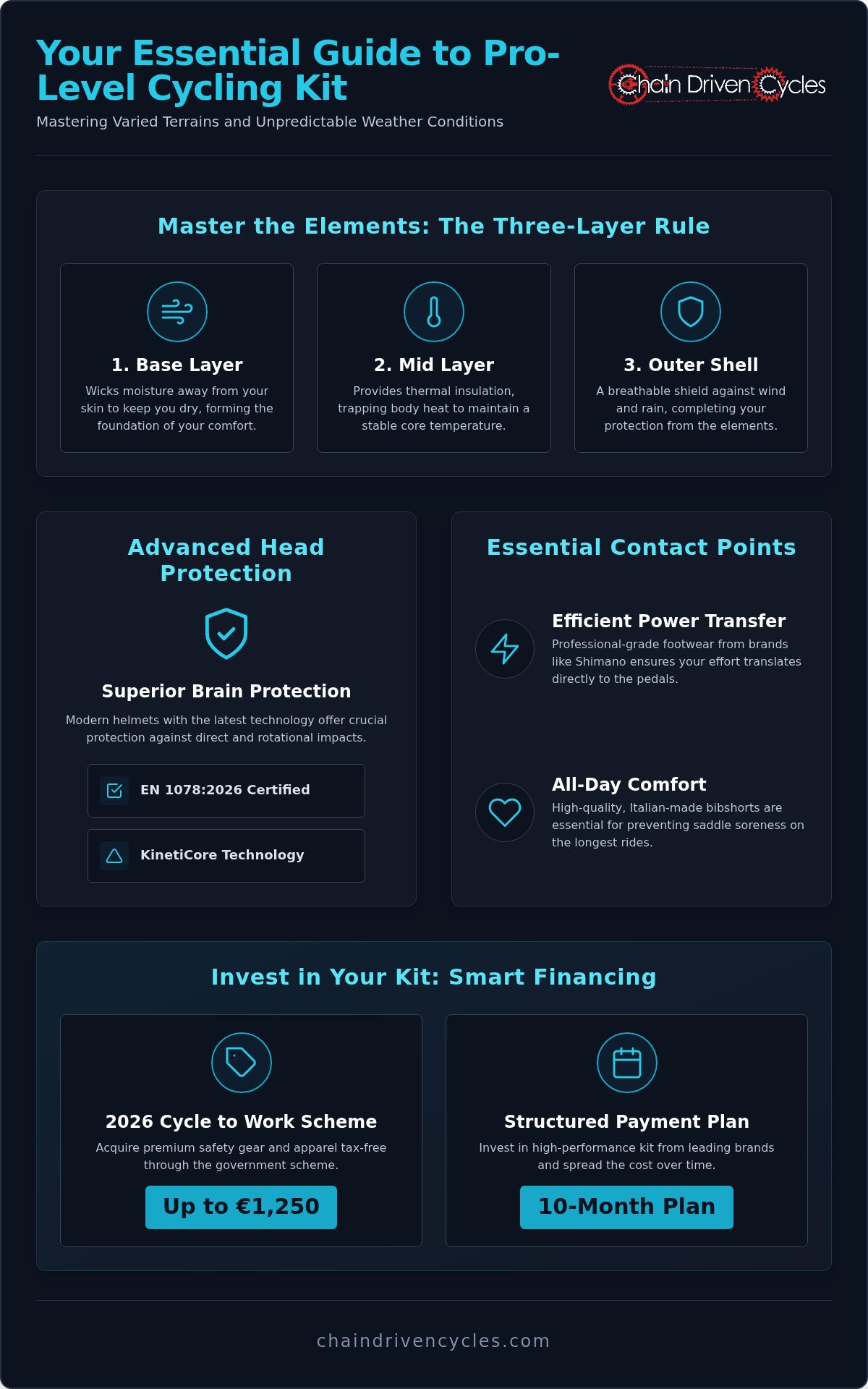
You shouldn't have to settle for saddle soreness or the anxiety of low visibility on narrow roads. This guide provides the expertise needed to select a versatile layering system that breathes while it protects. You'll discover how the latest EN 1078:2026 safety standards and KinetiCore technology offer superior brain protection. We also explain how to utilise the 2026 Cycle to Work scheme, which offers up to €1,250 for standard equipment, to invest in professional-grade Shimano or Northwave gear. From performance bibshorts to high-visibility solutions, we'll ensure you're prepared for every mile of the journey.
Key Takeaways
- Master the "Three-Layer Rule" to stay dry and maintain a stable core temperature despite the unpredictable Atlantic microclimates.
- Identify the specific benefits of EN 1078:2026 certified helmets and KinetiCore technology for enhanced safety on varied terrain.
- Learn why professional-grade footwear and Italian-made bibshorts are essential for comfort on the most demanding cycling routes Sligo features.
- Understand how to maximise the 2026 Bike to Work scheme limits to secure premium safety gear and apparel tax-free.
- Discover how a structured 10-month payment plan can help you invest in high-performance kit from leading brands like Shimano and Northwave.
Preparing for Cycling Routes in Sligo: Why Your Kit Choice is Critical
Sligo's cycling landscape is as beautiful as it is demanding. When you set out to explore the diverse cycling routes Sligo offers, you aren't just battling the gradient; you're managing a complex microclimate. In 2026, coastal weather patterns remain notoriously unpredictable. A sudden drop in temperature or a heavy Atlantic squall can turn a pleasant spin into a survival exercise if you're wearing casual leisure wear. Unlike cotton, which traps moisture and chills the skin, technical apparel is engineered to move sweat away from your body. This regulation is vital to prevent 'The Bonk'. While many riders associate hitting the wall solely with a lack of fuel, your body also exhausts its energy reserves trying to maintain a core temperature of 37°C when you're damp and cold.
Casual gear lacks the specific anatomical cut required for the cycling position. Performance kits are tailored to be shorter at the front and longer at the back, ensuring full coverage when you're tucked over the handlebars. This prevents the bunching of fabric that causes skin irritation over forty or fifty kilometres. When you're tackling the mixed terrain of the Northwest, from flat coastal runs to sharp inland ascents, this versatility is what keeps you in the saddle for longer. Choosing the right kit isn't about looking the part; it's about providing your body with the tools to handle Irish conditions safely.
Understanding the Terrain and Weather Relationship
Sligo's geography creates specific challenges for the unprepared rider. The Lough Gill Loop, for instance, often presents a relentless headwind that tests your resolve. Aerodynamics aren't just for professional racers; they help every rider conserve energy on exposed coastal paths. These routes are part of the broader Wild Atlantic Way, where the wind is a constant companion. Conversely, the Gleniff Horseshoe climb requires maximum breathability. As your heart rate spikes on the ascent, moisture-wicking fabrics become your best ally, preventing that 'boil-in-the-bag' feeling that leads to overheating and eventual fatigue on the descent.
The Anatomy of a High-Performance Cycling Kit
A head-to-toe philosophy ensures every contact point and muscle group is supported. High-performance fabrics like Merino wool offer natural thermal regulation, whilst Lycra Air Cell technology provides the compression and ventilation needed for long days in the saddle. If you've invested in a high-end machine, such as those discussed in our comparison of premium road bikes, your apparel should match that level of engineering. Quality kits reduce wind drag and eliminate the chafing common with loose clothing, allowing you to focus entirely on the rugged beauty of the Sligo coastline.
Mastering the Elements: Waterproofs and Layering for Irish Conditions
Sligo's geography ensures that a single ride can encompass three different seasons. Whilst competitors often focus solely on elevation, they frequently overlook that 1,000 metres of climbing in the Northwest usually involves passing through multiple rain fronts. To stay dry, you must adopt the 'Three-Layer Rule'. A technical base layer wicks moisture, a thermal mid-layer provides insulation, and a breathable outer shell protects against the wind and rain. This system allows you to adapt as you move from the sheltered woods of Hazelwood to the exposed Atlantic sections of the cycling routes Sligo is famous for.
When selecting a rain jacket, the balance between breathability and waterproofing is vital. A cheap, non-breathable plastic jacket will keep the rain out, but it will trap your sweat, leaving you wet from the inside. High-quality membranes allow water vapour to escape whilst preventing droplets from entering. Visibility is equally critical. When you're navigating national roads like the N15 or N4 in low-light conditions, bright colours and reflective accents aren't just aesthetic choices; they are essential safety features. Many riders find that a versatile gilet is the most used item in their wardrobe, providing core warmth and wind protection without the bulk of a full jacket.
Top Picks for Outer Shells and Gilets
For sudden downpours, the BBB BaseShield BBW-148 Rain Jacket is a lightweight, yellow essential priced at €39.0. It's easily packable, allowing you to store it in a jersey pocket when the sun reappears. If you're cycling at dawn or dusk, the Madison Stellar Shine Reflective Mens Gilet (€49.0) provides 360-degree visibility. To keep your kit organised, roll your layers tightly rather than folding them; this prevents creases and maximises space in your saddlebag or pockets.
Bibshorts and Lower Body Comfort
Your choice of bibshorts dictates whether you enjoy the scenery or count the minutes until the ride ends. For 40km loops like Lough Gill, gel pads are a non-negotiable requirement to prevent saddle sores. The Northwave Active Gel Bibshorts (€89.0) offer superior vibration dampening on rough Irish tarmac. For warmer summer days, the Alé Agonista Plus R-EV1 Bibshorts utilise advanced Body Mapping technology to ensure airflow where it's needed most. Remember that professional apparel and safety equipment are often eligible for tax relief under the Cycle to Work Scheme, making high-performance gear more accessible for every rider.
Safety and Aerodynamics: Choosing the Right Helmet
Whilst traditional guides simply tell you to wear a helmet, they rarely explain the technology that actually protects your brain during a fall on the diverse cycling routes Sligo offers. In 2026, the industry has moved beyond basic impact protection. The introduction of the EN 1078:2026 safety standard has formalised the need for rotational impact testing. This is where technologies like MIPS and Lazer's KinetiCore become essential. Unlike standard foam, KinetiCore uses built-in "controlled crumple zones" that deform during an impact, redirecting energy away from the brain. It's a significant advancement for anyone navigating the high-speed descents of the Ox Mountains or the technical forest trails near Union Wood.
Choosing between a road and an MTB helmet depends on your primary terrain. Road helmets prioritise ventilation and aerodynamics, keeping you cool during long summer climbs. MTB helmets provide deeper rear coverage to protect the back of the head from rocks or low-hanging branches. Regardless of the style, the fit is paramount. A helmet should sit level on your head, roughly two fingers above your eyebrows. The straps should form a "V" shape just below the ears. Many of these safety investments are eligible for tax relief through the Cycle to Work Scheme, which helps reduce the out-of-pocket cost for premium protection.
Performance Road and All-Round Helmets
For those focusing on speed and endurance, the LAZER Strada KinetiCore (€134.99) is a standout choice. It's exceptionally light and features advanced ventilation channels to manage heat during intense efforts. For riders seeking high performance at a lower price point, the Mavic Aksium Elite Helmet (€75.0) offers a secure fit and lightweight construction. Always look for helmets with hypoallergenic and washable pads; these are vital for maintaining hygiene and comfort during a long season on the cycling routes Sligo provides.
MTB and Full-Face Options for Rugged Trails
If your Sligo adventures lead you off-road, the Limar Alben MTB Helmet (€64.95) provides the necessary coverage for forest trails. For riders tackling steep, technical descents where the risk of a facial impact is higher, the O'NEAL Backflip Eclipse offers robust full-face protection. Recreational riders or those on a strict budget might consider the Schwinn MTB Helmet (€34.0), which provides reliable basic protection for casual road use. Remember that a helmet should be replaced after any significant impact or every five years, as the protective materials degrade over time.
The Contact Points: Shoes, Gloves, and Socks for Power Transfer
Your connection to the bicycle happens at three primary points: the hands, the feet, and the saddle. Whilst we have already addressed the importance of bibshorts for saddle comfort, your shoes and gloves dictate how effectively you move across the landscape. When you are tackling the steep inland gradients of the cycling routes Sligo is known for, every watt of energy matters. Standard trainers are designed for walking; they have flexible soles that absorb your energy. In contrast, dedicated cycling shoes use stiff soles to ensure that every ounce of effort is transferred directly into the drivetrain, making climbs significantly more manageable.
Footwear for Road and Gravel
The Shimano RC5 (RC502) is a standout choice for Irish riders, offering S-PHYRE trickle-down technology at €149.0. Its carbon-reinforced midsole provides a high level of stiffness for power transfer whilst remaining comfortable for five-hour loops. Understanding sole stiffness is vital; a stiffer shoe prevents 'hot spots' by spreading the pedal pressure across the entire foot. Matching your footwear to technical hardware like Assioma power meter pedals allows you to monitor this efficiency in real-time. We always recommend visiting a specialist for a fitting, as cycling shoe sizing can vary significantly between brands.
Gloves and Mitts for All Seasons
Rough Irish tarmac can be unforgiving, often leading to hand numbness or tingling on longer rides. Shimano Unisex Gloves (€33.0) feature strategic gel padding that acts as a shock absorber, protecting the ulnar nerve. For those transitional months where the Atlantic breeze carries a chill, the Madison Isoler Merino Thermal Gloves (€14.99) offer natural insulation without adding bulk. If you are out in the early morning mist, the Oxford Bright Thermal Cycle Gloves (€25.0) provide high visibility and touchscreen compatibility, allowing you to check your map without exposing your hands to the elements.
Don't neglect your choice of socks. Italian-made performance socks use specific fabric blends that reduce friction, which is the primary cause of blisters. They move moisture away from the skin far more effectively than cotton, keeping your feet at a stable temperature. To ensure you have the right kit for your next adventure, you can browse our range of technical footwear and apparel online or in-store. Having the correct gear at these vital contact points is the simplest way to improve your performance on the most challenging cycling routes Sligo has to offer.
How to Buy: Payment Plans and the Cycle to Work Scheme
Investing in a professional-grade kit for the diverse cycling routes Sligo offers shouldn't be a financial barrier. In 2026, the Irish government continues to incentivise active travel through the Cycle to Work scheme, allowing you to purchase safety equipment tax-free. This isn't limited to the bicycle itself; it includes the technical apparel and safety gear discussed throughout this guide. By utilising salary sacrifice, you can save a significant percentage on the cost of your gear, depending on your tax bracket. This makes high-end protection and performance wear far more accessible for the average rider.
Navigating the Bike to Work Scheme in 2026
Under current regulations, the tax-free limit for a standard pedal bicycle and its associated safety equipment is €1,250. If you're looking at more versatile options, the limit for pedelecs is €1,500. This allowance is generous enough to cover a high-quality helmet, waterproof jacket, and performance shoes alongside your machine. You can even combine a comprehensive clothing package with electric hybrid bikes Ireland cyclists prefer for tackling both the coastal winds and the hilly inland terrain of the Northwest.
To start the process, you'll need a formal quotation from an authorised retailer to present to your employer. They purchase the equipment directly, and you repay the cost through your gross salary over a period of up to 12 months. Remember that you can only avail of this scheme once every four tax years. If you used the scheme at any point in 2022, you are eligible to use it again from 1 January 2026. This cycle allows you to refresh your safety gear as technology, such as the new EN 1078:2026 helmet standards, evolves.
Spreading the Cost of Premium Gear
For items not covered by the scheme, or if you've already reached your limit, a 10-month payment plan provides a manageable way to access premium brands like Wilier or Bottecchia. This is particularly useful for high-ticket safety items like MIPS-equipped helmets or Shimano RC5 shoes. Spreading the cost allows you to prioritise quality over price, which pays dividends in the long term. High-end fabrics and components last longer and perform better under the persistent stress of the Irish climate.
Longevity also depends on proper maintenance. Never use fabric softeners on waterproof or wicking fabrics, as they clog the technical membranes. Wash your kit at 30 degrees and always air dry; the high heat of a tumble dryer can damage the elastic fibres in bibshorts and the adhesives in cycling shoes. Much like how professional bike servicing keeps your mechanicals running smoothly, proper apparel care ensures your kit remains breathable and protective for years of adventures on the cycling routes Sligo provides.
Before you head out on your next adventure, ensure your kit bag includes:
- A certified helmet that fits level on your head.
- A packable rain shell for sudden Atlantic squalls.
- High-visibility details for safe passage on national roads.
- Appropriate hydration and a basic repair kit for remote coastal sections.
Elevate Your Sligo Cycling Experience
As your local specialist, we support your journey with expert guidance and flexible purchasing options. Whether you're utilising the 2026 Cycle to Work scheme or our 10-month payment plans, professional-grade kit remains accessible. Our team of safety experts is ready to help you find the perfect fit to keep you protected on every descent. The rugged beauty of the Northwest is waiting, and with the right equipment, you can tackle it with total confidence. If these routes inspire you to explore even further afield on two wheels, Adrenalin Rush Trail offers premium guided motorcycle tours across the legendary landscapes of Vietnam.
Browse our full collection of Performance Cycling Clothing, Shoes & Helmets and prepare for your best season yet. We look forward to seeing you out on the road.
Frequently Asked Questions
What is the best cycling clothing for Irish weather?
The most effective clothing for the Irish climate is a technical three-layer system. This includes a moisture-wicking base layer, an insulating mid-layer, and a breathable, waterproof outer shell. This combination allows you to regulate your core temperature as weather fronts move in from the Atlantic. Avoid cotton fabrics, as they trap moisture and cause a rapid chill during descents or when the wind picks up along the coast.
Can I use the Bike to Work scheme for cycling shoes and helmets?
Yes, you can include professional cycling shoes and helmets in your Cycle to Work application as they are classified as essential safety equipment. In 2026, the tax-free limit is €1,250 for standard bicycles and equipment, or €1,500 for e-bikes. This allows you to invest in high-performance gear like Lazer KinetiCore helmets or Shimano footwear whilst significantly reducing the out-of-pocket cost through salary sacrifice.
What is the difference between MIPS and KinetiCore helmet technology?
Both technologies protect against rotational impact, but they use different mechanical approaches. MIPS utilises a slip-plane layer inside the helmet that slides during an impact to redirect energy. KinetiCore is integrated directly into the helmet's EPS foam using "controlled crumple zones" that deform under pressure. KinetiCore often results in a lighter helmet with better ventilation, whilst both meet the rigorous EN 1078:2026 safety standards required for modern Irish riders.
Are expensive cycling bibshorts actually worth the money?
High-quality bibshorts are a vital investment because they use superior chamois pads and graduated compression fabrics. Cheaper shorts often use basic foam that collapses after an hour, leading to saddle soreness. Premium Italian-made brands like Alé or Northwave use multi-density gel inserts that maintain their shape on long rides. They also feature flat-lock stitching and breathable mesh straps that prevent skin irritation and overheating during intense efforts.
What should I wear for a 40km cycling route in Sligo?
For a typical 40km loop amongst the cycling routes Sligo offers, we recommend a versatile mid-weight jersey paired with a windproof gilet. This setup provides core protection against coastal breezes whilst allowing for easy temperature adjustment. You should always wear padded bibshorts for a distance of this length to ensure comfort. Don't forget a packable rain jacket in your jersey pocket, as Atlantic squalls can appear without warning near Benbulben.
How do I choose the right size cycling shoes online?
You should measure your foot in millimetres and compare it to the manufacturer's specific size chart. Cycling shoes often fit tighter than standard trainers to ensure efficient power transfer, and sizing varies significantly between brands like Shimano and Northwave. If you have a wider foot, look for "Mega" or "Wide" fit options. We always recommend a professional in-store fitting to ensure the shoe's arch support and heel cup match your foot shape.
Do I need a different helmet for road cycling and mountain biking?
Whilst any certified helmet provides protection, road and MTB helmets are designed for different risk profiles. Road helmets are lighter and prioritised for aerodynamics and maximum ventilation at higher speeds. MTB helmets offer deeper coverage at the back of the head and often include a visor to protect against sun glare and low-hanging branches. If you ride both terrains, an all-round helmet with removable features can offer a practical and safe compromise.
How can I stay visible whilst cycling on national roads in Ireland?
Maximising visibility on national roads requires a combination of high-contrast colours and reflective materials. Choose apparel with 360-degree reflective accents, particularly on moving parts like your shoes or ankles, as this attracts a driver's attention more quickly. We also recommend using daytime running lights even in clear weather. Bright yellow or orange outer layers are significantly more visible against the grey tarmac and green hedgerows of the Irish countryside.