



How to Feel Confident Cycling on Irish Roads: A Practical Guide
Confidence on the road doesn’t mean feeling fearless. It comes from making predictable decisions and building experience one manageable ride at a time. If close-passing traffic, large vehicles or an uncertain junction make you hesitate, learning how to feel confident cycling on Irish roads starts with practical steps, not pressure to ride beyond your comfort zone.
Those concerns are understandable. Narrow lanes, uneven surfaces and changeable weather can make a familiar route feel demanding, especially if you’re unsure where to position yourself or how to approach a roundabout. With preparation, you can make clearer decisions and feel more in control.
This guide explains how to be visible, choose a safe and predictable road position, interact with traffic and plan a route that suits your current confidence. You’ll also find ways to practise skills gradually, prepare your bike and adapt to conditions before setting off. A well-maintained, appropriately set-up bicycle is one part of feeling ready, and professional servicing can help address a specific bike concern. Build steadily, ride within your limits and let confidence grow through repeatable experience.
Key Takeaways
- Road confidence comes from making visible, predictable choices, not from feeling fearless in every situation.
- Learn how your road position can change with visibility, road width, surface hazards and junctions.
- Use a deliberate approach to junctions and roundabouts, observing traffic and signalling as part of each manoeuvre.
- Build confidence cycling on Irish roads gradually. Practise one skill at a time on familiar routes before taking on more complex roads.
- A simple pre-ride check and a comfortable, well-maintained bike can help you feel more prepared.
How to feel confident cycling on Irish roads when traffic feels intimidating
A close pass can leave you tense long after the vehicle has gone. Add an unfamiliar junction or uncertainty about where to ride, and it’s understandable to question whether public roads are for you. Feeling exposed is not a personal failing, and it doesn’t mean cycling is unsuitable. Confidence can vary with the route, the day, traffic, weather, road conditions and your experience.
Road confidence means making visible, predictable decisions while adapting your ride to the conditions, not believing that every risk can be removed. You don’t need to feel completely relaxed to ride well. The aim is to have enough time and attention to observe, communicate your intentions and choose a sensible next step.
Why cycling on public roads can feel daunting
Traffic may pass closer than you’re comfortable with, while a junction can require you to judge several movements at once. On a narrow road, you might be unsure whether to ride near the edge or take a more visible line. These concerns are common, but the right response depends on the situation and your comfort, not on proving you can manage every road.
Road design matters, too. A route with space separated from motor traffic can feel very different from one with narrow lanes and busy junctions. The broad range of facilities described in Cycling Infrastructure helps explain why the riding environment can affect how exposed a cyclist feels. Choose a route that suits your current experience, even if that means avoiding a particular road or making the ride shorter.
What a confident, predictable ride looks like
A predictable rider gives themselves time to assess what’s ahead and makes their intentions clear when they’re ready to act. That could mean finding a safe place to wait before turning, signalling when appropriate, or slowing down to give the road surface or traffic closer attention. These actions can’t guarantee how others will respond, but they help you make deliberate decisions rather than rushing.
Don’t assume that hugging the kerb is always the best choice. Your line can depend on road width, the surface, parked vehicles and the need to be visible at a junction. Leave room to respond to hazards, and don’t squeeze into a gap that feels unsafe. The following sections cover positioning and traffic situations in more detail.
Nerves can be manageable when you can still observe, think clearly and control your bicycle. If traffic, poor visibility, a slippery surface or an unexpected hazard leaves you without enough time or space to make a considered choice, pause somewhere safe if possible. You can wait for conditions to change, dismount where it’s safe, or choose another route. Changing your plan is sound judgement, not a failure of confidence.
If you’re learning how to feel confident cycling on Irish roads, start by noticing which situations feel manageable and which feel overwhelming. That distinction helps you make practical choices without dismissing your concerns or expecting every road to suit every rider.
Choose a visible road position on Irish roads and prepare for conditions
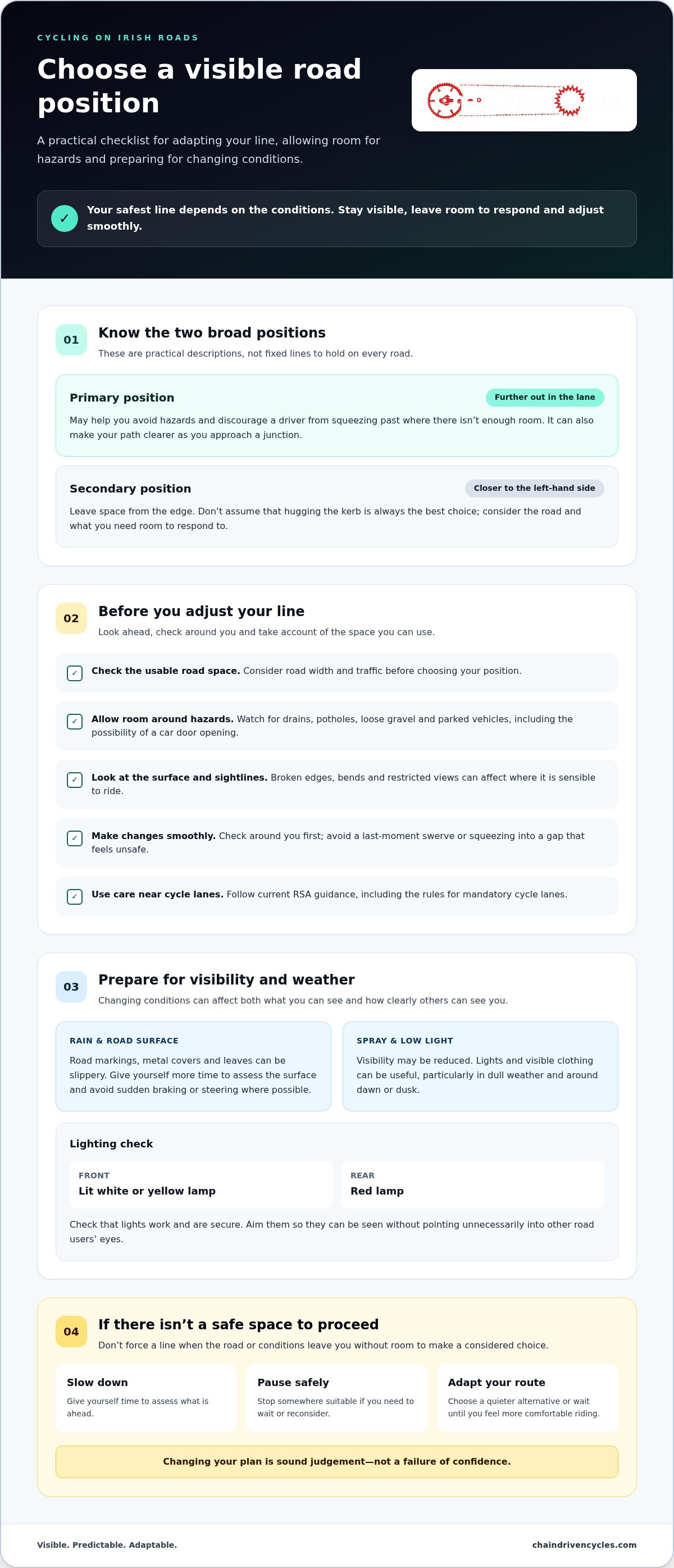
Your road position affects how clearly other road users can see you and how much room you have to respond to hazards. Cycling guidance often describes two broad positions: the primary position, where you ride further out in the lane, and the secondary position, where you ride closer to the left-hand side while leaving space from the edge. These are practical descriptions, not a reason to hold one line regardless of the road.
A predictable road position helps you stay visible and leaves room to respond; the safest line depends on the conditions around you. Look well ahead and consider the usable road space, surface and traffic before adjusting your position. Make changes smoothly, after checking around you, rather than swerving at the last moment.
When to take a more visible position
Moving out from the kerb can help you avoid hazards and discourage a driver from trying to squeeze past where there isn’t enough room. Allow space around drains, potholes, loose gravel and parked vehicles, where a car door could open. As you approach a junction, a more visible line may also help drivers see you and make your intended path clearer. Adapt to the road and follow current RSA guidance, including the rules for mandatory cycle lanes.
Narrow roads call for particular judgement. If the surface is broken close to the edge, riding further left may leave you with little room to steer around damage. On a bend or where sightlines are restricted, avoid moving into a position that puts you in the path of traffic you can’t see. If there isn’t a safe space to proceed, slow down or stop somewhere suitable rather than forcing a line.
Make yourself easier to see in changing conditions
Rain can make road markings, metal covers and leaves slippery, while spray and low light can reduce visibility. Give yourself more time to assess the surface and avoid sudden braking or steering where possible. If conditions make a route feel difficult to manage, choose a quieter alternative or wait until you’re more comfortable riding.
Lights and visible clothing are useful aids, particularly in dull weather and around dawn or dusk. Before setting off, check that your lights work, are secure and are aimed so they can be seen without pointing unnecessarily into other road users’ eyes. Under Irish lighting rules, bicycles need a lit white or yellow front lamp and a red rear lamp during lighting-up hours, and a red rear reflector is required at all times. High-visibility clothing can help you stand out, but no colour or light guarantees that others will notice you.
Position and visibility are only part of feeling prepared. If a mechanical concern is distracting you, professional bicycle servicing can help address it before you ride. A well-maintained bike supports a more settled ride, though it can’t remove the need to assess traffic and road conditions as you go.
Handle Irish junctions, roundabouts and passing traffic with a clear plan
Junctions ask you to make several decisions in a short space: where to position yourself, whether to wait and how to communicate a turn. A simple sequence can make this feel more manageable. Look ahead early, assess what other road users are doing and choose a safe moment rather than feeling rushed by traffic behind you.
Approach junctions and roundabouts deliberately
Before reaching a junction, ease your speed and check the layout, sightlines and traffic. Choose a suitable position in good time, then observe again as you get closer. If your view is blocked or there isn’t a safe gap, wait somewhere safe rather than edging into the junction to find out.
- Approach: Look for signs, road markings, turning traffic and surface hazards. Decide which way you intend to go and position yourself to give yourself room to proceed safely.
- Wait: If you need to give way, stop where you can see and be seen without obstructing others. Take the time you need to judge the traffic; a vehicle waiting behind you doesn’t make a gap safe.
- Turn: Check around you before changing position, and signal clearly when you can do so without losing control. Keep observing, because conditions may change between signalling and turning.
- Leave: Complete the manoeuvre steadily, then return to a suitable road position once you’ve checked it’s safe.
Roundabouts vary in size, markings, traffic flow and visibility, so there isn’t one position that suits every layout. Look at the exits and traffic before you reach the entry, and don’t commit if you’re unsure it’s safe to proceed. For specific rules on positioning and priority, use the current RSA Rules of the Road guidance rather than relying on a single rule of thumb. From an infrastructure perspective, balancing safe cycling access with vehicle capacity at complex junctions requires rigorous technical planning, an area where specialists such as ML Traffic Engineers UK support developers and highway schemes.
Make your intention clear before changing direction, then keep observing because a signal can’t guarantee that others have seen or understood it. Signalling is one part of a manoeuvre, alongside choosing a suitable position, checking traffic and allowing yourself time to act. If you can’t signal comfortably at a particular moment, prioritise control of the bicycle.
Respond calmly when vehicles pass or wait behind
A vehicle following you doesn’t mean you should squeeze towards the kerb or into a gap that feels unsafe. Hold a steady, appropriate line and let the driver decide when there’s room to pass. If traffic builds and there’s a suitable safe place to pause, you can stop and let it move on. Avoid gestures or confrontation; focus on your space and your next decision.
These routines won’t control other people’s behaviour, but they can give you a clearer plan for busy moments. If you’re learning how to feel confident cycling on Irish roads, practise the sequence first on a familiar route with junctions you can approach at your own pace. Build up to more complex layouts as your observations and decisions become steadier.
Build cycling confidence on Irish roads with a gradual practice routine
Confidence grows through repetition, not by treating one ride as a test of courage. A gradual plan lets you practise unfamiliar parts, then combine them at a pace that suits you. Keep each ride manageable and finish with a clear idea of what you’d like to repeat or work on next.
Start with a route that gives you time to think
Choose a short, familiar route with quieter roads, junctions you understand and safe places to stop. Before setting off, check the forecast, road conditions and daylight, then adjust the route if rain, poor visibility or a late return would make the ride feel difficult. A trusted companion can offer reassurance if you’d prefer not to ride alone.
Use this progression as a flexible routine. Repeat a stage until it feels more familiar, rather than moving on because you think you should.
- Practise basic control off the road. In a safe, traffic-free place, rehearse starting, stopping and braking smoothly. Get comfortable looking over a shoulder while maintaining control before trying this around traffic.
- Ride a familiar quiet route. Focus on relaxed control and noticing what’s ahead. Keep the route short enough that you can stay attentive throughout.
- Choose one skill to practise. For example, work on signalling clearly, checking behind you or approaching a familiar junction. Don’t try to concentrate on every new skill at once.
- Repeat the route and review. Notice which parts felt manageable and where you wanted more time or space. Keep your observations practical: a particular turn may need another attempt, or a section may be better avoided for now.
- Add one new challenge. Once the route feels familiar, try a slightly busier road or a junction with a different layout. Keep the rest of the ride predictable, and return to the easier route if conditions or confidence change.
Practise skills before combining them in traffic
Give each skill its own attention before using it in a more demanding setting. In a quiet, traffic-free area, practise a controlled stop, a smooth restart and braking without grabbing suddenly. Add looking over a shoulder only when you can keep a steady line and maintain control. Practise signalling separately, too, so the movement feels familiar rather than rushed.
After a ride, make a brief note of what went well and what you’d like to practise next. Progress may mean repeating the same route in different conditions, not travelling further or riding faster. If a specific bike concern is distracting you, professional servicing can be one practical part of preparing for a ride. For support with getting started and preparing your bicycle, explore cycling support and services.
Prepare your bike and yourself for more confident rides on Irish roads
A quick pre-ride check can help you set off with fewer distractions. It won’t remove the need to keep assessing traffic and road conditions, but knowing your bicycle feels in good working order can make it easier to concentrate on the ride. Give yourself enough time to check it before you leave, particularly if the bike hasn’t been used recently or you’re planning a longer journey.
Use a simple pre-ride check to feel prepared
Before setting off, check the parts that affect how your bike rolls, stops and handles. Look for tyres that are damaged or noticeably soft, and make sure both wheels are seated and secure. Test the brakes by squeezing each lever and checking that the bike responds when you apply them. Look over the chain for anything unusual, such as stiffness, visible damage or an unfamiliar noise.
- Tyres: Check for cuts, embedded debris or signs of low pressure.
- Brakes: Test both brakes and pay attention to a lever that feels unusually loose or braking that seems less effective than usual.
- Wheels: Make sure they appear properly seated and secure, and spin freely without obvious rubbing.
- Chain: Look for damage, unusual movement or a change in sound as you pedal.
- Lights and essentials: Check that lights work if they’re needed for your ride, and bring practical items such as a charged phone and anything you rely on for a puncture or unexpected stop.
After setting off, notice whether the bike feels or sounds different from usual. A new clicking noise, a change in steering or a brake that doesn’t respond as expected deserves attention, especially before you commit to a longer ride. If something feels unsafe, don’t ignore it just to stick to your plan. Stop somewhere safe and decide whether to turn back or arrange help.
Get practical support as your riding develops
A comfortable, correctly adjusted bicycle can reduce small distractions, such as reaching awkwardly for the handlebars or feeling unsettled by the saddle position. It doesn’t remove road risk, but a bike that feels familiar and responds as expected can help you focus on your surroundings. If you have a specific concern, professional bicycle repair services can help address mechanical issues. For more detail on looking after an electric or road bike, read this professional electric and road bike servicing guide.
If you’re not ready to choose a bicycle, bike hire can let you try riding before committing to one. As your confidence and riding needs develop, a suitable bike and dependable maintenance can support your next steps. Find cycling support at Chain Driven Cycles.
Make your next ride a manageable next step
You don’t have to tackle every road or situation at once. Choose one small aim for your next ride, such as taking a familiar route at a quieter time or practising a skill in a comfortable setting. That gives you something specific to focus on without turning the ride into a test. If plans change or a stretch feels beyond your comfort level, adjusting your route is a sensible part of riding.
Learning how to feel confident cycling on Irish roads is a personal process. Let each ride inform the next, and give yourself credit for decisions that help you stay calm, visible and in control. As your needs develop, Chain Driven Cycles can support you with bike hire, road bikes and electric hybrid bikes, alongside professional bicycle repair services.
Explore bike hire, bicycles and professional repair services at Chain Driven Cycles, and take your next step when you’re ready. Steady progress counts.
Frequently Asked Questions
Is it safe to cycle on Irish roads as a beginner?
Beginners can develop road skills gradually, but no route or technique removes every risk. To learn how to feel confident cycling on Irish roads, begin with a manageable ride and build experience at a pace that suits you. Check current RSA guidance and consider conditions before setting out. If you feel overwhelmed, stop somewhere safe or choose another route. Preparation helps you make decisions, but you’re never obliged to continue a ride that feels beyond your limits.
Can cyclists ride two abreast on Irish roads?
Whether riding two abreast is appropriate depends on the road, traffic and current rules. Don’t treat a general answer as applying equally on a wide, quiet road and a narrow stretch with limited visibility. Check the latest Rules of the Road or RSA cycling guidance for the current position. If riding alongside someone, consider whether you can both remain predictable and whether the available road space allows other traffic to pass safely.
Do cyclists have to use cycle lanes in Ireland?
Some cycle facilities are mandatory, so it’s not accurate to say that every lane is compulsory or that none are. The RSA identifies mandatory cycle lanes by a continuous white line. Check current Rules of the Road guidance and signs for the facility you’re approaching, as a painted lane, shared-use path and mandatory cycle track can have different rules. Don’t assume a dashed or shared facility has the same status as a mandatory lane.
Is it legal to cycle on the footpath in Ireland?
Don’t assume an ordinary footpath is a cycle route. A footpath and a signed shared-use path are different facilities, even if both run beside a road. Check the current Rules of the Road and any signs at the location before riding, and take particular care around pedestrians. If you’re using an electric bicycle, current guidance does not permit riding it on footpaths. Where the route is unclear, dismounting is a cautious option.
Do I have to wear a helmet when cycling in Ireland?
A helmet is recommended in Ireland, but it isn’t a legal requirement for cyclists under the current guidance. If you choose to wear one, make sure it fits securely and is worn as intended. A helmet is a personal safety measure, not a guarantee against head injury, and it doesn’t make a hazardous route safe. Continue to assess traffic, road conditions and your own comfort whether or not you’re wearing one.
What should I do if a driver passes me too closely?
Keep control of your bicycle and avoid swerving, chasing the vehicle or confronting the driver. Once there’s a safe opportunity, stop in a suitable place if you need a moment to settle or reconsider your route. If the incident was serious, note what you remember, such as the time, location and circumstances, when it’s safe to do so. Follow current official guidance for reporting collisions or road-safety concerns.
How can I regain confidence cycling after a frightening incident?
There’s no fixed timetable for feeling ready to ride again. Start with a short outing in familiar surroundings, and choose a time and route that feel manageable. You might first practise in a traffic-free space, then return to a quiet road when you’re comfortable. If a mechanical issue is adding to your worry, have the bicycle assessed before riding. A small step forward, or taking more time, is valid progress.