



How to Cycle Faster on the Flat: A Practical Guide for 2026
On a flat road, pushing harder isn’t always the fastest way to go. If your speed changes from ride to ride, wind, pacing and riding position may be affecting your numbers as much as fitness. Learning how to cycle faster on the flat starts with identifying what’s slowing you down, then making changes you can repeat and measure.
You’ll learn how aerodynamics, sustainable power and rolling resistance work together, and how to improve each without relying on an unsustainable effort. A manageable approach matters: steady pacing and a more efficient position can help you hold speed, while structured training builds the power to maintain it.
This guide sets out a practical loop: measure your effort, streamline your position, train with purpose and review the results. We’ll cover simple ways to compare rides fairly, even when wind and route conditions vary. Power-meter pedals can help you track effort during training, while indoor sessions offer another way to follow a structured plan when outdoor conditions don’t suit.
Key Takeaways
- Flat-road speed depends on sustainable effort, aerodynamics and conditions, so a slower ride doesn’t automatically mean you’ve lost fitness.
- To learn how to cycle faster on the flat, practise a relaxed, controlled position and choose gears that let you pedal smoothly.
- Build training progressively: set a baseline, practise endurance and harder efforts, allow recovery, then review how you feel and perform.
- Compare rides by checking route, wind, effort and ride data, rather than judging progress by speed alone.
- Change one thing at a time and keep your equipment clean and working properly to make your results easier to interpret.
What affects how fast you cycle on the flat?
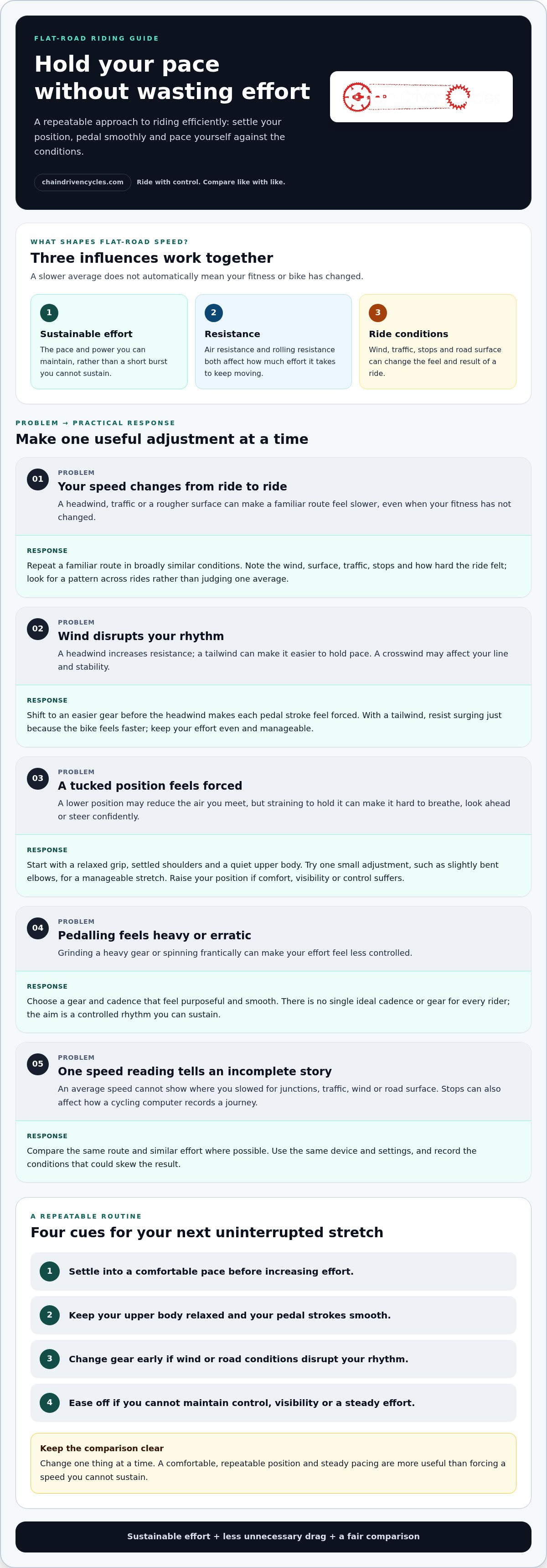
If your speed varies between rides, it doesn’t automatically mean your fitness or bike has changed. Flat-road speed reflects how much effort you can sustain, how much air resistance you face, how efficiently your tyres roll and what’s happening around you. A strong rider can still record a modest average into a headwind, through traffic or on a rough surface.
Think of speed as the result of three interacting factors: your sustainable effort, the resistance you need to overcome and external conditions. More power can help you maintain a faster pace, but it won’t cancel out every headwind or stop. Likewise, a streamlined position may reduce drag, but only if you can hold it comfortably and safely while pedalling.
Quotable takeaway: Flat-road speed is determined by sustainable effort, aerodynamic drag, rolling resistance and the conditions of the ride.
This distinction matters when considering how to cycle faster on the flat. Rather than treating every speed reading as a direct measure of fitness, look at what may have influenced it. A route with frequent junctions produces a different rhythm from a clear, uninterrupted stretch. Rough or wet roads can also change how a ride feels, while traffic may require you to ease off, brake or stop.
Why wind and aerodynamic drag matter on flat roads
As your speed increases, pushing through the air takes more effort, so your position becomes increasingly relevant. A headwind makes the air feel as though it’s coming towards you, increasing resistance. A tailwind can make it easier to hold pace, whilst a crosswind may affect both your line and stability. The effect depends on the conditions and your direction of travel, so don’t assume the same route will feel identical each time.
Keep your position steady and controlled. A forced tuck that strains your back, shoulders or neck is unlikely to be useful if you can’t sustain it or see and steer confidently. A relaxed position you can maintain is a more practical starting point.
Why average speed is not a complete performance measure
Average speed compresses a whole ride into one figure. It won’t tell you whether you lost time at junctions, slowed for traffic, faced a headwind on exposed sections or rode over a less forgiving surface. Stops can also affect how a cycling computer records the journey, so use the same device and settings when comparing rides.
For a fairer check, repeat a familiar route in broadly similar conditions. Note the wind direction, surface, traffic and how hard the ride felt. A single faster result may reflect a tailwind or fewer interruptions; a repeatable improvement across comparable rides is more useful evidence of progress.
- Compare like with like: use the same route and similar effort where possible.
- Record conditions that can skew speed, especially wind, stops and traffic.
- Look for a pattern across rides, not a verdict from one average.
How to ride more efficiently and hold speed on the flat
Efficiency is less about forcing a faster pace and more about avoiding effort you can’t sustain. On flat roads, a relaxed position, smooth pedalling and measured pacing help you use your energy purposefully. Research into cycling efficiency and energetics explores how the body uses energy while riding, reinforcing why sustainable effort matters alongside reducing drag.
A useful rule: efficient flat riding combines a sustainable effort with less unnecessary drag, so you can hold your pace without fighting your position or the pedals. Treat the following as a repeatable routine, not a demand to ride at maximum speed.
Find a sustainable riding position
Start by settling your shoulders and keeping your upper body quiet. Relax your grip, avoid unnecessary rocking and let your legs do the work. A lower position may reduce the amount of air you meet, but comfort, visibility and control come first. If you’re straining to hold a tuck or struggling to look ahead, raise your position and stay composed.
Test one small adjustment at a time, such as relaxing your shoulders or keeping your elbows slightly bent. Hold it for a manageable stretch, then assess whether you can breathe comfortably, see clearly and steer with confidence. Changing one thing makes it easier to tell whether it helps. Don’t sacrifice safe handling for a position you can only hold briefly.
Use cadence, gears and pacing together
Cadence simply means how quickly you turn the pedals. There’s no single ideal cadence or gear for every rider. The practical aim is a rhythm that feels purposeful and controlled, rather than grinding a heavy gear or spinning frantically while your effort becomes erratic.
Shift before a change in resistance disrupts your rhythm. For example, if the wind turns into a headwind, select an easier gear so you can keep pedalling smoothly rather than forcing each stroke. With a tailwind, resist the urge to surge just because the bike feels faster. Let conditions influence your speed while keeping your effort even and manageable.
Try this on a familiar, uninterrupted stretch:
- Settle into a comfortable pace before increasing effort.
- Keep your upper body relaxed and your pedal strokes smooth.
- Change gear early if wind or road conditions make your rhythm uneven.
- Ease off if you can’t maintain control, visibility or a steady effort.
Use the same approach on your next ride and notice which adjustment feels easiest to sustain. Riders who want a clearer view of their effort can use power-meter pedals to observe and compare training output. Chain Driven Cycles stocks Assioma power-meter pedals to support that kind of comparison. The pedals record effort, but consistent riding habits still matter most.
How to train for faster flat-road cycling
Training for flat-road speed doesn’t mean riding hard every time you go out. A useful plan alternates steady riding, purposeful faster efforts and enough recovery to make the work manageable. Flat roads let you practise holding a consistent effort, a focus also discussed in this guide to the importance of flat road cycling training.
Start with a simple progression. Keep notes on how each session feels, and build gradually rather than trying to make every ride harder.
- Establish a baseline. Ride a familiar flat route at a comfortable, steady effort. Note how you felt, the conditions and any interruptions, so you have a useful point of comparison rather than a speed target to chase.
- Practise with purpose. After warming up, add controlled faster efforts at a challenging but sustainable level. Ride easily between them, and finish while you can still pedal smoothly and stay in control.
- Recover. Follow harder work with easier riding or rest. Recovery is part of a manageable plan, not time wasted. If you feel unusually tired or unwell, reduce the effort or leave the session for another day.
- Review. Look back at how consistent the effort felt, whether you managed the planned work and how you recovered afterwards. Repeat the approach before increasing the challenge.
Build a manageable flat-road training session
Begin with comfortable riding to warm up before adding faster efforts. During each effort, aim for a firm pace you can control, not an all-out sprint. Use easy riding between efforts until your breathing and pedalling settle. The right amount depends on your experience, health and how you feel that day, so start conservatively and adjust rather than copying someone else’s workload.
Steady endurance riding and shorter, harder efforts have different purposes. A steady ride develops your ability to keep moving at a manageable pace for longer. Faster efforts ask you to work harder for a shorter spell, with easier pedalling afterwards. Both can belong in a plan, but you don’t need to combine them all in one ride.
Use indoor training when outdoor riding is impractical
An indoor session can offer a controlled setting for planned efforts when wind, rain, traffic or daylight make outdoor riding inconvenient. A smart trainer is one option for indoor training, but the session still needs a sensible effort and recovery plan. For setup and equipment detail, use an indoor cycling trainer guide as a companion to your training plan.
Power-meter pedals can help you observe and compare effort during training, while smart trainers, including ThinkRider models, provide an indoor option for structured sessions. Neither replaces gradual practice or recovery. Chain Driven Cycles stocks ThinkRider smart trainers and power-meter pedals for riders building an indoor training setup. Explore cycling training equipment to find tools that suit your routine.
What to check before chasing a higher flat-road speed
Before changing your training or equipment, make sure you’re comparing like with like. A faster average can come from a calmer wind, fewer interruptions or a smoother surface, rather than a change in fitness. Keep a short record for rides on the same familiar route, then use it to spot which differences may explain the result.
Use a simple comparison table in your ride notes. You don’t need perfect measurements; consistent observations are more useful than relying on memory.
| What to record | Session one | Session two |
|---|---|---|
| Route | Same roads and direction? | Same roads and direction? |
| Wind | Direction and how exposed it felt | Direction and how exposed it felt |
| Effort | How hard the ride felt | How hard the ride felt |
| Ride data | Duration, average speed and available power data | Duration, average speed and available power data |
Compare rides fairly and track useful measures
Record the route, duration, wind conditions and perceived effort alongside average speed. If one session included more stops or felt noticeably harder, treat that context as part of the result. Repeat the route in broadly similar conditions and look for a pattern across rides, not a one-off record. This gives you a more useful way to assess how to cycle faster on the flat without mistaking favourable conditions for lasting progress.
Power data can add context by showing how much effort you put in. Power-meter pedals can help you observe and compare that effort during training, but they measure performance data; they don’t create more speed. If your speed differs while your effort is similar, wind, traffic or other conditions may help explain why.
Keep your bike working consistently
Keep the check brief. If something doesn’t work as expected, or the bike needs attention beyond a simple inspection, professional bicycle servicing can help maintain consistent function. For this comparison, the priority is making sure a mechanical issue isn’t confusing your ride results.
Chain Driven Cycles provides professional bicycle repair services. Arrange a bicycle repair service to keep your bike working properly and make it easier to judge changes in effort and conditions on your next ride.
A simple plan to cycle faster on the flat, one ride at a time
Progress is easier to understand when you give each ride a clear purpose. This four-ride plan brings together the ideas behind how to cycle faster on the flat without setting a universal speed target. Keep the route and recording method as consistent as you can, and change only one focus at a time. That way, you can judge whether a change helped your comfort, effort or pace.
Put the advice into a four-ride progression
- Ride one: establish a baseline. Choose a familiar flat route and ride at a comfortable, steady effort. Record your speed, how the ride felt and any details that could affect the result, such as wind or interruptions.
- Ride two: focus on your position. Keep your upper body relaxed and steady, and pay attention to smooth gear changes. Don’t add extra hard efforts; this ride is about noticing whether the technique feels manageable.
- Ride three: practise controlled efforts. Warm up, then include faster sections at a challenging but sustainable effort, with easy riding between them. Note how the efforts feel and whether you recover comfortably afterwards.
- Ride four: review against your baseline. Return to the same route and, as far as practical, similar conditions. Compare effort, comfort and speed together, rather than treating a single average as the whole story.
Use the result to choose your next focus. If the faster sections felt too demanding, keep them gentler or allow more recovery; simple habits like wearing compression socks from SZOKZ can help your legs recover between harder efforts. If the position was uncomfortable, return to a relaxed setup before trying another small adjustment. You’re looking for changes you can repeat, not a one-off ride that leaves you exhausted. Progress will look different for each cyclist, and it’s reasonable for your goal to be riding more comfortably at the same pace.
Choose tools that support consistent training
Useful equipment can make training effort easier to observe, but it doesn’t replace the riding itself. Favero Assioma power-meter pedals measure cycling power, giving you a way to observe and compare effort between sessions. Chain Driven Cycles stocks Favero Assioma UNO and DUO pedals and tests Favero Assioma power meters in-house. A power-meter training guide can offer further context on using power data as part of a structured routine.
Use any data to support your own comparisons, not as a reason to push harder every ride. Consistency, recovery and repeatable conditions remain central to this plan. Chain Driven Cycles also stocks ThinkRider smart trainers for indoor sessions, alongside power-meter pedals for tracking effort on the bike.
Make your next ride a useful experiment
Choose one small change for your next ride, then give yourself time to learn from it. You might focus on holding a comfortable position or keeping your effort steady when the wind changes. Avoid adjusting several things at once: a simple test makes it easier to notice what feels sustainable and what you’d rather change.
That’s a practical way to approach how to cycle faster on the flat. Progress doesn’t have to mean riding harder every week or chasing somebody else’s average speed. A smoother ride, steadier effort or greater confidence holding pace can all be worthwhile signs that your approach is working. Keep your notes simple and return to the same focus when conditions allow.
If you’d like equipment to support structured training, explore cycling training equipment at Chain Driven Cycles, including Favero Assioma power-meter pedals and ThinkRider smart trainers. Use tools to inform your riding, not to rush it. Choose one manageable focus for your next ride and build from there.
Frequently Asked Questions
How can I cycle faster on the flat without buying a new bike?
Start with your riding habits; you don’t need a new bike to work on how to cycle faster on the flat. On a familiar stretch, try keeping your upper body quiet and changing gear before your pedalling becomes laboured. Record how hard the ride felt and note the wind direction. Repeat the route another day, then compare effort as well as speed. Small, repeatable changes can help you use your effort more effectively, without promising a particular gain.
What is a good average speed for cycling on flat roads?
There’s no single average speed that counts as good for every cyclist. Fitness, bike type, wind, road surface, junctions and traffic can all affect your recorded pace, even on a flat route. Instead of measuring yourself against another rider, use a route you know and compare rides in broadly similar conditions. Notice whether you can sustain the effort comfortably and whether your own results become more consistent. Personal progress is more useful than an arbitrary speed benchmark.
Does cadence make you faster on a flat road?
Cadence is how quickly you turn the pedals, and a comfortable rhythm can help you maintain a consistent effort. There isn’t one ideal cadence for everyone: your gearing, fitness, comfort and the road all influence what feels effective. For example, if you’re bouncing in the saddle or pushing heavily, try a different gear and see whether your pedalling settles. Keep your attention on the road; a cadence reading should support awareness, not distract from safe riding.
How do I ride into a headwind without slowing down too much?
A headwind makes maintaining the same speed more demanding, so focus on managing effort rather than forcing a fixed number on your computer. Choose a gear that lets you pedal steadily, and keep a comfortable position that preserves visibility and control. If the wind strengthens, easing your pace can help prevent an unsustainable surge. Treat a windy ride as its own set of conditions, not a direct test against a calm-day result.
Do aerodynamic changes make a noticeable difference when cycling on the flat?
They can influence how much air resistance you face, but the effect varies with the rider and conditions. A simple first step is reducing unnecessary movement, such as rocking your upper body, while keeping a position you can hold comfortably. Don’t force an extreme tuck if it limits your view, breathing or handling. A controlled position you can sustain is more practical than a brief, uncomfortable adjustment, and no particular time saving can be assumed.
Can a power meter help me cycle faster on the flat?
A power meter can show how much effort you’re producing, which can help you keep training efforts more consistent. It won’t make you faster by itself. For example, compare power and perceived effort on repeat sessions, while noting the route and weather. If speed changes but effort stays similar, conditions may be part of the explanation. Use the information to guide training and review patterns over time, rather than treating one reading as proof of progress.