



The Ultimate Guide to Chainsets and Chainrings: Optimising Your Drivetrain in 2026
A chainset isn't just a component; it's the primary interface between your effort and the road, requiring a precise balance of stiffness, weight, and gearing. You've likely felt that frustrating hesitation in a gear change or the irritating rub of a chain against the cage during a steep climb. Selecting the right chainsets and chainrings is often the difference between a ride that feels effortless and one plagued by mechanical distractions. We recognise that the technical landscape has shifted rapidly, leaving many riders confused by the evolving standards amongst Shimano, SRAM, and Campagnolo.
This guide will help you master the technical nuances of your drivetrain to achieve smoother shifting and superior power transfer on every ride. You'll learn how to identify wear before it leads to dropped chains and how to ensure perfect compatibility with your existing groupset. We'll explore the latest 12 and 13-speed developments, the rise of direct-mount systems, and why shorter crank arms are becoming a favourite for ergonomic efficiency. By the end, you'll have the expertise to build a lighter, stiffer drivetrain that responds instantly to every pedal stroke.
Key Takeaways
- Understand how the mechanical relationship between chainsets and chainrings determines your power transfer efficiency and shifting speed.
- Learn to accurately identify technical specifications like Bolt Circle Diameter (BCD) and speed compatibility to ensure your new components fit perfectly.
- Discover the best gearing configurations for your riding style, whether you need the speed of a semi-compact road setup or the simplicity of a 1x gravel system.
- Gain practical insights into installation and maintenance, including the correct use of torque settings to protect your drivetrain's longevity.
- Explore premium upgrade options from leading brands like Shimano and SRAM, with professional fitting services and 10-month payment plans available.
Understanding the Heart of Your Drivetrain: Chainsets and Chainrings
The chainset, or crankset, acts as the central hub of your drivetrain. It is the component where your physical effort meets the mechanical reality of the road. By combining the crank arms with one or more rings, this system converts your leg's vertical movement into the forward momentum that powers your ride. For a deeper look at the mechanical history and variations of this system, Wikipedia's detailed article on cranksets provides an excellent technical foundation. High-performance chainsets and chainrings do more than just spin; they define the tactile feel of your gear changes and the efficiency of your power transfer.
Upgrading to premium components can significantly reduce your bike's total weight whilst providing a stiffer platform for out-of-the-saddle efforts. This stiffness is vital for sprinting or tackling steep gradients where any flex in the crank arms results in lost energy. We recommend using genuine components from brands like Shimano or Campagnolo. These manufacturers invest heavily in specific tooth profiles and shifting ramps to ensure a predictable shifting behaviour that third-party alternatives often struggle to replicate. Investing in quality here pays dividends in reliability.
The Role of Crank Arms in Power Transfer
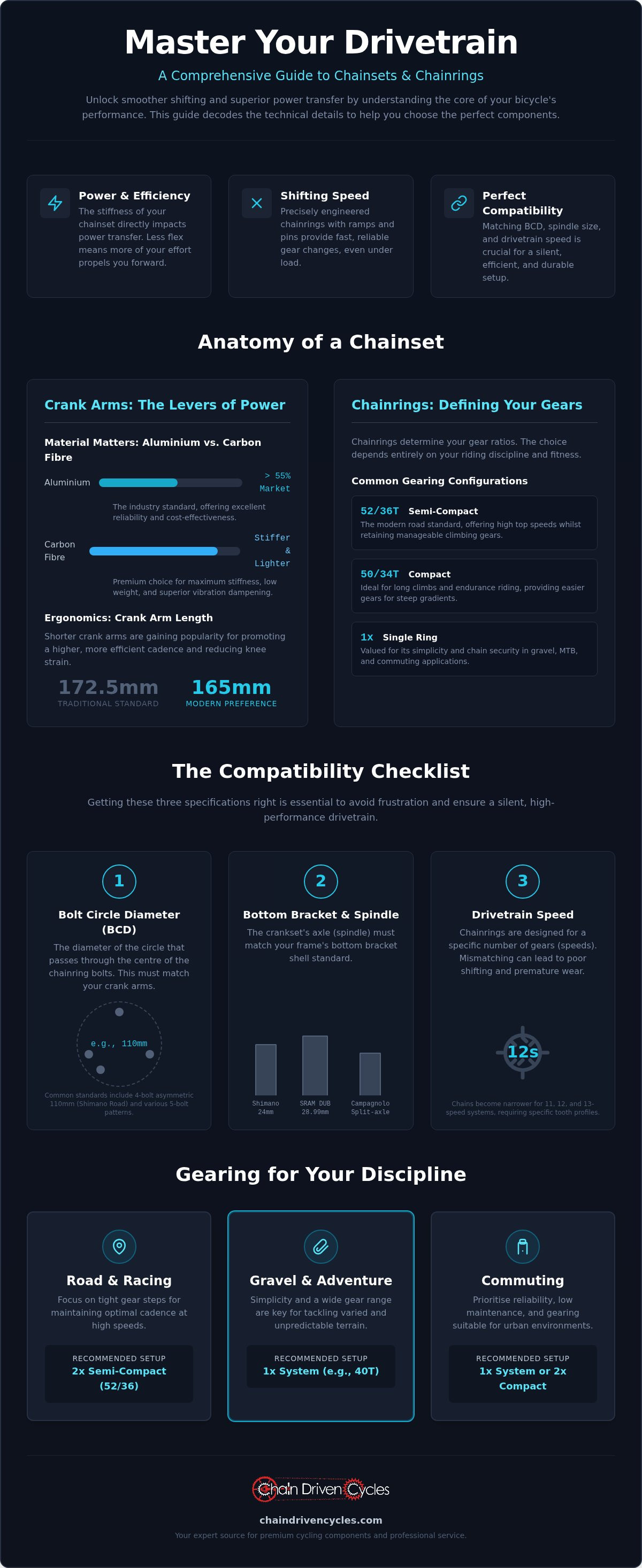
The choice between carbon and aluminium crank arms often comes down to a balance of weight and budget. Aluminium remains the leading material, accounting for over 55% of the market in 2026 due to its reliability and cost. However, carbon arms offer a distinct advantage in vibration dampening and absolute stiffness. Beyond material, the length of the arm is a critical ergonomic factor. While 172.5mm was once the default, many riders now prefer 165mm or 160mm lengths. These shorter arms encourage a more natural pedalling cadence and can alleviate knee strain amongst those who spend long hours in the saddle.
Anatomy of a Chainring
Chainrings are the toothed discs that dictate your gear ratios. A traditional 50/34 compact setup provides easier climbing gears, whereas the 52/36 semi-compact is now the standard for those seeking higher top speeds. The secret to crisp shifting lies in ramp and pin technology. These precisely engineered grooves and steel studs on the ring's surface grab the chain and lift it onto the teeth during a shift under load. Most high-quality rings are made from hardened aluminium, which is the favourite choice for balancing a lightweight profile with the durability needed to resist tooth wear over time.
Key Specifications: How to Ensure Compatibility
Selecting new chainsets and chainrings requires more than just picking a brand you like. You must first identify your Bolt Circle Diameter (BCD). This is the imaginary circle passing through the centre of the chainring bolts. While many modern Shimano road sets use an asymmetric 110mm 4-bolt pattern, older systems or those from SRAM and Campagnolo often vary significantly. Getting this measurement wrong means your new rings won't physically mount to your crank arms, regardless of the brand. It's a technical detail that saves hours of frustration during installation.
The choice between 1x (single) and 2x (double) systems also dictates your component compatibility. A 1x setup simplifies the drivetrain and is increasingly popular for gravel and commuting, whilst a 2x system remains the favourite for road riders who need tighter gear steps for racing. If you're looking to track your progress, high-performance hardware like Assioma power meter pedals offers a versatile way to add data to your new setup. These pedals avoid the clearance issues often associated with crank-arm-based power meters, making them compatible with almost any modern crankset.
Bottom Bracket Standards and Spindle Sizes
Your frame's bottom bracket shell determines which spindle size you can use. Shimano's Hollowtech II uses a 24mm steel axle, whereas SRAM's DUB standard features a 28.99mm diameter. Campagnolo's Ultra-Torque system uses a unique split-axle design. It's vital to check your frame's internal dimensions and threading before purchasing a new set. A correctly matched bottom bracket ensures a silent, creak-free ride and prevents premature bearing wear. If you're planning a major drivetrain overhaul, our team provides expert bicycle repair services to ensure every part is fitted to exact manufacturer tolerances.
Speed and Chain Compatibility
Precision is paramount when matching your rings to your chain. Using a 12-speed chainring with an 11-speed chain often leads to poor shifting behaviour because the tooth thickness and spacing are designed for narrower tolerances. This is particularly critical with SRAM's Flattop chains, which require specific tooth profiles that differ from traditional Shimano shapes. You must also ensure your front derailleur has the capacity to handle the tooth jump between your chosen ring sizes. Most modern road derailleurs are optimised for a 16-tooth difference, such as the jump from a 34T to a 50T ring. Exceeding this can lead to dropped chains and unreliable gear changes during high-intensity efforts.
Choosing for Your Riding Style: Road, Gravel, and Commuting
The demand for discipline-specific versatility has fundamentally reshaped how we select chainsets and chainrings in 2026. No longer is a one-size-fits-all approach acceptable; your gearing must reflect the specific challenges of your route. For those investing in Wilier road bikes Ireland, the drivetrain choice is often dictated by the need for Italian precision paired with local climbing demands. While a professional racer might demand the highest top-end speed, a daily commuter prioritises longevity and weather resistance. Brands like BBB and Shimano offer robust options for urban riders, often featuring integrated chain guards to protect clothing from grease and grime whilst ensuring reliable, low-maintenance performance.
The Road Cyclist's Dilemma: Standard vs Compact
Standard sets (53/39) were once the only choice for racers, but the introduction of 12 and 13-speed systems has changed the calculation. A 50/34 compact set was traditionally the favourite for endurance sportives and high-altitude climbs. However, the 52/36 semi-compact has emerged as the 2026 standard for speed and versatility. It provides a racing edge on the flats without sacrificing the spinning gears needed for steep Irish ascents. With the anticipated 13-speed Dura-Ace R9300, the gear range is now so broad that the gap between these configurations is narrower than ever.
Gravel-Specific Gearing and Chain Retention
Off-road riding introduces unique mechanical stresses that require specialised hardware. Narrow-wide tooth profiles are essential for 1x gravel setups to ensure chain retention on rough terrain. In April 2026, Shimano expanded the GRX line with 44T and 46T chainring options, providing more flexibility for those who mix tarmac and trail. SRAM's 13-speed AXS ecosystem offers a similar modularity for gravel enthusiasts. For loaded bike-packing amongst the rolling Irish hills, sub-compact 46/30 rings or 1x systems with a massive rear cassette are the most practical choices, allowing you to maintain a steady cadence even when the bike is weighted with gear.
Installation and Maintenance for Drivetrain Longevity
Proper installation is the foundation of drivetrain performance. To remove an old crankset, you'll typically need a 5mm or 8mm hex key, or a dedicated crank puller for older systems. Once removed, cleaning the bottom bracket shell is a non-negotiable step. Any grit left behind will lead to the dreaded "creak" that plagues poorly maintained bikes. When fitting new chainsets and chainrings, using a torque wrench is essential. Modern components, especially carbon crank arms and hollow-forged rings, have strict Newton-metre (Nm) specifications. Over-tightening can lead to catastrophic material failure, whilst under-tightening causes premature wear and dangerous instability.
When preparing the bottom bracket shell for a new installation, follow these steps to ensure longevity:
- Remove all old grease and grit with a clean, lint-free rag.
- Inspect the threads or press-fit surfaces for any signs of scoring or damage.
- Apply a fresh layer of high-quality waterproof grease or carbon assembly paste as required.
For those managing complex 12 or 13-speed systems, a professional electric and road bike service ensures every spacer and shim is perfectly aligned. This precision is what separates a drivetrain that simply works from one that delivers silent, crisp performance.
Daily Care and Cleaning
Road salt and winter grime act as an abrasive paste, accelerating the wear on your expensive chainrings. Regular degreasing is the best way to maintain the factory-fresh shifting behaviour of your drivetrain. Use a dedicated drivetrain cleaner and a stiff brush to remove debris from between the teeth. During your weekly clean, check for lateral play in the crank arms. If you feel a wobble when pulling the arms toward and away from the frame, your bottom bracket may need adjustment or replacement to avoid long-term frame damage. This simple check is a favourite practice amongst our workshop team for preventing costly repairs.
Signs of Wear and Tear
Identifying when to replace your components prevents expensive cascading failures. Use a chain checker tool regularly; a stretched chain will quickly "hook" the teeth of your chainrings, forcing them into a "shark-fin" profile. Once teeth are hooked, the chain will struggle to release during the bottom of the pedal stroke, leading to "chain suck" and potential frame gouging. Listen for the sound of your drivetrain under load. Persistent clicks or rhythmic creaks during power transfer are often the first warnings of worn teeth or loose mounting bolts. If you're unsure about the health of your chainsets and chainrings, book your next bicycle repair service to keep your ride running smoothly.
Premium Selection: Standout Chainsets at Chain Driven Cycles
Finding the ideal balance between weight, stiffness, and cost is the final step in your drivetrain journey. At Chain Driven Cycles, we stock a comprehensive range of chainsets and chainrings to suit every level of cyclist, from weekend enthusiasts to competitive racers. For those looking to invest in top-tier performance without the immediate financial burden, our 10-month payment plan is a popular way to spread the cost of premium upgrades like a full Dura-Ace or Ultegra setup. This service allows you to enjoy professional-grade hardware whilst managing your budget effectively.
Shimano Hollowtech II Excellence
Shimano’s Hollowtech II technology remains the industry benchmark for reliability and ease of maintenance. The Shimano 105 R7100 series is currently the favourite choice for enthusiast riders, offering 12-speed performance at a highly accessible price point. If you're seeking a competitive edge, moving up to the Ultegra R8100 provides significant performance gains through its carbon-reinforced construction and hollow-forged aluminium arms. We always recommend using genuine Shimano replacement rings to maintain the factory-level shifting behaviour your groupset was designed for. These rings feature the exact ramp and pin configurations required for the crispest gear changes, and we take pride in maintaining a consistent supply of these genuine Shimano components for the Irish market.
Specialist Options and Upgrades
While Shimano dominates the road market, specialist brands offer unique advantages for different riding styles. BBB chainrings are an excellent choice for riders seeking compatibility with older groupsets or budget-conscious repairs without sacrificing durability. For those looking towards the future of frame standards, SRAM DUB systems offer a universal bottom bracket compatibility that simplifies the upgrade process across different bike frames. Discerning cyclists often turn to Campagnolo for a blend of Italian flair and mechanical precision that remains unmatched in the peloton, especially when paired with their latest 13-speed Record and Super Record platforms.
Whether you're building a new gravel rig or refreshing your daily commuter, you can visit our online shop to browse our full range. We provide free delivery across Ireland for all qualifying orders, ensuring your new components arrive safely and promptly. If you require assistance with selection or installation, our workshop team is always available to provide the expert guidance you need to keep your drivetrain performing at its peak.
Elevate Your Riding Performance
Optimising your drivetrain is about more than just shedding weight; it's about the precision of every shift and the efficiency of every pedal stroke. We've explored how matching technical specifications and selecting the right gearing for your terrain ensures your bike performs exactly as intended. Whether you're navigating steep Irish gradients or sprinting on the flats, the correct configuration provides the mechanical advantage you need to excel.
Investing in high-performance chainsets and chainrings is the most effective way to transform your bike's power transfer and reliability. At Chain Driven Cycles, our national service centre offers expert technical support to guide you through complex compatibility questions. We provide free delivery across Ireland on all orders and a 10-month flexible payment plan to help you access the best hardware from Shimano, SRAM, and Campagnolo.
Upgrade your drivetrain today: Shop our full collection of Chainsets and Chainrings
Your next personal best is within reach. Let's ensure your drivetrain is ready for every mile of the journey ahead.
Frequently Asked Questions
How do I know if my chainset is compatible with my bike's frame?
Frame compatibility for new chainsets and chainrings is determined by your bottom bracket standard and spindle diameter. You must match the crank's axle, such as a 24mm or 30mm spindle, with the bearings installed in your frame's shell. Whether your bike uses a threaded BSA or a press-fit system, the spindle must be long enough to clear the shell width. If you're unsure, checking your frame's technical manual is the safest way to avoid mistakes.
What is the difference between a compact and a standard chainset?
The main difference lies in the number of teeth on the rings, which dictates your gear ratios. A standard set typically uses 53/39T rings for maximum speed on flat roads, whilst a compact set uses 50/34T rings to provide easier gears for climbing. Modern 12-speed systems have popularised the 52/36T semi-compact, which offers a versatile middle ground. Your choice should reflect your local terrain and your natural pedalling style.
Can I use a 12-speed chainring on an 11-speed drivetrain?
It is generally not recommended to mix speeds because 12-speed rings are designed for narrower chains. While a 12-speed chain might physically fit over the teeth, the spacing and tooth profiles are optimised for specific chain dimensions. Using mismatched components often leads to hesitant shifting, increased noise, and accelerated wear. For the most reliable gear changes, always match your rings to the speed of your cassette and chain.
How often should I replace my chainrings?
Most riders should replace their rings every 15,000 to 30,000 kilometres, though this varies based on cleaning habits and riding conditions. You'll know it's time when the teeth begin to resemble a sharp "shark-fin" shape rather than a symmetrical profile. If your chain starts to slip under heavy load or "suck" during shifts, it's a clear sign that the metal has worn too thin to maintain a secure grip.
Does crank arm length really matter for performance?
Crank arm length significantly impacts your ergonomics and cadence. Shorter arms, such as 165mm, are increasingly popular in 2026 because they reduce the range of motion at the hip and knee, potentially preventing discomfort. Longer arms provide more leverage for low-cadence grinding but can lead to "dead spots" in your stroke. Choosing a length that matches your height and flexibility is more important than following traditional sizing charts used in the past.
What is BCD and why is it important when buying chainrings?
BCD stands for Bolt Circle Diameter, which is the diameter of the circle that passes through the centre of all the chainring bolts. It is the most critical measurement when purchasing new chainsets and chainrings to ensure they mount correctly. If the BCD of your new rings doesn't match your crank's spider, the holes won't align. Most modern Shimano road sets use a 110mm four-bolt asymmetric pattern for their latest groupsets.
Is it worth upgrading to a carbon chainset?
Upgrading to carbon offers a noticeable improvement in stiffness and weight reduction. A carbon crankset provides a more direct feel during high-power efforts, as there is less flex in the material compared to standard aluminium. While it's a premium investment, it's one of the most effective ways to sharpen your bike's responsiveness. Our 10-month payment plan makes these high-end upgrades more accessible for riders looking to enhance their performance without the upfront cost.
Can I install a new chainset myself or do I need a professional?
While you can install a chainset with the correct hex keys and a torque wrench, professional installation is often safer for high-end components. Correct bearing preload and bolt tension are essential to prevent creaking or premature wear. If you're dealing with integrated power meters or electronic groupsets, our workshop team provides expert bicycle repair services to ensure every component is aligned to manufacturer specifications for a silent, reliable ride every time.