



Road Tubes Buying Guide: How to Choose the Best Inner Tubes in 2026
What if the most common roadside headache isn't bad luck with road debris, but carrying the wrong inner tube for your wheels? Standing on a damp verge trying to inflate a valve that barely clears an aero rim, or fighting a bulky spare that pinches inside wider 28c or 32c tyres, ruins a good ride fast. We've all felt the frustration of packing heavy spares that clutter our saddle bags. Choosing the right road tubes shouldn't involve guesswork, especially when you need dependable performance across demanding Irish road surfaces.
You deserve total confidence in your setup, from exact rim fitment to rolling efficiency. In this guide, you'll discover how to select the ideal road tubes for puncture resistance, speed, pack weight, and rim compatibility. We break down the practical differences between traditional butyl and lightweight TPU, explain precise valve calculations, and clarify modern ETRTO sizing so you can handle any roadside puncture with ease.
Key Takeaways
- Understand how switching between standard butyl rubber and modern thermoplastic polyurethane (TPU) road tubes influences rotational weight, rolling resistance, and saddle bag space.
- Match modern tyre widths from 28c to 32c accurately using standard ETRTO sizing rather than relying on rough estimates.
- Determine the correct Presta valve length or modular extender configuration needed to clear your specific rim depth cleanly.
- Evaluate the trade-offs between self-sealing tubes, heavy-duty butyl, and ultralight race options across unpredictable road surfaces.
- Master practical tyre seating and inflation habits that protect fresh tubes from destructive pinch flats during installation.
Understanding Road Tubes: Key Types, Materials, and Performance
Every pedal stroke transfers force directly through your wheels, making your choice of inner tube a critical component of ride feel. Far from being simple rubber bladders, modern road tubes directly influence rolling resistance, rotational weight, and casing suppleness. Picking the right tube ensures that your tyre maintains an optimal contact patch across unpredictable Irish asphalt, absorbing road buzz rather than bouncing over grit and coarse aggregate. Gaining insight into inner tube materials and performance characteristics allows you to match your setup directly to your training volume, racing ambitions, or daily route demands.
Classic Butyl vs Ultralight TPU Road Tubes
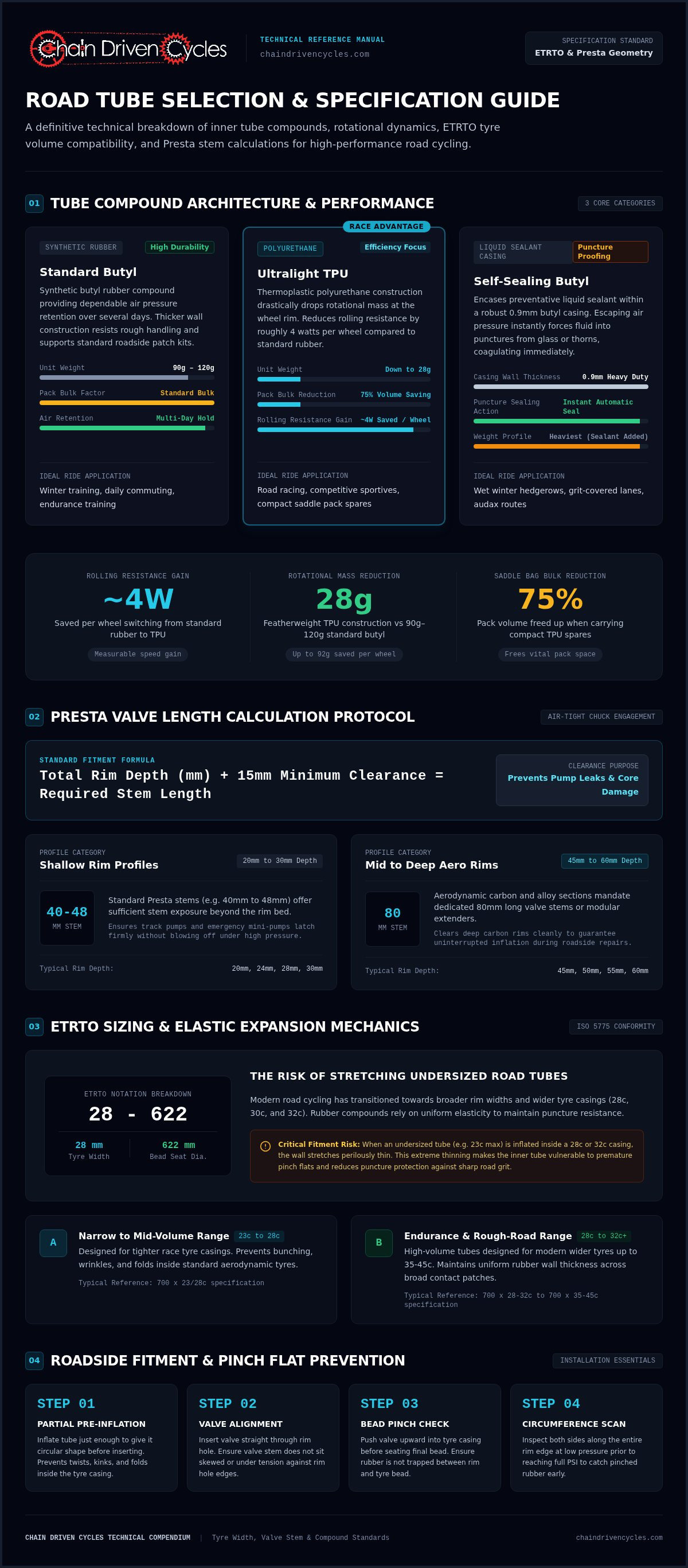
Synthetic butyl rubber remains the most dependable, cost-effective compound for regular cycling. Standard butyl models, such as the Nutrak road bike tube, deliver exceptional air retention over several days and handle roadside patch kits without fuss. Their thicker wall construction shrugs off rough handling, making them ideal for high-mileage winter training.
Thermoplastic polyurethane (TPU) represents a fundamental shift in wheel performance. Models like the Think Rider 28g Ultra Light road tube dramatically reduce rotating mass at the tyre rim. This drop in rotational weight saves roughly 4 watts of rolling resistance per wheel compared to standard rubber. TPU also reduces saddle bag bulk by up to seventy-five percent, freeing up vital space on endurance sportives.
- Butyl tubes: Highly durable, simple to repair, excellent pressure retention, slightly heavier at 90g to 120g.
- TPU tubes: Ultra-compact pack size, race-level rolling efficiency, featherweight construction down to 28g, premium investment.
Self-Healing and Sealant-Filled Road Tubes
Winter roads across Ireland present a gauntlet of wet hedgerow cuttings, flint, and surface grit. Pre-filled sealant tubes tackle this reality head-on. The Vittoria Auto Fix tube encases a preventative liquid sealant inside a durable 0.9mm butyl casing. As soon as a thorn or glass shard punctures the tread, air pressure forces the sealant into the hole, coagulating instantly to plug the leak.
While the extra fluid adds a modest weight penalty, eliminating roadside repairs on freezing, rain-soaked mornings is well worth the trade-off for daily commuters and dedicated audax riders.
Road Tube Sizing: Matching Tyre Widths and Rim Depths Accurately
Modern road cycling has largely shifted towards wider rims and tyre profiles measuring 28c, 30c, and even 32c. When tyres expand over modern, wider internal rim channels, an undersized tube stretches perilously thin against the tyre carcass. As highlighted in Sheldon Brown's guide to inner tubes, rubber relies on uniform elasticity to maintain structural integrity. Stretching a small tube beyond its intended design limit invites premature pinch flats and reduces resistance against sharp road grit.
Decoding Tyre Dimensions and Tube Sizing Ranges
Tyre sidewalls display standard ETRTO dimensions, such as 28-622, denoting tyre width and rim bead diameter in millimetres. Because road tubes possess inherent elasticity, manufacturers design them to cover a range of widths rather than a single fixed size.
- Narrow to mid-volume (23c to 28c): Options like the Chaoyang 700 x 23/28 deliver a snug fit without bunching inside modern race casings.
- Endurance and rough-road setups (28c to 32c+): Broader tyres demand higher-volume tubes, stretching up to options like the Nutrak 700 x 35-45C bike tube for mixed-surface endurance riding.
Using a tube that matches your tyre volume ensures consistent wall thickness across the entire circumference, keeping puncture resistance predictable across patchy road surfaces.
Presta Valve Lengths and Rim Profile Calculations
Road wheels universally utilise slender Presta valves capable of sustaining high inflation pressures. Selecting the correct valve length requires a simple calculation: measure your total rim depth and add a minimum of 15mm. This clearance ensures your mini-pump or track pump chuck engages the valve core securely without leaking air.
- Shallow rims (20mm to 30mm): Standard 40mm to 48mm stems, such as Impac Race tubes, provide ample working room.
- Mid to deep aero rims (45mm to 60mm): Rims in this profile require dedicated 80mm stems like the Continental Race Tube 80mm PV to clear the carbon bed cleanly.
If you ride deep aero sections that exceed standard lengths, you can browse our curated selection of road tubes and modular extenders to find the exact combination your wheels require.
Key Buying Criteria: How to Evaluate Your Next Road Tube
Choosing between different tyre setups requires balancing durability, speed, physical bulk, and roadside convenience. While price often drives initial decisions, matching the right tube construction to your terrain prevents frustrating walk-homes. Understanding how wall thickness and materials behave under pressure helps you narrow down options across our road tubes collection, ensuring you carry spares that actually suit your wheels.
Puncture Resistance vs Rotational Weight
Rotational mass sits at the furthest point from your wheel hub. Shedding weight here sharpens acceleration when kicking up steep gradients, making lightweight road tubes an attractive upgrade over heavyweight rubber. Yet, shaved grams require realistic consideration of your riding environment.
A thick 0.9mm butyl casing easily shrugs off sharp chip-and-seal aggregate that litters back roads. By contrast, featherweight TPU tubes rely on superior material tensile strength rather than sheer bulk to deflect punctures. Ensuring your rim tape sits flat during professional road bike servicing removes internal spoke nipple friction, protecting fragile tube walls regardless of compound.
Packability and Saddle Bag Efficiency
Carrying two conventional butyl spares quickly devours valuable saddle bag space. Bulky rubber forces you to choose between essential multi-tools, CO2 cartridges, or tyre levers. Think Rider TPU tubes compress into roughly a quarter of that volume. You can easily stow a pair of TPU spares alongside your emergency tools without stretching bag zips or overloading jersey pockets.
Removable Cores and Valve Extender Compatibility
Technical details matter when you flat miles from home. Removable Presta valve cores provide essential modularity. They allow you to thread on external accessories like BBB Valve Extender BTI-99 units for deeper wheels, or replace a bent valve pin with a fresh Continental Presta Valve Core in seconds. Threaded brass barrels also keep mini-pump heads locked firmly during vigorous roadside inflation. Consulting Understanding Road Tubes: Key Types and mechanical tolerances confirms why threaded, modular valves prevent frustrating roadside pressure loss.
Featured Road Tubes: Top Picks from Our National Collection
Reliability on the tarmac begins with dependable components inside your tyre casing. Our curated national inventory undergoes thorough assessment to guarantee consistent air retention, seam integrity, and smooth valve operation across Irish roads. Whether you need economical multi-pack training spares or cutting-edge ultralight race options, selecting proven manufacturing ensures consistent pressure retention on every ride.
Best for Everyday Training and Commuting
For daily mileage across abrasive chip-and-seal surfaces, robust butyl construction remains the sensible choice. These dependable workhorse tubes handle unpredictable weather and surface grit without fuss:
- Nutrak Road Bike Tube: Features strong welded butyl construction, available in versatile 700x19-25c and wider 25-32c variants.
- Impac Race 700 x 20/28 Tubes: Manufactured by Schwalbe, delivering proven quality and excellent value for high-mileage training wheels.
- Chaoyang 700 x 23/28: Utilises an enhanced butyl density engineered specifically to deflect road grit and debris impacts.
Best for Performance, Racing, and Deep Aero Rims
Modern deep-section carbon wheels demand featherweight internals and generous valve stems. The Think Rider 28g Ultra Light road tube sharpens acceleration on steep ascents, offering 65mm or 85mm valve stems to fit aero rim profiles cleanly without separate adapters. Vittoria Lite 700c road inner tubes with 80mm valves provide another exceptional choice for aerodynamic setups. Pairing these responsive road tubes with precision race machines and performance carbon frames yields immediate, noticeable improvements in rolling speed and ride feedback.
Best Value Bundles and Emergency Roadside Solutions
Carrying the right emergency equipment transforms a frustrating breakdown into a two-minute stop. Our 4 Tubes & CO2 Offer equips riders with four resilient spares alongside twin threaded gas canisters for rapid inflation. For rougher commutes and mixed-surface routes, Continental Tour 28 Hybrid Tube multi-packs provide durable, high-volume insurance. Riders tackling wet winter lanes can rely on Vittoria Auto Fix models, which deploy preventative liquid sealant to stop tread punctures instantly. Stock your workshop drawers and saddle bags directly through our full road tubes selection today.
Installation Essentials: How to Fit Road Tubes Without Pinching
Fitting a fresh tube correctly is just as critical as choosing the right material. Most sudden blowouts immediately after inflation aren't caused by faulty valves or road debris, but by pinch flats created during installation. When rubber becomes trapped between the tyre bead and the aluminium or carbon rim hook, it tears instantly under pressure. Adopting a methodical workshop approach guarantees dependable performance from your road tubes on every ride.
Inspecting the Rim Bed and Tyre Casing
Never rush to install a replacement without diagnosing the initial cause of the flat. Sweep the internal casing gently with a lint-free shop rag; bare fingers risk injury from fine wires or sharp flint shards stuck in the rubber. Confirm that your rim tape sits perfectly centred over every spoke bed hole without wrinkles or lifted edges. A brittle or displaced strip exposes bare spoke holes, causing immediate underside punctures at higher pressures. Always align your tyre's branding logo directly over the valve stem hole. This creates a clear reference point, allowing you to trace punctures on the tube directly back to matching spots on the tyre tread.
Tool-Free Bead Seating and Safe Inflation
Inflate the replacement tube with just enough air to give it a round shape. This low-pressure volume prevents the tube from twisting or dropping beneath the tyre bead during fitting. Follow these steps to secure a clean seat:
- Insert the valve straight through the rim hole, pushing the base slightly back into the tyre cavity so the beads nestle naturally underneath it.
- Feed the tube evenly into the tyre carcass around the entire circumference.
- Drop the tyre beads into the deep centre well of the rim, which creates crucial slack for the final section of tyre.
- Roll the remaining bead over the rim wall using the heels of your palms. Avoid tyre levers here; forcing tight beads with rigid plastic levers easily snags and nips the tube wall.
Before inflating, push both tyre beads inwards to inspect the rim channel. You should see only rim tape, with no tube material caught underneath.
Roadside Puncture Readiness and Pressure Maintenance
Check tyre pressures before rolling out for training, using a reliable floor pump gauge to avoid under-inflation pinch flats on broken road edges. Carry a dedicated roadside kit stocked with fresh tubes, strong nylon levers, and an emergency inflator. To replenish your spare kit with dependable options, browse our complete road tubes catalogue.
Equip Your Road Wheels with Total Confidence
Selecting the right road tubes transforms your experience in the saddle. Whether you choose the proven resilience of standard butyl for gruelling winter miles or switch to ultralight TPU to shed rotational weight and pack volume, matching tube dimensions to your tyre casing ensures optimal rolling efficiency. Calculating your valve stem clearance accurately and taking care during installation means you'll spend far less time stuck on roadside verges.
At Chain Driven Cycles, we supply cyclists across Ireland with an extensive national stock of inner tubes, covering everything from puncture-resistant self-healing models to featherweight race options. As an authorised retailer for world-class cycling brands, our team provides trusted technical advice alongside convenient 10 Month Payment Plan options on major cycling gear. When you're ready to refresh your saddle pack or prep your race wheels, browse our premium road tubes collection to ride every mile with complete peace of mind.
Frequently Asked Questions
What size road tube do I need for 700x25c or 700x28c tyres?
You need a 700c road tube with an elastic expansion range covering 23mm to 28mm or 25mm to 32mm. Inner tubes stretch across a span of widths printed directly on the packaging. If you ride 28c tyres, choosing a 25-32c tube prevents overstretching the material, maintaining proper wall thickness and reliable puncture resistance across rough tarmac. Avoid stretching an undersized 18-23c tube into a 28c tyre casing.
How do I choose the correct Presta valve length for my road bike wheels?
Measure your rim's external profile depth and add at least 15mm of extra valve length. This clearance ensures your pump chuck or emergency CO2 inflator locks securely onto the stem without air leaks. Shallow rims between 24mm and 30mm depth work perfectly with 40mm or 48mm valves. Mid-section aero rims between 45mm and 50mm require 60mm to 80mm stems, whilst deeper wheels demand dedicated modular extenders.
Are lightweight TPU inner tubes worth the higher price compared to butyl?
Yes, TPU inner tubes are well worth the investment if you want lower rolling resistance, faster climbing acceleration, and minimal pack volume. High-grade TPU saves roughly 4 watts per wheel compared to standard rubber, delivering rolling speeds close to tubeless systems. They roll up to a quarter of the size of standard road tubes, making them superb spares. For wet winter commuting, however, standard butyl remains the cost-effective everyday choice.
Can I use a road tube with a removable valve core on deep-section aero wheels?
Yes, tubes with removable Presta valve cores are the ideal choice for deep-section aero rims because they accept modular valve extenders. Rather than hunting for uncommon extra-long integrated stems, you simply unscrew the standard core with a small tool, thread an extender barrel into the stem, and refit the core at the top. This configuration provides dependable inflation access and trouble-free pressure adjustments on deep carbon wheels.
What is the main difference between Presta and Schrader valves on road bikes?
Presta valves are narrower, measuring 6mm in diameter, which makes them the universal standard for slender, high-pressure road rims. Schrader valves measure 8mm across and feature internal spring pins typical of car wheels. Drilling an 8mm hole in a narrow road rim weakens the wheel's structural integrity. Presta valves utilise a captive manual locknut, holding high operating pressures reliably whilst fitting neatly through slim rim profiles.
Why do my newly installed road tubes keep puncturing immediately?
Immediate punctures after installation are almost always caused by pinch flats or missed debris inside the tyre. If tube rubber gets trapped beneath the tyre bead during lever-assisted installation, it tears instantly as inflation pressure climbs. Alternatively, microscopic glass slivers, thorn tips, or broken spoke ends piercing through degraded rim tape will puncture the replacement tube straight away. Always inspect the casing interior and rim strip before fitting.
How many spare inner tubes should I carry on a road cycling sportive?
Carrying two spare road tubes provides the ideal level of self-sufficiency without overloading your bike during an organised sportive. Double punctures occasionally happen over cattle grids, pothole strikes, or hedgerow cuttings. Having two fresh spares paired with an emergency inflator guarantees you won't be stranded waiting for roadside assistance. Compact TPU tubes make packing two spares effortless, preserving valuable saddle bag volume for essential tools and ride fuel.