



How to Train with a Power Meter: 2026 Performance Guide
Have you ever finished a grueling interval session feeling completely spent, only to find your average speed was slower than your last recovery ride? It is a common frustration for cyclists across Ireland, where unpredictable coastal winds and rolling terrain often make traditional metrics like speed or heart rate feel like moving targets. If you want to stop guessing and start growing, learning how to train with a power meter is the most significant step you can take for your performance.
We understand that staring at a head unit full of data like TSS and IF can feel overwhelming at first. However, once you master the fundamentals, these numbers become your most reliable allies in breaking through fitness plateaus. This 2026 guide provides a clear roadmap to help you optimise your efforts, whether you are using Assioma pedals on the open road or a ThinkRider smart trainer in your home setup. We will show you how to calculate your Functional Threshold Power (FTP), define your personalised training zones, and ensure every watt you produce brings you closer to your goals.
Key Takeaways
- Understand why power is the ultimate objective metric, providing a real-time measure of intensity that ignores external variables like Irish headwinds or sleep quality.
- Discover how to train with a power meter by accurately establishing your Functional Threshold Power (FTP) to create personalised, data-driven training zones.
- Compare the benefits of hardware like Assioma pedals and ThinkRider smart trainers to find the most versatile solution for your specific cycling goals.
- Learn to execute structured workouts like "Sweet Spot" intervals to eliminate guesswork and see measurable improvements in your outdoor speed and endurance.
- Explore how to make high-performance technology more accessible by using 10-month interest-free payment plans on premium trainers and road bikes.
The Fundamentals: Why Train with a Power Meter?
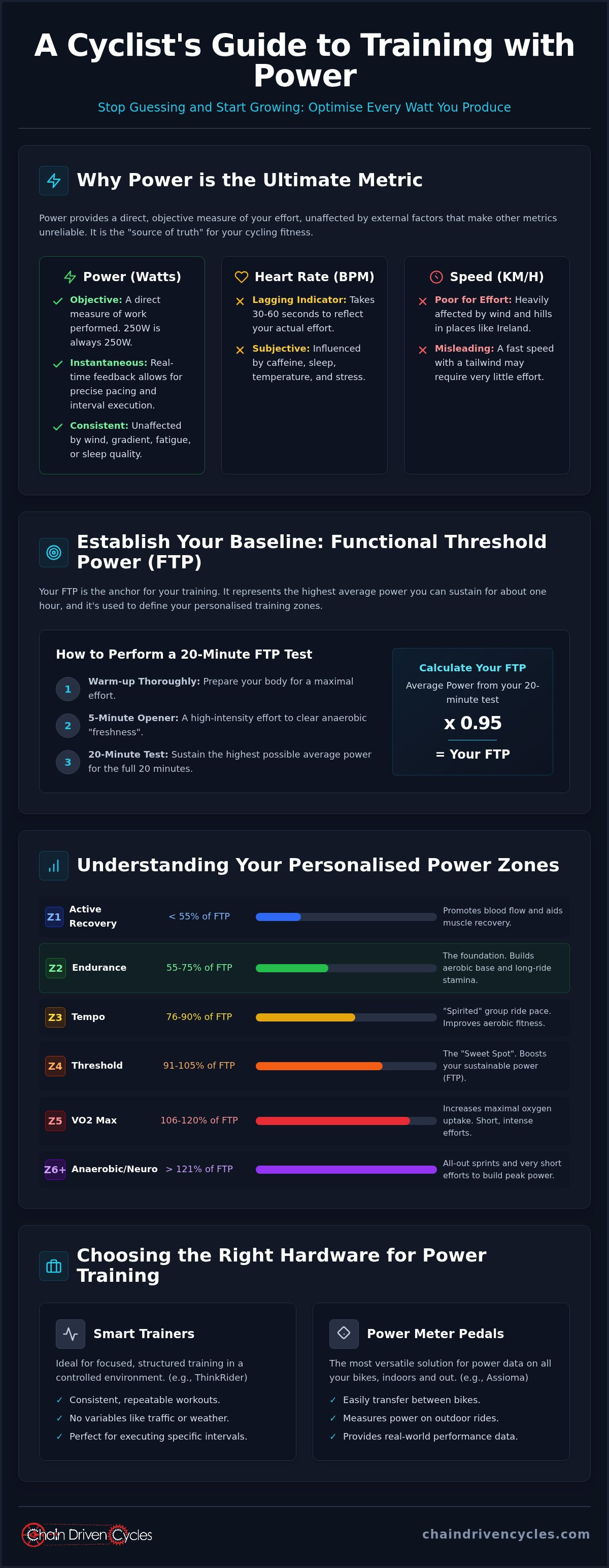
Power is the only objective measure of your cycling performance. Whilst speed and heart rate are influenced by external factors, power is a direct calculation of the work you perform on the bike. It is measured in Watts. If you are looking to understand what is a power meter, think of it as a tool that uses strain gauges to measure the force you apply to your pedals or cranks. This provides an instantaneous data point that tells you exactly how hard you are working at any given second. Mastering how to train with a power meter allows you to move beyond guesswork and base your progress on undeniable facts.
One of the greatest advantages of power is that it is unaffected by your physical or environmental state. Your heart rate might fluctuate due to a strong morning coffee, a lack of sleep, or even the temperature of a humid afternoon. Power ignores these variables. 250 Watts remains 250 Watts whether you are fighting a coastal headwind or training in the controlled environment of a ThinkRider smart trainer. This consistency makes it the "source of truth" for your fitness. It also helps you identify your mechanical efficiency; you can track how much energy you expend to produce a specific output, helping you refine your technique over time.
Power vs. Heart Rate: The Delayed Response
Heart rate is a "lagging" indicator. When you start a sprint or hit a steep incline, it takes your heart thirty to sixty seconds to respond to the increased demand for oxygen. By the time your heart rate monitor shows you are in the red, you may have already overexerted yourself. Power is different. It is instantaneous. If you surge to 400 Watts, your head unit shows it immediately. This allows for precise pacing amongst a group or during a solo climb, ensuring you don't "blow up" by going too deep, too early. Using hardware like Assioma Power Meter Pedals ensures you have this data available on every bike you own. Whilst power is the superior tool for intensity, using it alongside heart rate gives you a complete view of how your body is coping with the workload.
The Consistency of Watts
In Ireland, wind and gradient are constant challenges that make speed a poor metric for effort. A 30km/h pace might feel like a recovery ride with a tailwind, but it could be a maximal effort against a gale. Power removes these illusions. It allows you to maintain a perfectly steady effort regardless of the terrain. This objectivity provides a significant psychological benefit during difficult sessions. Instead of feeling slow because of a headwind, you can take confidence in the fact that your Watts are exactly where they need to be. Over several months, these numbers create a clear map of your improvement, showing gains that speed alone would hide.
Establishing Your Baseline: FTP and Power Zones
Functional Threshold Power (FTP) is the anchor for your entire training programme. It represents the highest average power you can maintain for approximately one hour. Without a confirmed FTP, your power data is just a collection of random numbers. By establishing this baseline, you can create personalised training zones that target specific physiological systems. Understanding how to train with a power meter begins here; it allows you to work at the exact intensity required for your body to adapt and improve.
How to Perform an FTP Test
A standard 20-minute test is the most practical way to find your FTP. You should approach this session well-rested and motivated. After a thorough warm-up, perform a five-minute high-intensity effort to clear any anaerobic "freshness" before starting the main 20-minute block. The goal is to sustain the highest possible average power for the duration. Beginners often start too aggressively; it's better to build your effort steadily over the first ten minutes. Once finished, take 95% of your average power to estimate your FTP. This adjustment accounts for the fact that a 20-minute effort is slightly higher than what you could sustain for a full hour. For the most consistent results, performing this test on a high-quality smart trainer eliminates variables like traffic or gradient changes.
Understanding the Training Zones
Whilst there are several models, we typically use the seven classic Coggan power zones to dictate training intensity. Each zone triggers a different adaptation. Zone 1 focuses on active recovery, whilst Zone 7 targets neuromuscular power. Learning how to train with a power meter effectively requires you to respect these zone boundaries, particularly the following three:
- Zone 2 (Endurance): 55-75% of FTP. This is the foundation of your aerobic engine, building mitochondrial density and fat-burning efficiency.
- Zone 4 (Threshold): 91-105% of FTP. Training here improves your ability to sustain high speeds for longer periods, which is vital for time trials and long climbs.
- Zone 5 (VO2 Max): 106-120% of FTP. These short, intense intervals raise your performance ceiling by increasing your maximum oxygen uptake.
By staying within these specific ranges, you ensure that every minute on the bike serves a purpose. You won't waste energy on "junk miles" that are too hard for recovery but too easy for significant gain. Re-testing every six to eight weeks ensures your zones remain accurate as your fitness improves.
Choosing the Right Hardware for Power Training
Hardware selection is the bridge between theory and performance. To master how to train with a power meter, you must choose a device that fits your riding style and budget. There are three primary options: pedal-based systems, crank-arm meters, and direct-drive smart trainers. Each has its strengths. Pedals offer the best transferability, whilst crank-arms are often a permanent, durable fixture. For those who do the bulk of their structured work away from unpredictable Irish weather, a smart trainer is the most integrated solution.
Outdoor Versatility: Power Meter Pedals
Assioma Power Meter Pedals have become a favourite amongst Irish club riders for good reason. They are incredibly easy to install and move between bikes. This versatility ensures your data remains consistent whether you are racing on a Sunday or doing a recovery spin on a different frame. When choosing, consider if you need single-sided or dual-sided measurement. A dual-sided system like the Assioma Duo identifies leg imbalances, allowing you to see if one leg is overcompensating. This insight is vital for long-term injury prevention and mechanical efficiency. Using the same meter for both indoor and outdoor rides is the best way to maintain data integrity across your entire season.
Indoor Excellence: Smart Turbo Trainers
Indoor training has evolved significantly, moving from simple resistance to high-precision data. The ThinkRider X7 Pro v3 is a game-changer for home setups, offering elite-level accuracy and a direct-drive design that eliminates tyre slip. For even greater realism during long endurance sessions, the Wahoo KICKR MOVE provides fore-and-aft motion to reduce saddle fatigue. A key feature of these trainers is ERG mode. This setting automatically adjusts resistance to keep you at a prescribed wattage, regardless of your cadence. It takes the thinking out of intervals, ensuring you never miss a target because of a lapse in concentration. Direct-drive units like the Elite Direto-XR provide the precision needed for the most demanding "all-out" sprints.
Ultimately, the best hardware is the one you will use consistently. If you have multiple bikes, the portability of pedals is hard to beat. If you are building a dedicated "pain cave" for winter, a direct-drive trainer provides the most immersive experience. By investing in the right tools, you transform your bike into a laboratory for performance, allowing you to track every Watt with total confidence.
Executing the Plan: Structured Workouts and Pacing
Mastering how to train with a power meter involves shifting your focus from total volume to specific intensity. Instead of aimless hours on the road, you use precision to hit physiological targets that force your body to adapt. One of the most effective methods is "Sweet Spot" training. By riding at 88-94% of your FTP, you achieve a high training load without the extreme fatigue associated with full threshold work. It is the most efficient way for time-crunched cyclists to build a robust aerobic engine during a busy week.
The Power of Intervals
Structured intervals are the fastest route to measurable progress. Sixty minutes of focused power work often yields better results than three hours of "junk miles" where your effort fluctuates inconsistently. A classic beginner workout is 2 x 20 minutes at Sweet Spot with a five-minute recovery between sets. During these sessions, it's helpful to monitor "Normalised Power" (NP). This metric provides an estimate of the physiological cost of the ride by accounting for the surges and lulls that a simple average power figure often misses. It gives you a truer reflection of how hard your body worked during a variable session.
Your cadence also plays a vital role in how you produce Watts. "Grinding" at a low RPM (revolutions per minute) places more stress on your muscles, whilst "spinning" at a higher RPM shifts the load to your cardiovascular system. Learning to balance these prevents premature muscle failure on long sportives. By monitoring your cadence alongside your power, you can identify which style allows you to sustain your target wattage for longer without your heart rate spiking uncontrollably.
Pacing Strategy for Climbs
Power is your best tool for pacing on rolling terrain or long climbs. It's easy to get carried away on the early slopes of a hill amongst a group, but "burning matches" early in a ride leads to significant late-session fatigue. By keeping your output strictly below your threshold (Zone 4), you ensure you have enough energy for the final kilometres. This discipline is especially important during winter training. You can refine these pacing skills by perfecting your road bike indoor training setup to simulate specific gradients before you hit the road in the spring.
Integrating your meter with software like Zwift or TrainerRoad automates this process. These platforms use your FTP to scale every workout to your current ability, ensuring you are always challenged but never overtrained. If you want to take full control of your winter preparation, consider upgrading to a precision-engineered direct-drive trainer to experience seamless resistance changes during your intervals.
Elevating Your Performance with Chain Driven Cycles
Choosing the right hardware is only the first step. To truly understand how to train with a power meter, you need equipment that provides consistent, repeatable data. At Chain Driven Cycles, we don't just sell boxes; we provide the expertise to ensure your setup is perfect from day one. Our team is available to help you calibrate your new meter and ensure it integrates seamlessly with your head unit or indoor software. We also provide essential accessories like ThinkRider floor mats and sweat covers. These protect your bike frame and your home from the corrosive effects of intense indoor sessions.
Our Top Smart Trainer Picks for 2026
In 2026, the market offers a range of high-performance options tailored to different needs. If you are working with limited space, the Elite Avanti is a standout choice. It is compact and lightweight, yet it provides the stability required for high-wattage intervals. For those seeking the gold standard of reliability, the Wahoo KICKR CORE remains a top contender. Its proven track record for Zwift compatibility makes it a favourite amongst the racing community. However, if you are looking for pro-level accuracy at an accessible price point, the ThinkRider X7 Pro v3 is the ultimate value-for-performance smart trainer. It offers a direct-drive experience that rivals much more expensive units, and many dedicated riders also explore gaming PCs to ensure their virtual environment is as responsive as their physical hardware.
The crossover between virtual cycling and other forms of digital competition continues to grow, as many athletes look to build comprehensive home simulation setups. If you are interested in exploring high-performance hardware beyond the bike, you can visit S5 Tech to discover their guide on the latest sim racing PC specifications.
We believe that elite-level technology should be accessible to every cyclist in Ireland. High-end hardware, such as a Wahoo KICKR BIKE or a dual-sided Assioma Duo system, represents a significant investment in your performance. To make this transition easier, we offer an interest-free 10-month payment plan on all major trainers and power meters. This allows you to spread the cost of a Garmin Edge 1030 Plus or a premium smart trainer into manageable monthly instalments. It's the most straightforward way to upgrade your setup without the initial financial strain. Browse our full collection of Smart Turbo Trainers and start your power journey today with the support of a trusted specialist.
Take Control of Your Cycling Progress
Transitioning to power-based training is the most effective way to eliminate the guesswork that often stalls fitness gains. By understanding the relationship between your Watts and your physiological limits, you ensure that every interval serves a specific purpose. We've explored how establishing an accurate FTP and selecting versatile hardware provides the "source of truth" needed to break through plateaus. Mastering how to train with a power meter isn't just about complex data; it's about making your training more efficient and your goals more attainable.
At Chain Driven Cycles, we're here to support your journey with expert advice and the industry's leading technology. As an authorised ThinkRider and Elite dealer, we offer free delivery across Ireland and an interest-free 10-month payment plan to make your upgrade seamless. Upgrade your training with our Smart Turbo Trainer Collection and start seeing the results your hard work deserves. The road to a higher FTP starts with the right data and a committed partner.
Frequently Asked Questions
Do I really need a power meter if I already have a heart rate monitor?
Power provides an instantaneous measure of effort, whereas heart rate is a delayed physiological response. Your heart rate can be affected by temperature, caffeine, or stress, making it less reliable for short, punchy intervals. When learning how to train with a power meter, you'll find that Watts represent the absolute truth of your work. Using both metrics together offers the most comprehensive view of your fitness and efficiency on the bike.
What is a good FTP for a beginner cyclist?
A "good" FTP is entirely relative to your body weight and experience level. Instead of chasing a specific number, beginners should focus on their power-to-weight ratio, measured in Watts per kilogram (W/kg). A typical entry-level range might be between 1.5 and 2.5 W/kg. The primary goal of your initial training block should be establishing a personal baseline and seeing consistent, measurable improvement over several months of structured riding.
Can I use a power meter on both my road bike and my indoor trainer?
Yes, you can use the same power meter for both environments, provided you choose a versatile system. Pedal-based meters like the Assioma Duo are particularly effective because they can be swapped between your road bike and an indoor trainer in minutes. This ensures your data remains consistent across all sessions. Using the same meter eliminates the data drift that often occurs when comparing different power sources like a trainer and a crank-arm.
How much does a reliable power meter or smart trainer cost in 2026?
In 2026, most reliable power meters and smart trainers range from approximately €300 to over €1,200, depending on the features and accuracy levels you require. Entry-level single-sided pedals or crank-arms sit at the lower end, whilst dual-sided systems and high-end smart trainers command a premium. To help manage this investment, we offer a 10-month interest-free payment plan that makes professional-grade performance technology accessible to more cyclists across Ireland.
Is it difficult to install power meter pedals like the Assioma Duo?
Installing Assioma Power Meter Pedals is as straightforward as fitting a standard set of pedals. You don't need a mechanic or specialised torque wrenches; a standard 8mm hex key is usually sufficient. Once threaded onto your crank-arms, you simply activate them via the smartphone app and perform a quick zero-offset calibration. This ease of installation is why they are a favourite for riders who frequently move between different bicycles during their season.
What is ERG mode on a smart trainer and should I use it?
ERG mode is a setting on smart trainers that automatically adjusts resistance to keep you at a specific wattage regardless of your cadence. If your workout prescribes 200 Watts, the trainer will increase resistance if you slow down and decrease it if you speed up. It's an excellent tool for structured intervals as it prevents you from cheating the effort, though you should occasionally train without it to practice manual pacing skills.
How often should I re-test my FTP to ensure my zones are accurate?
You should ideally re-test your FTP every six to eight weeks, typically at the end of a recovery week following a training block. Regular testing ensures your power zones remain accurate as your fitness improves. If your zones are too low, you won't trigger the necessary adaptations; if they are too high, you risk overtraining. Consistent testing is a fundamental part of learning how to train with a power meter effectively.
Do I need a special bike computer to see my power data?
You need a bike computer or a smartphone app that supports ANT+ or Bluetooth connectivity to display and record your power data. Most modern head units from brands like Garmin or Wahoo are fully compatible with power meters. These devices allow you to see real-time Watts, average power, and lap data while you ride. If you train indoors, platforms like Zwift can also receive this data directly from your meter or smart trainer.