



Choosing the Best City/Hybrid Bike Tyres: The 2026 Buying Guide
Is it truly possible to navigate a full season of Irish commuting without a single roadside repair? For many riders, the morning journey is often overshadowed by the fear of glass shards on the cycle lane or a sudden loss of traction on rain-slicked tarmac. It's a common frustration that can turn a healthy habit into a logistical headache, but it doesn't have to be the standard for your daily travel.
We believe your equipment should work for you, not against you. By choosing the right city/hybrid bike tyres, you can transform your ride from a jarring, puncture-prone chore into a smooth and confident experience. Whether you're struggling with the confusion between 700c and 28 inch sizing or simply want a "fit and forget" solution that handles potholes with ease, the technical details matter. This 2026 buying guide provides the expertise you need to balance speed, grip, and durability. We will examine the latest advancements in puncture protection, such as the 5.0 mm Rhino Skin inserts, and explain how modern width standards are improving comfort and cornering confidence for every urban cyclist.
Key Takeaways
- Learn how to decode ETRTO and imperial sizing to ensure your new tyres fit your rims perfectly every time.
- Understand the difference between Rhino Skin and Hippo Skin technology to find the right balance between weight and total puncture invulnerability.
- Discover why upgrading your city/hybrid bike tyres is the most cost-effective way to improve speed and grip on wet Irish roads.
- Master the essentials of tyre installation and maintenance, including how to verify rotation direction for maximum water evacuation.
- Explore high-performance options like the Schwalbe Marathon Plus and learn how to spread the cost of upgrades with a flexible payment plan.
Understanding the Role of City and Hybrid Bike Tyres
Hybrid tyres represent the versatile middle ground of the cycling world. They bridge the gap between high-speed, narrow road tyres and the heavy-duty, knobbly rubber found on mountain bikes. For the daily commuter or weekend explorer, choosing the right city/hybrid bike tyres is the single most important factor in determining how your bicycle interacts with the pavement. It is the only point of contact between you and the road, meaning your choice dictates your safety, speed, and overall comfort.
Most bicycles come equipped with "stock" tyres from the factory. These are often chosen by manufacturers to keep costs low, which frequently results in a ride that feels sluggish or lacks sufficient grip in the rain. Upgrading these components is the most cost-effective performance boost you can give your bike. A high-quality tyre improves safety by shortening braking distances and increases comfort by absorbing road vibrations before they reach your hands and saddle. Whilst there is always a trade-off between weight and durability, modern rubber compounds allow you to find a balance that suits your specific route.
Why Urban Tyres Require a Unique Design
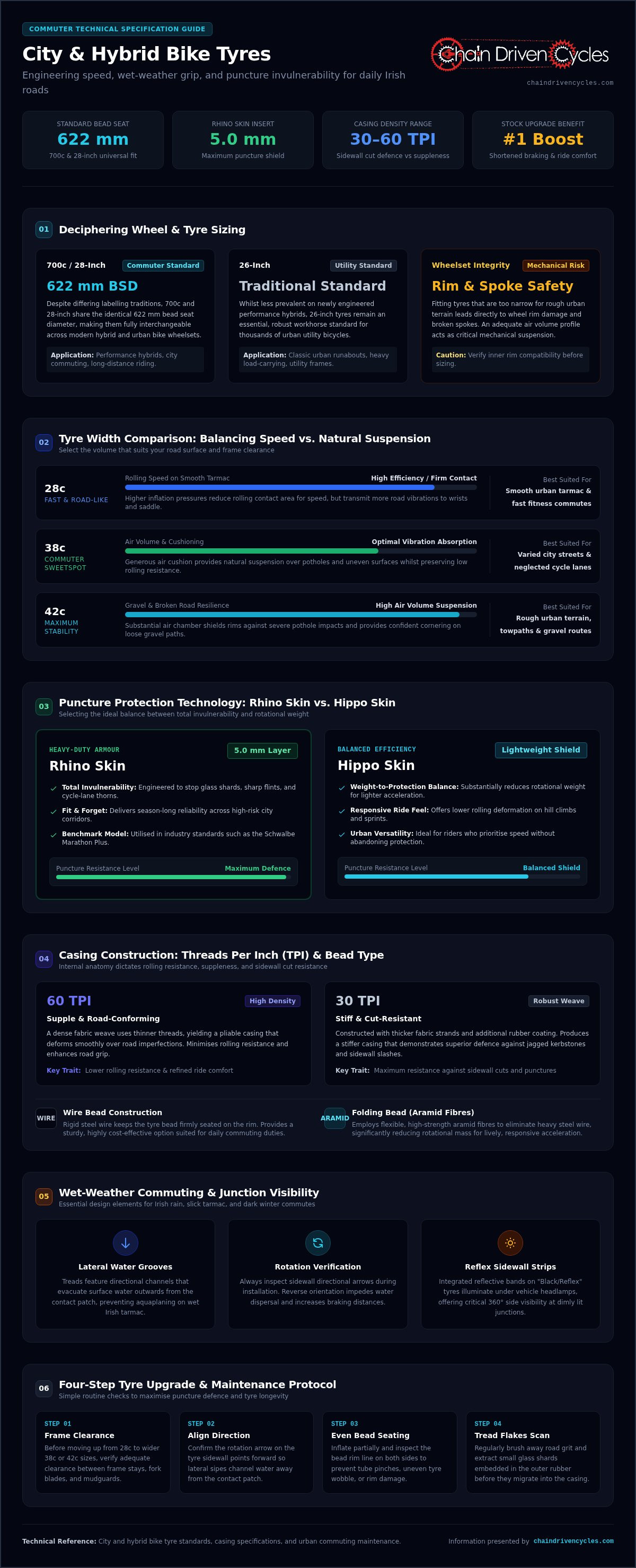
Urban riding requires a tyre that can handle a variety of surfaces, from pristine tarmac to neglected cycle lanes strewn with gravel and debris. To remain effective in the unpredictable Irish climate, these tyres feature specific tread patterns designed for water displacement. These lateral grooves channel water away from the contact patch, preventing aquaplaning and maintaining traction on wet corners. The efficiency of this process depends heavily on the bicycle tire construction and anatomy, including the TPI (threads per inch) of the casing and the shape of the tread.
Rolling resistance is the energy lost as the tyre deforms whilst moving across the road surface, and it is the primary factor in how "fast" a tyre feels during your commute. A well-designed urban tyre minimises this loss whilst maintaining enough rubber thickness to resist sharp objects like glass shards or thorns.
Comfort vs. Speed: Finding Your Balance
There is a constant tension between rolling efficiency and ride quality. Narrower tyres can be inflated to higher pressures, reducing the contact patch for better speed on smooth roads. However, wider city/hybrid bike tyres allow for a greater volume of air, acting as a form of natural suspension. This air cushion is vital for navigating potholes and uneven surfaces without jarring your joints or losing control.
Selecting the wrong balance can have mechanical consequences beyond a bumpy ride. Our road bike servicing Ireland team frequently sees riders with damaged rims or broken spokes caused by using tyres that are too narrow for the local terrain. By opting for a slightly wider profile with a robust casing, you protect your wheels and enjoy a more stable, confident journey through the city.
Technical Specifications: Deciphering Sizes, Treads, and Beads
Understanding the numbers on your sidewall is the first step toward a better ride. Many cyclists are confused by the overlap between 700c and 28-inch labels. In most cases, these refer to the same 622mm bead seat diameter. Whilst 26-inch tyres are less common on new performance hybrids, they remain a staple for many urban utility bikes. Beyond diameter, the casing construction defines the tyre's behaviour. TPI, or threads per inch, indicates the density of the fabric weave. A higher TPI, such as 60, creates a more supple tyre that conforms to the road. Conversely, a lower 30 TPI casing is stiffer and typically more resistant to sidewall cuts.
Safety is paramount on dimly lit Irish roads. Reflective sidewalls, often marked as "Reflex" or "Black/Reflex", are a critical feature for urban riders. They provide essential side visibility at junctions where your front and rear lights might not be seen by motorists. When selecting your next set, consider the bead type. Wire beads are rigid and cost-effective. Folding beads use aramid fibres to reduce rotational mass, which makes the bike feel more responsive during acceleration. For a deeper look at these technical trade-offs, this REI guide to choosing bike tires offers excellent expertise on pressure and performance.
Choosing the Right Width for Your Frame
Width is where you truly customise your ride. A 28c tyre feels fast and road-like, whilst a 38c or 42c profile provides the air volume needed for gravel paths and broken tarmac. Before upgrading to wider rubber, always check the clearance between your tyre and the fork blades or chainstays. Don't forget to account for mudguards. A wider tyre can often rub against the stays if the fit is too tight. If you're unsure which width suits your frame, you can browse our commuter tyre range to compare technical specs.
Tread Patterns: Slicks vs. Grooved Tyres
The tread pattern should match your route. A slick centre rib, like that found on the Chaoyang Kestrel, reduces rolling resistance on smooth tarmac. However, for national commuters facing fallen leaves and wet grit, a grooved "all-weather" tread is often the favourite choice. Shoulder knobs provide additional stability when cornering on loose debris. This ensures you don't lose traction when turning off the main road onto a gravel driveway. Finding the right balance ensures your bike remains predictable regardless of the weather.
Puncture Protection Technology: Rhino Skin vs. Hippo Skin
For many riders, the primary goal when choosing new rubber is to eliminate the frustration of roadside repairs. Punctures usually occur when sharp debris, such as glass shards or thorns, penetrates the tread and reaches the inner tube. To prevent this, manufacturers integrate internal protection belts directly beneath the outer rubber. These layers act as a physical shield, either by being too dense for objects to pierce or thick enough to stop them before they cause a leak. Understanding the hierarchy of these systems allows you to choose a tyre that matches the debris levels on your specific route.
The Chaoyang "Skin" system provides a clear example of how protection is scaled. Rhino Skin is the heavy-duty option, featuring a 5.0 mm thick composite layer of high-elasticity rubber and aramid. It is designed for riders who prioritise invulnerability above all else. In contrast, Hippo Skin utilises a thinner 1.5 mm Kevlar-reinforced layer. This provides a significant defence against everyday urban hazards whilst reducing the weight penalty by approximately 15% to 20% compared to the Rhino Skin models. For those seeking the ultimate "flat-less" reputation, the Schwalbe Marathon Plus remains a benchmark, using a patented SmartGuard sub-layer to deflect even the most stubborn road debris.
Even the most advanced city/hybrid bike tyres require proper maintenance to remain effective. Maintaining the correct inflation pressure is essential to avoid "pinch flats", often called snake bites. These occur when the tyre compresses fully against the rim after hitting a pothole, pinching the tube and causing two small parallel holes. Regularly checking your PSI ensures the protection layers can function as intended without the risk of internal damage.
The Anatomy of an Armoured Tyre
Modern sub-tread layers are far more sophisticated than simple strips of thick rubber. High-density compounds, such as those found in the Mitas Rubena Flash Reflex, use specialized polymers to resist wear whilst maintaining a flexible casing. This complexity is vital because puncture protection layers and tyre casings must work together to provide grip without feeling wooden. Whilst protection adds weight, it saves time in the long run by preventing the 20-minute delay of a mid-commute repair.
E-Bike Specific Protection Requirements
Modern electric hybrid bikes place unique demands on their tyres due to increased vehicle weight and higher motor torque. These bikes often weigh between 22kg and 30kg, which puts significantly more stress on the sidewalls during cornering and braking. The Chaoyang E-Liner is a prime example of a motor-optimised tyre, featuring a 60 TPI rigid construction and ECE-R75 certification for speeds up to 50 km/h. If you are riding a motorised model, consult our electric hybrid bikes Ireland guide for more detailed advice on selecting rubber that can handle the extra power.
Top Recommendations from Our Urban Collection
The ideal set of city/hybrid bike tyres depends entirely on your specific route and riding style. A commuter navigating the glass-strewn streets of a city centre has different requirements than a leisure rider exploring coastal greenways. Based on our extensive experience with Irish road conditions, we have selected the following models that excel in their respective categories. These choices balance the technical specifications discussed earlier, such as TPI and puncture protection layers, with real-world performance.
- Best for Speed: The Chaoyang Kestrel Slick (26") or Kestrel Rhino Skin (700c). These models feature a smooth centre rib that minimises rolling resistance, making them perfect for those who want to maintain high speeds on paved surfaces.
- Best for Puncture Resistance: Schwalbe Marathon Plus. This is the definitive "flat-less" choice. With its 5.0 mm SmartGuard protection layer, it is virtually impenetrable by the debris commonly found in urban cycle lanes.
- Best for Wet Weather: Vittoria Randonneur Wired Reflective. This tyre offers exceptional control on rain-slicked tarmac. Its specific tread pattern effectively evacuates water to maintain a reliable contact patch during winter commutes.
- Best Value: The Nutrak Trekking or Imperial range. These tyres offer professional-grade reliability and consistent grip at a price point that makes them an accessible upgrade for any hybrid bike.
- Best for E-Bikes: Vittoria Revolution Tech or Chaoyang E-Liner. These are built to handle the higher torque and weight of electric motors, ensuring the casing doesn't deform under pressure.
The Specialist Choice: Performance Hybrid Tyres
For riders who often take the "long way home" via gravel paths or canal banks, the Maxxis Rambler is an excellent specialist option. It provides the volume needed for comfort on unpaved surfaces without feeling sluggish on the road. Alternatively, the Vittoria Terreno Zero uses Corsa-inspired technology to provide high-speed efficiency on paved urban surfaces whilst offering enough side tread for light off-road excursions. These premium options are a favourite amongst high-mileage riders who demand versatility from their equipment.
Budget-Friendly Reliability
Quality protection doesn't always require a premium investment. The Nutrak Zilent+ is a standout performer in the budget category, offering integrated reflective safety bands and reinforced puncture belts for under €40. If you require a solid, dependable tyre for medium terrain, the Impac TourPac provides a rigid wire bead construction that seats securely on most standard hybrid rims. To find the perfect fit for your specific frame and riding goals, you can browse our full range of commuter tyres here and compare the latest 2026 models.
Installation and Maintenance: Getting the Most from Your Tyres
Installing city/hybrid bike tyres correctly is the final step in ensuring a reliable and safe commute. When fitting a rigid wire bead tyre, such as the Vredestein Dynamic Trek, take care to seat the bead evenly around the entire circumference of the rim. Before you reach full inflation, check that the tyre is sitting straight; an unseated bead can cause a "hop" in the wheel or even a blowout under pressure. Always verify the rotation direction arrow on the sidewall. Installing a tyre backwards compromises the tread's ability to displace water, which is a significant safety risk on wet Irish roads.
Having the right tools makes the process straightforward. A set of sturdy, plastic tyre levers is essential to avoid scratching your rims. Pair your new rubber with a high-quality inner tube, such as the Continental Tour 28, which is specifically designed for the air volume requirements of modern hybrid wheels. Recognising when to retire your equipment is just as important as the initial fit. You should replace your tyres if you notice visible carcass threads, deep cracks in the rubber sidewalls, or a sudden increase in punctures. These are clear signs that the protective belts have reached the end of their service life.
The Golden Rule of Tyre Pressure
The recommended PSI range is always embossed on the tyre sidewall. It's vital to adjust this figure based on your total load. If you carry heavy panniers for your daily commute, aim for the higher end of the scale to prevent the tyre from squirming or bottoming out on potholes. We recommend checking your pressure at least fortnightly. Consistent inflation prevents premature sidewall failure and ensures the casing doesn't perish. In wet conditions, dropping your pressure by 5 to 10 PSI can increase the contact patch for better grip, provided you remain within the manufacturer's safe limits.
Professional Support and Payment Plans
Whilst many riders enjoy DIY maintenance, some tasks are best handled by a specialist. If you notice a buckled wheel or persistent mechanical issues after fitting new rubber, it's time to visit a professional workshop for a bike repair. A full overhaul ensures your new components perform at their peak. To make high-performance upgrades more accessible, we offer a 10-month payment plan. This allows you to organise a comprehensive drivetrain and tyre refresh without a large upfront cost. Upgrade your ride with our premium city and hybrid tyres today to enjoy a smoother, safer journey.
Transform Your Daily Commute with the Right Rubber
Investing in high-quality city/hybrid bike tyres is the most direct way to enhance your safety and comfort on the road. By understanding the balance between rolling resistance and puncture protection, you can eliminate the anxiety of roadside repairs whilst enjoying a significantly smoother ride. Remember that maintaining your PSI and checking for carcass wear are simple habits that extend the life of your investment and keep you rolling efficiently through every season.
As an authorised dealer for premium brands, we provide the technical expertise needed to help you find the perfect match for your frame and route. If you're upgrading multiple tyres or wheels, our 10-month payment plan makes it easy to spread the cost of your performance boost. We also offer expert national shipping and support to ensure you receive the best equipment wherever you are in Ireland. Our team is here to ensure your bike remains a reliable partner in your daily journey.
Shop our full collection of city and hybrid bike tyres and enjoy a more confident, puncture-free journey today.
Frequently Asked Questions
What is the best tyre width for a hybrid bike?
The ideal width for most city/hybrid bike tyres falls between 32mm and 42mm. A 35mm or 38mm width is often considered the perfect balance for Irish roads, providing enough air volume to cushion against potholes whilst maintaining low rolling resistance. If your route includes canal paths or light gravel, opting for a wider 42mm profile will significantly improve your stability and comfort without requiring a change in your rim setup.
Can I put road bike tyres on my hybrid bike?
You can technically fit narrow road tyres to a hybrid, provided your rims are 700c (622mm). However, road tyres are usually 25mm to 28mm wide, which may be too narrow for the wider rims found on many hybrid bikes. This swap often results in a harsher ride and increased risk of rim damage on uneven surfaces. It's usually better to stick with a dedicated hybrid tyre that offers better volume and puncture protection for urban use.
How often should I change my city bike tyres?
You should consider replacing your tyres every 3,000 to 5,000 kilometres, depending on the rubber compound and your braking habits. Look for signs of "squaring off" on the centre tread or visible cracks in the sidewall rubber. If you start experiencing frequent punctures on routes that were previously trouble-free, the internal protection belt has likely thinned. Consistent inspections ensure your bike remains a reliable partner for your daily national commute.
What is the difference between 700c and 28-inch tyres?
In the context of modern city/hybrid bike tyres, 700c and 28-inch almost always refer to the same 622mm bead seat diameter. The difference is primarily down to regional naming conventions; 700c is the French metric system commonly used for road bikes, whilst 28-inch is the traditional German designation for utility and trekking bikes. Always check the ETRTO number on your current sidewall to ensure a perfect match before purchasing new rubber.
Are puncture-proof tyres really "flat-less"?
No tyre is completely immune to punctures, but "flat-less" models like the Schwalbe Marathon Plus are as close as technology allows. These tyres use a 5.0 mm thick internal protection layer that prevents sharp objects like glass shards or drawing pins from reaching the inner tube. Whilst they are significantly heavier than standard tyres, the trade-off is a near-total reduction in roadside repairs, making them a favourite for dependable year-round commuting.
Do I need different tyres for my electric hybrid bike?
How do I know if a tyre will fit my bike rim?
To confirm a fit, you must match the ETRTO diameter and ensure the width is compatible with your rim's internal measurements. The ETRTO number, such as 37-622, tells you the tyre is 37mm wide and fits a 622mm rim. Most hybrid rims safely accommodate widths from 28mm up to 45mm, but you must also check that your bike's frame and fork have enough clearance to prevent the rubber from rubbing against the stays.
What is the benefit of reflective sidewalls on commuter tyres?
Reflective sidewalls are a vital passive safety feature that provides 360-degree visibility at junctions and roundabouts. Whilst front and rear lights are essential, they are often less visible from the side to motorists entering your path. These reflective bands catch the headlights of cars, making the circular motion of your wheels instantly recognisable in low-light conditions. This is a non-negotiable addition for any rider navigating urban traffic during the winter months.