



Favero Assioma power accuracy vs Stages single-sided crank arm: Which should you choose in 2026?
What if a power meter with the tighter accuracy claim doesn’t give you the more dependable training data? In the Favero Assioma power accuracy vs Stages single-sided crank arm comparison, the key difference isn’t just the headline percentage. It’s where each system measures power and, with a single-sided meter, how it estimates your total.
It’s reasonable to want a clear winner before investing in a power meter. But manufacturers may calculate accuracy figures under different test conditions, and a single-sided crank arm measures one leg before estimating total power. If your legs don’t contribute equally, that estimate may not reflect your actual combined output. A pedal-based system has its own considerations, including cleat and bike compatibility.
This guide explains what each setup measures, where estimates enter the calculation and what can affect readings. You’ll learn how to compare accuracy claims fairly, check fit and compatibility, and choose a system that suits your training priorities. The goal is consistent, useful data, not simply the most appealing number on a specification sheet.
Key Takeaways
- Before comparing accuracy claims, check the exact model, how accuracy is defined and the conditions used to test it.
- Understand where each meter measures power and whether a single-sided reading estimates total power in a way that suits your riding.
- Assess dependability through repeatability and consistency, not just the headline accuracy figure.
- Check crankset or cleat compatibility, installation needs, calibration guidance and recording setup before choosing.
- Use the Favero Assioma power accuracy vs Stages single-sided crank arm comparison to weigh your bike fit, data needs and measurement preference, then verify current specifications and availability.
Favero Assioma vs Stages single-sided crank arm: what does “power accuracy” mean?
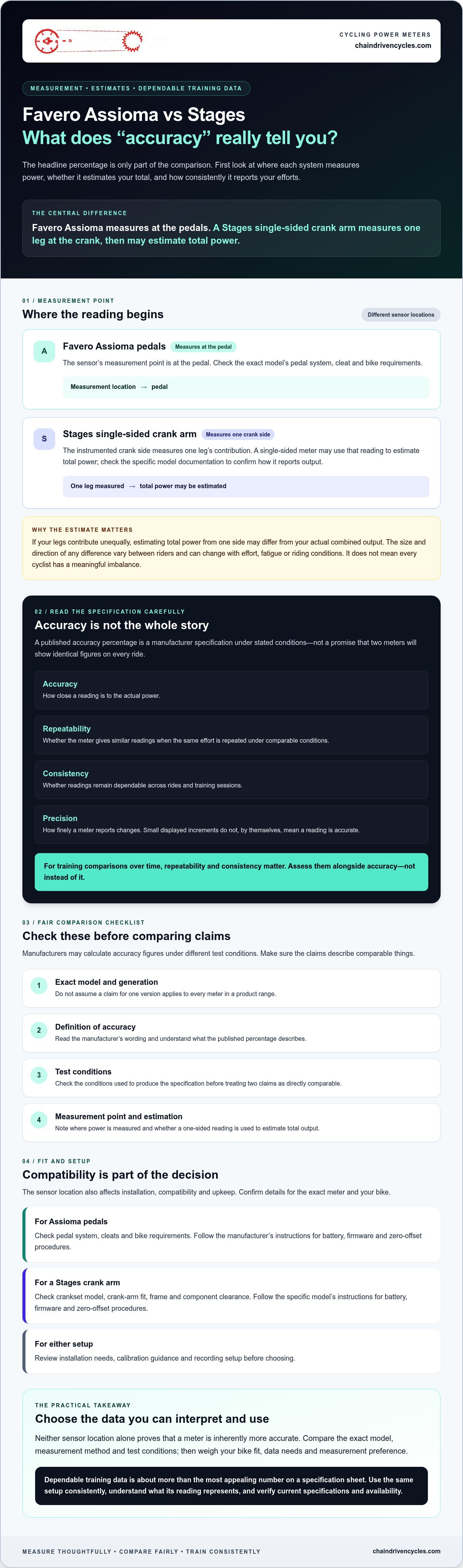
Compare power accuracy only after checking the exact model, test method and measurement point. A percentage on a specification sheet doesn’t guarantee that two meters will show identical figures on every ride. That matters in the Favero Assioma power accuracy vs Stages single-sided crank arm comparison: pedal meters measure power at the pedals, whilst crank meters measure it at the crank. A single-sided unit may also estimate total power from one leg.
A cycling power meter measures the force applied as you pedal and uses it with rotational speed to calculate power. For a neutral introduction to what a cycling power meter is, including the different sensor locations, see the overview of the technology. Measurement location helps explain why readings from different systems may not be directly interchangeable.
What does a power meter accuracy percentage tell you?
A published accuracy percentage is a manufacturer specification under stated conditions, not a promise that your ride file will match another meter exactly. Before comparing figures, confirm the exact model and generation, the manufacturer’s wording and the test conditions. Don’t assume a claim for one version applies to every meter in a product range.
It also helps to distinguish four related ideas:
- Accuracy is how close a reading is to the actual power.
- Repeatability is whether the meter gives similar readings when the same effort is repeated under comparable conditions.
- Consistency is whether readings remain dependable across rides and training sessions.
- Precision describes how finely a meter reports changes. A display showing small increments can still be inaccurate.
For training, repeatability and consistency matter because you need to compare efforts over time. But a meter can repeat a reading reliably without that reading being perfectly accurate. Assess both rather than treating one specification as the whole story.
How does a single-sided crank arm estimate total power?
Single-sided power estimation means measuring power from one leg and using that measurement to estimate your total output. A single-sided crank meter may double the measured side’s contribution, but check the documentation for the specific Stages model to confirm how it reports power.
If one leg contributes more than the other, doubling one side can produce a total that differs from your actual combined output. The size and direction of any difference vary between riders and can change with effort, fatigue or riding conditions. That doesn’t mean every cyclist has a meaningful imbalance. A single-sided meter may still provide useful, repeatable data for structured training, particularly when you understand what the number represents and use the same setup consistently.
How Favero Assioma pedals and Stages crank arms measure cycling power
Both systems calculate cycling power, but their sensors sit in different places. Favero Assioma measures at the pedals; a Stages crank-arm meter measures at the crank. That difference affects compatibility, installation and how readings relate to the force reaching the drivetrain. By itself, it doesn’t prove that one meter is faulty or inherently more accurate.
| Comparison | Favero Assioma pedals | Stages single-sided crank arm |
|---|---|---|
| Sensor location | At the pedal | On one crank arm, with the exact side and model to be confirmed |
| What it measures | Power at the pedal measurement point | Power from the instrumented crank side; check the model documentation to understand its reported output |
| Installation | Fitted in place of compatible pedals | Requires a compatible crankset and suitable frame and component clearance |
| Compatibility | Check pedal system, cleats and bike requirements for the exact model | Check crankset model, crank-arm fit and clearance for the exact meter |
| Upkeep | Follow the manufacturer’s instructions for battery, firmware and zero-offset procedures | Follow the specific model’s instructions for battery, firmware and zero-offset procedures |
In short: sensor location describes where power is measured; a single-sided total is an estimate based on one leg’s reading. This distinction is central to the Favero Assioma power accuracy vs Stages single-sided crank arm comparison.
What changes when the meter sits at the pedal rather than the crank?
Pedal-based meters can be convenient if you want to move a meter between compatible bikes, though each bike still needs to suit the pedal and cleat system. A crank-arm meter depends on crank compatibility: check the exact crankset, frame clearance and installation requirements rather than assuming it will fit because the bike is a road bike. Neither measurement point is automatically more accurate in every riding condition. For further testing context, see this in-depth review of Favero Assioma accuracy, while remembering that a past review doesn’t replace current model documentation.
Which factors can make two power meters disagree?
Before comparing ride files, follow each manufacturer’s instructions for zero-offset or calibration procedures. Temperature, battery condition and firmware may also be relevant, depending on the device, so check its guidance rather than applying the same procedure to every meter. Confirm that both devices are recording at the same interval and that head-unit settings such as smoothing aren’t changing how the figures appear.
A steady difference between two meters is not the same as erratic readings. A small offset may persist even when both devices report power consistently; readings that jump or vary unexpectedly warrant checking setup, fit, settings and the manufacturer’s troubleshooting advice. If you’re considering Assioma pedals, you can explore Assioma power-meter pedals and confirm compatibility before choosing.
Which is more dependable in practice: Assioma pedals or a Stages single-sided meter?
Neither design is the dependable choice for every rider. A meter is useful when it gives readings you can interpret and compare consistently, and when it suits your bike and training. In the Favero Assioma power accuracy vs Stages single-sided crank arm decision, the practical question is whether the measurement method and fit work for your needs, not simply which specification looks better.
A single-sided crank meter can provide a steady reference for pacing intervals and tracking changes over time. Its limitation is that total power may be estimated from one leg, so left-right differences can affect how closely the reported figure reflects combined output. That effect varies by rider and effort; it doesn’t automatically make a single-sided meter unsuitable. If you already have one that fits your crankset and produces consistent data, a stated accuracy difference alone may not justify replacing it.
Assioma pedals measure at the pedals, and a compatible setup may suit riders who want to move a meter between bikes. Check the exact model’s compatibility and installation requirements, and verify which sides it measures and what data it reports. Don’t assume every model offers the same measurement arrangement or features.
When can a single-sided crank arm be a sensible choice?
It may suit you if the meter is compatible with your existing crankset and you want straightforward power data for structured sessions. Keep the setup consistent when comparing workouts: use the same meter, follow its instructions and avoid drawing firm conclusions from one ride. If you’re concerned about left-right balance, consider whether that information would change your training decisions before choosing a different system.
When might Assioma pedal-based measurement suit your setup?
Pedals may be practical if you value pedal-based installation or expect to transfer a compatible meter between bikes. Confirm the pedal and cleat requirements for the specific model, then check that it suits each bike you plan to use. A specialist retailer can help you explore Assioma power-meter pedals and compatibility; the linked guide also explains how to train with a power meter, which can help put readings into context.
For a further reference point, DC Rainmaker’s in-depth accuracy analysis examines Assioma testing against other meters. Treat any review as useful context, not a substitute for checking current documentation for the exact model you’re considering.
How to compare power-meter accuracy fairly before you buy
A useful comparison starts with the exact devices and a consistent test, not two headline percentages copied from product pages. Manufacturer specifications are meaningful only when you understand what each figure describes and the test conditions behind it. For the Favero Assioma power accuracy vs Stages single-sided crank arm comparison, check the current documentation for each model rather than assuming details apply across a whole product range.
Comparable setups and repeatable testing matter more than an isolated reading. Use this checklist before buying or testing:
- Confirm the exact model and fit. Check crankset compatibility, pedal thread, shoe-cleat system, frame clearance and which bike you intend to use.
- Read the current product manual. Follow the model-specific installation, zero-offset or calibration, and firmware instructions.
- Check the data you need. Confirm the meter and head unit can record the metrics and data fields used by your training platform.
- Match the recording setup. Use the same head unit where possible, with consistent recording intervals, smoothing and other relevant settings.
- Compare specifications carefully. Check the manufacturer’s wording and test conditions before treating accuracy figures as directly comparable.
What should you check before installing either power meter?
Compatibility is specific, so don’t rely on a general product description alone. Confirm the pedal and cleat interface for an Assioma model, or the crankset and clearance requirements for the Stages unit you’re considering. Check current instructions for installation and calibration, and make sure the system records the data your training platform needs. If a manual or product page is unclear, resolve that before purchase rather than relying on assumptions.
How can you test whether readings are consistent?
Choose a repeatable effort, such as a steady interval on the same indoor trainer or a familiar route, and keep the bike, position and recording settings as similar as possible. Repeat the effort under comparable conditions rather than comparing unrelated rides affected by different terrain, fatigue or weather. For help choosing and setting up an indoor option, see this guide to indoor cycling trainer guidance.
Look for readings that behave steadily across repeated efforts. A consistent offset between two meters doesn’t, by itself, prove either is inaccurate; different measurement locations and methods can produce different values. Unstable or unexpectedly changing readings warrant checking installation, battery, firmware, calibration and recording settings. To explore Assioma pedal options, view Assioma power-meter pedals.
Choose the power meter that fits your bike, data needs, and next steps
The best choice depends on what will work reliably with your bike and give you useful training data. In the Favero Assioma power accuracy vs Stages single-sided crank arm decision, compare compatibility and measurement approach before focusing on a headline accuracy figure. A meter that fits your components and provides readings you can interpret consistently may be more useful than a specification that looks closer on paper but doesn’t suit your setup.
A quick decision framework for Assioma versus Stages
- Start with compatibility. Check your crankset, pedal and cleat system, frame clearance and intended bike against the exact model requirements.
- Consider transfer between bikes. If you want a pedal-based meter you can move between compatible bikes, verify the installation requirements for each bike.
- Think about measurement preference. A single-sided crank meter can suit straightforward training, but consider whether a left-right contribution difference could affect how useful its estimated total is for you.
- Prioritise comparable data. If you track progress across seasons or equipment changes, keep your setup and recording method consistent, or account for differences when interpreting results.
Neither option is a universal winner. If your current crank-based meter fits, behaves consistently and supports your training, a difference between manufacturers’ accuracy claims alone may not be a good reason to change. Switching measurement systems can also change the baseline, so don’t assume figures from different devices will match exactly.
What to do before committing to a power-meter change
Check the current manual and product support information for the exact model, including compatibility, installation, firmware and calibration guidance. Confirm that the meter records the data fields your head unit and training platform need. Also check that the product is currently available in the configuration you want; model names and specifications can vary, so don’t rely on an old review or broad product description as your only reference.
If crank, pedal, cleat or frame compatibility is uncertain, ask a qualified retailer or bicycle mechanic to assess the fit before buying. That’s a practical check, not a reason to choose one measurement system automatically. Match the device to your bike, training priorities and preference for measurement location.
Chain Driven Cycles sells Favero Assioma power-meter pedals, which are one option to investigate if pedal-based measurement suits your setup. Explore the range with your compatibility requirements in mind, then compare the exact model details with your training needs. The right decision is the one that gives you dependable, interpretable data on the bike you actually ride.
Choose a setup that supports your training
The Favero Assioma power accuracy vs Stages single-sided crank arm decision comes down to more than a specification. Check the exact model’s compatibility and instructions, consider how a single-sided estimate suits your training, and compare readings under consistent conditions. If your current meter gives stable, useful data and fits your bike, a difference in headline accuracy claims alone may not make a change worthwhile.
If you’re considering pedal-based measurement, make sure the pedal and cleat system suit your bike and riding setup. Chain Driven Cycles sells Favero Assioma power-meter pedals, and its professional bicycle repair services are another option for maintaining your bike.
Explore Assioma power-meter pedals at Chain Driven Cycles and check the current model details before deciding. With compatible equipment and a consistent approach to recording your rides, you can choose with confidence and focus on the training ahead.
Frequently Asked Questions
Is Favero Assioma more accurate than a Stages single-sided crank arm?
There’s no fair universal winner without comparing the exact models, their published specifications and the conditions behind those figures. A single-sided crank meter estimates total power from one measured side, so your left-right balance can affect its result. Assioma models also differ. For the Favero Assioma power accuracy vs Stages single-sided crank arm comparison, check current manufacturer documentation and consider repeatability as well as stated accuracy.
Can a single-sided power meter give accurate training data?
Yes, it can provide useful, consistent training data, but its estimated total depends on how well the measured leg represents both legs. Left-right contribution can vary with fatigue, intensity or riding conditions, and the effect differs between riders. Follow the exact meter’s setup instructions and compare repeated efforts in similar conditions. This helps you judge whether its readings are dependable enough for your training, rather than relying on a single ride.
How does a single-sided crank power meter calculate total power?
A single-sided meter measures power on one side and uses that reading to estimate total output, commonly by scaling it. The precise method depends on the model, so check the manufacturer’s documentation instead of assuming every Stages meter reports power in the same way. If your legs contribute differently, scaling one side may not reflect your combined output exactly. That doesn’t automatically make the data unsuitable for training.
What can cause Favero Assioma and Stages readings to differ?
Readings can differ because the meters measure at different locations, or because a single-sided system estimates total power. Zero-offset or calibration procedures, temperature, firmware and recording settings may also contribute. A stable offset between devices doesn’t automatically mean either is faulty. Check that each meter is fitted and configured correctly, follow its current instructions, and compare repeatable efforts using similar conditions and head-unit settings.
Can I move Favero Assioma pedals between bikes?
Pedal-based meters can be convenient to transfer between bikes, provided each bike is compatible with the exact Assioma model. Before moving the pedals, check the pedal threads, shoe-cleat system and installation requirements for both bikes. Follow Favero’s current fitting and calibration instructions each time. If you want to compare training data across bicycles, keep your recording setup consistent and remember that changing bikes or components may affect how readings compare.
Should I replace a working Stages single-sided meter with Assioma?
Not solely because one published accuracy figure appears better. First consider whether your current meter fits your bike, gives consistent readings and supports your training. A change may make sense if you need a different installation format, compatibility or measurement approach. Before deciding, check the current specifications for both exact models and, if possible, compare repeated efforts under similar conditions. A new meter may also establish a different baseline for your training data.
How can I compare two cycling power meters fairly?
Identify the exact models and check how each manufacturer defines accuracy and the conditions used to establish it. Follow the correct installation and calibration instructions, then use the same head unit and comparable recording settings where possible. Compare repeatable efforts under similar conditions, not unrelated rides. Note a stable offset separately from readings that vary unexpectedly. Manufacturer specifications and a controlled ride test answer different questions, so consider both when assessing performance.