



Bicycle Locks: How to Choose the Right Lock in 2026
The most secure bicycle lock on paper may not be the right one for your daily ride if it’s too heavy to carry or awkward to fit around your bike and a suitable anchor. Choosing bicycle locks means balancing resistance with practical details, including where you park and how long you leave your bike unattended.
Comparing lock types and security claims can be difficult. You may also be wondering how to secure the frame and wheels, or whether a cable is enough to protect removable parts. Those details matter as much as choosing a lock you’ll actually carry and use.
This guide explains the trade-offs between U-locks, chains, folding locks and cables, and how their size, construction and carrying options suit different routines and parking environments. You’ll also learn what to check in the product details, how to lock your bike effectively, and how to narrow down options for your needs.
Key Takeaways
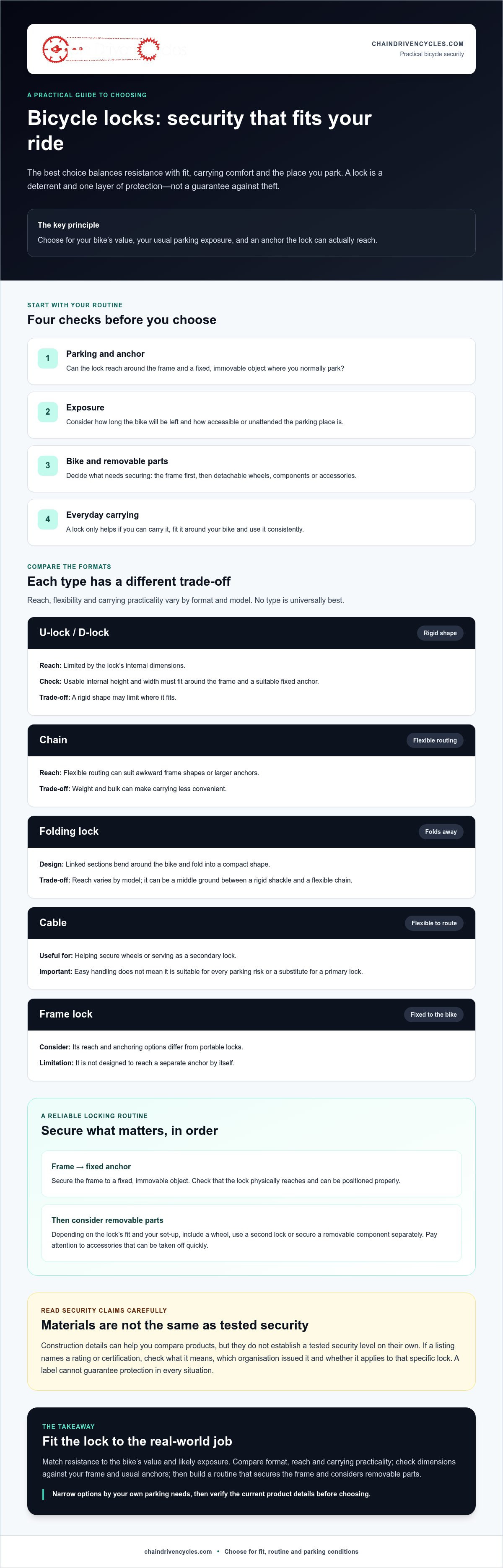
- Match a lock’s level of resistance to your bike’s value, where you park and how long it will be left unattended.
- Compare U-locks, chains, folding locks and cables by their reach, carrying practicality and intended use.
- When choosing between bicycle locks, check the dimensions against your frame and the fixed anchors you’re likely to use.
- Build a reliable locking routine: secure the frame to a fixed object, then consider how to protect removable parts.
- Use the article’s use-case shortlist to narrow your options, then check current product details before choosing.
Bicycle locks explained: what security does a lock actually provide?
A bicycle lock is a deterrent and one layer of protection, not a guarantee against theft. A sensible choice depends on the likely exposure: where the bike will be parked, how long it will be left, and its value. A bike left briefly in a visible place presents a different situation from one routinely parked for hours in an accessible, unattended location. Choose with your usual parking habits in mind, not just the lock’s advertised features.
What makes one bicycle lock different from another?
U-locks have a rigid shape that can limit where they fit; chains offer flexible reach but may be heavier to carry. Folding locks hinge into a compact form, whilst cable locks are often easy to handle but shouldn’t automatically be treated as suitable for every parking risk. Frame locks attach around a wheel, though their reach and anchoring options differ from portable locks. The Bicycle lock types overview provides further background on these formats and their trade-offs.
How should you think about bicycle-lock security?
Separate a product’s materials and locking mechanism from evidence provided by an independent rating or certification. Construction details can help you compare products, but they don’t establish a tested security level on their own. If a listing names a rating or certification, check what it means, which organisation issued it and whether it applies to the specific lock. A label doesn’t guarantee protection in every situation.
Fit matters, too. A lock can anchor your bike only if it reaches around the frame and a suitable fixed object. Before choosing a size, consider the frame’s shape and the anchors available where you normally park. A lock with limited reach may be difficult to use in some locations. Extra reach can make securing the bike easier, but may affect how convenient the lock is to carry.
Protect the frame first, then consider detachable parts. Depending on the lock’s fit and your parking set-up, you may be able to include a wheel in the same lock, use a second lock, or secure a removable component separately. Accessories also need attention if they can be taken off quickly. Check what the lock can physically secure rather than assuming every part is covered.
- Parking: Can you reach a fixed, immovable anchor?
- Exposure: How long is the bike left, and how accessible is the parking spot?
- Bike and parts: What needs securing, including detachable wheels or accessories?
- Routine: Will you carry and use the lock consistently?
In short: match the lock to the bike’s value, your usual parking exposure and the anchor you can actually use.
Bicycle lock types compared: choose between U-locks, chains, folding locks and cables
The right format is one you can carry, fit around your bike and use with the anchors available where you park. Each design balances reach, flexibility and everyday convenience differently. None is universally best, and a cable used on its own may not suit every parking risk.
| Format | Carrying and reach | Typical consideration |
|---|---|---|
| U-lock or D-lock | Rigid shape; reach is limited by its internal dimensions. | Check that it fits around the frame and a suitable anchor. |
| Chain | Flexible routing; weight and bulk can affect carrying. | Useful where a rigid lock’s shape or reach is awkward. |
| Folding lock | Linked sections fold into a compact shape; reach varies by model. | A middle ground between a rigid shackle and a flexible chain. |
| Cable | Flexible and often easy to route; length varies. | Can help secure wheels or act as a secondary lock, but isn’t automatically a substitute for a primary lock. |
| Frame lock | Fixed to the bike; not designed to reach a separate anchor by itself. | Consider whether it meets your needs for the way and place you park. |
When does a U-lock or D-lock make sense?
A U-lock uses a rigid shackle that closes into a crossbar. Check its usable internal height and width, not just its overall size. The shackle must fit around a suitable part of the frame and a fixed anchor, with enough room to position it properly. The Master Lock 8170 U-Lock and Master Lock 8195 U-Lock are examples to compare. Check their current listings for specifications rather than assuming their dimensions or features.
Are chain, folding and cable locks easier to live with?
A chain can route around awkward frame shapes or larger anchors, though carrying it may feel less convenient. A folding lock’s linked sections bend around the bike and fold away between stops. The Kryptonite Keeper Mini Folding Lock 80cm is one named example; confirm its current details and check whether its reach suits your set-up. The WB Key Cable Bicycle Lock is another example of a cable format.
A cable’s flexibility can help secure a wheel alongside a primary lock. Adding cable length doesn’t change the construction or security characteristics of that primary lock, so consider what each lock is actually securing. Check the product listing for confirmed specifications and use a cable in a role that suits its design.
Takeaway: choose for both everyday convenience and the anchor you can use. A lock that’s easy to carry but can’t reach a suitable anchor may not suit your parking routine. Compare current bicycle lock options by format and listed specifications.
How to compare bicycle locks: security features, fit and carrying
A useful comparison starts with the details that affect how a lock works for your bike and routine. Product names alone don’t tell you its usable dimensions, how it closes or how you’ll carry it. Check the full listing for current specifications, and compare like with like rather than inferring features from a model name or lock format.
Which lock features should you check before buying?
Look for details that are explicitly stated. Depending on the format, these may include shackle dimensions, chain length and construction, cable length, locking mechanism and any supplied mounting hardware. If a detail isn’t listed, don’t assume it from a photograph or the product name. Confirm it before relying on it to suit a particular frame or anchor.
Consider how you prefer to lock up. A key-operated mechanism means keeping track of a key; a combination mechanism avoids carrying one but relies on remembering the code. Neither is automatically the better choice for every rider. Think about which method you’ll use consistently and how easily you can manage it during everyday stops.
Treat a stated security score or certification as something to check, not a complete explanation of performance. Look up the issuing organisation and the current meaning of the rating, and make sure it applies to the exact product you’re considering. A stated material or construction detail is useful for comparison, but it isn’t the same as an independently verified security rating.
Will the lock fit your bike and your routine?
For a rigid U-lock, measure the space you need to secure: include the frame section, any wheel you want to capture and the fixed anchor. Allow for the shapes and clearance around the bike, rather than choosing by overall lock size alone. A shackle that looks large enough may not have usable internal dimensions for your actual parking set-up.
Flexible formats need a different check. A longer chain or cable may help you reach an anchor or route around a frame and wheel, but extra length can also affect how easy the lock is to carry and handle. Think about the parking points you use most, then assess the reach needed there.
- On the listing: Confirm length or internal dimensions, construction, locking method and included mount, if specified.
- On the bike: Check frame clearance and where the lock can sit while riding.
- For your routine: Consider the lock’s carrying method and whether a separate compatible mount may be needed.
Checking these details makes it easier to shortlist bicycle locks that fit both your bike and your daily habits. To compare the available formats and current product listings, browse the bicycle lock collection.
How to lock a bicycle well and avoid common security mistakes
A good routine starts with the anchor, not the lock. Choose a fixed, immovable object that the bike can’t simply be lifted over or moved with it, and make sure you’re allowed to lock to it. Avoid anything loose, damaged or easy to remove. Leave enough room for people to pass safely, and don’t obstruct entrances or public access.
What is a sensible way to secure a bike with a lock?
Work through the set-up in order. Position the bike beside the anchor, then pass the primary lock through the frame and around the anchor. Check that both are enclosed and the lock is properly closed. If the lock’s shape and reach allow it, include a wheel too. The exact arrangement depends on the bike and anchor, so check that the lock fits without forcing it.
Next, consider what remains unsecured. If a wheel or other component can be detached, you could secure it with a second compatible lock or a cable. A cable can provide useful reach for this purpose, but it shouldn’t be assumed to have the same construction as a rigid lock. A second lock isn’t mandatory for every situation; decide based on your bike, the parts you want to protect and where you’re leaving it.
Before walking away, check that the lock is fully engaged and the bike is stable. Position the lock neatly around the frame and anchor, without unnecessary slack or loose sections hanging down. A compact arrangement is less likely to snag or shift, but it doesn’t guarantee protection or make a lock impossible to defeat.
Which bicycle-lock mistakes should you avoid?
- Using a convenient but unsuitable anchor: A nearby object is no use if it can move, be lifted over or isn’t suitable for locking to. Check the anchor itself, not just whether it’s close.
- Leaving a wheel unsecured: If the main lock only captures the frame, consider whether the wheel needs a separate means of securing.
- Relying on cable length alone: A long cable may reach around more of the bike, but length doesn’t change its construction. Choose a primary lock appropriate to your parking situation.
- Guessing about fit: Check the lock’s usable reach against the actual frame and anchor before relying on it. An awkward fit can make proper locking difficult.
- Blocking access: Confirm that parking there is permitted and leave pathways, entrances and shared areas clear.
A consistent routine makes bicycle locks easier to use correctly: anchor the frame, secure detachable parts where practical, then check the whole set-up. Compare bicycle lock options by format and listed specifications.
Which bicycle lock should you buy? Product examples and next steps
Rather than looking for a single best option, shortlist locks by how you’ll use them. A rigid D-lock, a U-lock paired with a cable and a combination chain each offer a different balance of format and convenience. The examples below are starting points for comparison, not rankings or guarantees of theft prevention.
Which listed bicycle locks are useful examples to compare?
Use the product listing to confirm each lock’s current features and any stated rating. Check the meaning and applicability of security labels and scores before using them to judge one lock against another.
| Product | Confirmed listed feature | May suit a rider who… |
|---|---|---|
| Master Lock Gold Sold Secure D-Lock Plus Cable | Stated 13mm hardened-steel shackle. The product name includes “Gold Sold Secure”; verify the current certification details and what they apply to. | Wants to compare a D-lock format and is considering a cable as an additional way to secure a wheel or other component. |
| Zefal K-Traz U13 U-Lock with 120cm Cable | A U-lock supplied with a 120cm cable described for securing the wheel and saddle. | Would find a cable useful alongside a U-lock for parts beyond the primary lock’s reach. |
| Zefal K-Traz M12 Code Chain Lock | Listed as a chain lock with a combination system and a stated score of 12/20. Check the listing for the score’s source and context. | Prefers a chain format and combination locking, and wants to confirm its length and carrying practicality. |
How can shoppers narrow the final choice?
Start with your regular parking set-up. Consider how exposed the bike is, which fixed anchors are available, what parts you need to secure and whether the lock’s dimensions work with your frame. Then weigh that fit against the effort of carrying and using the lock on everyday rides. A feature is only useful if it suits your actual routine.
Before deciding, read the complete, current listing. Check the specified dimensions, construction, locking method, included cable or mounting hardware, and any variants or compatibility details. Don’t infer a feature from a model name, and don’t compare a stated score with a certification as if they were necessarily equivalent. If a rating is important to your choice, verify its current meaning and that it applies to the exact product.
There’s no single lock that suits every bike, parking arrangement or rider. Use the listed details to make a practical shortlist, then compare bicycle locks in the collection before choosing.
Choose a lock that fits your everyday ride
The right bicycle lock balances the security your parking routine calls for with a format you can carry and use consistently. Think about how long the bike is left, the anchors available and whether the lock can secure the frame and the parts you want to protect. Check dimensions and listed features against your bike and usual parking set-up before deciding.
U-locks, chains, folding locks and cables each involve practical trade-offs in reach, flexibility and carrying. A lock is one layer of protection, not a guarantee against theft, and it’s worth checking a security claim or rating before relying on it. A careful choice, paired with a sensible locking routine, can help you park with greater confidence.
The collection includes folding, U-lock, cable and chain formats, with examples from Master Lock, Zefal and Kryptonite. Compare the current listings to see which options suit your needs: compare bicycle locks in the collection.
Check the fit and listed features, then choose a lock that works for the rides you actually make.
Frequently Asked Questions
Is a U-lock better than a chain lock?
Neither is automatically better for every cyclist. A U-lock has a rigid shackle and defined internal dimensions, whilst a chain can offer more flexible routing around a bike and anchor. Compare the confirmed construction, usable reach and carrying requirements of each option, then check how it fits your frame and usual parking points. The more suitable lock is one that matches your likely exposure and that you can use consistently.
Can a cable lock secure a bicycle on its own?
A cable lock can offer flexible reach and may help secure a wheel or accessory, but its construction differs from a rigid U-lock or chain. Don’t assume that every cable suits every parking risk. Check the specific product details and consider how long the bike will be left and where it will be parked. If the situation calls for a more substantial primary lock, use one suited to that set-up.
How do I lock a bicycle to a fixed object?
Choose an appropriate, immovable anchor where you’re permitted to park. Pass the primary lock through the bike’s frame and around the anchor. If the lock’s dimensions allow, include a wheel as well. Check that the lock is fully closed, the bike is stable and the arrangement doesn’t obstruct other people. If the lock can’t reach both frame and anchor, change the parking position or choose a more suitable format before leaving the bike.
What happens if my bicycle lock is too small for the frame and anchor?
If a lock can’t fit around both the frame and a suitable anchor, it may not secure the bike as intended. Don’t force the lock or rely on securing only an easy-to-remove part. Before buying, compare its usable dimensions with your frame and the anchors you expect to use. A different size or a more flexible format may fit your set-up better; check the specific product measurements rather than relying on its name.
Are combination bicycle locks as secure as key locks?
The opening method alone doesn’t establish a lock’s overall security. A combination mechanism and a key mechanism describe how the lock is operated, not its complete construction or independently verified rating. Compare confirmed materials, dimensions and product features, and verify the meaning of any stated rating. Then choose the mechanism you can manage reliably: consider whether you’d rather keep track of a key or remember a combination.
Should I use two locks on my bicycle?
A second lock can help secure another component or add flexibility, but it isn’t essential for every bike or parking situation. Consider which parts the primary lock leaves unsecured and whether a second lock can be used effectively with a suitable anchor. A cable paired with a primary lock may provide extra reach for a wheel, but that combination doesn’t guarantee protection. Choose based on your bike, routine and available parking set-up.
How do I choose a bicycle lock for an electric bike?
Start with the bike’s parking routine: consider how exposed the location is, how long the bike will be left and whether the lock can secure its frame to an appropriate anchor. Check the dimensions against the frame and think about how you’ll carry the lock. Plan how to secure removable wheels or accessories, too. For general bike-type context, see the electric hybrid bikes guide, but confirm fit for your specific model.