



Bottecchia vs Wilier Road Bikes: A Premium Italian Buying Guide
Choosing the wrong Italian frame is often more than a minor oversight; it's a decision that fundamentally dictates your comfort on a six-hour epic or your power transfer in a local sprint. You likely appreciate the prestige and heritage of these historic marques, yet the sheer volume of technical jargon regarding carbon grades and frame stiffness can be genuinely confusing. It's perfectly normal to worry about whether a World Tour-ready geometry is too aggressive for your current fitness level or how these high-end frames handle less-than-perfect road surfaces.
This guide clarifies the Bottecchia vs Wilier road bikes debate by stripping away the marketing fluff to focus on performance metrics and ride quality. We'll help you understand each brand's unique personality, from the raw racing feedback of a Bottecchia Reparto Corse to the sophisticated aerodynamic integration found in Wilier's Filante range. You'll gain the confidence to select a frame geometry that matches your goals, whilst also learning how to maximise savings through the Bike to Work scheme to make your premium investment even more rewarding.
Key Takeaways
- Understand how specific carbon fibre grades and integrated aerodynamic designs influence the performance and vibration dampening of each frame.
- Evaluate Bottecchia vs Wilier road bikes based on their distinct geometries to ensure your chosen machine matches your fitness level and handling preferences.
- Identify the ideal model for your specific cycling goals, whether you prioritise lightweight climbing prowess or the raw power transfer required for sprinting.
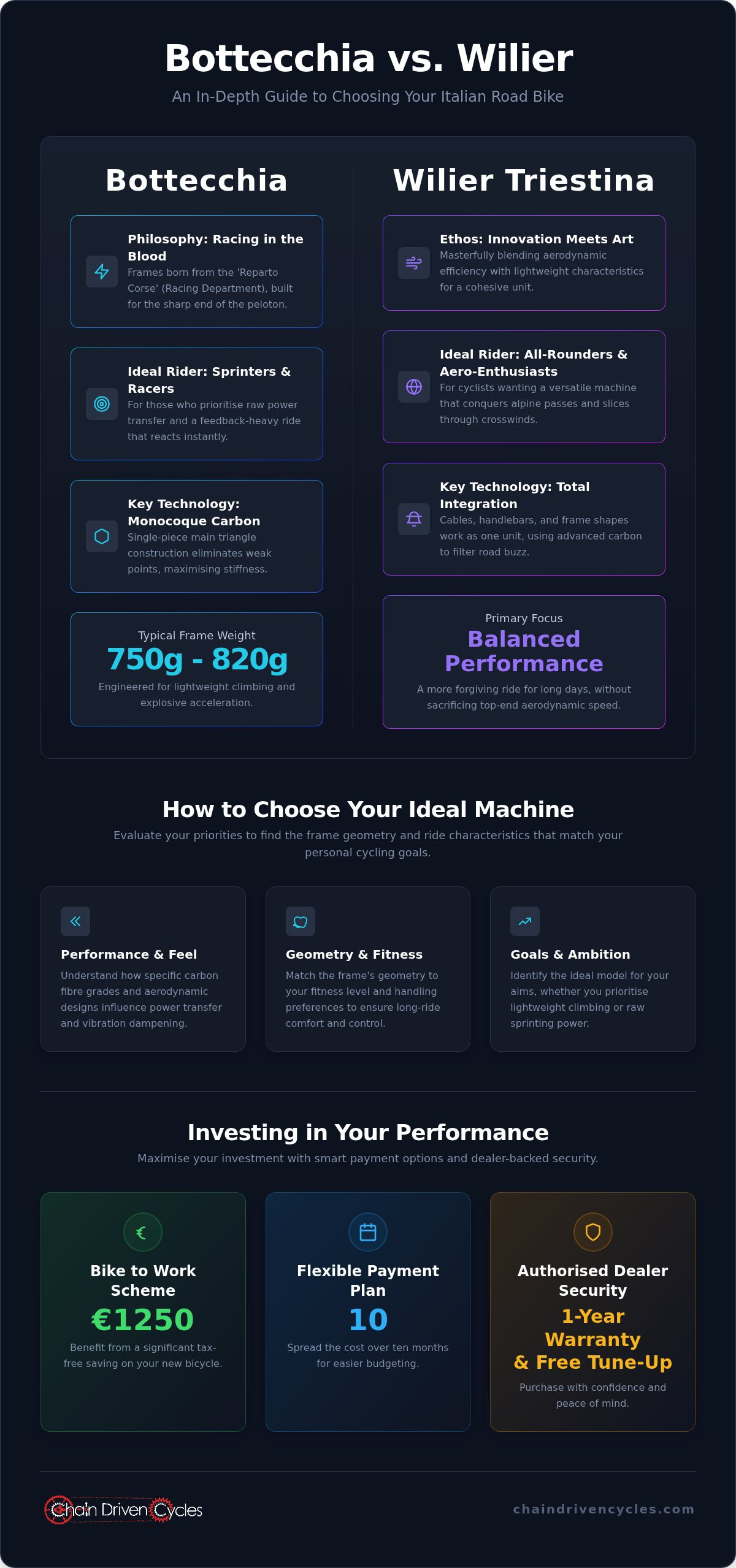
- Maximise your investment by utilising the €1250 tax-free Bike to Work scheme and our flexible 10-month payment plan for easier budgeting.
- Benefit from the security of purchasing through an authorised national dealer, including a one-year warranty and a complimentary tune-up service.
Choosing Between Bottecchia and Wilier Road Bikes: An Italian Rivalry
Italian cycling isn't merely about moving from point A to B; it's an expression of culture and competitive obsession. For over a century, brands from the Italian peninsula have set the standard for what a racing machine should be. When you compare Bottecchia vs Wilier road bikes, you aren't just looking at carbon fibre and components. You're weighing up two distinct legacies that have survived the toughest eras of the Giro d'Italia and the Tour de France.
These brands dominate the high-performance market because they refuse to treat a bicycle as a simple commodity. There is a perceived "soul" in an Italian frame, a combination of aggressive geometry and refined aesthetics that mass-produced alternatives often lack. This emotional appeal is backed by serious engineering, making them the favourite choice amongst enthusiasts who demand both style and substance. Whether it's the deep heritage of the Bottecchia name or the cutting-edge integration of a Wilier, each brand offers a unique perspective on what constitutes the perfect ride.
The Bottecchia Philosophy: Racing in the Blood
Bottecchia's identity is inseparable from its "Reparto Corse," or racing department. This division focuses on creating frames with extreme lateral stiffness to ensure every watt of energy translates into forward motion. A Bottecchia isn't designed for a casual Sunday stroll; it's built for the sharp end of a peloton. The typical rider is often a sprinter or a dedicated racer who prioritises raw power transfer and a feedback-heavy ride. If you enjoy the sensation of a bike that reacts instantly to a violent out-of-the-saddle effort, the Bottecchia philosophy will likely resonate with your riding style.
The Wilier Triestina Ethos: Innovation Meets Art
Wilier Triestina takes a slightly different path by masterfully blending aerodynamic efficiency with the lightweight characteristics usually reserved for climbing bikes. Their design language centres on "total integration," where cables, handlebars, and frame shapes work as a single, cohesive unit. Whilst Wilier frames are undeniably fast, they often offer a more balanced ride quality compared to the uncompromising stiffness of some rivals. The typical Wilier rider is an all-rounder or an aero-enthusiast. They want a machine that is as capable of conquering a 2,000-metre Alpine pass as it is slicing through a crosswind on a flat coastal road. This focus on versatility makes Wilier a formidable choice for those who value sophisticated engineering alongside classic Italian flair.
Engineering Excellence: Carbon Technology and Aerodynamic Innovation
The technical battle between Bottecchia vs Wilier road bikes is fought within the complex layup of their carbon fibre. While both manufacturers utilise high-modulus materials, their construction methods differ to meet specific performance goals. Modern frames must strike a delicate balance; they need enough lateral stiffness for explosive sprinting, yet sufficient vertical compliance to dampen vibrations on varied road surfaces. Total cable integration is now a standard requirement for aerodynamic performance, as exposed housings create turbulent air that slows you down at speeds above 30kph.
Frame construction directly dictates how a bike behaves when the tarmac gets rough. Bottecchia's focus on monocoque stiffness provides a direct, communicative feel that is exceptional for smooth racing circuits. Conversely, Wilier’s advanced material blends aim to filter out high-frequency road buzz, making them a slightly more forgiving choice for long, undulating days in the saddle. Finding the sweet spot between weight and stiffness is what separates these premium machines from entry-level carbon frames.
Bottecchia’s Technical Edge
Bottecchia's Reparto Corse line relies on sophisticated Monocoque carbon technology. By moulding the main triangle as a single piece, they eliminate the heavy joints and weak points associated with traditional bonding. They typically use high-modulus carbon to keep frame weights between 750g and 820g. This approach maximises power output, ensuring that every watt you press into the pedals is converted into forward momentum. It's a design philosophy that rewards riders who prefer a rigid, reactive platform for aggressive climbing and sprinting.
Wilier’s Aerodynamic Prowess
Wilier Triestina approaches engineering with an emphasis on "total integration." Their Filante and 0 SLR series use truncated aerofoil shapes to slice through the wind without the weight penalty of traditional aero bikes. A top-tier Wilier 0 SLR frame can weigh as little as 780g, which is remarkable for a bike with integrated features. They employ HUS-Mod carbon technology, which integrates liquid crystal polymers into the resin to improve impact resistance and vibration dampening. The integrated handlebar and stem are central to this, hiding cables entirely to reduce drag.
| Feature | Bottecchia (Reparto Corse) | Wilier (Filante/0 SLR) |
|---|---|---|
| Carbon Construction | Monocoque High-Modulus | HUS-Mod with Liquid Crystal Polymer |
| Integration Level | Internal routing prioritising stiffness | Full "Total Integration" cockpit |
| Typical Frame Weight | 750g to 820g | Approximately 780g |
You can explore the latest technical specifications across our full range of road bikes to see these engineering philosophies in person. Understanding these nuances helps you choose a machine that doesn't just look fast, but actually complements your physical strengths on the road.
Handling and Geometry: Finding Your Perfect Riding Position
Geometry acts as the skeleton of your ride, determining whether a bike feels like a twitchy racing tool or a stable companion. While our previous look at carbon layup focused on weight, it is the frame angles that dictate how Bottecchia vs Wilier road bikes handle at high speeds. Bottecchia typically employs steeper head tube angles and shorter wheelbases. This design prioritises rapid cornering and agility, allowing you to flick the bike through tight bends with minimal input. In contrast, Wilier often leans towards a more balanced geometry that provides confidence-inspiring stability, particularly when descending at speed on unpredictable surfaces.
Aggressive vs Endurance: Which Geometry Suits You?
For those unfamiliar with technical charts, the two most important figures are "Stack" and "Reach". Stack is the vertical distance from the centre of the bottom bracket to the top of the head tube, whilst Reach is the horizontal distance between those same points. A racier geometry usually features a low stack and a long reach. This forces your torso into a lower, more aerodynamic position. Whilst this is faster, it demands greater core strength and flexibility. If you plan on riding for five or six hours at a time, a frame with a slightly higher stack will reduce strain on your lower back and neck. Matching your frame size to your intended riding duration is essential for long-term enjoyment.
Ride Quality on National Road Surfaces
National road surfaces are rarely as pristine as a professional race circuit. High-modulus carbon is stiff, but without clever geometry and tyre choice, it can feel harsh on rougher asphalt. Both brands have adapted to this by increasing tyre clearance. The modern standard has shifted from 23mm to 28mm or even 30mm tyres. These larger volumes allow you to run lower pressures, which significantly improves vibration dampening without increasing rolling resistance.
Disc brakes have also become a non-negotiable standard, providing consistent stopping power on damp, grit-covered lanes where traditional rim brakes often struggle. This combination of wider tyres and reliable braking allows you to maintain speed through corners even when the surface is less than perfect. Whether you choose the sharp handling of a Bottecchia or the composed nature of a Wilier, ensuring your setup includes wider tyres will offer the best balance of speed and comfort for the varied conditions you'll face on every outing.
Practical Selection: Which Italian Machine Suits Your Riding Goals?
Identifying your rider profile is the first step in resolving the Bottecchia vs Wilier road bikes choice. The Climber requires a frame that feels weightless on 10% gradients, whilst the Sprinter demands a platform that won't flex during a 1,000-watt effort. For many, the Weekend Warrior profile is most accurate; you need a machine that is fast enough for the local club run but comfortable enough for a century ride. Investing in a Wilier road bike is a long-term performance choice, offering a balanced ride quality that remains rewarding as your fitness improves over several seasons.
Groupset selection often dictates the daily reliability of your machine. Shimano Di2 and SRAM eTap are the industry standards for electronic shifting. Di2 provides rapid, wired precision, whereas eTap offers a completely wireless setup for a cleaner aesthetic. These systems remove the frustration of gear indexing and cable stretch, ensuring every shift is crisp and immediate. This level of precision is particularly beneficial when you are under pressure during a steep climb or a fast-paced group ride.
Standout Models to Consider
The Bottecchia Emme series is designed as the ultimate climbing machine, prioritising a high stiffness-to-weight ratio for those who love tackling steep gradients. When comparing Bottecchia vs Wilier road bikes, the Emme stands out for its raw, communicative feedback from the road. If you prioritse speed and aerodynamics, the Wilier Filante SLR uses truncated aerofoil shapes to slice through the wind with minimal drag. For those seeking a perfect entry point into the world of Italian performance, the Bottecchia 8AVIO range provides a responsive carbon frame that doesn't compromise on the brand's racing DNA.
Component Integration: Power Meters and Trainers
The frame is just one part of your performance ecosystem. Adding Assioma power meter pedals is the most effective way to quantify your progress and manage your training intensity. These pedals provide accurate, dual-sided data that helps you avoid overtraining and pace your long-distance efforts perfectly. To maintain these gains through the colder months, integrating smart trainers into your routine ensures you don't lose your edge when the weather turns. Electronic shifting completes this setup, offering the precision needed for both indoor sessions and competitive outdoor efforts.
Explore our full range of road bikes to find the machine that aligns with your specific performance goals and budget.
Investing in Your Performance: Finance Options and the Bike to Work Scheme
Acquiring a world-class racing machine is a significant commitment. Whether you've finally settled the Bottecchia vs Wilier road bikes debate or are still weighing up the technical nuances, managing the financial aspect is the final step toward your new PB. We believe that premium Italian engineering should be accessible to dedicated riders, which is why we provide structured paths to help you manage the investment whilst securing a machine that will last for years.
A high-end carbon frame is more than just a purchase; it's a long-term performance asset. To make this easier, our 10-month payment plan allows you to spread the cost into predictable monthly instalments. For those looking to upgrade, our trade-in service offers a practical way to put the value of your current bicycle towards a new flagship model. This methodical approach ensures you don't have to compromise on componentry or carbon grade due to immediate budget constraints.
Saving Money with the Bike to Work Scheme
The Bike to Work scheme remains the most effective way to subsidise your new ride. In 2026, the tax-free allowance for standard bicycles is €1250. To claim this, you simply request a quote from us for your chosen model and submit it to your employer. The €1250 is then deducted from your gross salary over an agreed period, saving you the tax, PRSI, and USC you would have otherwise paid.
Because premium Bottecchia vs Wilier road bikes often exceed the €1250 limit, you simply pay the remaining balance yourself. This allows you to apply the maximum tax saving to a top-tier frame, significantly reducing the total cost of ownership. It's a straightforward process that makes professional-grade equipment much more affordable for the everyday cyclist.
The Chain Driven Cycles Advantage
Choosing a national authorised dealer provides peace of mind that a private sale or "grey market" import cannot match. Every high-performance bike we sell includes a professional setup by our expert mechanics. This is essential for high-end carbon frames to ensure that every bolt is torqued correctly and the electronic shifting is indexed perfectly. We also provide a free tune-up service after your initial few hundred kilometres to account for any minor cable stretch or component bedding-in.
- One-Year Warranty: Full coverage for manufacturing defects and peace of mind on your investment.
- Free Shipping: We provide secure, free shipping across Ireland for all road bike orders.
- Technical Expertise: As specialists in Italian performance, we offer the necessary expertise to maintain your bike for the long term.
Browse our full range of Bottecchia and Wilier road bikes today to find the machine that will transform your riding experience. Our team is ready to assist with sizing, technical questions, or help with your Bike to Work application.
Elevate Your Performance with Italian Excellence
Deciding between Bottecchia vs Wilier road bikes ultimately comes down to how you want to feel on the road. Whether you crave the raw, uncompromising stiffness of a Bottecchia Reparto Corse frame or the sophisticated, aerodynamic integration of a Wilier Filante, you're investing in a machine with a century of racing pedigree. By selecting the right geometry for your fitness and using the Bike to Work scheme to manage the costs, you can secure a professional-grade setup that enhances every mile.
As an authorised dealer for both marques, we support your journey with a 10-month interest-free payment plan and free national shipping. Every bike also includes a free tune-up service to keep your high-end carbon performing at its peak. We're here to ensure your transition to Italian performance is seamless and rewarding. Our expertise is always available to help you find the frame that matches your ambition.
Explore our premium road bike collection and start your Italian racing journey
Frequently Asked Questions
Is a Bottecchia road bike more aggressive than a Wilier?
Generally, yes. Bottecchia's Reparto Corse frames often feature steeper head tube angles and shorter wheelbases for rapid cornering and agility. Wilier tends to offer a more balanced geometry that prioritises stability during high-speed descents. The choice between Bottecchia vs Wilier road bikes depends on whether you prefer a twitchy, reactive racing feel or a composed, aerodynamic machine that handles unpredictable surfaces with confidence and ease.
Can I use the Bike to Work scheme for a bike that costs more than €1250?
You can apply the scheme to any bike regardless of the total price. The tax-free allowance is capped at €1250 for standard bicycles in 2026. If your chosen Italian machine exceeds this amount, you simply pay the balance yourself whilst still benefiting from the maximum possible tax savings on the first €1250. This makes premium carbon frames significantly more affordable for Irish employees through their PAYE system.
What is the main difference between Wilier Filante SLR and 0 SLR?
The Filante SLR is an aerodynamic specialist, whilst the 0 SLR is a lightweight climbing machine. The Filante uses truncated aerofoil tube shapes to reduce drag at high speeds on flat or rolling terrain. Conversely, the 0 SLR focuses on a high stiffness-to-weight ratio for maximum efficiency on steep gradients. Both models utilise Wilier’s HUS-Mod carbon technology and feature total cable integration for a clean, professional aesthetic.
Do Bottecchia and Wilier bikes come with a warranty?
Every new bicycle purchased through an authorised dealer like Chain Driven Cycles comes with a one-year warranty. This covers manufacturing defects and provides peace of mind for your investment. We also include a free tune-up service after your initial rides to ensure the components have bedded in correctly. Regular professional servicing is essential to maintain the structural integrity and performance of high-end carbon frames over their lifespan.
Are these Italian road bikes suitable for beginners?
Whilst these are high-performance machines, they are suitable for any beginner committed to the sport. Models like the Bottecchia 8AVIO Rev provide a more accessible entry point into Italian racing heritage without the extreme aggression of flagship models. We recommend a professional setup to ensure the geometry matches your current flexibility. Starting with a quality frame prevents the need for an expensive upgrade as your fitness and cycling goals improve.
How much can I save on a road bike using the 10-month payment plan?
The 10-month payment plan is designed to spread the cost rather than provide a direct discount. It allows you to budget for a premium machine without a large upfront capital outlay. By combining this with the Bike to Work scheme, you can maximise your monthly cash flow whilst securing a top-tier Bottecchia vs Wilier road bikes setup. This interest-free structure ensures you pay no more than the retail price for your machine.
What tyre width is best for Irish roads on a carbon road bike?
A tyre width of 28mm or 30mm is currently the best standard for varied Irish road surfaces. These wider tyres allow you to run lower air pressures, which significantly improves vibration dampening and grip on rough asphalt. Modern carbon frames from both brands are designed with increased clearance to accommodate these volumes. This setup offers a superior balance of comfort and rolling efficiency compared to traditional, narrower racing tyres.
Do I need a professional bike fit before buying a Wilier or Bottecchia?
A professional bike fit is highly recommended when investing in a premium Italian frame. Because these bikes often feature integrated cockpits, making adjustments to stem length or handlebar height later can be complex and costly. A fit ensures you select the correct frame size and geometry from the start. This prevents common injuries and ensures you can maintain an efficient, comfortable position during long-distance endurance rides or competitive events.