



Shifters and Derailleurs: The Ultimate Buyer’s Guide for 2026
Precision shifting isn't actually about buying the most expensive component in the shop. It is the result of a perfectly synchronised ecosystem where your shifters and derailleurs work in total harmony. If you have ever felt the frustration of a skipped tooth whilst climbing or the anxiety of wondering if those new parts will actually fit your frame, you're certainly not alone. Many cyclists find the technical jargon of drivetrain compatibility more exhausting than a category four climb.
We agree that your gear transitions should be felt, not heard. This guide will help you master the complexities of modern drivetrain components so you can achieve crisp, reliable shifting on every single ride. We will explore the 2026 options for wireless electronic systems and mechanical workhorses, providing the clarity you need to choose between industry leaders like Shimano and SRAM with absolute confidence. From understanding the ROI of premium groupsets to solving compatibility puzzles, you'll find the expert insight required to transform your bike's performance.
Key Takeaways
- Understand how the synchronised relationship between shifters and derailleurs defines your ride quality by acting as the command centre and the executioner of every gear change.
- Discover why prioritising a shifter upgrade can often provide a more immediate improvement in tactile feedback and ergonomic comfort than a new derailleur alone.
- Compare the maintenance requirements of traditional mechanical cables against the battery life and precision of electronic systems like Shimano Di2 and SRAM eTap.
- Master the rules of brand ecosystem compatibility to avoid the common pitfalls and frustrations of mixing components from different manufacturers.
- Learn how to make high-end Italian groupsets more accessible through professional installation services and flexible payment plans.
Understanding the Heart of Your Drivetrain: Shifters and Derailleurs
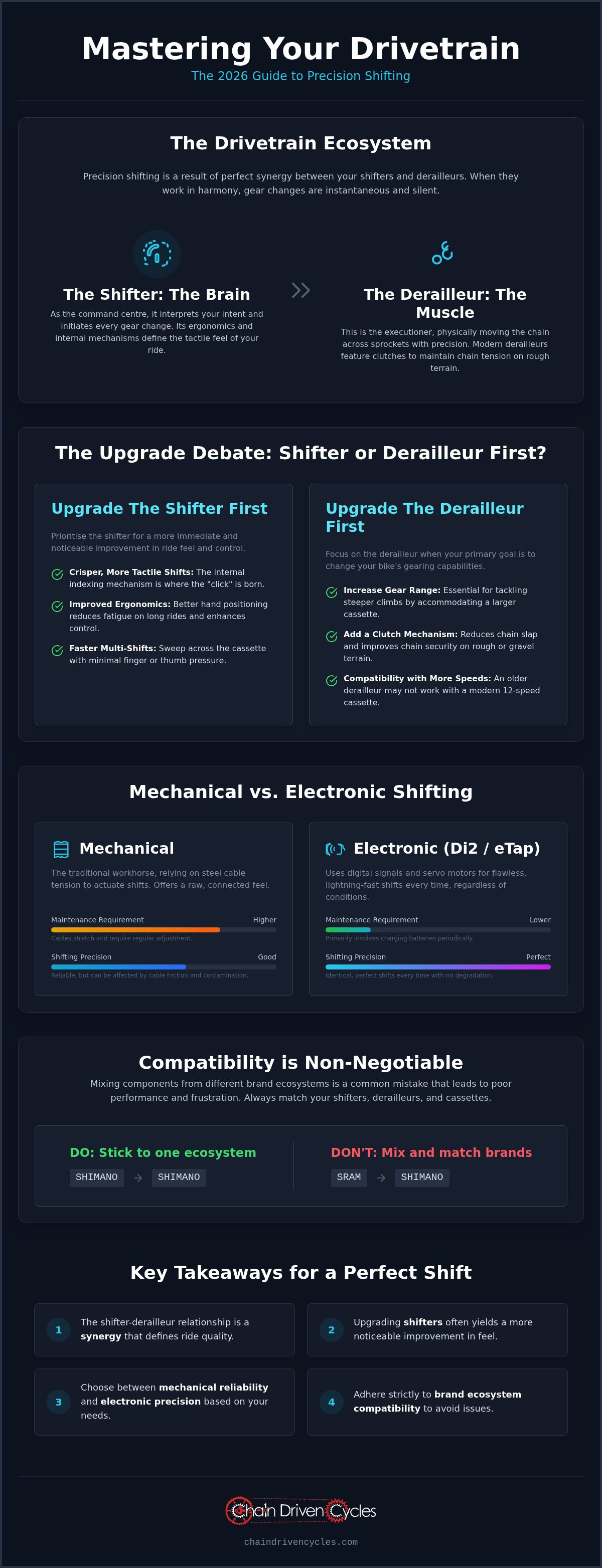
To achieve a truly synchronised ride, you must understand the relationship between your shifters and derailleurs. Think of the shifter as the control centre or "brain" of your bike. It's the component that interprets your intent and initiates a change. The derailleur acts as the "muscle", physically moving the chain across different sprockets to change your mechanical advantage. When these two parts work in perfect synergy, gear changes are instantaneous and silent. However, when that harmony is lost, you'll experience sluggish responses, frequent chain drops, or frustrating indexing issues that can ruin a Sunday morning spin.
Shifting technology has transformed dramatically over the decades. We've moved from basic friction levers mounted on the downtube to the sophisticated wireless electronic systems that dominate the market in 2026. This evolution has removed the physical effort and cable friction that once plagued long-distance riders. If your current setup feels heavy or requires multiple clicks to find the right gear, it's often a sign that the components are worn or that the technology has simply moved on.
The Role of the Gear Shifter
The shifter is your primary point of contact with the drivetrain. In mechanical systems, it manages precise amounts of cable tension to pull or release the derailleur. In electronic setups, it sends a digital signal to a motor. Ergonomics are vital here. Whether you prefer trigger shifters on a mountain bike, twist shifters for simplicity, or integrated road levers that combine braking and shifting, the feel of the lever matters. A well-designed shifter ensures you can change gears without shifting your hand position, which reduces fatigue on long rides and improves your overall control of the bicycle.
The Role of the Derailleur
The derailleur's job is to guide the chain between gears with surgical precision. The rear derailleur manages the cassette and maintains chain tension. Its cage length must match your gear range; longer cages are necessary for the large 12-speed cassettes common in modern setups. Front derailleurs handle the chain rings, though they're increasingly rare on off-road bikes. Many modern units, such as the Shimano Deore XT M8200 released in June 2026, feature clutch mechanisms. These increase spring tension to prevent the chain from bouncing off or slapping the frame when you're riding over rougher terrain or gravel paths.
The Great Debate: Should You Upgrade Your Shifter or Derailleur First?
When you're looking to sharpen your bike's performance, the choice between upgrading shifters and derailleurs often sparks heated debate in cycling circles. Most riders instinctively look at the rear derailleur first because it's the most visible and flashy component. However, mechanical precision often starts at the handlebars. Whilst the derailleur executes the move, the shifter houses the indexing heart that determines the speed and accuracy of that movement.
One factor to consider is the "trickle-down" effect of modern cycling technology. In 2026, mid-range components often incorporate the same shifting logic and materials found in pro-level gear from just a few seasons ago. A modern 12-speed shifter will frequently outperform an older, top-tier model simply due to advancements in internal ratchet designs and reduced friction. If your goal is a more tactile, immediate response, the bars are usually the best place to start.
Case for the Shifter Upgrade
Upgrading your shifter is the secret to achieving that "crisper" click. Premium shifters utilise higher-quality internal bearings and refined mechanisms that allow for faster multi-shifts, letting you sweep across the cassette with minimal thumb or finger pressure. Beyond the internal mechanics, high-end models offer significant weight savings and superior ergonomics. Better hand positioning and adjustable lever reach can drastically reduce fatigue during long climbs or technical descents. The quality of your shifter dictates the tactile feedback of the entire drivetrain. If you want your bike to feel brand new, changing the way you interact with the gears is the most effective route. Our expert workshop can help you determine which upgrade path offers the best return on investment for your specific frame.
Case for the Derailleur Upgrade
There are specific scenarios where the derailleur must take priority. If you're looking to increase your gear range for steeper gradients, you'll likely need a derailleur with a larger capacity and a longer cage to manage the extra chain slack. Modern rear derailleurs also feature enhanced spring tension and clutch mechanisms, which are essential for reliable shifting under heavy pedalling loads or on bumpy terrain. Furthermore, durability is a major hallmark of premium derailleurs. High-end units often swap out steel and plastic for carbon fibre and titanium, offering a more robust structure that resists flexing. This rigidity ensures the chain stays exactly where it's supposed to be, even when you're putting down maximum power during a sprint.
Mechanical vs Electronic Shifting: Choosing Your Gear System
The decision between mechanical and electronic shifters and derailleurs often comes down to how you value precision versus simplicity. With the wireless electronic segment projected to grow at a CAGR of 11.6% between 2026 and 2034, it's clear that many cyclists are moving away from traditional cables. Shimano Di2, SRAM eTap, and Campagnolo EPS systems have redefined what we expect from a drivetrain, offering a level of consistency that mechanical systems struggle to match over time.
The Mechanical Standard
Mechanical systems remain the favourite for long-distance tourers and riders who frequent remote areas. Their primary advantage is simplicity. If a cable snaps in the middle of the countryside, a basic multi-tool and a spare inner cable can get you moving again. Traditionalists also enjoy the tactile, mechanical "clunk" that provides direct feedback through the levers. However, these systems are susceptible to cable stretch and housing compression. To maintain peak performance, especially in wet British weather, you'll need to regularly clean your cables and occasionally tweak the barrel adjusters to keep your indexing sharp.
The Electronic Revolution
Electronic shifting removes the variables of friction and tension. You get a perfect shift every time with a light button press, even when you're pedalling hard out of the saddle. Systems like the 12-speed Shimano 105 Di2 offer a battery life of over 1,000 km per charge, whilst fully wireless options like SRAM Rival AXS typically provide between 800 and 1,000 km. Because there are no cables to stretch, these systems require almost zero re-indexing once set up correctly by a professional workshop.
Modern electronic shifters and derailleurs also offer extensive customisation through smartphone apps. You can re-map button functions, adjust shifting speed, or organise "synchro-shift" patterns that automatically move the front derailleur when you reach certain points on the cassette. While the initial investment is higher, the reduction in maintenance and the increase in reliability often justify the cost for enthusiasts. If you're looking to make the leap to electronic, our 10-month payment plan helps distribute the cost of these premium components, making pro-level technology more accessible for your next build.
Compatibility and Speed: How to Select the Right Components
Selecting the correct shifters and derailleurs requires more than just picking parts from the same brand. The golden rule of drivetrain mechanics is that your shifter speed must match your derailleur and cassette perfectly. If you try to use a 10-speed shifter with an 11-speed derailleur, the indexing will never align correctly. This is because the internal ratchet in the shifter is designed to pull a specific amount of cable for each click. That measurement must correspond exactly to the spacing between the cogs on your cassette to ensure the chain lands precisely where it should.
Matching Speeds and Ratios
Compatibility issues often stem from "pull ratios". This is the mathematical relationship between the amount of cable the shifter pulls and the distance the derailleur moves. SRAM and Shimano use fundamentally different ratios, which is why mixing them is a recipe for frustration. Even within a single brand, standards vary significantly between road and mountain bike components. For instance, Shimano road shifters and mountain bike derailleurs often use different cable pull standards. Drivetrain speed must be consistent across the shifter, derailleur, chain, and cassette to ensure smooth operation. When you upgrade from 10-speed to 11 or 12-speed, you'll also need to consider if your rear wheel hub can accommodate the specialised cassettes required by modern groupsets.
The Importance of the Derailleur Hanger
Sometimes, shifting problems aren't caused by the shifters and derailleurs themselves. The derailleur hanger is a small, sacrificial piece of metal that connects the derailleur to your frame. It's designed to bend or break during an impact to protect your expensive frame from damage. Even a slight misalignment in the hanger can mimic the symptoms of a failing derailleur, such as ghost shifting or a chain that won't stay in the highest gear. If your shifting remains inconsistent despite careful indexing, you may need a professional bike repair to align the hanger with precision tools. Ensuring this component is perfectly straight is the only way to achieve the silky smooth transitions we've discussed. To get your build started with the right parts, you can browse our full range of drivetrain components and consult with our technical team to verify compatibility for your specific frame.
Revitalise Your Ride with Premium Components from Chain Driven Cycles
Choosing the right shifters and derailleurs is a significant investment in your cycling future. At Chain Driven Cycles, we have curated a collection of 94 premium products from industry leaders to ensure every rider finds their perfect match. Our team understands that technical compatibility can feel like a minefield. Whether you're building a custom Wilier Road Bike or upgrading a trusted Bottecchia, we provide the expert guidance needed to ensure your components work in total harmony. Our authorised status with Shimano and SRAM means you're getting genuine parts backed by professional knowledge and long-term support.
Professional installation is the final piece of the performance puzzle. Our dedicated service centres offer expert workshop support to dial in your indexing with surgical precision. We don't just sell parts; we provide the Bicycle Repair Services required to maintain them for the long term. This methodical approach ensures your new drivetrain performs exactly as the engineers intended, preventing the premature wear that often results from poor home setup. If you're unsure about pull ratios or hanger alignment, our technicians are here to help.
Standout Products in Our Collection
Shimano Ultegra Di2 remains the gold standard for riders seeking pro-level performance and exceptional value. It offers the same lightning-fast shifting logic as Dura-Ace in a slightly more robust package. For those who prefer a clutter-free aesthetic, SRAM Force eTap AXS provides total wireless freedom and innovative gearing ranges that simplify your climbing experience. If you value Italian heritage and mechanical precision, Campagnolo Record is the perfect partner for high-end frames, offering a tactile shift feel that is truly unique amongst its peers. These systems represent the pinnacle of 2026 drivetrain technology.
Ready to Upgrade Your Shift?
We believe pro-level technology should be accessible to the entire national cycling community. Our flexible 10-month payment plan allows you to spread the cost of high-end electronic groupsets, making that dream upgrade a reality today. You can browse our full range online and enjoy the convenience of nationwide delivery directly to your door. Our stable and dependable expert team is always available to answer your questions before you commit to a purchase.
Shop the Shifters and Derailleurs Collection
Master Your Drivetrain Performance
Achieving a perfect gear change is about more than just expensive parts; it's about the confidence that comes from a well-optimised drivetrain. By understanding the synergy between your shifters and derailleurs, you can transform every climb and technical descent into a seamless experience. Whether you prefer the tactile feedback of a mechanical setup or the wireless precision of electronic systems, ensuring brand compatibility is the foundation of a reliable ride.
As an authorised dealer for Shimano, SRAM, and Campagnolo, Chain Driven Cycles offers the expert nationwide support and professional servicing required to dial in your setup with precision. Our flexible 10-month interest-free payment plan makes even the most advanced groupsets accessible for your next upgrade. Browse our full range of Shifters and Derailleurs to find the perfect match for your frame and riding style. We're here to help you navigate the technical complexities so you can focus on the road ahead.
Frequently Asked Questions
Can I use a Shimano shifter with a SRAM derailleur?
No, you generally cannot mix Shimano shifters with SRAM derailleurs because they use different cable pull ratios. The amount of cable pulled by a Shimano shifter does not match the movement required by a SRAM derailleur to move across the cassette. This incompatibility results in poor indexing and dropped chains. Whilst some third-party adaptors exist, we always recommend sticking to a single brand ecosystem to ensure the reliability and precision your drivetrain requires.
How do I know if my derailleur is worn out or just needs indexing?
You can identify a worn derailleur by checking for excessive "play" or wobbling in the pivot points and pulleys. If the component feels firm but gears are skipping, it usually just needs indexing or a new set of cables. However, if the spring tension has weakened or the cage is visibly bent, a replacement is necessary. Regular cleaning helps prolong life, but mechanical wear in the bushings eventually makes precise shifting impossible.
Is electronic shifting better than mechanical for climbing?
Electronic shifting offers a distinct advantage for climbing because it maintains precision even under high pedalling loads. When you're out of the saddle on a steep gradient, a mechanical system might hesitate or crunch. Electronic motors provide the consistent force needed to move the chain across the cassette instantly. This reliability allows you to maintain your cadence and rhythm without worrying about a missed gear or a mechanical slip during a tough ascent.
What is the difference between a short cage and a long cage derailleur?
The primary difference lies in the derailleur's capacity to manage chain slack across different gear ranges. Short cage models are designed for smaller road cassettes with tight gear steps. Long cage versions are essential for modern 1x setups or climbing cassettes with large 34T or 52T sprockets. Choosing the wrong length can lead to a chain that is too loose in small gears or one that snaps the derailleur when shifting into larger ones.
Do I need to change my chain when I buy a new derailleur?
We strongly recommend fitting a new chain whenever you install new shifters and derailleurs. An old, stretched chain will accelerate wear on your brand-new components and likely cause poor shifting performance from the start. Since chains are relatively inexpensive compared to a high-end derailleur, replacing them together ensures the best possible interface. It's a simple way to protect your investment and guarantee the silky smooth gear transitions you expect from an upgrade.
How long do electronic shifting batteries typically last?
Battery life depends on the specific system you choose. Shimano Di2 systems typically last over 1,000 km on a single charge because they use a larger internal battery. SRAM AXS systems use smaller, individual batteries on each derailleur, providing roughly 800 to 1,000 km of riding or about 20 to 25 hours of active shifting. It's good practice to check your levels via the manufacturer's app before any long-distance event or multi-day cycling tour.
Can I upgrade my 10-speed bike to 11-speed by just changing the shifter?
No, you cannot simply change the shifter to move from 10-speed to 11-speed. An 11-speed system requires a narrower chain, a cassette with different sprocket spacing, and a derailleur designed with the correct geometry for those specific increments. Upgrading your speed count usually involves a complete drivetrain overhaul. You should also check if your current rear wheel hub is compatible with the wider 11-speed or 12-speed cassettes before purchasing any new components.
What are the benefits of a clutched rear derailleur for road bikes?
Clutched shifters and derailleurs are becoming increasingly popular for road and gravel bikes because they significantly improve chain retention. The clutch mechanism increases spring tension on the cage, which prevents the chain from bouncing or "slapping" against the frame on rough surfaces or cobbles. This results in a much quieter ride and virtually eliminates the risk of the chain dropping off the rings. It's a vital feature for anyone riding on poorly maintained country lanes or light gravel.