



Road Bike Brake Upgrade Ireland: The 2026 Performance & Safety Guide
53.1% of Irish cyclists report a close pass from a vehicle on nearly every ride, a statistic that underscores why your ability to stop quickly isn't just a performance metric; it's a safety essential. Whether you're navigating a damp morning commute or a technical descent, a road bike brake upgrade Ireland riders can trust is the most effective way to regain control. We understand the frustration of brakes that squeal the moment the clouds burst, or that unnerving feeling when your levers lack the bite needed for a sharp corner. It's difficult to stay relaxed on the bike when you're fighting for modulation in the rain.
This guide will show you how to transform your stopping power and build descending confidence by choosing the right components for our unique climate. We'll explore the 2026 transition to hydraulic standards, solve compatibility questions across different groupsets, and explain how professional servicing ensures your system remains quiet and reliable all year round. From shorter stopping distances to smoother lever feel, discover how the right technical choices make every ride safer and more enjoyable.
Key Takeaways
- Understand why standard factory brakes often struggle in wet weather and how a road bike brake upgrade Ireland riders trust can significantly reduce stopping distances.
- Discover the critical differences between organic and sintered brake pads to choose the right balance of quiet operation and durability for Irish road conditions.
- Learn why converting a rim brake frame to disc is rarely feasible and explore the best dual-pivot or pad upgrades to maximise your current system's performance.
- Identify the "quick win" upgrade path that begins with high-quality cables and pads to provide immediate improvements in lever modulation and control.
- Recognise the importance of professional installation for hydraulic systems to ensure safety-critical components are fitted with the precision and specialised tools they require.
Why Upgrade Your Road Bike Brakes for Irish Conditions?
Riding in Ireland presents unique challenges that standard components often aren't designed to handle. While a factory groupset might suffice in drier, flatter climates, the combination of coastal salt air, frequent rainfall, and steep, winding terrain means a road bike brake upgrade Ireland enthusiasts invest in is often a necessity rather than a luxury. When you upgrade your braking system, you're not just adding safety; you're unlocking the true potential of your bicycle. High-performance frames from brands like Wilier or Bottecchia are engineered for speed and precision, yet that performance is often bottlenecked by mediocre braking. Understanding the evolution of bicycle brake technology helps illustrate why modern systems offer such a significant leap in reliability over older standards.
There is a direct relationship between braking confidence and your overall average speed. It sounds counterintuitive, but the faster you can safely slow down, the faster you'll feel comfortable riding. If you're constantly second-guessing your stopping distance on a greasy technical descent, you'll naturally hold back. A professional upgrade provides the bite and consistency required to carry more momentum through corners, turning a nervous ride into a controlled, high-speed experience.
Tackling Wet Weather and Road Grime
Irish winters are notorious for road salt and fine grit, which act like sandpaper on your braking surfaces. This abrasive mixture accelerates pad wear and can quickly degrade the performance of standard rim brakes. Upgrading to high-quality hydraulic systems or premium pads offers better protection against the elements. Superior seals in upgraded calipers prevent road grime from entering the system, which is a common cause of lever stickiness and hydraulic failure. Proper modulation is also vital here; it allows you to apply precise pressure to the rotors without locking up your wheels on slick, oil-slicked backroads.
Confidence on Steep Descents
Managing heat buildup is a critical concern on long, technical descents. Standard brakes can suffer from "brake fade" as temperatures rise, leading to a terrifying loss of stopping power. Upgraded rotors and pads are designed to dissipate heat more efficiently, maintaining a consistent feel from the top of the climb to the bottom. The psychological benefit of "one-finger" braking cannot be overstated. By reducing the physical effort required to slow down, you significantly lower hand fatigue during multi-hour endurance rides. This allows you to stay focused on your line and your surroundings rather than struggling with heavy, unresponsive levers.
Disc Brakes vs Rim Brakes: The Upgrade Dilemma
When planning a road bike brake upgrade Ireland riders frequently ask if they can convert an older rim brake frame to use modern discs. The short answer is almost always no. Disc-specific frames require reinforced mounting points on the fork and chainstay to handle the immense torque generated during stopping. Additionally, hub spacing and axle standards differ significantly. Unless you're prepared to replace your entire frameset and wheelset, your best path is to maximise the technology your bike was originally designed for.
The weight debate remains a significant talking point in 2026. A hydraulic disc system typically adds between 300 and 500 grams compared to a lightweight rim setup. However, the performance gains in Irish conditions far outweigh this slight penalty. Adhering to Road Safety Authority cycling guidelines means prioritising control and predictability. The ability to brake later and with more precision into corners actually results in faster segment times than the marginal gains of a slightly lighter bike on the climbs.
Maximising Rim Brake Performance
If you're staying with rim brakes, the quality of your components is paramount. Upgrading to dual-pivot calipers provides a more linear feel and increased stiffness, reducing the spongy sensation common with entry-level brakes. Pad selection is equally critical. You must use specific compounds for aluminium rims versus carbon surfaces to avoid overheating or poor friction. Don't overlook your cables. High-performance, compressionless housing ensures that every millimetre of lever pull translates directly into stopping power. You can browse our selection of premium rim brake components to find a compatible solution for your existing groupset.
The Superiority of Hydraulic Disc Systems
Hydraulic disc brakes are now the universal safety standard for 2026. Their primary advantage is consistency. Unlike rim brakes, which often require a full revolution of the wheel to clear water before they bite, discs provide immediate power in the rain. This is a game-changer for Irish weather. Beyond stopping power, disc frames allow for much wider tyre clearance. Many modern frames now accommodate 32mm or even 34mm tyres, which are the gold standard for grip and comfort on uneven road surfaces.
Maintaining these systems requires a specialised skill set. Air bubbles or contaminated fluid can compromise your safety, which is why professional road bike servicing is essential for periodic hydraulic bleeding and hose inspections. This ensures your upgrade remains a reliable partner on every technical descent.
Choosing the Right Brake Pads and Rotors
Selecting the right contact points between your calipers and wheels is the most cost-effective part of a road bike brake upgrade Ireland riders can perform. While the caliper provides the leverage, the pad compound and rotor design determine the actual friction and heat dissipation. It's not just about stopping; it's about how the brake feels under your fingers during a long day in the saddle. High-quality components ensure that your braking remains predictable, even when the weather turns.
Rotor size is your first major decision. While 140mm rotors are popular with weight-conscious racers, 160mm rotors provide significantly more stopping power. For most Irish terrain, where steep gradients and wet roads are common, a 160mm front rotor is the sensible choice for added safety. Once installed, new pads must be "bedded in" through a series of controlled stops. This process transfers a thin layer of pad material onto the rotor, ensuring maximum friction and preventing premature wear. You should also regularly inspect for glazing. This is a shiny, glass-like finish on the pad surface caused by excessive heat or light braking, which leads to a significant loss of bite and a noticeable squeal.
Brake Pad Compound Comparison
Organic pads, often called resin pads, are made from soft fibres bonded with resin. They offer an immediate, sharp bite and operate almost silently, making them a favourite for summer racing. However, they wear down quickly in the grit and grime of a typical Irish winter. Sintered or metallic pads are the durable alternative. They are made from metallic particles pressed together under high heat. While they can be noisier in the wet, they offer superior longevity and performance when the roads are covered in salt and road spray. Semi-metallic options provide a middle ground, offering better heat management than organic pads without the full noise profile of sintered versions.
High-Performance Rotors and Heat Management
Modern rotors have evolved far beyond simple steel discs. Premium models now feature integrated cooling fins that act as a heat sink, drawing temperature away from the braking surface. This technology is vital for preventing brake fade on long, winding descents where constant braking is required. You should also consider the mechanical benefits of floating rotors. These consist of a steel outer braking surface riveted to an aluminium inner carrier. This design allows the braking surface to expand and contract independently of the carrier, preventing the rotor from warping under extreme heat. Maintaining high-end cycling components like these ensures that your road bike brake upgrade Ireland continues to perform at its peak through every season.
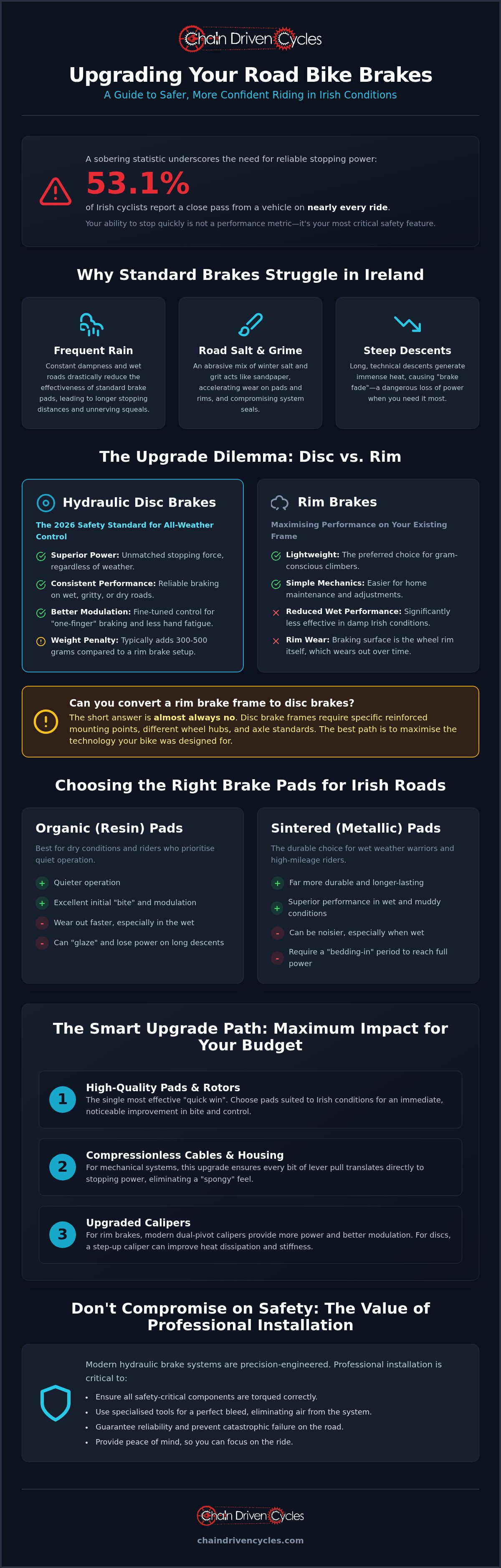
The Step-by-Step Road Bike Brake Upgrade Path
Approaching a road bike brake upgrade Ireland riders can manage often feels daunting due to the technical variables involved. You don't always need to replace the entire system at once. A logical, tiered approach allows you to address the most significant performance bottlenecks first while staying within a specific budget. By following a structured path, you ensure that every new component works in harmony with your existing setup, whether you're riding a high-end Wilier or a dependable winter trainer.
The process begins with a thorough assessment. You must identify if your current levers are compatible with higher-tier calipers, as pull ratios differ between brands and generations. The four-step path usually looks like this:
- Step 1: Assess compatibility and check for wear in your current housing and fluid.
- Step 2: Execute the "Quick Win" by installing premium pads and, for rim brakes, compressionless cables.
- Step 3: Upgrade hardware, such as rotors or calipers, to improve heat management and modulation.
- Step 4: Achieve full integration by matching the entire braking system to a single groupset series.
Common mistakes can compromise your safety and investment. Mixing brands, such as trying to use Shimano calipers with SRAM levers, leads to poor performance because the fluid types and leverage designs are fundamentally different. Ignoring bleed intervals is another frequent error; hydraulic fluid absorbs moisture over time, which can lead to a "spongy" feel and reduced power during long descents.
Phase 1: Consumables and Small Gains
Fresh, high-quality brake fluid is arguably the most cost-effective performance upgrade available. If your hydraulic levers feel sluggish, a professional bleed with premium mineral oil or DOT fluid can restore that "new bike" snap. For those on rim brake systems, replacing standard cables with compressionless housing is transformative. Standard housing flexes under pressure, wasting energy that should go to the rim. Premium pads also play a vital role here; they offer better bite whilst being kinder to your expensive wheel rims, extending the lifespan of your equipment.
Phase 2: Significant Component Upgrades
Once you've optimised your consumables, the next step involves hardware. Upgrading your calipers can provide a stiffer platform, which translates to better modulation and a more linear braking feel. It's essential to select calipers that precisely match your shifters' pull ratio to avoid a wooden or unresponsive lever. On the disc side, moving to larger or more aerodynamically efficient rotors helps dissipate heat faster, which we previously noted is critical for Irish descents. You can browse our full range of brakes and parts to find the exact components needed for your specific groupset. If you're planning a major overhaul, our bicycle repair services provide the expert installation required for these safety-critical parts.
Professional Installation and Maintenance in Ireland
Brakes are the most safety-critical component on your bicycle. Whilst many riders enjoy basic home maintenance, a complex road bike brake upgrade Ireland enthusiasts choose often requires specialised mechanical expertise. Modern hydraulic systems operate under high pressure with incredibly tight tolerances. A single loose fitting or a slightly misaligned caliper can lead to fluid leaks or inconsistent performance. Professional installation ensures that every bolt is torqued to manufacturer specifications, protecting both your safety and your component warranty.
Specialised tools are a prerequisite for a successful upgrade. Hydraulic hose cutting requires a dedicated tool to ensure a perfectly square edge, which is essential for a leak-free seal with the olive and barb. Similarly, professional-grade bleed kits are necessary to cycle fluid through the system without introducing contaminants or air. At Chain Driven Cycles, we use precision equipment to ensure your system feels firm and responsive from the very first pull. Our bicycle repair services are designed to handle these technical intricacies, providing the peace of mind that comes with expert craftsmanship.
The Benefits of Expert Servicing
Precision is the difference between a system that merely works and one that performs flawlessly. Expert caliper alignment is vital to eliminate disc rub, that persistent metallic noise that saps wattage and causes uneven pad wear. Beyond the physical hardware, professional bleeding removes microscopic air bubbles that often linger in home-serviced systems. These bubbles expand under heat, leading to lever fade on long Irish descents. Understanding these technical nuances is just as important as knowing how to choose a road bike for Irish terrain in the first place. A well-maintained system doesn't just stop better; it provides the tactile feedback you need to ride with total confidence.
Investing in Your Performance
We believe that high-tier safety and performance should be accessible to every dedicated rider. To help you manage the cost of premium components, we offer a 10-month payment plan for high-end equipment. This allows you to spread the investment over nearly a year, making a full hydraulic road bike brake upgrade Ireland-wide more manageable. Whether you're upgrading a Wilier frame or refreshing a Bottecchia, this finance option ensures you don't have to compromise on component quality.
Once your upgrade is complete, a regular maintenance schedule is essential. We recommend a professional bleed at least once a year, or more frequently if you're tackling high mileage in winter conditions. Regular inspections of rotor thickness and pad wear will keep your system operating at peak efficiency. Ready to transform your stopping power? You can secure your brake upgrade parts today through our online store and take the first step toward a safer, faster ride.
Master Every Descent with Confidence
Your ability to stop with precision is the foundation of every great ride. As we have explored, a road bike brake upgrade Ireland riders choose is about more than just safety; it's about the confidence to carry speed through technical corners and the reliability to ride year-round in our unpredictable climate. By selecting the correct pad compounds and ensuring your hydraulic system is professionally maintained, you remove the performance bottlenecks that often hold back even the most advanced frames.
Chain Driven Cycles is proud to be an authorised premium brand specialist, offering the technical expertise required for precision maintenance and safety-critical installations. We make high-end performance accessible through our 10-month payment plan, ensuring you don't have to compromise on quality. Whether you're refreshing your current setup or planning a full system overhaul, our professional bicycle repair services are here to support your journey.
Upgrade your stopping power: Shop the full Brakes collection
Take the next step in your performance journey today. We look forward to helping you achieve a quieter, more reliable, and ultimately faster ride on the roads you love.
Frequently Asked Questions
How do I know if my road bike brakes need an upgrade or just a service?
You can tell if you need a road bike brake upgrade Ireland riders often consider by checking for persistent spongy lever feel or visible corrosion on the caliper pistons. If a professional bleed and fresh pads don't restore that crisp, immediate bite, your internal seals or mechanical linkages may be worn beyond repair. Upgrading is often more cost-effective than attempting to rebuild old, entry-level calipers that have suffered from years of road salt exposure.
Can I mix Shimano and SRAM brake components on the same bike?
You should never mix Shimano and SRAM braking components because they are fundamentally incompatible. Shimano systems use mineral oil whilst SRAM systems require DOT fluid; mixing these will destroy the internal seals and lead to total brake failure. Additionally, the cable pull ratios and hydraulic leverage ratios differ between brands. To ensure your safety and performance, it is essential to maintain a system using components from the same manufacturer and groupset series.
Are carbon-rim-specific brake pads really necessary for my Bottecchia?
Carbon-rim-specific pads are essential for your Bottecchia to prevent catastrophic rim failure. Standard brake blocks are designed for aluminium and generate far too much heat when used on carbon surfaces, which can lead to the resin melting or the rim warping. Carbon-specific pads are formulated to provide the necessary friction on a smoother surface. Using the wrong compound will result in dangerously long stopping distances, especially when descending in damp Irish weather.
How often should I bleed my hydraulic road bike brakes in Ireland?
We recommend bleeding your hydraulic brakes at least once every twelve months to maintain peak performance. Ireland’s high humidity and frequent rain mean that hydraulic systems are more susceptible to moisture ingress, which lowers the boiling point of the fluid and causes a spongy lever feel. If you are a high-mileage rider or frequently tackle steep technical descents, a bi-annual service ensures that your stopping power remains consistent and your internal components stay protected.
Will upgrading my rotors really help with braking noise in the rain?
Upgrading to high-performance rotors can significantly reduce braking noise in the rain. Premium rotors often feature advanced drilling patterns and cooling fins that help clear water and road grit from the braking surface more efficiently than standard discs. This faster clearing action reduces the vibration that causes that high-pitched squeal. When paired with the correct pad compound, a rotor upgrade provides a much quieter and more predictable experience during wet winter training rides.
What is the best brake pad compound for the Irish winter?
Sintered metallic pads are the superior choice for the Irish winter due to their exceptional durability in gritty conditions. Unlike organic pads, which can wear down completely in a single wet, sandy ride, sintered compounds are made from metallic particles that resist abrasion from road salt and fine grit. Whilst they take slightly longer to warm up and can be noisier, their longevity and consistent performance in the rain make them the most reliable option for year-round cycling.
Is it possible to upgrade from mechanical to hydraulic disc brakes?
It is possible to upgrade from mechanical to hydraulic disc brakes, but it typically requires replacing your shifters as well as your calipers. Since the master cylinder for a hydraulic system is located inside the lever body, your existing mechanical shifters cannot push the fluid needed. This is a significant road bike brake upgrade Ireland cyclists often perform to achieve better modulation and reduced hand fatigue, particularly on long endurance rides or technical coastal routes.
How much does a professional brake installation cost at Chain Driven Cycles?
The cost of professional brake installation depends on the complexity of your current setup and whether your bike features internal cable routing. A simple pad replacement and adjustment is a straightforward task, whereas a full hydraulic system installation involving hose cutting and specialised bleeding requires more time. We invite you to contact our workshop directly or book through our bicycle repair services to receive an accurate quote tailored to your specific bicycle and component choices.