



Assioma power meter pedals, training benefits and prices
Your legs can feel strong while your pace stays the same, but power gives you a clearer way to assess effort. A pedal-based meter measures force at the pedal and combines it with crank speed to calculate your output in watts. Assioma power meter pedals provide this reading, helping you pace efforts and compare training sessions using a consistent measure.
To make training data useful, understand what the number means and how to apply it. Power can guide interval intensity and show how your effort changes during a ride. It also gives you information that speed alone cannot, since speed varies with terrain and conditions.
This guide explains how pedal power is measured, what it can add to your training and what affects the cost of a power meter. It also compares the practical considerations for Assioma road and off-road options, so you can identify the setup that suits your riding and equipment.
Key Takeaways
- Use power readings to pace efforts and compare training sessions, rather than relying on speed alone.
- Compare pedal options by intended riding and setup to understand what shapes the buying decision.
- Explore how second-generation road and off-road designs can suit different riding needs.
- Match the pedal system to your cleats: Assioma PRO RS pedals are compatible with Shimano SPD-SL® cleats.
Why Is It Useful to Train with a Power Meter?
A power meter measures effort in watts, giving you a clear target for each interval. Unlike speed, power describes your output when a climb, headwind or changing road surface affects pace. For example, you can compare how steadily you hold an effort on two different rides. Assioma power meter pedals measure power at the pedals, making the data available during training and for later review.
Use the readings to structure a session: set an effort target, monitor your output, then review how consistently you held it. This makes repeated intervals easier to compare, even when route conditions vary. Power can also show when your effort rises on a hill, but the number alone does not explain fatigue, comfort or technique. Consider the data alongside how the ride felt, while ensuring your overall energy and recovery are supported with clean nutritional choices from My Wellness.
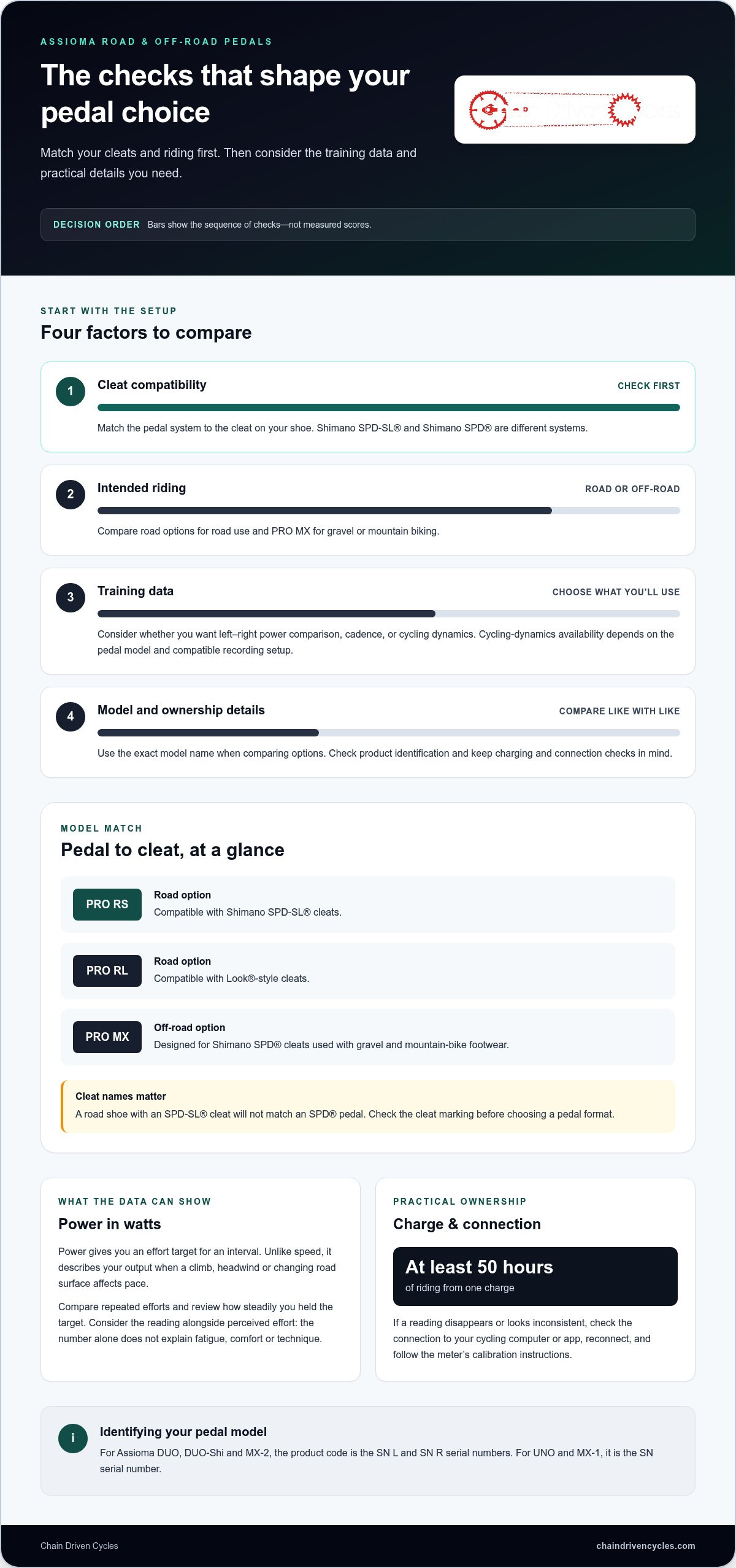
Cleat compatibility is a practical consideration when choosing a system. Assioma PRO RS pedals are compatible with Shimano SPD-SL® cleats, a road-style option. Assioma PRO RL pedals are compatible with Look®-style cleats. Assioma PRO MX pedals are designed for the Shimano SPD® system used with gravel and mountain-bike footwear. Match the pedal to the cleat on your shoe.
That distinction matters when switching between bikes. Shimano SPD-compatible gravel and mountain-bike pedals use a different cleat system from Shimano SPD-SL-compatible road pedals. A road shoe with an SPD-SL® cleat will not match an SPD® pedal just because both systems carry Shimano’s name. Check the cleat marking before buying, then choose the corresponding pedal format.
If an Assioma reading disappears or looks inconsistent, check the connection to your cycling computer or app, then reconnect and follow the meter’s calibration instructions. Keep the pedals charged; one charge lasts at least 50 hours of riding. A fresh charge and a correct pairing are sensible first checks before reviewing a training file.
For a useful comparison, repeat a familiar interval and note both power and perceived effort. Together, they can help you spot changes in pacing without treating one reading as the whole story. Clear targets, compatible cleats and consistent recording make pedal data easier to use from ride to ride.
Power-meter pedal prices
Compare power-meter pedals by model and intended riding, not by headline cost alone. With Assioma, first identify the pedal system that matches your shoes and riding.
Comparing pedal prices
Begin your comparison with the exact model name. Assioma PRO RS, PRO RL and PRO MX are distinct options, so compare like with like rather than treating every pedal meter as interchangeable. Check the intended riding style, cleat compatibility and fit with your existing setup. These details help explain why two products in the same category may not be equivalent purchases.
Product starting prices
Starting prices can provide a reference when comparing product ranges, but they don’t describe every option or configuration. The research price figures for Assioma models are in dollars, so they can’t be presented as Irish euro prices. Instead, use the exact model name to compare relevant product information, such as the PRO RS for road riding or PRO MX for off-road use.
Before deciding, work through a simple comparison:
- Choose the riding use: distinguish road options such as PRO RS and PRO RL from off-road PRO MX.
- Match your cleats: PRO RS suits Shimano SPD-SL® cleats, while PRO RL is compatible with Look®-style cleats.
- Compare the same model: use the product name and pedal system when reviewing options, rather than comparing broad categories.
Keep the decision focused on fit and intended use, rather than an isolated price. If you use Shimano SPD-SL® shoes, compare the compatible PRO RS option. If your setup uses Look®-style cleats, compare PRO RL. For off-road riding, consider PRO MX alongside your gravel or mountain-bike setup.
Once you have narrowed the choice to a compatible model, consider how it fits your bike and training plans. Comparing specific models makes the cost information easier to interpret and helps you avoid weighing unlike options against one another.
Second-generation Assioma road and off-road power meter pedals
Assioma’s road and off-road options let you match the pedal format to your riding. Start by identifying your cleats and the types of routes you ride.
For road use, PRO RS pedals are compatible with Shimano SPD-SL® cleats. PRO RL pedals work with Look®-style cleats, giving riders another road setup to consider. For gravel and mountain biking, PRO MX pedals use Shimano SPD® cleats. This distinction matters when choosing between a road-shoe setup and footwear designed for off-road riding.
A dual-sided power meter can compare left and right contributions, while cadence records pedalling rate. Cycling dynamics are separate metrics, and their availability depends on the pedal model and compatible recording setup. Consider which data you will use in training instead of assuming every pedal records the same measurements.
Check the product identification details when setting up or registering your pedals. For Assioma DUO, DUO-Shi and MX-2, the product code is the SN L and SN R serial numbers. For UNO and MX-1, the product code is the SN serial number. These identifiers distinguish the relevant pedal models and are useful when you need to identify your equipment.
Battery use is another practical part of ownership. A charge of the Favero Assioma pedal batteries lasts for at least 50 hours of riding. Keep charging in mind when planning regular training, particularly if you record longer rides or several sessions between charges.
To narrow your choice, follow these steps:
- Identify your cleats: match Shimano SPD-SL® with PRO RS, Look®-style with PRO RL, or Shimano SPD® with PRO MX.
- Choose your riding: compare road models for road use and PRO MX for gravel or mountain biking.
- Consider your data needs: decide whether left-right comparison, cadence or cycling dynamics matter for your training.
- Note the model code: use the relevant serial-number format when identifying your pedals.
Are Assioma pedals compatible with Shimano, Look, and other cycling shoes and cleats?
Compatibility depends on the cleat fitted to your shoe, not just the shoe brand. Assioma PRO RS pedals are compatible with Shimano SPD-SL® cleats, while Assioma PRO RL pedals are compatible with Look®-style cleats. Match the cleat system before choosing a road pedal.
For example, a road shoe fitted with a Shimano SPD-SL® cleat corresponds to the PRO RS system. A shoe fitted with a Look®-style cleat corresponds to PRO RL. The shoe manufacturer alone does not establish compatibility: check the cleat itself and identify its system. This is especially useful when replacing pedals but keeping your current shoes.
Use this quick check before buying:
- Read the cleat marking: identify whether your shoes use Shimano SPD-SL® or Look®-style cleats.
- Match the pedal: choose PRO RS for Shimano SPD-SL® cleats or PRO RL for Look®-style cleats.
- Check both shoes: make sure the same cleat system is fitted to each shoe.
Shimano SPD® and Shimano SPD-SL® are different cleat systems. PRO RS is specifically compatible with SPD-SL®, not every Shimano cleat. Similarly, PRO RL is specified for Look®-style cleats. If your footwear uses another system, do not assume it matches either road option based on brand alone.
For gravel or mountain-bike footwear, cleat choice may differ from a road setup. Compare the cleat on your shoe with the stated compatibility for the pedal model. PRO MX is an off-road model, but match it to its specific cleat system rather than inferring compatibility from the words “gravel” or “MTB”. This helps avoid confusing road and off-road shoe standards.
Before changing your setup, check the cleat label and compare it with the pedal’s stated system. For Shimano SPD-SL®, choose PRO RS; for Look®-style cleats, choose PRO RL. Matching the cleat and pedal makes your choice more straightforward.
Chain Driven Cycles: Bottecchia bicycles
Chain Driven Cycles offers Bottecchia bicycles and Assioma power meter pedals for riders choosing a bike or adding pedal-based power data. If your current bike suits you, focus on choosing pedals that match your cleats and intended riding. If you are considering a new road bike, Bottecchia bicycles offer another option to explore alongside your equipment choice.
For a different riding routine, Chain Driven Cycles also offers electric hybrid bikes and bike hire. These options can suit everyday journeys or occasional rides, while Assioma pedals are relevant when you want power readings for training. The right next step depends on whether you are choosing a bicycle, hiring one or finding pedals for your existing setup.
Contact Chain Driven Cycles to discuss Bottecchia bicycles or Assioma power meter pedals.
Make your next ride a more informed one
Choose your next step based on the riding you want to do. If you are refining a road setup, consider how power data will fit your bike, shoes and training routine. Chain Driven Cycles offers Assioma power meter pedals and Bottecchia bicycles to consider as you plan your equipment.
Before choosing Assioma power meter pedals, identify your cleat system and decide which readings will be useful in training. This gives you a practical starting point for matching pedals to your existing setup, rather than buying based on a model name alone. If you are also considering a different bicycle, compare how each option suits the routes and rides you have in mind.
For help with your next cycling decision, contact Chain Driven Cycles. A considered setup can make it easier to enjoy every ride and build towards your next goal.
Frequently Asked Questions
What Are the Possibilities to Determine the Pedalled Wattage?
Pedal power can be measured at the pedals, crank, chainring spider or rear hub. Each system measures force at a different point in the drivetrain, then uses rotational movement to calculate power. Pedal meters measure near where force enters the bike. For example, you can use pedal readings to review effort across intervals and keep the same meter for consistent comparisons between sessions.
What is the accuracy, battery life, and connectivity of Assioma power meters?
The Assioma UNO measures power with ±1% accuracy, and its rechargeable battery provides at least 50 hours of use per charge. To check connectivity before a session, pair the pedals with your recording device through its sensor settings, then confirm that live power appears. The UNO has its power sensor on the left pedal, so readings come from that side.
How do you install, calibrate, and maintain Assioma pedals?
Install pedals according to the instructions for the specific model, fitting each to the correct side of the crank. For calibration, follow the meter’s setup procedure with the bike stationary, then check that your recording device displays power. Keep the pedal bodies clean, inspect them during routine bike checks and recharge the battery before it runs low.
Where can I buy Assioma power meter pedals in Ireland, and what is the warranty?
Chain Driven Cycles offers Assioma Power Meter Pedals. The warranty information is not available.