



Ultimate 2026 Bottom Bracket and Headset Buying Guide
What if that irritating creak during every steep climb isn't a sign of a failing frame, but simply a mismatch of internal standards? It's an experience many cyclists share; the frustration of sorting through an alphabet soup of BB30, PF30, and Tapered interfaces while fearing an expensive compatibility mistake. Finding the right bottom brackets and headsets shouldn't feel like a gamble. You deserve a ride that's silent, efficient, and perfectly tuned to your specific frame's requirements.
We understand the annoyance of press-fit interfaces that won't stay quiet or the dread of ordering a part that doesn't quite seat correctly. This guide provides the technical clarity you need to master these essential bearings for a high-performance ride. We'll examine the 2026 shift towards T47 and BSA standards, explain why the industry is moving away from through-headset cable routing, and weigh the performance benefits of ceramic versus steel. You'll finish this guide knowing exactly how to identify the components your bike needs for long-term reliability and smooth performance.
Key Takeaways
- Identify the specific standards for bottom brackets and headsets required for your frame to ensure total compatibility and a noise-free ride.
- Understand the mechanical advantages of threaded BSA systems versus the weight-saving benefits and stiffness of modern press-fit interfaces.
- Learn to distinguish between integrated, semi-integrated, and external cup headsets to improve front-end stability and precision handling.
- Evaluate the cost-to-performance ratio of ceramic bearings compared to high-quality steel options to optimise your bike's drivetrain efficiency.
- Discover why precise alignment and professional workshop installation are vital for preventing premature wear and eliminating mechanical drag.
Understanding the Critical Role of Bottom Brackets and Headsets
While a sleek carbon frame or a deep-section wheelset often captures the eye, the true performance of your bicycle relies on the components you rarely see. These "hidden" parts are responsible for every revolution of your pedals and every turn of your handlebars. Because they're tucked away inside the frame, they're frequently overlooked until something goes wrong. However, maintaining high-quality bottom brackets and headsets is the most effective way to ensure your bike remains silent and responsive under load.
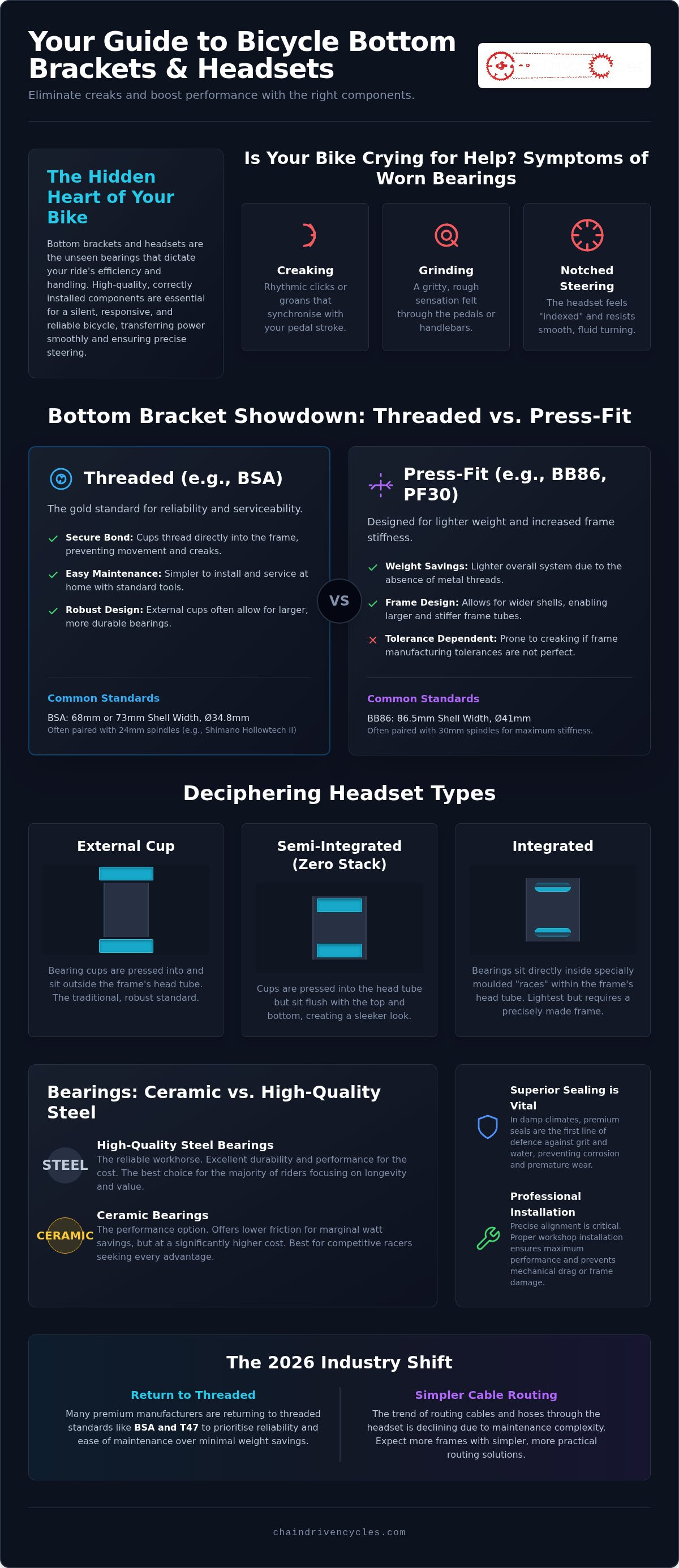
The bottom bracket sits at the core of the machine. It's the mechanical heart that facilitates power transfer from your legs to the drivetrain. Understanding bottom bracket basics is essential for any rider looking to maintain efficiency, as even minor drag here translates to lost watts. Conversely, the headset acts as the critical interface between your fork and frame. It doesn't just hold the front end together; it dictates the precision and fluidity of your handling. When these bearings begin to fail, the symptoms are unmistakable:
- Creaking: Rhythmic clicking or groaning sounds that synchronise with your pedal stroke.
- Grinding: A gritty sensation felt through the soles of your shoes or the handlebars.
- Notched Steering: A headset that feels "indexed," resisting smooth movement through its rotation.
The Anatomy of a Bicycle Bearing
Modern cycling has largely moved away from traditional loose ball bearings in favour of sealed cartridge units. In a cartridge system, the balls, "cup," and "race" are integrated into a single, replaceable component. This design ensures better alignment and easier maintenance. For owners of high-performance Italian frames like those from Wilier or Bottecchia, precision engineering in these bearings is vital. A perfectly machined interface prevents the micro-movements that lead to frame wear and irritating noises.
Why Quality Matters for Irish Cyclists
The damp Irish climate presents a unique challenge for bicycle longevity. Road spray, grit, and salt can easily penetrate inferior components, leading to rapid corrosion and seized bearings. Whilst a budget bearing might spin well in a dry showroom, it won't last long on a rainy winter ride. Superior sealing is the only way to ensure your bottom brackets and headsets survive the season without needing a complete overhaul. Premium seals act as the definitive first line of defence against the ingress of contaminants in 2026.
Navigating Bottom Bracket Standards: Threaded vs Press-Fit
Choosing the right interface for your frame is the most critical step in upgrading your bottom brackets and headsets. The industry is currently witnessing a significant shift. While press-fit systems dominated for years, many premium manufacturers are returning to threaded shells in 2026 to prioritise reliability and ease of maintenance. Identifying your specific standard requires measuring two key dimensions: the width of the frame's bottom bracket shell and its internal diameter. A standard BSA shell is typically 68mm or 73mm wide with a 34.8mm diameter, whilst press-fit systems like BB86 use a wider 86.5mm shell with a 41mm bore.
Crankset compatibility also dictates your choice. Shimano systems traditionally use a 24mm spindle, whereas many modern carbon cranksets opt for a 30mm spindle to increase stiffness. It's vital to check a complete guide to bottom bracket standards if you're unsure how these measurements interact with your specific frame and crank combination before making a purchase.
Threaded Bottom Brackets: The Reliable Choice
The BSA threaded standard remains the gold standard for many riders. Its popularity endures because the cups thread directly into the frame, creating a secure mechanical bond that's resistant to movement. Systems like Shimano Hollowtech II and FSA MegaExo use external cups, which place the bearings outside the frame shell. This design allows for larger bearings and simpler home maintenance. It's a robust solution that handles high mileage with minimal fuss. If you're building a bike for longevity, these threaded options from Shimano and FSA are often the wisest investment for trouble-free riding.
Solving the Press-Fit Problem
Press-fit standards like BB30, PF30, and BB86 were designed to save weight and allow for larger, stiffer frame tubes. However, they can be prone to creaking if the frame tolerances aren't perfect or if the installation is rushed. The "creak" usually happens because the nylon or aluminium cups shift slightly under load. To fix this, many cyclists now use thread-together press-fit converters. These units screw into each other inside the frame, locking the two sides together and eliminating movement. For those dealing with persistent noise, seeking professional road bike servicing Ireland ensures these complex bottom brackets and headsets are installed with the precision required for a silent ride.
Whether you're stickng with a classic threaded setup or optimising a modern carbon frame, choosing the right components ensures your drivetrain remains efficient for thousands of kilometres. Our workshop specialists are experts in high-performance Wilier and Bottecchia frames, providing the technical support needed to manage even the most difficult press-fit installations.
Deciphering Headset Types for Modern Performance Frames
Identifying the correct headset for a modern frame is often more complex than selecting bottom brackets and headsets for older models. The industry has moved toward the Standardised Headset Identification System (S.H.I.S.), which uses a specific code to define the exact dimensions required for your frame and fork. Without this code, you're left guessing between three main standards that dictate how the bearings interface with your head tube:
- External Cup (EC): The bearings sit in cups that are pressed into the frame and remain visible outside the head tube.
- Semi-Integrated (ZS): Cups are pressed into the frame, but the bearings sit flush inside the head tube for a cleaner look.
- Integrated (IS): No separate cups are used; the bearings sit directly on machined seats within the frame itself, common on carbon road bikes.
For a deeper dive into the technical measurements and historical standards involved, Sheldon Brown's headset guide remains an invaluable resource for understanding these nuances. Mastering these codes ensures you don't end up with an expensive component that simply won't seat correctly.
Tapered vs Straight Steerers
Most high-performance road bikes, including the latest models from Wilier and Bottecchia, have abandoned straight 1-1/8" steerer tubes in favour of a tapered design. Typically, these feature a 1-1/8" top bearing that flares out to a 1-1/2" lower bearing. This architectural change significantly increases front-end stiffness. For the rider, this translates to precision cornering and a noticeable reduction in brake chatter during high-speed descents. It creates a stable platform that handles the lateral forces of aggressive sprinting without the vague feeling associated with older, narrower standards.
Integrated Routing and the Modern Cockpit
Whilst fully integrated routing was a dominant design trend, 2026 is seeing a shift in how these systems are managed due to significant maintenance challenges. Cables passing through the top bearing make replacement labour-intensive, as hydraulic hoses often require disconnecting and re-bleeding just to change a bearing. This has led to a renewed focus on bearing longevity. If your frame uses this design, stainless steel bearings are essential. They provide the durability needed to withstand the ingress of moisture and grit, ensuring you don't have to face a complex cockpit strip-down every season. Choosing high-end bottom brackets and headsets with superior sealing is the best way to mitigate the inherent service difficulties of modern internal routing.
Key Features to Compare: Bearings, Sealing, and Performance
Performance in bottom brackets and headsets isn't solely about weight; it's about how the internal mechanics manage the specific stresses of cycling. Most high-end components now utilise angular contact bearings rather than standard radial ones. This is a vital distinction. Angular contact bearings are designed with a specific race angle that allows them to handle both vertical and lateral loads simultaneously. This is particularly important for headsets during aggressive cornering and for bottom brackets when you're putting down high torque out of the saddle. Without this design, bearings can develop play quickly, leading to the dreaded "notched" feeling in your steering.
The materials used for the housing also dictate longevity. Whilst composite or plastic sleeves can help dampen vibrations and prevent galvanic corrosion in certain carbon frames, high-grade aluminium cups remain the preferred choice for stability. They provide a more secure press-fit interface, which is essential for maintaining the alignment of the bearing races over thousands of kilometres. As the bicycle components market continues to grow, reaching a projected $14.48 billion in 2026, the focus on these technical refinements has never been higher.
The Case for Ceramic Bearings
For competitive road cyclists, ceramic bearings represent the pinnacle of drivetrain efficiency. These bearings are harder, smoother, and lighter than their steel counterparts, potentially saving several watts by reducing mechanical drag. However, they aren't a "fit and forget" solution. Ceramic systems often require more frequent cleaning and specialized lubricants to maintain their performance edge. Because these are a significant investment, we offer a 10-month payment plan to help riders access premium upgrades from brands like CeramicSpeed or Kogel without the upfront cost.
Sealing for Longevity
Balancing low friction with weather protection is a constant challenge, especially during an Irish winter. Labyrinth seals are excellent for racing as they offer almost zero resistance, but they provide less protection against heavy rain and road salt. Dual-lip seals create a more robust barrier, which is essential for preserving grease and preventing internal corrosion. Contact seals are preferred for daily commuters because they provide a physical barrier that prevents grit from grinding down the bearing races. Finding the right balance ensures your bottom brackets and headsets spin smoothly regardless of the weather.
If you're ready to upgrade your ride, explore our curated selection of premium bicycle bearings to find the perfect match for your frame and performance goals.
Selecting Your Component and Ensuring Long-Term Performance
Choosing the correct bottom brackets and headsets represents the final step in restoring your bicycle's factory-fresh feel. While the technical specifications discussed in previous sections guide your selection, the brand you choose dictates the long-term support and part availability you can expect. It's essential to match the component's quality to the demands of your riding, whether you're building a lightweight climbing machine or a durable winter trainer. Making an informed choice now prevents mechanical headaches and ensures every watt of power is efficiently transferred to the road.
Standout Products from Our Collection
For riders prioritising reliability, Shimano Hollowtech II remains the industry benchmark for threaded systems. It offers an exceptional balance of weight, durability, and value, making it the favourite for many cyclists. If your frame requires a press-fit solution, FSA provides remarkable versatility with components designed to bridge the gap between various frame and crankset standards. For those who already have high-quality cups installed, refreshing your ride with premium cartridge bearing replacements is a cost-effective way to restore performance. These standalone kits allow you to upgrade to higher-grade steel or ceramic internals without replacing the entire housing.
Professional Installation and Maintenance
Whilst many aspects of bicycle maintenance are suitable for the home mechanic, installing bottom brackets and headsets often requires specialised tooling. Using a dedicated press tool is non-negotiable for press-fit systems to ensure the bearings are perfectly square to the frame. Misalignment by even a fraction of a millimetre can lead to premature wear and persistent creaking. For owners of high-end machinery, understanding Wilier Road Bikes Ireland frame care provides essential context for maintaining premium Italian performance. Our professional workshop is equipped to handle these delicate installations, ensuring your frame remains protected and your bearings spin freely.
Regular servicing is the only way to prevent the "seized" component scenario, where moisture and lack of grease cause the bearing to bond with the frame. We recommend a seasonal inspection of all rotating parts to catch wear before it affects your ride quality. Before you complete your purchase, use this final checklist to ensure total compatibility:
- Verify your frame's shell width and internal diameter.
- Confirm your crankset spindle diameter (24mm vs 30mm).
- Identify the correct S.H.I.S. codes for your headset.
- Select a sealing level appropriate for your local climate.
Taking these final steps ensures your new components provide the silent, efficient ride you expect. Browse our full range of bottom brackets and headsets here to find the perfect upgrade for your bicycle.
Elevate Your Performance with Precision Components
Mastering the interface between your frame and drivetrain is the most effective way to eliminate mechanical drag and annoying creaks. By identifying the exact S.H.I.S. codes and shell dimensions required, you move from guesswork to guaranteed compatibility. Whether you're upgrading to ceramic for a competitive edge or choosing stainless steel for winter durability, the right bottom brackets and headsets are foundational to your bike's longevity and your own enjoyment on the road.
As an authorised dealer for Shimano, FSA, and Wilier, we provide the technical expertise needed to manage even the most complex press-fit installations. If you're investing in premium upgrades, our flexible 10-month payment plan makes high-end performance more accessible. Our national service centre is always available to offer expert advice, ensuring you choose the components that best suit your frame and riding style. Enjoy the quiet confidence that comes with a perfectly tuned machine.
Upgrade your ride with our premium Bottom Brackets and Headsets
Frequently Asked Questions
How do I know which bottom bracket fits my bike?
Identifying the correct fit requires measuring your frame's bottom bracket shell width and internal diameter with a digital calliper. A standard road bike often uses a 68mm threaded shell or an 86.5mm press-fit shell. You must also match the bearing's inner diameter to your crankset spindle, such as 24mm for Shimano or 30mm for carbon models. Consulting your bike manufacturer's technical specification sheet is the most reliable way to confirm these measurements.
Can I upgrade my headset to allow for internal cable routing?
Upgrading to fully internal routing is rarely possible unless your frame and fork were specifically designed with the necessary ports and clearances. Modern integrated headsets require a specific head tube diameter and a compatible steerer tube to house the cables. Whilst some aftermarket kits exist for semi-integrated setups, they often compromise steering geometry or bearing life. If your frame wasn't built for it, sticking to external or semi-internal routing is safer for long-term performance.
Are ceramic bearings actually faster for the average cyclist?
Ceramic bearings offer a marginal gain of approximately one to three watts by reducing friction compared to standard steel. For a competitive racer, this saving is significant over a long distance. However, for the average cyclist, the performance increase is often less noticeable than the benefits of a clean, well-lubricated drivetrain. Ceramic options require more frequent maintenance to stay smooth, so you should weigh the watt-savings against the increased service requirements and initial investment.
What is the difference between a Press-Fit 30 and a BB30?
The primary difference lies in how the bearings interface with the frame. BB30 systems use bearings that are pressed directly into a precision-machined aluminium shell inside the frame. In contrast, Press-Fit 30 (PF30) uses bearings housed within composite or nylon cups, which are then pressed into the frame. The PF30 standard was developed to allow for looser frame manufacturing tolerances whilst reducing the likelihood of the creaking often associated with direct-fit BB30 systems.
How often should I service or replace my headset bearings?
You should inspect your headset bearings at least once a year, or more frequently if you regularly ride in wet Irish conditions. Signs that replacement is necessary include a gritty sensation when turning the bars or a "notched" feeling where the steering wants to settle in one position. Because modern bottom brackets and headsets are often sealed, they cannot always be regreased. If the steering feels heavy or inconsistent, replacing the cartridge units is the best solution.
Do I need special tools to install a bottom bracket at home?
Home installation requires tools specific to your standard. Threaded systems need a dedicated notched socket or spanner that matches the external cup design. Press-fit systems require a bearing press and specific drifts to ensure the cups remain perfectly aligned during installation. Attempting to use a hammer or a makeshift vice can easily damage your frame's bearing seats. For complex installations, visiting a professional workshop ensures your bottom brackets and headsets are fitted with the necessary precision.
What causes a bottom bracket to start creaking?
Creaking is usually caused by microscopic movement between the bearing cup and the frame shell. This often happens due to poor installation, lack of proper grease, or frame tolerances that are slightly out of specification. Contamination from grit and road salt can also degrade the interface, leading to noise under high torque. Ensuring the shell is clean and using a high-quality thread-together bottom bracket is the most effective way to eliminate these frustrating mechanical sounds.
Can I use a Shimano crankset with a SRAM-standard bottom bracket?
You cannot use a Shimano crankset with a standard SRAM GXP or DUB bottom bracket without specific adapters. Shimano uses a consistent 24mm spindle diameter, whilst SRAM DUB uses 28.99mm and older GXP systems use a tapered 24mm to 22mm spindle. Mixing these standards will result in either a crank that won't fit through the bearings or significant play in the drivetrain. Always ensure your chosen bearing's internal diameter matches your specific crankset spindle for a secure fit.