



Pedals and Cleats: 2026 Performance Cycling Buying Guide
What if the secret to your fastest century ride isn't found in your carbon frame, but in the few millimetres of contact between your shoes and your drivetrain? It is a common misconception that more tension always equals more speed. In reality, the wrong setup often leads to wasted watts or nagging knee pain.
We understand that transitioning to performance pedals and cleats can feel daunting. Whether you are worried about the "clipless tumble" at a red light or you are simply confused by the alphabet soup of SPD, SPD-SL, and Look Keo standards, you aren't alone. Every serious rider has faced that same steep learning curve whilst searching for the right setup.
This guide will help you master the technical world of clipless systems and discover the perfect pedal and cleat combination to transform your power transfer and riding comfort. We will break down the mechanical differences between two-bolt and three-bolt systems, explain how to use cleat float to prevent injury, and explore how high-end options like Favero Assioma power meters can refine your training. From local club runs to competitive racing on a Wilier or Bottecchia, you'll gain the confidence to choose gear that supports your long-term cycling goals.
Key Takeaways
- Gain a clear understanding of how clipless systems provide 360-degree power transfer to improve your overall pedalling efficiency.
- Compare the mechanical trade-offs between two-bolt and three-bolt pedals and cleats to determine the best fit for your specific discipline.
- Learn how to adjust cleat float and tension to protect your joints and find your natural, most comfortable foot position.
- Discover why Favero Assioma power meter pedals are the gold standard for riders seeking to integrate precise performance data into their training.
- Pick up expert maintenance tips on pedal installation and cleat replacement to ensure your equipment remains safe and durable for years to come.
Understanding Pedals and Cleats: Why Switch to a Clipless System?
The term "clipless" is famously confusing for new riders. It describes a system where your shoe locks directly into the pedal, yet it's named for the absence of the old-fashioned toe clips and leather straps that once dominated the sport. By choosing the right combination of pedals and cleats, you create a rigid, secure connection that transforms how you interact with your bike. This modern Bicycle pedal technology allows for a much more integrated experience than traditional flat platforms.
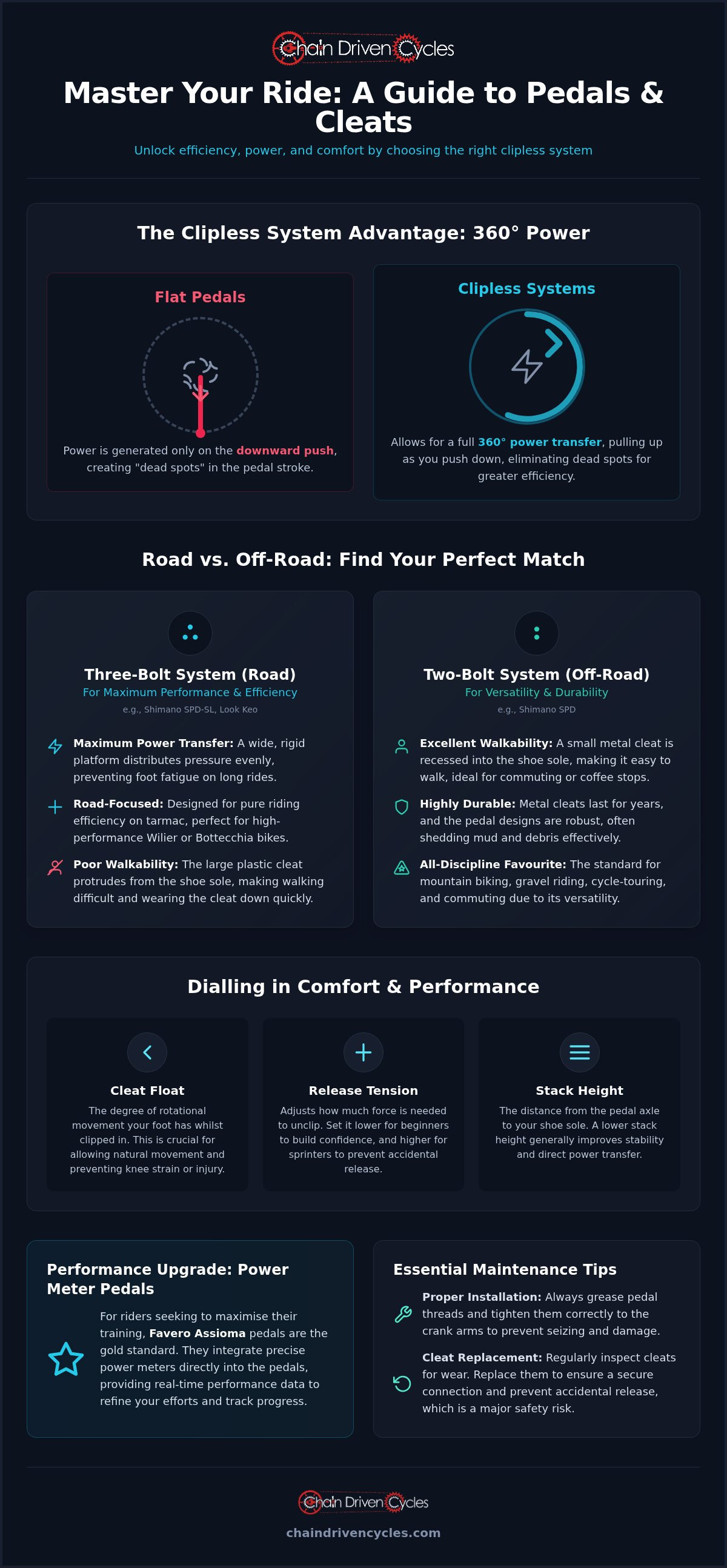
Efficiency is the primary driver for this upgrade. In a standard flat system, you only generate power during the downward phase of the stroke. With a clipless setup, you achieve a full 360-degree power transfer. You can effectively pull up during the recovery phase whilst pushing down on the opposite side. This circular pedalling motion reduces "dead spots" in your stroke, which is particularly noticeable during steep climbs or when you're trying to maintain a high pace over long distances.
Many riders hesitate to switch because they fear being unable to unclip at a junction. This is largely a myth. Modern retention systems feature adjustable tension, allowing you to set a light release that makes exiting the pedal effortless and intuitive. Over time, the twisting motion of the heel becomes muscle memory. For long-distance comfort, the added stability prevents your foot from shifting, which reduces the risk of hotspots and ensures your joints stay aligned.
The Anatomy of the System
Understanding the hardware is the first step toward a better ride. The system consists of three distinct parts. The pedal is the platform that threads into your crank arm. The cleat is the small plastic or metal interface bolted to the sole of your cycling shoe. Finally, the retention mechanism is the spring-loaded jaw on the pedal that physically grips the cleat. These parts must work in harmony to provide both security and a clean release.
How Clipless Improves Your Ride
The benefits extend beyond raw speed. You'll find improved cadence control amongst varied terrain, as your feet stay glued to the pedals even when the road gets bumpy. This eliminates the danger of foot-slip during high-intensity sprints or in wet weather. High-performance machines, such as Wilier or Bottecchia road bikes, are designed to be ridden with specific pedals and cleats. A professional setup ensures that every watt you produce is delivered directly into the drivetrain without any mechanical loss.
Road vs Off-Road Systems: Finding the Right Standard
Choosing the right pedals and cleats often starts with a single question: how often do you need to put your feet on the ground? The cycling industry has split into two primary standards to solve different problems. Road systems prioritise a rigid, wide platform for maximum power, whilst off-road systems focus on versatility and mud clearance. Your choice will dictate not only your pedalling efficiency but also the type of shoes you need to buy.
Material choice plays a significant role in long-term ownership. Metal cleats, typically found in two-bolt systems, offer exceptional durability and can last for years of heavy use. In contrast, plastic road cleats are lighter and provide a larger contact patch but wear down quickly if you walk on tarmac frequently. If you're a hybrid rider who uses their bike for both fitness and errands, a dual-sided platform pedal offers the best of both worlds, providing a clip-in mechanism on one side and a flat surface for regular shoes on the other.
The Three-Bolt Road System (SPD-SL, Look Keo)
This system is the standard for performance road cycling. By using three bolts to secure the cleat, manufacturers create a massive contact area between the shoe and the pedal. This distributes pressure across the sole, which is vital for preventing foot fatigue during long days in the saddle. Because these cleats protrude from the sole, they are notoriously difficult to walk in. They are designed for pure riding efficiency on high-performance machines like a Wilier or Bottecchia. Getting the Cleat float right on these systems is essential to ensure your knees remain healthy during high-intensity racing or endurance efforts.
The Two-Bolt Recessed System (SPD)
Originally designed for mountain biking, the two-bolt system has become the favourite amongst gravel riders, commuters, and cycle-tourists. The metal cleat is small and sits inside a recess in the shoe's tread. This allows you to walk naturally without the awkward gait associated with road shoes. These systems are usually dual-sided, making it much faster to clip in at traffic lights or on technical off-road trails. They also feature excellent mud-clearing capabilities, ensuring the mechanism doesn't jam when conditions get messy. If you're unsure which standard matches your riding style, our team can help you select the ideal pedal and cleat configuration to suit your specific goals.
Technical Specs: Float, Tension, and Stack Height
Beyond the basic standard, the fine-tuning of your pedals and cleats determines whether you finish a ride with a personal best or a sore knee. One of the most critical metrics to understand is "float". This refers to the degree of rotational movement your foot has whilst clipped in before the mechanism releases. For most riders, a completely fixed position is a recipe for injury. Humans aren't perfectly symmetrical; our knees and ankles need to track naturally through the pedalling arc. Float provides the necessary wiggle room to accommodate these biomechanical quirks.
Stack height is another technical detail that high-performance riders monitor closely. This is the distance from the centre of the pedal axle to the sole of your shoe. A lower stack height brings your foot closer to the spindle, which improves power transfer and lowers your centre of gravity. If you switch to a system with a significantly different stack height, you'll need to adjust your saddle height to maintain your optimal bike fit. Even a difference of 2mm or 3mm can be felt by an experienced cyclist.
Choosing Your Float Colour
Most manufacturers use a colour-coding system to indicate the level of float. In the Shimano ecosystem, yellow cleats offer 6 degrees of float, making them the favourite choice for beginners and endurance riders. Blue cleats provide a tighter 2 degrees of movement, whilst red cleats are fixed at 0 degrees. Unless you have had a professional bike fit that confirms your alignment is perfect, avoid 0-degree cleats. If you feel a "tugging" sensation on your joints during a ride, it is a clear sign that your body needs more float to allow for natural lateral movement.
Adjusting Spring Tension
The fear of being unable to unclip is easily managed by adjusting the retention spring. Most modern pedals feature a small screw that you can turn with a 2.5mm or 3mm hex key to increase or decrease the release tension. We recommend that beginners start at the lowest possible setting. You'll know the tension is correct when you hear a crisp, audible "click" upon entry, but can still exit with a gentle flick of the heel. As your confidence grows, or if you start competing in high-torque sprints, you can gradually tighten the tension to ensure you don't accidentally pull out during a maximal effort.
Standout Performance Upgrades: Assioma Power Meter Pedals
Once you have mastered the basics of pedals and cleats, the next logical step for performance-minded riders is the integration of power data. Favero Assioma has established itself as the gold standard in this category, offering a level of precision that was once reserved for professional racing teams. Unlike crank-based or hub-based systems, which require complex mechanical installation, these pedals house all the necessary sensors within the spindle. This design allows you to swap your power meter between different bikes in minutes using a standard hex key.
The Assioma system is built around the popular Look Keo cleat standard, ensuring that road cyclists can maintain a familiar feel whilst gaining access to elite-level metrics. With a verified accuracy of +/- 1.0%, these units provide the reliable data needed to track fitness gains and manage fatigue. They are designed to withstand the harshest Irish weather, featuring a fully waterproof construction and rechargeable batteries that offer over 60 hours of riding time on a single charge. This reliability has made them a favourite amongst cyclists who demand consistency across every training session.
Assioma Duo vs Uno: Which Should You Choose?
The primary difference between the two models lies in how they calculate your output. The Assioma Uno is a single-sided system that measures the force from your left leg and doubles it to provide a total power reading. It is an excellent, affordable entry point for those learning how to train with a power meter. The Assioma Duo, however, features sensors in both pedals. This provides true left/right balance data, which is essential for identifying leg strength imbalances and refining your pedalling technique during high-intensity efforts.
Integrating with Your Training Ecosystem
Modern training is built on connectivity. Assioma pedals use both ANT+ and Bluetooth to broadcast data to your head unit or smartphone. They also integrate seamlessly with indoor cycling trainers, ensuring your power numbers remain consistent whether you are riding outdoors on your Wilier or tackling a virtual climb in your living room. By analysing your power phase and rider position data, you can make informed adjustments to your setup to maximise every watt. You can browse our selection of Assioma Power Meter Pedals to find the right tool for your performance goals.
Installation, Maintenance, and Buying from Chain Driven Cycles
Installing your new pedals and cleats is a straightforward task that requires precision to ensure long-term reliability. A single cross-threaded pedal can ruin an expensive crankset. Always apply a thin layer of waterproof grease to the threads before installation. This is particularly important in the damp Irish climate to prevent the metal from seizing over time. Remember the golden rule: the left-hand pedal is reverse-threaded. You'll need to turn it anti-clockwise to tighten it, whilst the right side follows the standard clockwise rotation.
Cleats are consumable items that wear down every time you put your foot on the ground. Most plastic road cleats feature wear indicators; once these colours fade or the edges become rounded, it's time for a replacement. Worn cleats lead to vague engagement and dangerous accidental pull-outs during high-torque sprints. Whilst you can replace them at home, professional road bike servicing ensures your alignment is millimetre-perfect. This level of precision is vital for protecting your knees from long-term strain and ensuring your power transfer remains efficient.
The Perfect Setup
Before you remove your old cleats, use a permanent marker to trace their outline on the sole of your shoe. This simple trick allows you to install the new set in the exact same position without needing a fresh bike fit. Once the new hardware is in place, check the bolt tightness after your first two or three rides. The vibrations from the road can occasionally cause new bolts to settle; a quick check with a hex key provides necessary peace of mind. If you are upgrading to premium hardware like Assioma power meters, our flexible 10-month payment plan allows you to secure your gear today and manage the cost over nearly a year.
Why Shop with Chain Driven Cycles?
We pride ourselves on being more than just a retail outlet; we act as a technical partner for the Irish cycling community. Our national collection includes over 60 different options, ensuring we have the right pedals and cleats for every discipline and budget. Whether you are seeking a lightweight racing setup for your Wilier or a durable gravel system for a Bottecchia, our experts can guide you through the selection process. We understand the nuances of high-performance Italian frames and can recommend the specific stack height and tension settings that complement your machine. You can browse our full range of Pedals and Cleats online today to find your perfect match.
Take Control of Your Power Transfer
Selecting the right pedals and cleats is one of the most impactful upgrades you can make to your cycling setup. By balancing the mechanical security of a three-bolt road system or the versatility of a two-bolt off-road standard, you ensure that every watt is used efficiently. We've explored how fine-tuning your float and tension protects your joints and how upgrading to Assioma power meters can provide the elite-level data needed to reach your training goals.
At Chain Driven Cycles, we are more than just a retailer. As an authorised dealer for Assioma Power Meter Pedals, we provide the expert technical support you need to align your cleats and maintain your drivetrain. Whether you are racing on a Wilier or exploring gravel trails on a Bottecchia, our team is here to help you find the perfect match. You can even spread the cost of premium hardware with our flexible 10-month payment plan, making professional-grade equipment more accessible than ever.
Shop the full Pedals and Cleats collection at Chain Driven Cycles
We look forward to helping you transform your riding experience. Trust in our expertise to keep you moving efficiently and comfortably through every season.
Frequently Asked Questions
Do pedals and cleats come with the bike?
Most high-performance road bikes, such as those from Wilier or Bottecchia, don't come with pedals. Manufacturers assume that serious cyclists already have a preferred system of pedals and cleats they wish to use. Occasionally, entry-level hybrid bikes include basic flat plastic pedals, but these are usually replaced quickly. Buying them separately ensures you get the exact mechanical interface that suits your riding style and shoe choice.
Can I use any cycling shoes with any pedals?
No, you must match your shoes to the specific bolt pattern of your cleat system. Performance road shoes typically use a three-bolt pattern for systems like SPD-SL or Look Keo. In contrast, mountain bike or gravel shoes use a two-bolt pattern for SPD systems. Some entry-level shoes feature both patterns, but it's vital to check the sole before purchasing your pedals and cleats to ensure they are physically compatible.
How do I know when my cleats need replacing?
You should replace your cleats when the engagement feels vague or if you notice significant physical wear on the plastic edges. Most road cleats have coloured pads that serve as wear indicators; once these are worn away, the structural integrity is compromised. If you find yourself accidentally pulling out of the pedal during a climb, or if the "click" sounds dull, it's time to install a fresh set to maintain safety.
What is the difference between SPD and SPD-SL?
SPD refers to Shimano's two-bolt system, which uses a small metal cleat recessed into the shoe sole for easy walking. It's the standard for gravel and commuting. SPD-SL is a three-bolt road system with a much larger plastic cleat that sits proud of the sole. This provides a wider platform for better power transfer during long road rides but makes walking difficult. Your choice depends on how much time you spend off the bike.
Are clipless pedals dangerous for beginners?
Clipless pedals aren't dangerous if you take a methodical approach to learning. We recommend starting with the spring tension at its lowest setting, which allows for an effortless exit. Practising whilst leaning against a wall or on a soft grass verge helps build the necessary muscle memory. Most beginners find that the twisting motion becomes second nature after just a few rides, leading to much greater confidence and control in traffic.
Can I use power meter pedals on an indoor smart trainer?
Yes, using power meter pedals like the Assioma Duo on an indoor smart trainer is highly effective. It ensures that the power data you see on your ThinkRider smart trainer matches what you see on the road. This consistency is vital for tracking your fitness accurately across different environments. Since the pedals are the primary source of truth, you won't have to worry about calibration differences between your indoor and outdoor setups.
How much float do I need for my cleats?
Most cyclists benefit from a moderate amount of float, typically between 4 and 6 degrees. This allows your foot to rotate slightly during the pedal stroke, which prevents strain on your knees and ankles. Only professional racers with a perfect bike fit should consider zero-float cleats. If you experience any joint discomfort after a long ride, it's often a sign that you need to switch to a cleat colour that offers more rotational freedom.
Is it difficult to install new pedals at home?
Installing pedals at home is a simple task that requires only a 15mm spanner or an 8mm hex key. The most important factor is remembering that the left-hand pedal is reverse-threaded. You must turn it anti-clockwise to tighten it. Always apply a small amount of waterproof grease to the threads to prevent them from seizing. If you feel any resistance whilst threading them in by hand, stop immediately to avoid damaging the crank arm threads.