



The Ultimate Road Bike Tyres Buying Guide: Speed, Grip, and Reliability
Your road bike tyres are the only point of contact between your machine and the tarmac, meaning they have a greater impact on your ride quality than almost any other component on your bike. It's a simple truth that even the most advanced carbon frame will feel sluggish if it's wrapped in the wrong rubber. We understand the frustration of a Sunday morning ride being cut short by a persistent puncture or the confusion that often comes with choosing between clincher and tubeless systems. You want to feel confident when leaning into a wet corner and enjoy the sensation of effortless speed on the flats.
This guide will help you master the technical nuances of tyre construction to transform your ride quality, speed, and puncture resistance. Whether you're looking for the ultimate racing clincher or a robust winter tyre, we'll provide the expertise you need to make an informed choice. We'll examine the trade-offs between rolling resistance and durability, ensuring your next set of tyres delivers faster average speeds and far fewer roadside repairs. By the end of this article, you'll have the confidence to select rubber that perfectly matches your riding environment and performance goals.
Key Takeaways
- Understand the practical differences between clincher and tubeless systems to balance maintenance ease with improved puncture resistance.
- Learn why wider road bike tyres paired with lower pressures offer a faster and more comfortable ride than traditional narrow alternatives.
- Determine whether to prioritise supple race casings for maximum speed or durable training compounds for high-mileage reliability.
- Decode the science behind advanced rubber compounds and why slick tread patterns often provide the best grip on wet tarmac.
- Identify industry-leading models from brands like Continental and Vittoria that deliver the best balance of speed and longevity.
Understanding Road Bike Tyre Types: Clincher, Tubeless, and Folding
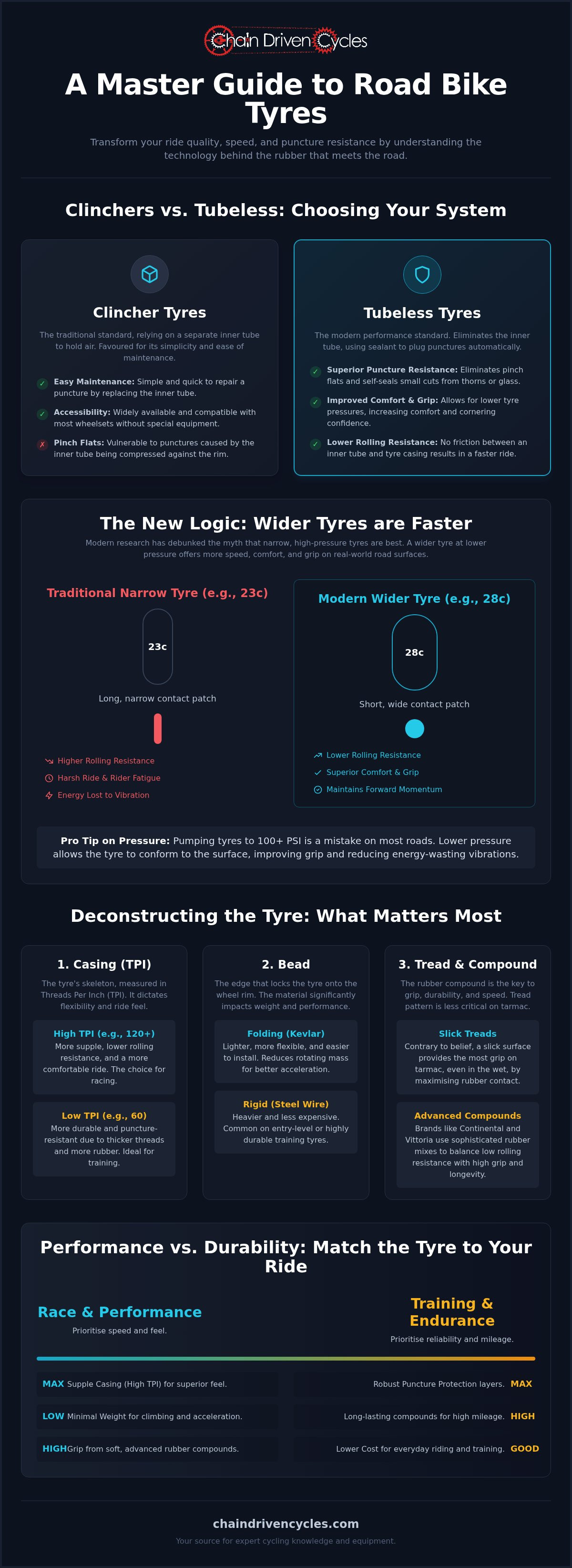
Every road tyre is built from three essential components: the casing, the bead, and the tread. The casing acts as the tyre's skeleton, typically constructed from nylon or cotton. Its flexibility is measured in TPI (threads per inch). A higher TPI creates a more supple casing that deforms easily over road imperfections, reducing rolling resistance. The bead is the reinforced edge that locks the tyre onto the rim, whilst the tread is the outer rubber layer designed for grip and wear resistance.
Clincher tyres have long been the industry standard. They rely on a separate inner tube to hold air pressure, which makes them the favourite choice for riders who value ease of maintenance. If you suffer a puncture, the repair process is simple: remove the tyre, replace the tube, and reinflate. This accessibility ensures that clinchers remain a practical option for both daily commuting and long-distance touring where roadside repairs must be quick and clean. It's a reliable system that doesn't require the mechanical complexity of newer technologies, making it ideal for those who prefer a traditional setup.
The Rise of Tubeless Tyres
Tubeless technology has fundamentally changed performance expectations for road bike tyres. By removing the inner tube entirely, these systems eliminate 'pinch flats' caused by the tube being compressed against the rim. This allows you to run significantly lower pressures, which improves comfort and provides a larger contact patch for cornering confidence. To work effectively, the system requires tubeless-compatible rims and a liquid sealant that stays liquid inside the tyre to plug small punctures instantly. Tubeless-ready tyres are now the modern standard for endurance cycling because they offer the best balance of speed and reliability.
Folding Tyres for Performance
The distinction between folding and rigid tyres lies in the bead material. Rigid tyres use a heavy steel wire, which makes them difficult to store and adds weight to the wheel's outer edge. In contrast, folding tyres use flexible Kevlar or other high-strength synthetic fibres. This reduces the rotating mass of the wheel, making the bike feel significantly more responsive when you accelerate or climb. Performance brands like Vittoria and Pirelli prioritise folding beads for their high-performance ranges because they're lighter and easier to install. For the serious cyclist, the weight savings and improved rim interface of a folding bead are well worth the investment.
Decoding Tyre Width and Pressure for Optimal Performance
The traditional belief that narrow, rock-hard tyres are faster has been thoroughly debunked by modern testing. Whilst 23c tyres were once the racing standard, the industry has shifted decisively towards 28c and 30c+ options. This change isn't just about comfort; it's about efficiency. A wider tyre has a shorter, wider contact patch, which reduces internal friction and energy loss as the casing deforms. This extra volume allows you to run lower pressures without increasing the risk of punctures, creating a smoother ride that maintains speed over real-world surfaces.
On typical 'chip-and-seal' road textures, high-pressure tyres tend to chatter and bounce. Every micro-bounce represents energy that should be moving you forward but is instead being lost to vertical vibration. Wider tyres act as a suspension system, damping these vibrations and significantly reducing rider fatigue on long endurance rides. When choosing your width, consider your wheel rim's internal diameter. To maintain aerodynamic efficiency, you want to avoid the 'lightbulb' effect where the tyre is excessively wider than the rim. Ideally, the tyre should sit flush with the rim walls to ensure the air flows smoothly over the side of the wheel.
Choosing the Right Width for Your Frame
Modern carbon frames, such as those from Wilier or Bottecchia, are designed with generous clearance for 28c or even 32c tyres. If you're riding a vintage steel frame, you'll need to measure the gap between the chainstays and brake calipers carefully, as older designs often struggle with anything over 25c. The 28c width has become the professional standard because it offers the best balance of weight, aerodynamics, and cornering confidence. The increased surface area provides a massive boost in braking performance, especially during high-speed descents or in unpredictable weather.
The Importance of Tyre Pressure (PSI/Bar)
Pumping your tyres to 100 PSI or more is often a mistake on anything but the smoothest velodrome. On damp or rough roads, a lower pressure allows the rubber to conform to the ground rather than skipping over it. Adjusting your tyre pressure directly dictates the size and shape of the contact patch, which in turn determines the level of mechanical grip available for braking and cornering. Don't be afraid to drop your pressure by 5-10 PSI if the clouds gather or the road surface deteriorates. If you're looking to upgrade your setup, you can browse our full range of road bike tyres to find the perfect width for your wheels.
Performance vs Durability: Choosing for Your Riding Style
Every cyclist faces a compromise between speed and longevity. High-performance race tyres prioritise a supple feel and maximum grip, often using thinner tread layers to save weight and reduce rolling resistance. These deliver an exhilarating ride, but they typically have a shorter lifespan, sometimes lasting only 2,000km before the casing begins to show. In contrast, dedicated training tyres are built with thicker rubber and robust sidewalls to survive 5,000km or more of daily miles. Choosing road bike tyres that match your specific mileage and performance goals is the first step toward a more reliable ride.
If you ride year-round, four-season tyres are the sensible choice for unpredictable conditions. These models feature specialised rubber compounds that stay soft in near-freezing temperatures, maintaining grip on greasy winter roads. They also include reinforced beads to prevent debris from cutting into the casing. Investing in high-performance rubber is the most effective way to complement the precision engineering of Wilier road bikes Ireland riders often choose for competitive events. A premium Italian frame deserves a tyre that can translate its handling characteristics accurately to the road.
TPI: The Secret to a Supple Ride
TPI stands for Threads Per Inch and refers to the density of the fabric used in the tyre's casing. A high TPI, such as the 320 TPI found in the Vittoria Corsa, indicates a casing made of many fine threads. This makes the tyre more flexible, allowing it to deform over road textures with minimal energy loss. Conversely, a tyre like the Continental Gatorskin uses a lower TPI with thicker threads. This results in a stiffer ride but provides significantly better resistance to sidewall cuts and abrasions. The casing construction directly dictates the 'feel' of your bike, determining whether it absorbs road buzz or transmits every vibration to your hands.
When to Prioritise Puncture Protection
Modern road bike tyres often incorporate protective belts made from materials like Vectran or Kevlar. These layers sit directly beneath the tread to stop glass and flints from reaching the inner tube or air chamber. Although these belts add a small amount of weight, they're vital for winter riding when rain washes sharp grit into the gutter. Winter-specific tyres also use a higher silica content to ensure the tread doesn't harden in the cold. Heavier protection is a small price to pay for avoiding a roadside repair in freezing conditions. Matching your tyre's protection level to the season ensures you spend more time riding and less time fixing flats.
Key Features to Compare: Compounds and Tread Patterns
The performance of road bike tyres is largely dictated by the chemical composition of the rubber. Leading manufacturers spend years developing proprietary compounds to solve the age-old conflict between grip and speed. Continental’s BlackChili compound, for instance, uses nanometric carbon soot particles to ensure the rubber remains flexible enough to grip the road whilst maintaining a high level of durability. In contrast, Vittoria’s Graphene 2.0 technology incorporates layers of graphene to alter the tyre's behaviour based on the forces applied. It stays hard on the straights to reduce rolling resistance and becomes softer during braking or cornering to maximise traction. Side-wall protection is equally vital, especially on narrow country lanes where thorns and sharp stones are common; many brands now include a reinforced mesh layer on the sidewall to prevent cuts without compromising the tyre's ability to deform.
One common misconception is that road tyres require deep tread patterns to displace water. In reality, a bicycle tyre's contact patch is too small and the pressure too high to suffer from hydroplaning at any speed a human can reach. Slick tyres actually provide the most grip on wet tarmac because they offer the maximum surface area for the compound to interact with the road. Any tread you see on a road tyre is usually minimal and designed to provide mechanical keying on light debris or simply for aesthetic appeal. The compound itself does the heavy lifting when it comes to wet-weather braking performance, staying supple enough to find purchase on a greasy surface.
Tread Patterns and Aesthetics
Most high-performance road bike tyres are either entirely slick or feature a very fine 'file' pattern on the shoulders. While these patterns offer a psychological boost in confidence, the science of friction confirms that rubber-to-road contact is the primary factor in grip. Beyond performance, tan walls have seen a massive resurgence in the cycling community. These coloured side-walls don't just offer a classic look; they often indicate a more supple casing that hasn't been coated in heavy black rubber, though modern versions are now available for both aesthetic and performance-oriented riders.
Longevity and Wear Indicators
Riding on worn-out rubber is a significant safety risk. Most premium tyres now include a Tread Wear Indicator (TWI), which consists of two small circular pits in the centre of the tread. When these pits disappear, the rubber has worn too thin and the tyre should be replaced. If you notice the flat 'squaring off' of the tyre profile or start seeing the internal casing threads, you've waited too long. For a complete safety check and to ensure your drivetrain is as fresh as your rubber, we recommend booking a professional road bike servicing Ireland session. You can also explore our full range of road bike tyres to find the latest compound technologies from Pirelli and Schwalbe.
Standout Road Bike Tyres for 2026: Our Expert Picks
The market for road bike tyres in 2026 is defined by a few key performers that consistently deliver on their promises. The Continental Grand Prix 5000 remains the industry benchmark, successfully balancing low rolling resistance with robust puncture protection. It's a tyre that feels as fast during a local crit as it does reliable on a 100km endurance ride. For those seeking the ultimate in ride quality, the Vittoria Corsa Pro uses a high-thread-count cotton casing to provide a supple, race-ready feel that few others can match. This professional-grade tyre is designed for riders who demand maximum feedback from the road surface. Meanwhile, the Pirelli P Zero Race draws on the brand's motorsport heritage to offer exceptional grip during high-speed cornering, making it a favourite for aggressive descenders who need absolute confidence in their rubber.
The Best All-Rounders
Cyclists in the UK and Ireland face unique challenges, from damp tarmac to debris-strewn country lanes. The GP5000 is often the first choice because it handles these variable conditions without sacrificing speed. It's a versatile option that works well for both competition and spirited club rides. For riders who have fully embraced tubeless technology, the Schwalbe Pro One is a standout performer. The Schwalbe Pro One has earned a strong reputation for easy tubeless seating, often inflating with a standard floor pump where other tyres might require a compressor. This ease of setup, combined with its balanced performance profile, makes it a highly practical choice for the home mechanic.
Value and Commuter Options
While top-tier race rubber is exciting, there's a significant place for reliable, cost-effective alternatives. The Chaoyang Road Series is an excellent example of a tyre that provides durability and reliable grip without the premium price tag. These are often the better choice for heavy winter training miles or daily commuting where longevity is more important than saving a few grams of rotating weight. Using a value tyre during the off-season preserves your expensive race rubber for when it truly matters. We understand that upgrading your setup is an investment, so we offer a flexible 10-month payment plan to help you access premium components and tyres. You can browse our full range of road bike tyres to find your perfect match, whether you're chasing podiums or simply looking for a dependable ride to work.
Elevate Your Ride with the Right Rubber
Selecting the ideal road bike tyres is about more than just avoiding punctures; it's about unlocking the full potential of your machine. By embracing wider casings and fine-tuning your pressure, you can enjoy a smoother, more efficient ride that reduces fatigue on even the roughest surfaces. Whether you've chosen the supple feel of a high-TPI race tyre or the rugged reliability of a four-season training compound, your decision dictates how your bike interacts with every corner and climb.
If you're ready to transform your cycling experience, our team of professional mechanics is here to offer expert advice on compatibility and setup. We provide free delivery across Ireland and a flexible 10-month payment plan to help you invest in premium equipment without compromise. You can shop the full road bike tyres collection at chaindrivencycles.com today. Trust your equipment. Enjoy the extra grip. We look forward to seeing you out on the road.
Frequently Asked Questions
How often should I replace my road bike tyres?
You should replace your road bike tyres when the Tread Wear Indicators (TWI) disappear or if you notice the casing threads showing through the rubber. Most performance tyres last between 2,500km and 5,000km. A squared-off profile or frequent punctures are also clear signs that the rubber has thinned. Don't wait for a total failure; check your sidewalls regularly for cuts or dry rot that could compromise your safety during high-speed descents.
What is the best tyre width for road bikes in 2026?
For most riders in 2026, 28c is considered the optimal width for a balance of speed, comfort, and grip. Modern frames are increasingly designed to accommodate 30c or even 32c tyres, which allow for lower pressures and better vibration damping on rougher surfaces. Professional racing has largely moved away from narrow 23c options because wider tyres offer a more efficient contact patch and significantly reduced rider fatigue over long distances.
Can I put tubeless tyres on regular clincher rims?
You shouldn't attempt to fit tubeless tyres on standard clincher rims unless they are specifically designated as tubeless-ready. Standard rims lack the internal hook profile and airtight seal required to lock the tyre bead safely under pressure. Attempting this setup can lead to sudden tyre blow-offs, which are extremely dangerous. Always verify your rim's compatibility and use the correct rim tape and valves before moving away from traditional inner tubes.
Is there a real difference between 25c and 28c tyres?
The transition from 25c to 28c road bike tyres offers a noticeable improvement in ride quality and cornering confidence. A 28c tyre provides a larger air volume, allowing you to run lower pressures without increasing rolling resistance or the risk of pinch flats. This extra volume effectively damps road buzz and provides a wider contact patch. Whilst 25c remains popular for certain aero-focused setups, 28c has become the preferred standard for endurance riding.
Which road bike tyres are best for avoiding punctures?
For maximum puncture protection, look for tyres with reinforced sub-tread layers made from materials like Kevlar or Vectran. Models such as the Continental Gatorskin or the Schwalbe Marathon range are specifically engineered to resist sharp debris and glass. Whilst these tyres are slightly heavier and less supple than race-day options, they're the best choice for commuting or winter training. Balancing protection with rolling speed is key to enjoying a trouble-free ride.
Do I need different tyres for winter and summer riding?
Using different tyres for winter and summer is highly recommended to account for changing road conditions. Summer tyres prioritise low weight and maximum grip in dry conditions, whilst winter tyres use softer rubber compounds that maintain flexibility in the cold. Winter models also feature enhanced puncture protection to handle the increased grit and debris washed onto roads by rain. Swapping your rubber seasonally ensures you maintain performance and safety throughout the entire year.
Why are some road bike tyres so much more expensive than others?
Premium road bike tyres are more expensive because of the advanced research and proprietary rubber compounds used in their construction. Technologies like Vittoria’s Graphene 2.0 require complex manufacturing to balance low rolling resistance with high grip. Cheaper tyres often use simpler rubber and lower-quality casings, resulting in a slower ride. Our 10-month payment plan is available to help you invest in these premium components, whilst our mechanics provide expert advice on the best fit.
What does TPI mean and why should I care?
TPI stands for Threads Per Inch and refers to the density of the fabric casing beneath the rubber tread. A high TPI, typically over 120, means the tyre uses finer threads, resulting in a more supple casing that deforms easily over road imperfections for a smoother ride. A lower TPI indicates thicker threads and more rubber, providing better durability and resistance to cuts. This directly affects your comfort and rolling efficiency.