



The Ultimate Bicycle Lights Buying Guide: See and Be Seen in 2026
What if your 2,000-lumen front lamp is actually making your night ride more dangerous? It's a common misconception that higher brightness always equals better safety; blinding oncoming traffic with a poorly aimed beam can lead to disastrous results. Choosing the right bicycle lights in 2026 requires looking beyond the headline figures to understand how beam optics and smart technology work together. Whether you're navigating unlit rural lanes on a high-performance Wilier road bike or commuting through busy city centres, your visibility is a non-negotiable priority.
We understand the anxiety of a battery failing mid-ride or the struggle of fitting a standard mount to a high-end aerodynamic frame. You want a lighting setup that's reliable, durable, and easy to manage. This guide will help you master technical specifications like StVZO compliance and reactive flash patterns so you can ride with total confidence. We'll explore how to select the perfect balance of output and run-time for your specific riding style, whilst ensuring your equipment remains a long-term investment in your safety and enjoyment of the sport.
Key Takeaways
- Understand the specific legal requirements for cycling in Ireland and why a dual-purpose setup is essential for both visibility and illumination.
- Learn why the distribution of light and specific beam patterns, such as cut-off optics, are more critical for road safety than high lumen counts alone.
- Discover how to choose the ideal bicycle lights for your specific machine, whether you are riding a high-performance Wilier road bike or a versatile electric hybrid.
- Master the art of proper light alignment and mounting to ensure maximum road coverage without dazzling oncoming motorists or other cyclists.
- Explore the benefits of synchronised light sets and how professional servicing can help maintain your electrical components for long-term reliability.
Illuminating the Essentials: Why Quality Bicycle Lights Matter
Bicycle lights serve two distinct but equally vital roles: they act as your eyes on the road and your signal to everyone else. In Ireland, legal requirements specify that you must use a white front light and a red rear light during lighting-up hours. However, meeting the bare minimum of the law rarely provides the level of safety needed for high-speed descents on a Wilier road bike or navigating unlit national routes. The history of bicycle lighting shows a dramatic evolution from flickering oil lamps to the precision-engineered LEDs we use today, yet the fundamental need for reliable visibility remains unchanged.
Confidence plays a massive role in cycling performance. Knowing your bicycle lights are powerful enough to reveal a pothole or a patch of gravel from fifty metres away allows you to maintain speed and focus. It's not just about avoiding a fine; it's about creating a safety bubble. When you are properly illuminated, motorists can judge your distance and speed more accurately, which leads to safer overtaking manoeuvres and fewer close calls in heavy traffic.
The "Be Seen" vs "To See" Distinction
Urban commuting often relies on safety lights that prioritise side visibility and varied flash patterns to cut through the visual noise of city centres. A "be seen" light is a low-intensity beacon designed for 180-degree visibility. These are compact and easy to mount, but they won't help you spot a hedge on a dark corner. Conversely, rural riding requires performance lights with high lumen counts and focused optics. If you are pushing the pace on unlit lanes, 800+ lumens are non-negotiable to ensure you have enough reaction time. Owners of premium Bottecchia bicycles often opt for high-output systems to match the capabilities of their machines. For those using electric hybrid bikes in Ireland, integrated lighting systems often provide a convenient solution, and our 10-month payment plan makes investing in these premium safety sets more accessible.
Weatherproofing and the Irish Climate
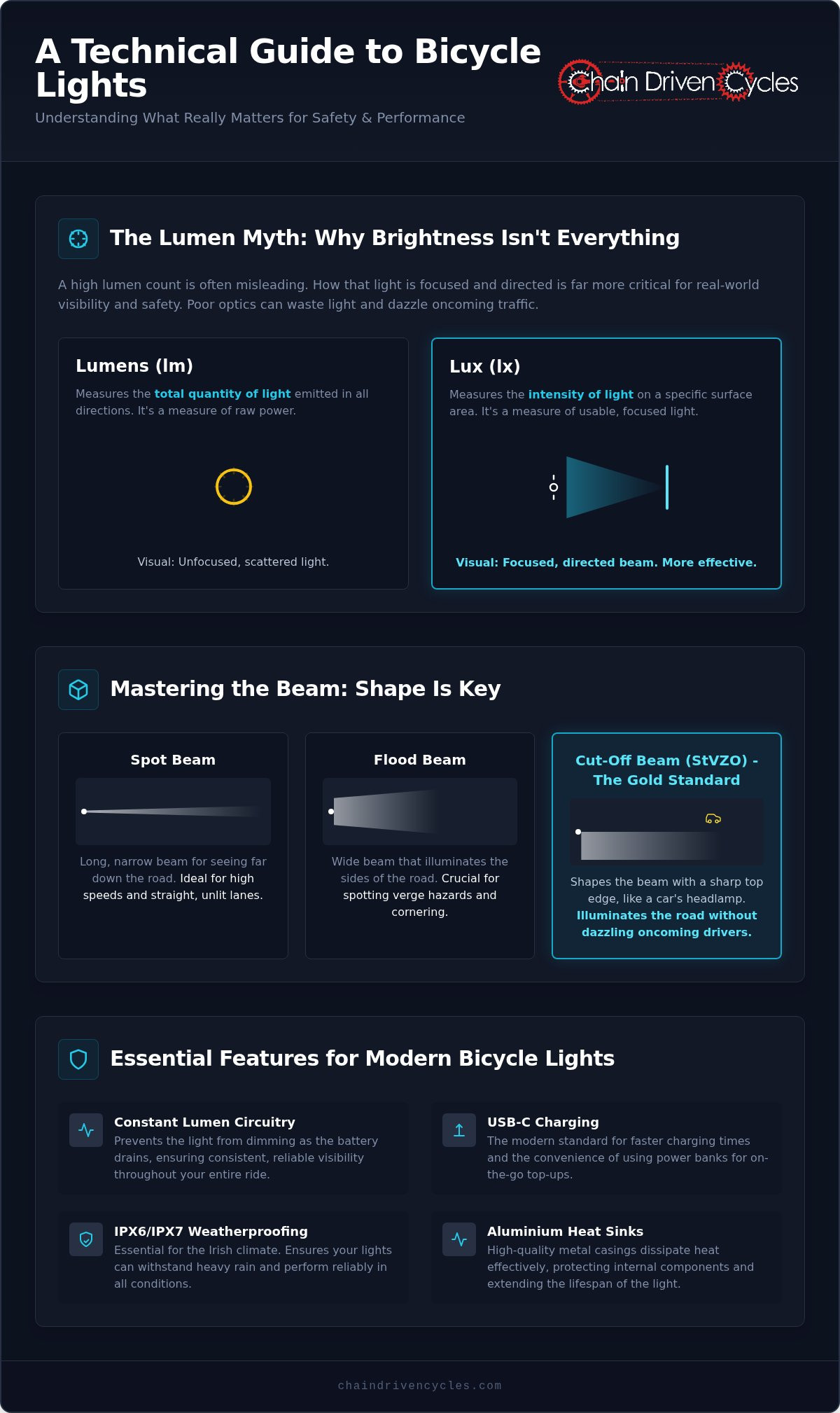
The Irish climate presents unique challenges for cycling electronics. We recommend looking for IPX6 or IPX7 ratings to ensure your gear survives persistent Atlantic rain. Cold temperatures also impact lithium-ion battery performance; expect a slight reduction in run-times during deep winter. High-quality lights often use aluminium heat sinks rather than plastic casings. This helps dissipate the heat generated by powerful LEDs, extending the lifespan of the internal components. Our professional road bike servicing includes checking these mounts and electrical connections to ensure your setup remains dependable throughout the seasons.
Technical Specifications: Lumens, Beam Patterns, and Battery Tech
Many riders focus solely on the lumen count when browsing for bicycle lights, but this figure only tells half the story. Lumens represent the total amount of light emitted by the source in all directions. However, for a cyclist, how that light is managed centrally is what determines safety. Lux measures light intensity at a specific point, which is critical for road safety. If a light lacks high-quality optics, those thousands of lumens might simply scatter into the sky or dazzle oncoming drivers rather than illuminating the tarmac ahead.
A well-designed beam typically incorporates a mix of spot and flood patterns. Spot beams provide the "throw" needed to see far ahead at high speeds, whilst flood patterns offer the peripheral vision required to spot pedestrians or animals entering from the road verge. Modern "cut-off" beams are becoming the gold standard in 2026. These shape the light so it doesn't rise above the handlebars, mimicking car headlights to prevent blinding other road users. This is particularly important for those riding high-performance Wilier road bikes, where speed necessitates a clear but responsible view of the path.
Smart battery management is another essential feature for the serious cyclist. Look for units with regulated circuitry or "constant lumen" technology. This prevents the light from fading as the battery drains, ensuring your visibility remains consistent from the start of your ride to the very end. The industry has also standardized around USB-C charging, allowing for faster top-ups and the convenience of using a power bank for on-the-go charging. If you are investing in a premium setup from brands like Lezyne or Cateye, our 10-month payment plan makes these advanced technical features more affordable.
Decoding Lumen Requirements
Selecting the right output depends entirely on your environment. Whilst higher is generally better for visibility, matching the lumens to your specific needs preserves battery life and prevents unnecessary glare. We recommend the following benchmarks:
- 200–400 Lumens: Ideal for well-lit city streets and as a secondary backup for urban commuting.
- 400–800 Lumens: The sweet spot for suburban cycling and routes with occasional dark stretches.
- 1000+ Lumens: Essential for high-speed road cycling on unlit national routes and rural lanes.
Beam Optics and Side Visibility
Collimating lenses are the secret to performance, as they organise light into a usable path and reduce wasted "spill." Side cut-outs in the light casing are equally vital. These allow light to bleed out the sides, ensuring you are visible at junctions where motorists might otherwise miss your profile. While federal bicycle safety regulations often focus on passive reflectors, active lighting with 180-degree visibility provides a significantly higher level of protection in modern traffic conditions. Ensuring your mounts are professionally checked during a road bike service will keep these optics correctly aligned for maximum effect.
Selecting the Right Setup for Your Riding Style
Your choice of illumination should be as intentional as the choice of your frame. A rider navigating city traffic on electric hybrid bikes in Ireland has vastly different requirements than a performance cyclist training on a carbon road racer. Whilst the former prioritises ease of use and 360-degree visibility, the latter must balance high-intensity output with aerodynamic efficiency and weight. Modern bicycle lights are now designed to meet these specific situational needs, ensuring you don't have to compromise on safety or speed.
Opting for a synchronised light set is a practical way to manage your gear. These bundles often share a single charging cable and a unified mounting system, which simplifies your pre-ride routine. Many premium sets now feature "Daytime Running Lights" (DRL) technology. These aren't just dimmed night lights; they use specific flash patterns and high-intensity pulses designed to be visible even in direct sunlight. Research suggests that using DRLs can significantly reduce the risk of daytime collisions, making them an essential addition for any road user.
The Commuter’s Choice: Reliability and Ease
For those cycling to work, the best setup is one that requires minimal thought. We recommend prioritising quick-release mounts. These allow you to remove your lights in seconds when parking in public areas, protecting your investment from theft. Look for units equipped with ambient light sensors that automatically toggle between modes as you move from bright streets to darker underpasses. Accurate battery indicators are also vital. Knowing exactly how much run-time remains ensures you aren't caught in a sudden blackout on your way home. If you're upgrading your daily rig, our 10-month payment plan can help you secure a professional-grade setup without a large upfront cost.
The Road Enthusiast: Speed and Distance
Performance riders on Wilier road bikes in Ireland often face the challenge of mounting hardware on proprietary aerodynamic bars or seat posts. We stock specialised mounts designed to fit these sleek profiles without scratching the carbon finish. Weight is a critical factor for these riders, leading many to choose integrated units for shorter training sessions. However, for long-distance endurance events, external battery packs are often superior, as they provide the capacity needed for all-night riding. High-intensity rear pulses are particularly effective on national roads, where they grab the attention of motorists from a significant distance, even at high approach speeds. Ensuring these mounts are correctly fitted is a standard part of our professional servicing, protecting both your frame and your safety.
Mounting and Maintenance: Getting the Most from Your Gear
Investing in high-performance bicycle lights is only the first step toward road safety. To truly maximise their effectiveness, you must ensure they are mounted correctly and maintained with the same precision as your drivetrain. Poor alignment is a frequent mistake amongst cyclists; a front beam angled too high will dazzle oncoming motorists, whilst one aimed too low significantly reduces your stopping distance at speed. Ideally, your main beam should hit the tarmac approximately ten to fifteen metres ahead, providing a clear view of hazards without causing glare for other road users.
Durability in the Irish climate also depends on routine care. Road salt, grit, and mud can quickly degrade lens clarity and compromise the seals on charging ports. We recommend wiping your lenses with a soft, damp cloth after every wet ride to prevent scratches. For the internal components, long-term battery health is paramount. If you are storing your lights during the brighter summer months, avoid leaving them completely empty or fully charged. Storing lithium-ion cells at roughly 50% capacity in a cool, dry place will significantly extend their total lifespan and ensure they are ready for the autumn transition.
Optimising Your Mounting Position
Standard handlebar mounts are reliable, but they can create long shadows from your front tyre. Mounting a light on the fork crown or a dedicated front rack eyelet lowers the light source, which often provides better contrast on uneven road surfaces. Helmet lights are an excellent secondary option for rural riding. Because they follow your gaze, they allow you to "look-to-see" into corners or signal your presence to motorists at side junctions. For rear visibility, always double-check that your light isn't obscured by a saddlebag, a long jacket, or mudguards. A clear line of sight is essential for the high-intensity pulse modes to do their job effectively.
Integration with Professional Servicing
Your lighting system should not be an afterthought during your maintenance schedule. A professional road bike servicing in Ireland provides the perfect opportunity to verify the integrity of your setup. Our technicians check mount tension to ensure lights don't vibrate loose on rough terrain and inspect cable routing for wired systems on electric hybrid bikes. Many modern "smart" lights also require occasional firmware updates to optimise battery efficiency or improve sensor responsiveness. Keeping these systems updated ensures your hardware performs at its peak. If you are looking to upgrade your current setup, you can browse our full collection of professional bicycle lights and take advantage of our flexible 10-month payment plan.
Secure Your Ride with Premium Lighting at Chain Driven Cycles
At Chain Driven Cycles, we believe that high-performance visibility should be standard for every rider. Our curated collection of LED bicycle lights is selected specifically for the challenging Irish environment, where unlit rural roads and heavy coastal rain are part of the landscape. We specialise in equipment that matches the calibre of the Wilier and Bottecchia frames we sell. By stocking industry leaders like Lezyne and Cateye, we offer our customers proven reliability and cutting-edge beam technology that ensures you are seen from every angle.
Premium safety equipment is an investment in your well-being. To make top-tier lighting accessible, we offer a flexible 10-month payment plan. This allows you to equip your machine with a professional-grade setup immediately whilst spreading the cost over a manageable period. Our team consists of passionate cyclists who understand the difference between a city commute and a high-speed descent on a national road. We are always on hand to provide expert advice on lumen counts and beam optics tailored to your specific riding style.
Standout Products in Our Collection
Our inventory includes high-lumen front lights that act as powerhouses for the darkest rural routes, providing the clarity needed for safe navigation. For performance-focused road racers, we offer compact rear beacons. These minimalist designs provide maximum output without disrupting the clean lines of a carbon frame. If you have just purchased a new bicycle, our complete light sets are the most efficient way to ensure you are road-legal and fully protected from day one. These matched sets offer synchronised modes and simplified charging routines, making your pre-ride preparation much faster.
Why Shop with Chain Driven Cycles?
We provide national delivery across Ireland for all lighting and accessories, ensuring you have access to professional gear regardless of your location. Our technical expertise is rooted in years of professional bike repair and competitive racing. This means we don't just sell products; we offer the necessary expertise to help you maintain them. Whether you need help mounting a light on an aerodynamic seat post or advice on winter battery care, we are your trusted partners in cycling safety. Browse our full range of Bicycle Lights and stay safe today.
Ride with Confidence: Your Path to Total Visibility
Choosing the right lighting system is a fundamental step in ensuring your safety and enjoyment on the road. By prioritising beam quality and intelligent battery management over simple lumen counts, you create a safer environment for yourself and other road users. Whether you are navigating unlit rural lanes on a performance Wilier frame or commuting through city centres on an electric hybrid, your setup should be as precise as your machine.
At Chain Driven Cycles, we are committed to supporting your journey with expert advice and industry-leading hardware. As an authorised premium dealer, we provide national Irish delivery and professional support to keep your gear in peak condition. Our flexible 10-month payment plan makes high-end safety accessible to every cyclist, allowing you to invest in quality without compromise. We know reliability isn't negotiable when the sun goes down.
Ready to light up your next ride? Upgrade your visibility with our premium bicycle lights collection and experience the confidence that comes with professional-grade optics. We look forward to seeing you out on the road.
Frequently Asked Questions
How many lumens do I need for cycling on unlit country roads?
You need at least 800 to 1,000 lumens to safely navigate unlit country roads at speed. This level of output ensures you can spot hazards like potholes or debris from a distance that allows for safe braking. Whilst total lumens are important, the beam pattern matters just as much. A focused beam with a strong "throw" is essential for rural riding, especially on high-performance Wilier road bikes where you're likely maintaining a higher pace.
Is it better to have a flashing or a solid rear light for safety?
A combination of both is the most effective strategy for rear visibility. A solid light helps motorists judge your distance and speed accurately, whilst a flashing mode is superior for grabbing attention in busy traffic. Many modern units offer a "pulse" mode that combines a steady beam with a brighter flash. This provides the best of both worlds, ensuring you remain conspicuous without making it difficult for drivers to track your movement.
Are rechargeable USB bike lights better than battery-powered ones?
Rechargeable USB-C lights are almost always the superior choice for modern cyclists. They offer a more consistent power output and eliminate the ongoing cost and environmental waste of disposable cells. Most premium units from brands like Lezyne feature regulated circuitry to ensure your bicycle lights don't dim as the battery drains. If you're worried about long-distance rides, carrying a small power bank allows for convenient top-ups during coffee stops or mid-ride breaks.
What is the legal requirement for bike lights in Ireland?
In Ireland, you're legally required to have a white or yellow front light and a red rear light during lighting-up hours. These must be visible from a reasonable distance, and you must also have a red rear reflector fitted to your machine. Whilst the law sets the minimum standard, we recommend using high-quality LED systems even in daylight. We provide national delivery for all road-legal lighting sets to ensure every rider stays protected.
Can I mount high-powered lights on my carbon fibre handlebars?
You can safely mount lights on carbon fibre handlebars, but you must use the correct mounting hardware. Most high-end lights come with rubber shims that protect the carbon surface and provide a secure grip without excessive clamping force. It's vital not to over-tighten the mounts, as this can damage the structural integrity of the bars. If you're unsure, our professional road bike servicing includes checking all mounts and electrical components to ensure everything is secure.
How long does a typical 800-lumen bike light battery last?
A typical 800-lumen light will last between 1.5 and 2.5 hours when used on its highest steady setting. However, most riders don't need full power for the entire duration of a ride. By toggling to a lower setting or a pulse mode during well-lit sections, you can often extend this run-time to over 10 hours. Always check the battery indicator before you set off to avoid being caught in the dark on unlit national roads.
Do I need a different light for my electric hybrid bike?
You don't need a different light, but electric hybrid bikes often offer the option of integrated lighting. These systems draw power directly from the e-bike's main battery, meaning you never have to worry about charging separate units. If your bike isn't pre-fitted with these, standard rechargeable lights work perfectly well. We offer a 10-month payment plan to help you invest in premium lighting sets that match the high-end technology of your electric bicycle.
What should I do if my bike light gets wet in heavy rain?
If your light gets wet, dry the exterior with a soft cloth and ensure the charging port cover is securely closed. Most quality bicycle lights feature an IPX6 or IPX7 rating, meaning they're designed to withstand heavy Irish rain. If you notice moisture inside the lens, don't turn the light on; instead, let it dry out completely in a warm area. Regular cleaning of the seals and ports is a standard part of our professional maintenance services.