



Bicycle Wheel Repair and Part Replacement: The 2026 Buying Guide
What if the difference between a high-performance ride and a mechanical failure isn't the price of your wheelset, but the precision of a single 12mm thread pitch? Finding reliable bicycle wheel repair Sligo cyclists can trust often starts with understanding the complex ecosystem of modern components. It's frustrating when a simple weekend service turns into a week-long search for a specific Mavic ratchet kit or the correct freehub body. You've likely felt the confusion of matching a Shimano Micro Spline hub to a Boost-spaced frame, only to realise the axle thread doesn't quite line up.
We understand that maintaining your bike shouldn't require an engineering degree. This 2026 guide will help you master the technicalities of bicycle wheel components to ensure your next repair or upgrade delivers smooth, reliable performance on any terrain. We'll examine the nuances of QR versus thru-axle standards, decode drivetrain compatibility for SRAM and Shimano, and explain why genuine replacement parts are essential for long-term durability. By the end, you'll have the confidence to select from the 34 specialised components in our collection to keep your wheels spinning perfectly.
Key Takeaways
- Recognise the early warning signs of hub wear, such as lateral play or a gritty sensation in the cartridge bearings, to prevent costly damage to your wheel system.
- Master the technicalities of modern axle standards and thread pitches to streamline the bicycle wheel repair Sligo riders rely on for long-term mechanical reliability.
- Decode the compatibility requirements for Shimano HG, Micro Spline, and SRAM XD/XDR systems to ensure your freehub matches your drivetrain perfectly.
- Understand the importance of using genuine, brand-specific spares like Mavic ratchet kits to maintain the structural integrity and performance of premium wheels.
- Learn how strategic performance upgrades, including high-engagement hubs and low-friction bearings, can provide a measurable boost to your climbing efficiency.
Signs Your Bicycle Wheels Need Repair or a Component Overhaul
Your wheels are the most hard-working components on your bike, enduring constant rotational friction and vertical impact. Identifying a problem before it leads to a total mechanical failure is the key to maintaining a safe, efficient ride. When searching for bicycle wheel repair Sligo cyclists often ask whether a specific sound or sensation is a normal part of wear or a sign of imminent failure. Mastery of these diagnostic signs ensures you don't spend money on a full wheelset when a simple bearing swap or freehub service would suffice.
Diagnostic Noises and Vibrations
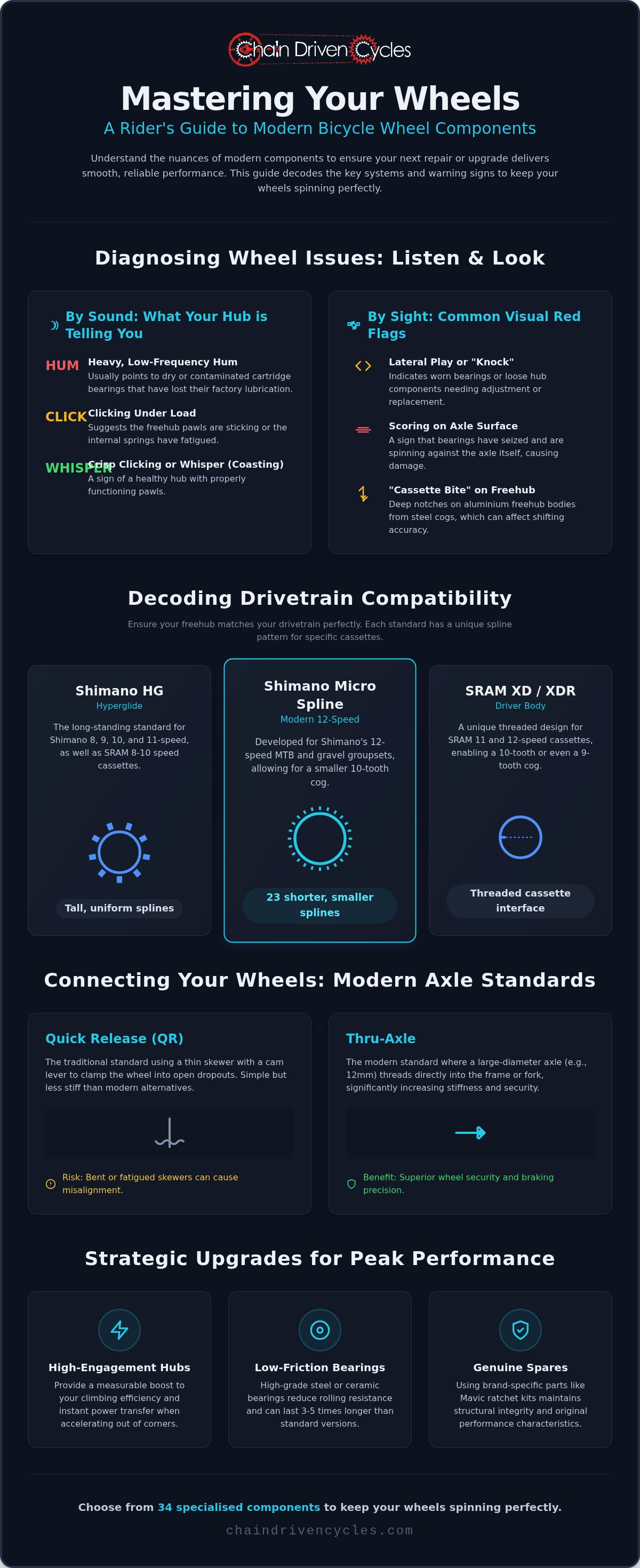
Sound is often the first indicator that your hub internals are struggling. A healthy hub should whisper or produce a consistent, crisp clicking from the pawls whilst coasting. If you notice a heavy, low-frequency hum, it usually points to dry or contaminated cartridge bearings that have lost their factory lubrication. Clicking sounds that only occur whilst pedalling under load often suggest the freehub pawls are sticking or the internal springs have fatigued. Hub play is the lateral movement of the hub shell along the axle, which can cause the rim to rub against brake pads and significantly degrade stopping power. You can test for this by holding the top of the tyre and trying to wiggle the wheel side-to-side; any noticeable "knock" indicates a need for adjustment or replacement parts.
Visual Inspection of Hubs and Axles
A physical inspection can reveal hidden damage that hasn't yet caused a noise. Start by removing the wheel and checking the axle surfaces for scoring or dark discolouration, which suggests the bearings have been spinning against the axle rather than around it. For those using aluminium freehub bodies, look for "cassette bite," where the steel cogs have dug notches into the splines. Whilst minor marking is common, deep gouges can make it impossible to shift gears accurately or remove the cassette for cleaning. Don't overlook the small stuff; bent or fatigued quick release skewers can lead to inconsistent wheel alignment and ghost rubbing against the frame. This comprehensive guide to bicycle wheels highlights how these small interfaces are critical to the structural integrity of the entire system.
Deciding when to replace versus when to service depends on the component type. Most modern performance wheels use sealed cartridge bearings. These aren't designed for internal repair; once they feel "gritty" when turned by hand, they must be pressed out and replaced with fresh units. In contrast, freehub systems can often be revived with a deep clean and specific Mavic ratchet kits or brand-specific pawl oil. If the internal teeth of the hub shell are rounded or the freehub body is slipping consistently, a replacement is the only way to ensure your drivetrain remains reliable. Keeping a small stock of genuine spares from a collection of 34 essential wheel parts can prevent a minor service from turning into a long-term project.
The Hub and Bearing Guide: Restoring Smooth Rotation
The hub is the central heart of your wheel system, serving as the anchor point for spokes and the pivot for rotation. Whilst the front hub is a relatively straightforward component designed for smooth spinning, the rear hub is a far more complex piece of engineering. It must house the freehub mechanism and withstand the massive torque loads generated by your drivetrain. A professional approach to bicycle wheel repair Sligo riders can trust often involves a complete hub overhaul rather than just a quick adjustment. Focusing on the hub's internal condition is essential before you consider a full rim replacement.
High-quality bearings are the primary defence against rolling resistance. According to industry data, premium ceramic bearings can last three to five times longer than standard steel versions, offering replacement intervals of up to 50,000 km. However, for most road and gravel applications, high-grade stainless steel bearings provide a perfect balance of durability and cost-effectiveness. Choosing the right bearing is about more than just speed; it's about ensuring your wheels remain reliable in the face of unpredictable weather and road salt.
Cartridge vs Cup-and-Cone Bearings
Most modern wheelsets utilise sealed cartridge bearings, which are pressed into the hub shell as a complete unit. These are incredibly low-maintenance. When they wear out, you simply replace the entire cartridge, such as a 6902 or 6803 unit. In contrast, traditional cup-and-cone systems allow for precise adjustment but require regular cleaning and re-greasing to prevent pitting. For a deeper look at maintaining these complex systems, see our guide on Professional Electric and Road Bike Servicing Ireland.
Selecting the Right Hub for Your Build
If your hub shell is damaged, selecting a replacement requires careful attention to compatibility. You must match the spoke hole count exactly to your rim. A 28-hole hub cannot be used with a 32-hole rim. You also need to decide on disc brake mounting standards. Center Lock systems are becoming the standard for road and gravel due to their ease of installation, whilst 6-bolt remains popular in the mountain bike world for its simplicity. Weight and durability are always in tension. Lightweight performance hubs use thinner aluminium shells to shave grams, but they may require more frequent servicing. Once your hub is serviced, you'll likely need a professional wheel truing guide to ensure the rim is perfectly centred. When searching for bicycle wheel repair Sligo cyclists should verify their hub's hole count and brake mounting before ordering from our collection of 34 technical wheel spares.
Freehub Bodies and Ratchet Systems: Optimising Engagement
The freehub body is the critical interface between your cassette and the rear hub shell. It's responsible for transferring every watt of power from your pedals to the road, whilst also allowing you to coast silently when the work is done. For those seeking bicycle wheel repair Sligo specialists often encounter, a slipping drivetrain is frequently traced back to internal freehub wear rather than a faulty chain. Identifying the correct standard is the first hurdle in any repair. Shimano Hyperglide (HG) remains the most common for 8 to 11-speed setups, but high-performance 12-speed systems now require Shimano Micro Spline or SRAM XD/XDR bodies to accommodate smaller 10-tooth cogs.
Engagement mechanics generally fall into two categories: traditional pawl systems and star-ratchet designs. Pawl systems use spring-loaded "teeth" that bite into the hub shell's internal ring. Whilst effective, they can suffer from uneven loading if one pawl sticks due to old grease or debris. Star-ratchet systems, found in premium hubs, use two floating rings that engage simultaneously across their entire surface area. This design offers superior torque distribution and improved longevity. Maintenance is straightforward but vital; we recommend a deep clean and fresh lubrication every 3,000 km to prevent the "ghost pedalling" effect caused by sticking internals.
Mavic Ratchet Kits and Internal Spares
Mavic has pioneered engagement technology with their Instant Drive 360 (ID360) system, which uses a dual-ratchet mechanism for near-instant power transfer. Using genuine Mavic spares is non-negotiable for these wheels, as the tolerances are incredibly tight. If you notice a delay in engagement or an inconsistent sound whilst coasting, it's usually a sign that the internal springs have lost their tension or the ratchet teeth have rounded. Replacing these small components is a cost-effective way to restore that crisp mechanical feel without the expense of a full hub replacement.
Drivetrain Compatibility and Adapters
One of the most versatile aspects of modern hubs is the ability to swap freehub bodies to suit different drivetrains. You can often convert a wheelset from Shimano HG to SRAM XDR by simply removing the end caps and swapping the body. Spacers also play a vital role, especially when fitting a 10-speed cassette onto an 11-speed freehub. SRAM XDR is particularly beneficial for gravel and road riders because it allows for 12-speed cassettes with a 10-tooth small cog, enabling a much wider gear range whilst maintaining tight steps between gears. When planning your next upgrade, browse our collection of 34 technical wheel spares to ensure your hub and cassette remain perfectly aligned.
Compatibility Checklist: Quick Release, Thru Axles, and Adapters
Axle standards have moved fast. Whilst a 9mm quick release was the industry benchmark for decades, the advent of disc brakes necessitated the stiffer, more secure interface provided by thru axles. This evolution has made finding the right parts for a bicycle wheel repair Sligo riders can perform at home significantly more complex. The most common error isn't choosing the wrong diameter, but overlooking the thread pitch. A 12mm axle might come with a 1.0, 1.5, or 1.75mm pitch; using the wrong one will permanently damage the threads inside your frame or fork. Measuring the total length of the axle, rather than just the hub spacing, is the only way to ensure a perfect fit.
Modern hubs often feature modular end caps, allowing for cross-frame compatibility. These hub adapters enable a single wheelset to migrate between a traditional quick-release frame and a modern thru-axle setup. This versatility is a hallmark of premium engineering, ensuring your investment remains relevant even if you upgrade your frameset. Before purchasing, verify the internal diameter of your hub and the specific adapter kit required by the manufacturer to avoid mechanical play or alignment issues.
Quick Release Skewers for Road and Hybrid
For rim-brake machines and many entry-level hybrids, the quick release (QR) skewer remains a reliable standard. Security depends entirely on the clamping force of the internal cam mechanism. Steel skewers are the industry standard for durability and "bite" against the dropouts, but riders seeking to shave weight often opt for titanium alternatives. These can save approximately 30 to 50 grams per pair. When maintaining high-performance machines, such as those featured in our guide to Wilier Road Bikes Ireland, ensure the skewer lever is tucked neatly against the frame to prevent it from snagging on road debris.
Modern Thru Axle Standards
Performance cycling is now dominated by thru-axle standards that vary by discipline. Road and gravel bikes typically utilise a 12x100mm front and 12x142mm rear configuration. Mountain bikes have largely shifted to "Boost" spacing, which widens the hub to 15x110mm at the front and 12x148mm at the rear to allow for stiffer wheel builds and better tyre clearance. Safety is paramount here; always use a torque wrench to tighten axles to the manufacturer's specification, usually between 9 and 12 Nm. Over-tightening can crush bearings, whilst under-tightening leads to dangerous wheel wobble. You can find the exact axle for your frame amongst our collection of 34 technical wheel spares.
Essential Wheel Parts for Performance Upgrades
While basic repairs restore function, strategic part replacement transforms the riding experience. Upgrading to high-engagement hubs is one of the most effective ways to improve technical climbing performance. By increasing the points of engagement (POE) within the freehub, you reduce the "dead zone" in your pedal stroke, allowing for near-instant power transfer when navigating steep, rocky sections. This is particularly noticeable for those seeking bicycle wheel repair Sligo riders use to sharpen their bike's response on technical trails. A hub with 54 or 72 points of engagement provides a crisp, immediate feel that standard 18-point systems simply cannot match.
Speed gains aren't just about aerodynamics; they're about reducing internal friction. Upgrading to low-friction cartridge bearings can measurably decrease rolling resistance, allowing you to maintain higher speeds with less effort. Weight reduction is another critical factor. Replacing stock steel axles with high-grade aluminium or carbon fibre alternatives can save nearly 100 grams of weight; a significant reduction in unsprung mass that improves handling and acceleration. Our collection of 34 specialised wheel components is curated to offer these precision gains, ensuring every rotation is as efficient as possible.
Standout Products in Our Collection
We stock genuine Mavic ID360 service kits, which are essential for maintaining the high-engagement performance of premium road and gravel wheelsets. These kits include the specific ratchets and springs required to restore factory-fresh engagement without replacing the entire hub shell. For those riding in harsh, wet conditions, our precision cartridge bearings offer superior sealing to ensure all-weather durability. We also provide a wide range of replacement freehub bodies for the latest 12-speed drivetrains, allowing you to upgrade your wheels to match the newest Shimano Micro Spline or SRAM XDR standards without the cost of a new wheelset.
Final Steps Before Your Purchase
Precision is the key to a successful upgrade. Before ordering, double-check your hub model and the specific year of manufacture, as internal designs often change between product generations. Selecting the correct lubricant is equally vital; pawl-based systems often require a light oil, whilst star-ratchet systems need a specific grease viscosity to prevent the teeth from sticking in cold weather. Using the wrong lubricant can lead to engagement failure or accelerated wear. Once you've confirmed your specifications, you can browse our full range of wheel parts and spares today to find the exact component needed for your next performance boost.
Achieve Precision Performance on Every Ride
Mastering the technical nuances of your wheelset is the most effective way to ensure your bike remains reliable and efficient. By identifying the early signs of bearing wear and understanding the strict compatibility requirements of modern thru-axles and freehub standards, you can avoid the frustration of mechanical failure mid-ride. Whether you're performing a routine bicycle wheel repair Sligo cyclists trust or executing a high-performance hub upgrade, the right components make all the difference to your ride quality.
We provide expert technical support to help you navigate the complexities of 2026 component standards, from thread pitches to engagement systems. With 34 specialised wheel components currently in stock, including genuine Mavic and Shimano spares, we have the precise internals needed to restore your wheels to factory standards. Don't let a gritty bearing or a slipping freehub hold you back from your next adventure. You can shop precision wheel parts and spares today and ride with total confidence in your equipment. Your wheels are the foundation of your performance; keep them spinning perfectly with the right expertise and parts.
Frequently Asked Questions
How do I know if I need a new freehub body or just a service?
A service is usually sufficient if the freehub is just making a dull noise or the pawls are sticking due to old grease. However, you need a replacement if you experience consistent slipping under load or if the internal teeth are rounded. Deep cassette "bite" on the splines that prevents smooth shifting is another sign a new body is required. Identifying these issues early is vital for the bicycle wheel repair Sligo cyclists perform to maintain drivetrain efficiency.
Are all thru-axles the same size for road bikes?
No, they are not universal. Whilst 12x100mm for the front and 12x142mm for the rear are the current dominant dimensions for road bikes, the thread pitch varies significantly between frame manufacturers. You might require a 1.0, 1.5, or 1.75mm pitch to match your specific fork or frame. Always measure the total length of the axle and verify the pitch before purchasing to avoid damaging the internal threads of your bicycle. Precise measurement is essential for a secure fit.
Can I convert my quick-release wheel to a thru-axle system?
This depends entirely on your hub's design. Many high-performance hubs are modular, meaning you can swap the end caps to move between a 9mm quick-release and a 12mm thru-axle system. However, entry-level hubs are typically manufactured with fixed axle types that cannot be converted. If you're upgrading your frame to a thru-axle standard, check your hub manufacturer's compatibility list to see if a conversion kit is available amongst their technical spares. Not all hubs support this transition.
What is the difference between Shimano HG and Micro Spline freehubs?
The primary difference is the spline pattern and cassette compatibility. Shimano Hyperglide (HG) is the long-standing standard for 8, 9, 10, and 11-speed cassettes. In contrast, Micro Spline is a newer 23-rectangular spline design required for Shimano 12-speed mountain and gravel drivetrains. This design allows for a smaller 10-tooth cog, which provides a wider gear range. You cannot fit an HG cassette onto a Micro Spline freehub body without a complete hub standard swap. They are physically incompatible.
How often should I replace the bearings in my bicycle hubs?
Standard steel cartridge bearings typically last between 10,000 and 25,000 km, depending on riding conditions and maintenance. If you frequently ride in wet or muddy terrain, you may need to replace them sooner. You should check for "grittiness" by spinning the wheel by hand; any resistance or vibration indicates the internal races are pitted. Replacing bearings before they develop lateral play protects your hub shell from permanent, expensive damage. Regular inspections prevent unexpected failures during long rides.
What tools do I need to replace a freehub body at home?
To replace a freehub body, you generally need a chain whip and a cassette lockring tool to remove the cogs first. Depending on your hub brand, you may also need a set of 5mm or 10mm hex keys to unscrew the axle end caps. Some modern "press-fit" hubs can be serviced by hand, whilst others require a specific bearing puller or press. Always ensure you have the correct brand-specific grease or oil for the internal engagement pawls.
Why is my rear hub making a grinding noise when I coast?
A grinding noise whilst coasting is a classic symptom of contaminated or dry bearings within the freehub body itself. Since the noise only occurs when the wheel is spinning but the pedals are stationary, it points directly to the freehub internals rather than the main hub shell bearings. This is a common issue addressed during the bicycle wheel repair Sligo enthusiasts undertake after a winter of heavy riding. A deep clean and specialised re-greasing often solves the problem.
Are Mavic ratchet kits compatible with other hub brands?
No, Mavic ratchet kits are proprietary components designed specifically for Mavic’s Instant Drive 360 (ID360) and older FTS-L systems. They utilise a unique dual-ratchet or pawl design that will not fit hubs from other manufacturers like Shimano or SRAM. Using non-genuine or incompatible parts in a high-performance hub can lead to immediate mechanical failure. Always source genuine spares from a collection of 34 specialised wheel parts to ensure total mechanical reliability and safety on any terrain.