



The Ultimate Guide to Bicycle Cables and Casings: Optimising Your Gear and Braking Performance
Could the most affordable component on your bicycle actually be the one that dictates your entire riding experience? While many riders invest heavily in lightweight frames or high-end wheelsets, the humble system of cables and casings often remains an afterthought. It's a common oversight, yet these thin strands of steel and their protective housings are the critical link between your hands and your drivetrain. When they're neglected, even the most expensive groupset will feel sluggish, imprecise, and frustratingly unreliable.
We understand the annoyance of ghost shifting during a steep climb or a spongy, unpredictable feel when you pull the brake lever in the wet. You deserve gear changes that click into place instantly and braking that offers both power and fine modulation. This guide provides the technical expertise you need to optimise your setup for long-term performance. We'll examine the differences between mechanical and electronic requirements, the impact of polymer coatings, and how to choose the perfect replacement kit for your specific Shimano or Campagnolo setup to ensure your bike performs exactly as the engineers intended.
Key Takeaways
- Learn the structural differences between linear strand gear housing and coiled brake housing to prevent spongy braking and ensure indexed shifting precision.
- Identify why stainless steel and polymer-coated inner cables and casings are essential for resisting corrosion and reducing friction in damp riding conditions.
- Master the signs of wear, such as ghost shifting or cable fraying, to determine exactly when your control system requires a professional overhaul.
- Understand the specific compatibility requirements for high-performance groupsets, including the nuances of Shimano Dura-Ace and Campagnolo Ultra-Shift systems.
- Discover how correct fitment and precise housing lengths can transform your bike's tactile feedback and long-term mechanical reliability.
Understanding the Critical Role of Cables and Casings in Modern Cycling
Many cyclists spend hours researching aerodynamic frames or carbon wheelsets, yet they frequently overlook the very components that translate their physical input into mechanical action. High-quality cables and casings act as the nervous system of your bicycle. If this system is compromised, even the most expensive groupset will feel sluggish and imprecise. Friction is the primary antagonist in this scenario. When grit or internal corrosion enters the housing, the derailleur spring struggles to overcome the resistance, resulting in "ghost shifting" or a frustrating delay when you try to change gears.
For those riding in Ireland, the climate presents a unique set of challenges. Our frequent rain and salted winter roads create a corrosive environment that can quickly ruin standard galvanised components. This makes the choice of materials a practical necessity rather than a luxury. Without rust-resistant stainless steel or polymer-coated wires, your shifting performance will inevitably degrade within a single season of coastal or winter riding. Precision isn't just about the derailleur; it's about the integrity of the path the cable takes to get there.
Mechanical vs Electronic: Choosing Your Path
The distinction between mechanical and electronic systems has changed how we approach bicycle maintenance. Traditional mechanical groupsets rely on the physical tension of stainless steel cables. While these are reliable and easily serviced, they're susceptible to "cable stretch" and environmental wear. Electronic systems, such as Shimano Di2, replace these steel strands with electric wires. By removing physical friction and the risk of corrosion, electronic shifting offers identical precision on every ride, regardless of the weather. While the mechanics of bicycle braking systems often still rely on traditional cables in many setups, the shift toward electronic gears has redefined what we expect from drivetrain reliability.
Anatomy of a Cable System
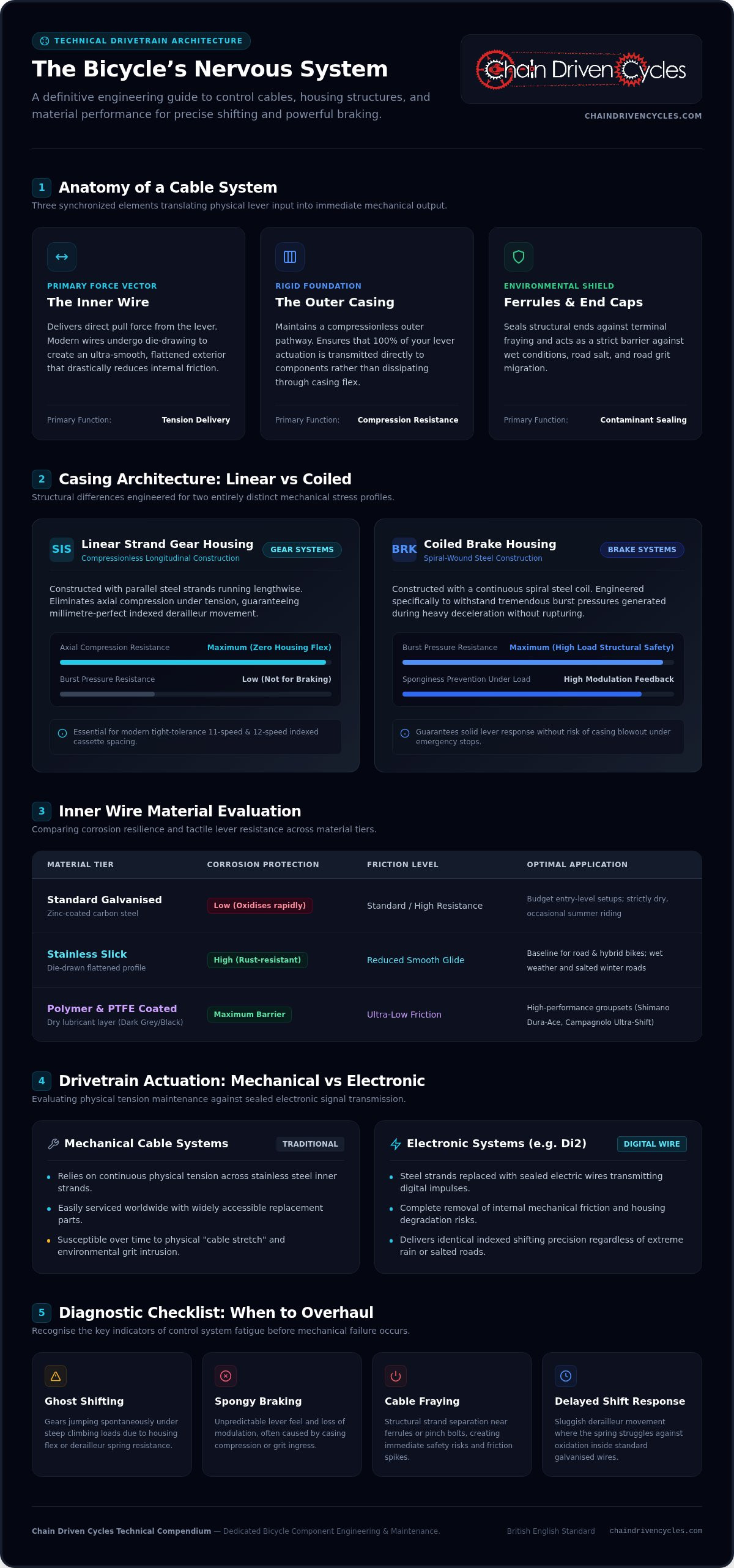
To maintain your bike effectively, you need to understand the three core elements of the control system:
- The Inner Wire: This is the heart of the system that delivers the pull force. Modern wires are often die-drawn to create a smoother surface, reducing friction against the outer housing.
- The Outer Casing: This provides the compressionless structure. A high-quality casing ensures that 100% of your lever pull is transmitted to the component rather than being lost to housing flex.
- Ferrules and End Caps: These small but essential parts seal the system. They prevent the casing from fraying and act as a barrier against the Irish mud and grit that can otherwise migrate into the inner workings.
Inner Cables: Comparing Materials for Maximum Efficiency
The choice of inner wire material determines how long your shifting remains crisp before the elements take their toll. While they may look identical to the naked eye, the microscopic differences between various cables and casings components dictate everything from lever feel to service intervals. Understanding these materials allows you to choose a setup that balances performance with the practicalities of maintenance.
Standard Galvanised vs Stainless Slick
Galvanised cables serve as a budget-friendly entry point, featuring a zinc coating over carbon steel. They work well for occasional summer riders, but the coating eventually wears away, leaving the steel vulnerable to the damp Irish air. Once oxidation begins, the friction increases exponentially, leading to the sluggish shifting behaviour often mistaken for a faulty derailleur.
In contrast, stainless steel inners are the baseline for any serious road or hybrid bike. They are inherently rust-resistant, making them essential for year-round cycling. Many premium options, like the Shimano compatible stainless steel gear inner cable, undergo a "slick" treatment. This process involves die-drawing the wire through a series of moulds to flatten the outer surface. By reducing the surface area that touches the housing, these wires move with significantly less resistance, resulting in faster, more reliable gear changes.
Performance Coatings: Polymer and PTFE
High-performance groupsets demand even lower friction levels to function correctly. PTFE coatings, often recognisable by their dark grey or black appearance, provide a dry lubricant layer that shrugs off dirt. However, the current gold standard is the polymer coating found in the Shimano Dura-Ace RS900 set. Unlike a simple spray-on layer, this polymer is wrapped around the cable in a micro-grooved pattern. These tiny ridges act as reservoirs for grease; this ensures the system remains lubricated even after months of heavy use.
Advanced sets like the Campagnolo Ultra-Shift system require these specialised low-friction wires to maintain the tactile, mechanical "click" the brand is famous for. Whilst these coatings offer unparalleled smoothness, they do require careful handling during installation to avoid peeling. If you're looking to upgrade your current setup, exploring our range of professional-grade cables and casings is the first step toward restoring that "new bike" feel.
Specialised bikes also require specific solutions. Tandems have significantly longer reach requirements than standard frames. Using a standard inner wire on a tandem is physically impossible, which is why products like Clarks Stainless Steel Tandem cables are engineered with the necessary length and tensile strength to handle the unique geometry of a two-person machine. Choosing the correct material for your specific bike type ensures that your control inputs are never lost to mechanical inefficiency.
Outer Casings: SIS Gear Housing and Brake Cable Solutions
While the inner wire provides the tension, the outer housing acts as the rigid spine of the entire system. Understanding the synergy between cables and casings requires an appreciation of the architecture hidden inside those plastic tubes. Many riders assume gear and brake housings are interchangeable, but they serve entirely different mechanical purposes. Swapping them isn't just a performance error; it can be a safety risk. The outer casing must provide a stable environment for the inner wire to move, resisting both compression and environmental contamination.
Gear Housing and Indexed Shifting
Modern indexed shifting relies on extreme precision. Gear housing, typically 4mm in diameter, uses linear steel strands arranged longitudinally. This design is known as "compressionless" because the housing doesn't shorten when you click the shifter. Without this rigidity, the derailleur wouldn't move the exact distance required to align with the cassette sprocket. For modern "Shadow" rear derailleurs, which require a much tighter cable loop at the back of the bike, the Shimano Dura-Ace OT-RS900 outer is a necessary upgrade. It's more pliable than standard housing, preventing the cable from binding as it enters the mechanism.
Protecting these precise systems from the Irish elements is a constant battle. Using a Shimano SIS SP40 sealed cap provides an internal rubber shield that keeps grit and water from migrating into the housing. This small addition can significantly extend the life of your drivetrain, ensuring that your shifting remains light and crisp even after a winter of wet-weather riding.
Brake Casings and Safety
Brake housing is built to handle much higher loads. Unlike gear housing, it uses a coiled steel spiral designed to withstand the immense "burst" pressure of a hard emergency stop. Using linear gear housing for brakes is dangerous, as the strands can pull through the lever under load. To ensure the best performance, pair your housing with high-quality SS brake inner cables. This combination provides a firm, modulated feel rather than the "spongy" sensation associated with cheaper, non-stainless alternatives.
- V-Brake Solutions: For hybrid or mountain bike riders, the BBB BCB-91 VeePipe Kit is an excellent accessory. It creates a clean, low-friction path for the cable to enter the brake arm, reducing drag.
- Frame Protection: Constant vibration causes housing to rub against the headtube, which eventually wears through the paint. A simple application of Trivio cable wrap acts as a protective buffer, preserving your frame's finish.
Choosing the right housing is about more than just colour. It's about matching the mechanical requirements of your specific components to ensure every input you make is delivered with total accuracy.
Standout Products: Selecting the Best for Your Bike
Selecting the right components is the final step in restoring your bike's factory-fresh performance. While we have discussed the technical differences between materials, choosing a specific kit depends on your groupset and riding style. Investing in high-quality cables and casings ensures that your drivetrain and braking system operate as a cohesive unit. For those undertaking a complete groupset upgrade or a full seasonal overhaul, our 10-month payment plan offers a practical way to bundle these essential parts with professional bicycle repair services at Chain Driven Cycles.
The Professional Choice: Shimano Dura-Ace
The Shimano Dura-Ace RS900 gear cable set is the gold standard for high-performance road cycling. It is specifically engineered to work with the R9100 and R8000 series rear derailleurs, featuring the polymer-coated inner wires mentioned previously. Buying a complete set rather than individual components is always the better choice. These kits include the specific sealed ferrules and the specialised OT-RS900 rear housing segment required for the tight cable loops found on modern Shadow derailleurs. This comprehensive approach is the only way to achieve the near-instantaneous shifting response that professional riders demand.
For owners of premium Italian machines like Bottecchia, the Campagnolo Ultra-Shift and Power-Shift cable kits are essential. Campagnolo systems use slightly different cable head dimensions compared to Shimano. Using an incompatible wire can damage the internal ratchet of your Ergopower levers. These genuine Italian kits preserve the tactile, mechanical feedback that defines the brand's heritage.
Specialist and Utility Options
Not every bike fits the standard road or hybrid template. Electric hybrid bikes and modern road builds often utilise electronic shifting, which requires Shimano EW-SD300 or the older EW-SD50 Di2 wires. These are not traditional cables but rather digital transmission lines. They eliminate mechanical wear entirely, providing consistent performance in the harshest Irish winter conditions. If you're maintaining a tandem, standard wires simply won't reach the rear brakes or derailleur. The 3060mm Clarks stainless steel cable is a vital solution, providing the extreme length necessary for these specialised frames without sacrificing tensile strength.
Fine-tuning your setup is equally important. Inline adjusters, such as the Shimano SM-CB70, allow you to tweak brake tension whilst on the road. This is particularly useful as pads wear down during long rides. Finally, never overlook the small essentials. A pack of 10 inner cable end caps is a workshop staple; these prevent the wire from fraying, which is the most common cause of skin punctures and difficult maintenance later on. You can browse our full range of professional-grade cables and casings to find the exact match for your bicycle's requirements.
Installation and Maintenance: Getting the Most from Your Cables
Even the highest quality cables and casings eventually succumb to the rigours of the road. In Ireland, where rain and road salt are constant companions, proactive maintenance is the only way to prevent a total mechanical failure. You should inspect your control system every few months for visible signs of trouble. Look for fraying near the anchor bolts, white powdery oxidation on the wires, or any cracking in the outer plastic housing. If your shifting feels heavy or your brakes don't snap back instantly, it's usually a sign that internal friction has become too high.
When you decide to replace your system, the golden rule is to "measure twice and cut once". Use your old housing segments as a template, but don't be afraid to add a few millimetres if the original setup felt too tight. Housing that's too short creates sharp bends that increase friction and degrade shifting accuracy. Conversely, excessively long housing can catch on obstacles or rub against your frame. Use a dedicated pair of bicycle cable cutters to ensure a clean, square end; a crushed housing entry will immediately compromise the smoothness of your new inner wire.
The Maintenance Checklist
A clean aesthetic often hides complex mechanical requirements. If your bike features internal routing, the process of threading new wires can be challenging without specific magnetic guiding tools. For external setups, keep an eye out for "kinks" or sharp bends that may have occurred if the bike was leaned against a wall or transported in a car. These small deformities in the steel structure of the casing are permanent and will cause persistent indexing issues until replaced.
- Seal the System: Always use sealed end caps on your gear housing. These small components act as a primary defence against the grit that flies off your front wheel.
- Aesthetic vs Function: Whilst internal routing looks sleek, it can trap moisture inside the frame. Ensure your bottom bracket cable guide is clean and lightly lubricated to prevent the wires from binding.
- End Caps: Never leave an inner wire without a crimped end cap. A frayed cable is impossible to re-thread and can cause painful injuries during routine cleaning.
Professional Servicing and Support
Whilst many riders enjoy the process of a DIY tune-up, certain tasks are best left to a professional service centre. Modern integrated cockpits, where cables and casings run through the handlebars and headset, are notoriously difficult to service without specialized knowledge. Furthermore, securing inner wires requires precise torque. Over-tightening a pinch bolt can crush and weaken the wire, whilst under-tightening can lead to a dangerous loss of braking power at a critical moment.
If your bike requires a comprehensive mechanical refresh, our professional bicycle repair services are available to ensure every component is installed to factory specifications. For customers bundling a full cable overhaul with a new groupset or a seasonal service, we offer a 10-month payment plan to help manage the cost of premium maintenance. You can browse our full range of cables and casings to start your upgrade and restore the precision your bicycle was designed to deliver.
Restore Precision to Every Ride
Maintaining the tactile connection between your hands and your bicycle is the simplest way to transform your riding experience. By selecting the correct cables and casings, you eliminate the mechanical drag that leads to ghost shifting and spongy braking. We have explored how stainless steel and polymer coatings resist the harsh Irish elements, whilst compressionless housing ensures every gear change is delivered with absolute accuracy.
Whether you are performing a seasonal overhaul or a performance upgrade, using genuine Shimano and Campagnolo parts preserves the integrity of your groupset. Our team provides expert technical support to help you navigate specific compatibility requirements, from Di2 wiring to tandem-length cables. If you are planning a major maintenance project, our flexible 10-month payment plan is available to help you manage the investment in high-quality equipment.
Don't let worn components compromise your safety or enjoyment on the road. Shop our professional range of Cables and Casings today and experience the difference that precision engineering makes. We look forward to helping you keep your bike in peak condition for many kilometres to come.
Frequently Asked Questions
How often should I replace my gear and brake cables?
You should replace your inner wires and outer housing annually if you ride year-round, or every 3,000 to 5,000 kilometres. In the damp Irish climate, salt and grit accelerate internal corrosion. Regular replacement prevents the inner wire from snapping inside the shifter; this is a common issue that can cause expensive damage to the delicate internal ratchets of your levers.
Can I use gear housing for my brakes, or vice versa?
You must never swap these housings as they are engineered for different physical loads. Gear housing uses longitudinal steel strands to remain compressionless for precise indexing. Brake housing uses a coiled spiral to withstand high burst pressures during emergency stops. Using gear housing for brakes is dangerous; the strands can pull through the lever under the immense forces required for braking.
What is the difference between Shimano EW-SD300 and EW-SD50 Di2 wires?
The EW-SD300 is a thinner wire designed for the latest 12-speed Dura-Ace and Ultegra series. The EW-SD50 is the original standard for 10-speed and 11-speed systems. These wires are not cross-compatible without a specific adapter. Both provide a weatherproof digital connection that eliminates the mechanical friction issues often found in traditional cables and casings, ensuring identical shifting performance in all weather conditions.
Why are polymer-coated cables more expensive than standard stainless steel?
Polymer cables feature a micro-grooved wrapping that acts as a reservoir for lubricant, significantly reducing friction levels. This manufacturing process is far more complex than standard die-drawing used for stainless steel. Whilst the initial cost is higher, they provide the ultra-light shifting action required for high-end Shimano groupsets. They are a performance-oriented upgrade designed to maintain a "new bike" feel for longer.
Do I need special tools to cut bicycle cable housing?
A dedicated pair of bicycle-specific cable cutters is essential for a professional finish. Standard wire cutters or pliers will crush the outer housing and the internal plastic liner, creating immediate friction. After making the cut, you should use an awl or a small pick to open the internal liner. This ensures the inner wire can move without any resistance from the housing ends.
What are ferrules, and why are they necessary for my bike?
Ferrules are the small caps that sit on the ends of the outer housing. They provide a stable interface between the housing and the frame stops. Without them, the steel strands of the housing would eventually pull through the frame or derailleur body. Sealed versions are particularly effective in Ireland; they act as a primary barrier against mud and grit entering your gear system.
Will these cables work with both Shimano and SRAM systems?
Most stainless steel inner wires are compatible with both Shimano and SRAM because they use identical 1.1mm or 1.2mm diameters and cylinder-shaped heads. However, Campagnolo systems require a slightly smaller head and are not interchangeable. Always verify the specific kit requirements, as modern 12-speed road groupsets perform most reliably when paired with the manufacturer's proprietary cables and casings for optimal indexing precision.
How do I prevent my cables from scratching my bike frame?
You should use protective rubber "donuts" or frame protectors at every point where the housing contacts the paintwork. Constant vibration during rides causes the plastic casing to act like sandpaper, eventually wearing through the clear coat. Clear adhesive patches applied to the headtube are an effective, invisible way to preserve your bicycle's aesthetic value and prevent long-term damage to the frame finish.