



Road Bike Tyres Ireland: Ultimate 2026 Buying Guide
The fastest tyre in a laboratory setting is frequently the slowest choice for a rain-slicked Sunday morning on Irish tarmac. When you're searching for the best road bike tyres Ireland has to offer, the raw data on rolling resistance often takes a backseat to the practical realities of hedge clippings, road grit, and unpredictable dampness. We understand that nothing ruins a training block quite like a series of avoidable punctures or the lack of confidence that comes from a sliding rear wheel on a technical descent.
It's frustrating to invest in a high-performance machine only to have your momentum halted by debris or technical confusion over tubeless compatibility. You deserve a setup that offers both speed and security. In this 2026 buying guide, you'll master the nuances of casing TPI, compound grip scores, and why wider 30mm or 32mm options are becoming the new standard for local conditions. We'll preview the latest high-performance innovations and explain how professional fitting can transform your riding experience, ensuring fewer mechanical interruptions and higher average speeds on every outing.
Key Takeaways
- Understand how to choose road bike tyres Ireland riders can rely on to navigate the unique challenges of chip-seal surfaces and damp tarmac.
- Learn why the shift toward wider 28mm and 32mm tyres offers superior rolling efficiency and comfort on unpredictable road textures.
- Discover how to balance TPI and rubber compounds to ensure maximum puncture protection without compromising on your ride quality.
- Gain the technical knowledge needed to transition between high-speed summer slicks and robust winter tyres for consistent year-round performance.
- Identify the best tyre categories for your specific cycling goals, from competitive racing setups to durable endurance and commuting options.
Choosing the Right Road Bike Tyres for Irish Conditions
Your tyres are the most critical contact point for performance. They dictate how much of your power translates into forward motion and how much confidence you feel through a corner. Choosing the right road bike tyres Ireland requires a different approach than selecting rubber for the smooth, sun-baked roads of Southern Europe. In our climate, the interaction between the rubber and the road surface is constantly changing.
Irish road surfaces present a unique set of challenges. We frequently deal with heavy chip-seal, which creates significant vibration and friction. There's also the constant presence of agricultural grit and dampness that lingers long after the rain has stopped. A tyre that feels fast on a smooth track might feel sluggish or skittish on a backroad in the midlands. High-quality rubber compounds are essential to maintain traction when the tarmac turns greasy.
Understanding Bicycle tire construction is the first step in making an informed choice. Most riders choose between three main categories. Clinchers are the traditional choice with an inner tube. Tubeless tyres remove the tube and use sealant to fix punctures on the fly. Tubulars involve a tyre sewn around a tube and glued to the rim; these are generally reserved for professional racing or high-end event wheels.
Upgrading your factory-fitted rubber is the most cost-effective way to enhance the feel of Wilier road bikes Ireland or high-performance Bottecchia machines. A more supple casing reduces road buzz and makes a premium Italian frame feel even more responsive. It's the simplest modification to improve both comfort and average speeds.
Clincher vs Tubeless: Which is Better for You?
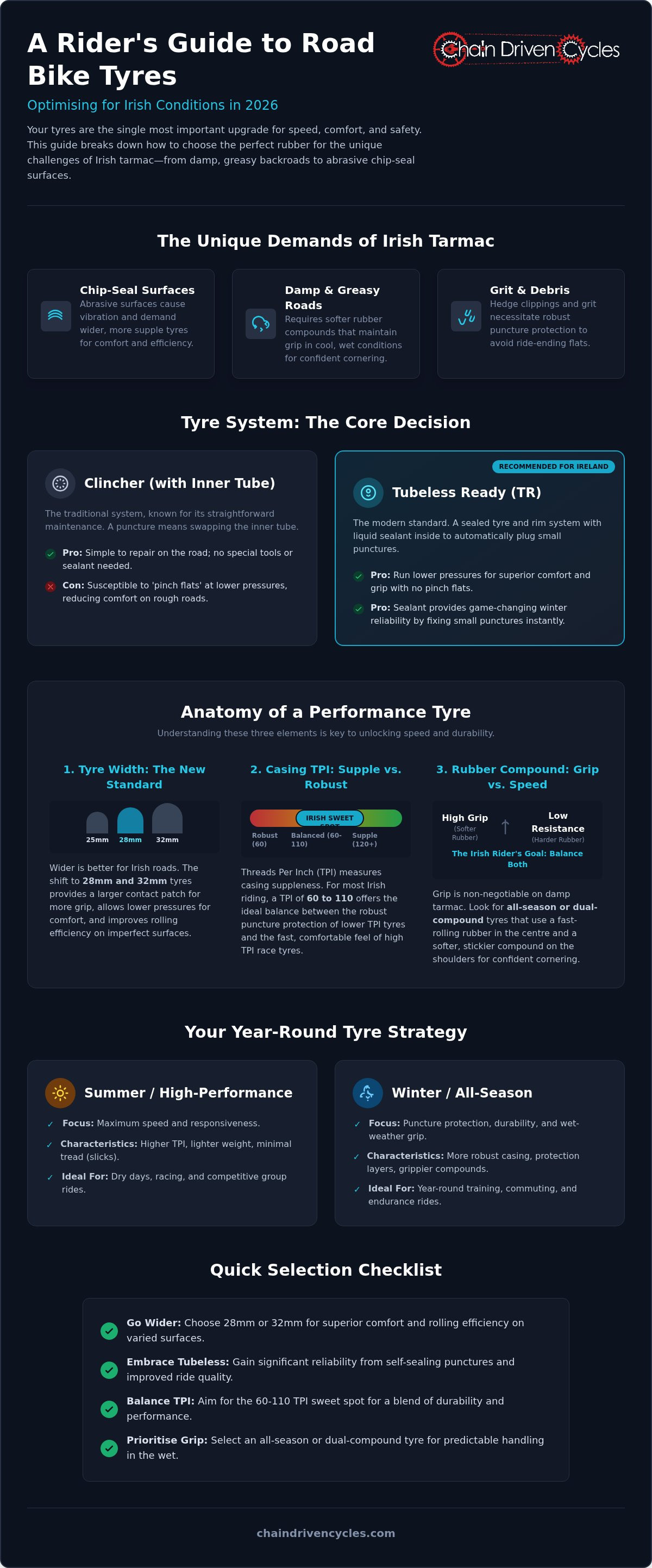
Clinchers remain popular because they're simple to maintain. If you get a flat, you just swap the tube and continue your ride. However, Tubeless Ready (TR) systems are rapidly becoming the standard for Irish cyclists. By running lower pressures without the risk of pinch flats, you gain significant comfort on rough chip-seal. The sealant inside provides essential winter reliability by plugging small holes from road debris before you even notice them. It's a game-changer for those who want to avoid standing on a cold roadside with tyre levers.
Understanding Rolling Resistance and Grip
Speed isn't just about a lack of tread. In Ireland, grip is a vital component of performance. A tyre with a softer rubber compound might have slightly more rolling resistance on paper, but it'll keep you upright on greasy, damp tarmac. All-season tyres are frequently the smartest investment for national routes. They use compounds that remain flexible in cooler temperatures, ensuring your braking and cornering stay predictable regardless of the weather. Balancing a fast-rolling centre with 'sticky' shoulders is the secret to a tyre that performs year-round.
Understanding Tyre Construction: Width, TPI, and Compounds
A tyre's performance isn't just about the rubber on top. The skeleton underneath determines how it reacts to the road. The 'bead' is the edge of the tyre that sits in the rim. Folding beads use Kevlar or similar materials to save weight and improve security, while wire beads are heavier and found on entry-level models. For those looking for the best road bike tyres Ireland has for high-end performance, a folding bead is almost always the preferred choice.
The casing structure is what gives a tyre its personality. It influences how the tyre deforms over a pebble and how much energy is lost as heat. If you're upgrading a premium machine, choosing a casing that complements your frame's characteristics is vital. Our professional bicycle repair services can help you match the right tyre construction to your specific wheelset and riding style.
The Science of TPI and Casing
TPI stands for Threads Per Inch. It measures the density of the nylon or cotton threads in the tyre's casing. High TPI tyres (120+) use finer threads. This creates a supple feel because the tyre deforms more easily around road imperfections. While these are among the Best road bike tyres for racing, they often have thinner sidewalls. This makes them faster but more vulnerable to the sharp flints and 'hedge-cutting' thorns common on rural Irish lanes.
Low TPI tyres (60 or less) use thicker threads and more rubber. They're robust and offer better protection for daily training. For most riders, a 'sweet spot' of around 60 to 110 TPI provides the best balance of speed and durability. It's enough to feel responsive without leaving you stranded with a torn sidewall on a remote coastal road.
Width and Pressure: The Comfort Equation
We've seen a massive shift from the old 23mm standard to 28mm and even 32mm widths. Wider tyres are often faster in real-world conditions because they have a shorter, wider contact patch that reduces internal friction. Crucially, they allow you to run lower pressures without increasing drag or risking a pinch flat.
Lower PSI is the secret to comfort on rough backroads. It allows the tyre to absorb vibrations rather than bouncing over them. You should calculate your ideal pressure based on your total system weight and the tyre's actual volume. Modern rims are wider too; a 28mm tyre on a wide rim might actually measure 30mm when inflated. This extra volume provides a significant safety margin on greasy or uneven surfaces.
Seasonality and Puncture Protection on Irish Tarmac
Irish cycling isn't defined by four distinct seasons but rather by varying levels of dampness and road debris. While summer slicks are designed to maximise speed during rare dry spells, they can be a liability on a typical greasy morning. For many, the "Four Season" tyre is the most practical choice for road bike tyres Ireland riders encounter. These tyres offer a compromise, maintaining low rolling resistance whilst providing enough grip and protection to handle the transition from a July heatwave to a misty October afternoon.
The primary enemies of Irish tubes are flint, glass, and thorns. Rural lanes are often covered in sharp agricultural debris, especially after hedge-cutting season in autumn. Urban routes present a different challenge with shattered glass and road grit. Using the best road bike tyres available ensures you have a casing designed to deflect these hazards before they penetrate the inner carcass. Investing in tyres with "sticky" compounds for winter is equally vital, as these remain flexible in cold temperatures to provide essential traction on wet corners.
Puncture Protection Technologies
Modern tyres use sophisticated materials like Kevlar or Vectran breakers. These are high-strength layers positioned directly under the tread to stop sharp objects from reaching the tube or tubeless cavity. Some tyres also feature Duraskin sidewall protection, which is a polyamide fabric that prevents "snakebite" flats or flint cuts on the side of the tyre. There's always a weight penalty with heavy-duty protection. However, a slightly heavier tyre is a small price to pay compared to the cost and frustration of a long walk home in the rain.
Tyre Care and Maintenance for Longevity
Longevity depends on proactive care. You should check your tyres for small cuts or embedded shards of glass after every ride. If left alone, these tiny fragments eventually work their way through the protection layer. Most high-end tyres include wear indicator dimples in the tread. When these disappear, it's time to retire the tyre. Because safety depends on your contact patch, comprehensive road bike servicing Ireland should always include a thorough tyre inspection to spot squaring off or structural fatigue before it causes a failure.
Expanding Your Horizons: Transitioning to Off-Road Adventures
Irish road cyclists are increasingly looking beyond the tarmac. The expansion of the national greenway network and the accessibility of canal towpaths have sparked a new interest in "road-to-trail" riding. While your search for road bike tyres Ireland usually focuses on speed and tarmac grip, exploring these rugged routes requires a shift in technical thinking. Transitioning to off-road surfaces isn't just about changing your route; it's about adapting your equipment to handle loose grit, mud, and uneven forest floors.
The fundamental difference between road and off-road tyres lies in how they generate traction. Road tyres rely on chemical grip, where the rubber compound bonds with the road surface. In contrast, off-road tyres use mechanical grip. Large tread blocks, often called "knobs," dig into soft ground to provide stability. If you're used to the high-pressure, narrow profile of a racing tyre, the increased volume and lower pressures of an off-road setup will transform your confidence on unpredictable terrain.
The Versatility of Mountain Bike Tyres
Mechanical grip is essential when you're facing Irish mud or wet grass. Knobby treads are designed to shed debris as the wheel rotates, preventing the tyre from becoming a slick, sliding surface. Choosing the right width is a balancing act. A wider tyre offers a larger contact patch and better floatation over soft ground, which is ideal for forest trails and mountain paths. However, you must ensure your frame has the necessary clearance to accommodate this extra volume.
If you're ready to explore the wilder side of cycling, our MTB tyre collection is the perfect place to start your adventure. We stock options that range from fast-rolling cross-country treads to aggressive patterns for technical descents. Upgrading your tyres is a cost-effective way to repurpose a hybrid bike or prepare a dedicated mountain machine for the local trail centres. Don't forget that our 10-month payment plan is available to help you invest in premium rubber for your next expedition.
BMX and Dirt Jump Tyres: For the Thrill-Seekers
For those who prefer skateparks or dirt tracks, tyre choice is about durability and impact resistance. BMX and dirt jump tyres are built with sturdy casings to survive high-impact landings and heavy lateral loads. The tread patterns are often specialised. Slicker, wrap-around treads provide maximum surface area for concrete parks, whilst deeper grooves offer better tracking on loose dirt jumps. Selecting a tyre with a high-pressure rating ensures it won't deform during a landing, giving you a predictable platform for every trick. You can find the right equipment to push your limits by visiting Chain Driven Cycles today.
Selecting Your Next Set: Standout Categories for 2026
Choosing the right set of road bike tyres Ireland offers involves matching the technology to your primary cycling discipline. In 2026, the distinction between race, endurance, and off-road rubber has become sharper, allowing riders to fine-tune their setup with precision. If you're looking to overhaul your performance, combining a premium tyre set with a new wheelset is often the most impactful change you can make. We offer a flexible 10-month payment plan to make these high-end upgrades more accessible for our community.
For the competitive cyclist, high-performance race tyres remain the gold standard. These models focus on maximum energy return and minimal weight. Whilst they require more frequent replacement than training tyres, the speed gains on smooth tarmac are undeniable. Conversely, endurance and commuting tyres are built for the long haul. They prioritise thicker tread depths and reinforced belts to survive thousands of kilometres of rough Irish chip-seal without complaint.
Standout Categories in Our Collection
- All-Season Road Tyres: These are the reliable choice for national weather. They feature silica-rich compounds that stay soft in the cold, providing dependable grip when the roads are perpetually damp.
- Aggressive Trail Tyres: If your goals involve muddy forest tracks, these are part of our specialised mountain bike tyre range. They provide the mechanical bite needed for loose or slippery terrain.
- Puncture-Resistant Commuter Tyres: These are designed for the daily grind. By incorporating dense sub-tread layers, they virtually eliminate the stress of the morning puncture, ensuring you arrive at your destination on time.
Final Checklist Before You Buy
Before making your final selection, verify your rim compatibility. Many modern wheels are tubeless-ready, but some older models are restricted to clincher setups. You also need to check your frame clearance. Whilst 30mm or 32mm tyres offer superior comfort, they may not fit into older rim-brake frames with tight tolerances. It's always best to measure the actual gap between your stays before sizing up.
Finally, consider the benefits of a professional fitting. Achieving a perfect seal on a tubeless setup can be tricky without the right high-pressure pump or compressor. Our service centre experts are available to ensure your new road bike tyres Ireland are seated correctly and filled with the optimal amount of sealant. This small step guarantees that you'll enjoy the full performance benefits of your investment from the very first kilometre.
Elevate Your Riding Experience for 2026
Selecting the right equipment is about more than just speed; it's about the confidence to ride in any weather. We've explored how technical nuances like TPI and rubber compounds dictate your performance on local roads. By choosing road bike tyres Ireland riders can trust, you ensure that every watt of power translates into forward momentum, regardless of the chip-seal surface or damp conditions. Whether you're upgrading to a wider tubeless setup or preparing for a winter training block, the right rubber remains your most cost-effective performance gain.
If you're ready to push beyond the tarmac, we're here to support your transition. With over 50 specialised off-road tyres in stock and expert technical support for all tyre fittings, we ensure your bike's perfectly prepared for the trail. You can also take advantage of our 10-month flexible payment plans to invest in premium components today. Ignite your off-road adventures with our dynamic MTB tyre collection and discover the thrill of exploring new horizons. We look forward to seeing you out on your next ride.
Frequently Asked Questions
What size road bike tyre do I need for Irish roads?
28mm or 30mm tyres are now the standard for Irish tarmac. These widths provide a larger air volume that cushions the ride on rough chip-seal surfaces. Whilst 25mm was once common, the increased comfort and lower rolling resistance of wider rubber make them superior for national routes. If your frame allows, 32mm is even better for winter riding or light gravel paths.
Is tubeless better than clincher for cycling in Ireland?
Tubeless is generally superior for Irish conditions because of its ability to self-heal small punctures caused by hedge-cutting debris. You can also run lower tyre pressures, which significantly improves grip on damp, greasy roads. Whilst clinchers are easier to change on the roadside, the reliability of a tubeless setup reduces the chance of ever needing to do so in the rain.
How often should I replace my road bike tyres?
You should replace your tyres every 3,000 to 5,000 kilometres, or when you see the wear indicator dimples disappear. Irish roads are particularly abrasive, so check for a squared-off profile on the rear tyre or any deep cuts that expose the casing threads. If you begin to experience frequent punctures, it's a clear sign the rubber has thinned too much to provide adequate protection.
Can I put wider tyres on my old road bike?
Frame clearance is the limiting factor when sizing up on older machines. Most rim-brake bikes are limited to 25mm or 28mm widths before the rubber rubs against the brake calipers or the fork crown. Before purchasing road bike tyres Ireland retailers stock in larger sizes, measure the narrowest point of your frame. You typically need at least 3mm of clearance on each side for safe operation.
What is the best road bike tyre for wet weather grip?
All-season tyres with a high silica content in the rubber compound offer the best wet-weather performance. These materials remain flexible in cold temperatures, allowing the tread to key into the road surface for better braking and cornering. Look for tyres specifically marketed as AS or All Season to ensure you have the necessary traction for a typical misty morning on national routes.
Are expensive road tyres worth the investment?
Premium tyres are the most cost-effective way to improve your bike's handling and speed. High-end models use more advanced compounds and supple casings that reduce rolling resistance whilst maintaining robust puncture protection. When you buy road bike tyres Ireland enthusiasts recommend, you're investing in a safer, more comfortable ride. The difference in feel compared to entry-level rubber is immediately noticeable on the first descent.
How do I know if my tyres are tubeless compatible?
Look for markings such as TR (Tubeless Ready), TLE (Tubeless Easy), or UST on the tyre sidewall. If these labels aren't present, the tyre is likely designed for use with an inner tube only. You must also ensure your rims are compatible. Our service centre experts can verify your equipment and provide professional fitting to ensure your tubeless setup is airtight and safe.
What is TPI and why does it matter for my ride quality?
TPI stands for Threads Per Inch and refers to the density of the tyre's casing. A higher TPI (above 100) means the tyre is more flexible and supple, leading to a smoother ride and lower rolling resistance. A lower TPI (around 60) results in a stiffer, more durable tyre that offers better resistance to sidewall cuts. Choosing the right TPI depends on whether you prioritise racing speed or daily durability.