



Indoor Cycling Trainer Ireland: Choose a Setup That Fits Your Riding
The right indoor cycling trainer isn’t necessarily the one with the most features. It’s the one that suits your bike, training goals and available space. If you’re comparing an indoor cycling trainer Ireland cyclists can use at home, it’s easy to get caught between turbo trainers and standalone exercise bikes, especially when compatibility, noise and setup all matter.
Trainers differ in how they connect to your bike, provide resistance and support structured workouts. The best fit depends on the riding experience you want, not simply the number of features on the box.
This guide explains how indoor trainers work and compares the main options, from wheel-on and direct-drive turbo trainers to exercise bikes. You’ll learn what to consider for your bicycle, drivetrain, budget and home setup, and how smart-trainer features can support planned sessions. We’ll also look at ThinkRider smart trainers from Chain Driven Cycles as an option for building an indoor setup, so you can make a practical choice and get started with confidence.
Key Takeaways
- Choose between riding your own bicycle on a trainer and using a standalone exercise bike.
- Before choosing an indoor cycling trainer for home use, check compatibility with your bike’s axle and drivetrain.
- Allow enough room for the trainer and bicycle, including space to mount and dismount. Consider where you’ll store the equipment between rides.
- Choose features to match your routine, such as manual resistance or resistance controlled by a smart trainer.
- ThinkRider smart trainers from Chain Driven Cycles are an option for building an indoor setup around your bicycle.
What is an indoor cycling trainer, and who is it for?
An indoor cycling trainer is equipment that lets you ride a bicycle or exercise bike indoors by supporting the bike and providing resistance as you pedal. It offers a way to ride without depending on outdoor conditions, which can be useful when rain, limited daylight or a busy schedule makes a road ride less practical. For a general introduction to the equipment and its main forms, see What is a Bicycle Trainer?
This guide focuses on the equipment and how it can fit into your routine. It isn’t a ranking of exercise bikes or a promise of particular fitness or weight-loss results. The aim is to help you compare the options and decide which format suits your bicycle, home and reasons for riding.
Turbo trainer or exercise bike: what is the difference?
A turbo trainer uses your bicycle: you attach or position the bike on a supporting unit, then pedal against resistance. An exercise bike is a standalone machine with its own frame, saddle, handlebars and pedals. A trainer lets you use a bicycle you already know; an exercise bike doesn’t require you to own a separate bike.
Think about space as well as riding position. A turbo trainer needs room for both the trainer and bicycle, and you’ll need to plan how to set it up and store it. It can suit someone who wants to keep using their own bike indoors. A standalone exercise bike avoids fitting a bicycle to a trainer, but it still needs room of its own. Neither format is right for every home: storage, access and familiarity all matter.
Who benefits from indoor cycling?
Indoor riding can suit beginners who want a regular place to practise pedalling and get comfortable on a bike without planning around the weather or daylight. You can fit a session around the time you have, and a controlled indoor setting removes some of the variables of riding outdoors, such as traffic and route choice.
For experienced cyclists, indoor sessions can complement outdoor rides. They offer a practical way to keep riding when a suitable route or outdoor conditions aren’t available, or to fit a planned session around work and other commitments. Depending on your equipment and routine, you can choose a steady ride or follow a structured workout.
An indoor cycling trainer Ireland riders choose should support the way they actually want to ride, rather than an imagined training plan. If you already own a bicycle and want to keep its familiar riding position, a turbo trainer may be a natural starting point. If you don’t have a bicycle, or prefer a dedicated indoor machine, an exercise bike may suit you better. Before comparing formats, it helps to understand how a trainer supports a bicycle and creates resistance.
How does an indoor cycling trainer reproduce the ride?
A trainer holds a bicycle steady while you pedal against resistance. Depending on the design, the resistance unit acts on the rear tyre or connects directly to the bicycle’s drivetrain. The resistance creates the effort of a ride without the bicycle moving forwards. The feel varies by design: a basic setup may offer simple resistance adjustments, while a connected system can respond to digital instructions.
This difference affects how you manage a session. With manual adjustment, you change resistance yourself, much as you might shift gears or turn a control. A smart trainer can communicate with compatible training software and alter resistance in response to a workout or simulated route. An app may show a virtual landscape or guide you through intervals, but those features depend on the app, trainer and their compatibility.
What makes a smart trainer different?
A smart trainer sends ride data to a compatible device or application and can adjust resistance electronically. Depending on the equipment, the data may include power and cadence. The application can then use that information to guide a session. Virtual routes and workout libraries are features of the software, not necessarily of the trainer itself.
Before choosing a setup, check the specific trainer’s documented functions and the app’s compatibility requirements. Connection standards, supported devices and software compatibility vary, so don’t assume that every trainer connects to every platform. Where supported, ERG mode can automatically adjust resistance to help you hold a target power during an interval.
What do power, cadence and resistance tell you?
Power describes the rate at which you’re producing effort on the pedals, usually shown in watts. It can help you follow a prescribed target rather than relying only on how hard a session feels. Cadence is your pedalling rate, usually displayed as revolutions per minute. It helps you see whether you’re turning the pedals quickly or slowly.
Resistance is the opposing force you feel as you pedal. A low setting can feel like spinning along an easy, flat road; more resistance can make each pedal stroke feel heavier, like riding uphill. Gearing, cadence and resistance interact, so a heavier-feeling effort doesn’t by itself tell you your power output.
If you want to understand how power targets can shape a training session, Chain Driven Cycles’ guide, How to Train with a Power Meter: The Comprehensive 2026 Guide, explores the topic further. For a bicycle-based indoor setup, explore ThinkRider smart trainers. Compare the specifications with your bike, chosen software and the data you want to use before building a routine around them.
Indoor cycling trainer types compared: which experience suits you?
Trainer formats differ in how they support your bike, how much setup they involve and what you need to store. Use this comparison to narrow down the riding experience that suits your home. Smart control may be available on bicycle-mounted trainers, but it isn’t a separate physical format like a standalone exercise bike.
| Format | Bicycle use and setup | Storage and riding experience |
|---|---|---|
| Wheel-on trainer | Your bike’s rear wheel stays in place and rests against the trainer’s resistance unit. The bike must be secured correctly, and setup depends on the trainer and bicycle. | Store the trainer and bicycle together or separately, depending on the design and your space. You ride your own bike; resistance adjustment and connected features vary by model. |
| Direct-drive trainer | The rear wheel is removed and the bicycle attaches to the trainer at the rear axle or drivetrain interface. This involves fitting the bike and checking compatibility. | You’ll need room for the trainer and bike, and a place for the removed wheel. You ride your own bicycle, with features depending on the particular unit. |
| Standalone exercise bike | This is a complete machine, so there’s no need to fit your bicycle to a trainer. Adjustments are made on the exercise bike itself. | It needs its own floor space and may be less convenient to move or store, depending on its design. It offers a dedicated indoor riding position rather than your own bicycle’s setup. |
Wheel-on and direct-drive trainers
The main distinction is where the trainer meets the bicycle. On a wheel-on unit, the rear tyre contacts the resistance mechanism. With direct drive, the bicycle connects to the trainer in place of its rear wheel. These designs involve different setup steps and storage arrangements, but neither is automatically the better choice for every rider. Check axle, drivetrain and other fit requirements against the specifications for both your bike and the trainer.
Smart trainers and standalone exercise bikes
A smart trainer can connect with compatible training software to share ride data or adjust resistance during a session. That may suit a rider who wants to follow a structured workout or use a virtual route. An exercise bike can also have its own controls or connected features, but it doesn’t use your bicycle. Its functions depend on the specific machine.
App support isn’t guaranteed by the word “smart”. Confirm the trainer’s documented connectivity and the software’s compatibility before choosing a setup. Check product-specific details, including resistance functions and supported devices, against verified manufacturer information.
When choosing an indoor trainer, start with the practical decision: do you want to train on your own bike, or use a dedicated indoor machine? Then compare setup requirements and storage space before weighing up connected features. That order keeps the decision focused on the experience you’ll actually use.
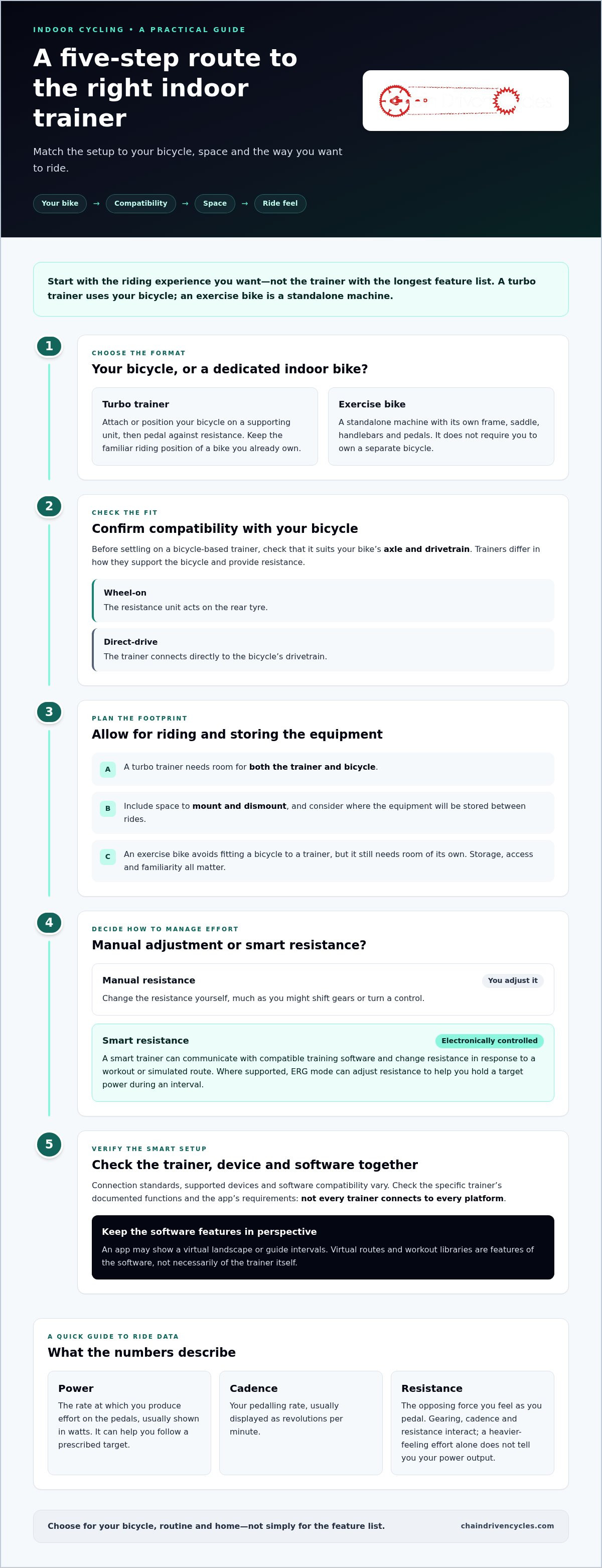
How to choose and set up an indoor cycling trainer
Choose in a practical order: decide how you’ll ride, check what your bicycle requires, then make sure the setup works in your home. The right indoor cycling trainer is one that fits both your bike and your routine, not just the available features.
- Start with your riding goals and bicycle. Decide whether you want occasional steady rides, structured sessions or a way to ride indoors on your existing bike. If you don’t own a bicycle, consider whether a standalone exercise bike better suits your needs.
- Identify your bicycle’s key details. Note the bike type, rear axle arrangement and drivetrain. Wheel-on and direct-drive trainers attach differently, so check the bicycle and trainer manufacturer’s specifications for compatibility before choosing.
- Plan the space. Measure the area the bike and trainer will occupy, leaving room to get on and off safely. Consider ventilation, a nearby power supply if your chosen equipment needs one, and whether the setup can stay in place or must be stored after each session.
- Match features to your routine. For simple indoor rides, manual resistance may be enough. If you want app-led workouts or resistance that responds to a session, check the trainer and software specifications for the functions and compatibility you need.
- Set up according to the instructions. Follow the manufacturer’s guidance for assembly, bike attachment and any required adjustments. Before riding, check that the trainer is stable, the bicycle is secured as directed and components are correctly fitted.
Match the trainer to your bicycle and home
Compatibility depends on the bike and trainer combination. Check details such as axle type, wheel size or drivetrain requirements against manufacturer information. Don’t assume that a trainer will fit simply because it is designed for bicycles. Keep the setup area clear of loose items and choose a position where you can ride without blocking a doorway or walkway. A stable, uncluttered space makes it easier to begin sessions regularly.
Give storage the same attention as initial fit. If you’ll move the trainer after riding, make sure you have somewhere accessible to keep it and any parts removed from the bicycle. If it will stay assembled, allow enough space to mount, dismount and move around the bike.
Plan a first indoor session
Keep your first ride manageable and use it to get familiar with the position, controls and feel of the resistance. There’s no need to start with a performance target. A fan can improve comfort, while a towel and water within reach can make it easier to settle into the session. For more ideas on arranging a home riding space, see the Indoor Training Setup: Essentials for Your Home Gym article.
- Confirm the bicycle is attached and the trainer is stable.
- Check that your chosen display or training app is ready, if you’re using one.
- Keep water and a towel nearby, then begin at an easy pace.
For a bicycle-centred setup, explore ThinkRider smart trainers as you compare options for your home and training routine.
ThinkRider smart trainers from Chain Driven Cycles
Once you’ve compared trainer formats and considered your bicycle, space and routine, you can look at equipment options. Chain Driven Cycles sells ThinkRider smart trainers for cyclists building an indoor setup around a bicycle. They’re one option if you want to ride your own bike indoors rather than use a standalone exercise bike.
Choosing a smart trainer is still a matter of fit. Your riding goals, available space and bicycle specifications all affect whether a particular setup is practical. A connected training routine also depends on the equipment and software working together, so base your decision on verified product and manufacturer information rather than assumptions about a brand or category.
Where a ThinkRider smart trainer fits
A ThinkRider smart trainer may suit a cyclist who wants an indoor setup centred on their bicycle. Before choosing a trainer, consider what you want from your sessions: straightforward indoor riding or workouts that use connected features. Then weigh that against the room you have for the bike and trainer, and your bicycle’s requirements. No single trainer will be the right match for every rider or bike.
Use the manufacturer’s information to check the specific model’s fit requirements and functions, including any software or device support you plan to use. This grounds your choice in the setup you intend to build. It also helps distinguish what the trainer itself does from features supplied by an application or another device.
Keep your indoor setup useful over time
A reliable routine depends on more than choosing equipment. Follow the manufacturer’s instructions for assembly, bicycle attachment, operation and care. Before riding, make sure the trainer and bicycle are set up as directed, and keep the area around the equipment clear. Regular attention to your bicycle also matters, particularly if indoor sessions become a regular part of your riding.
Chain Driven Cycles provides professional bicycle maintenance alongside indoor-training equipment. Keeping your bicycle in good working order supports its use on the trainer and outdoors, while following the care guidance helps you look after the trainer itself. If your training routine changes, review how the setup fits your space and goals rather than assuming the same arrangement will always be practical.
If you’re considering an indoor cycling trainer for use with your own bike, match the equipment to your intended routine and compatibility requirements. Explore Chain Driven Cycles’ indoor training equipment to see whether a ThinkRider smart trainer suits the setup you have in mind.
Make indoor riding part of your routine
Your first setup doesn’t need to be complicated. Start with the kinds of rides you’ll realistically make time for, then build a routine that feels manageable alongside your outdoor cycling. As you get used to riding indoors, you can refine your sessions and equipment around what works for you.
If you’re still weighing up an indoor cycling trainer for use with your own bike, let your intended routine guide the final choice. Think about the experience you want from each session, the space you can dedicate to it and how you’ll keep the bicycle ready to ride. A practical setup is one you’ll be glad to use, not one that adds unnecessary complexity.
Chain Driven Cycles offers cycling equipment and ongoing bicycle care to support your riding beyond the initial setup. Explore indoor training equipment at Chain Driven Cycles and find a setup that fits your bike and routine.
Frequently Asked Questions
Is an indoor cycling trainer the same as an exercise bike?
No. A turbo trainer supports your own bicycle, while an exercise bike is a standalone machine with its own frame and components. With a turbo trainer, you need to attach and secure your bicycle according to the equipment instructions; an exercise bike is a complete unit. If you already have a bike and want to use its familiar position indoors, a trainer may suit you. Neither option is universally better.
Can I use my road bike on an indoor cycling trainer?
Often, but check the exact bicycle and trainer specifications first. A trainer’s attachment system may require a particular axle arrangement or wheel setup, and direct-drive designs have different fitting requirements from wheel-on units. For example, two road bikes can have different rear axle standards, so don’t assume a trainer will fit both. Use the manufacturer’s documentation for your specific equipment before buying or attempting installation.
How much space do I need for an indoor cycling trainer?
There’s no single footprint that suits every setup. The trainer’s design, your bicycle and the space you need to mount and dismount all affect it. Measure the intended area with the bike in position, and leave enough clearance to move around safely. Also consider where the equipment will go between rides, whether the room can be ventilated, and how to protect the floor from sweat or marks.
Do I need a smart trainer to start indoor cycling?
No, you can begin indoor cycling without a smart trainer. Simpler equipment can suit steady rides where you adjust effort yourself; connected features may appeal if you want interactive routes or sessions guided by software. Think about how you’ll use the setup before paying for features you may not need. If you plan to use an app, check the trainer and software documentation for compatible devices and functions.
What happens if my bike does not fit an indoor trainer?
A bike may not fit because its frame, axle or other attachment details differ from the trainer’s requirements. Check the manufacturer’s specifications before setting it up, and don’t force a connection or improvise parts: an insecure fit can make the setup unsafe. If the documented requirements don’t match your bicycle, use equipment designed for that combination. A standalone exercise bike is another format that doesn’t require fitting your own bicycle.
Can I use training apps with an indoor cycling trainer?
App use depends on the trainer’s connectivity and the software’s supported devices. A smart trainer communicates information or resistance instructions; the app supplies features such as workout plans or virtual environments. These roles are separate, so an app’s feature list doesn’t prove that it will work with every trainer. Check current manufacturer and software documentation for confirmed compatibility before choosing an indoor cycling trainer.
Is indoor cycling suitable for beginners?
Yes, indoor cycling can suit beginners because you can choose a comfortable pace and decide how long to ride. Start with a manageable session focused on learning the controls, getting used to the riding position and stopping safely. Follow the manufacturer’s setup instructions, and have water nearby. Progress varies with individual circumstances and consistency, so treat early rides as a chance to build familiarity rather than a guarantee of a particular fitness or weight-loss result.