



Electronic Shifting Guide: Optimising Your 2026 Drivetrain
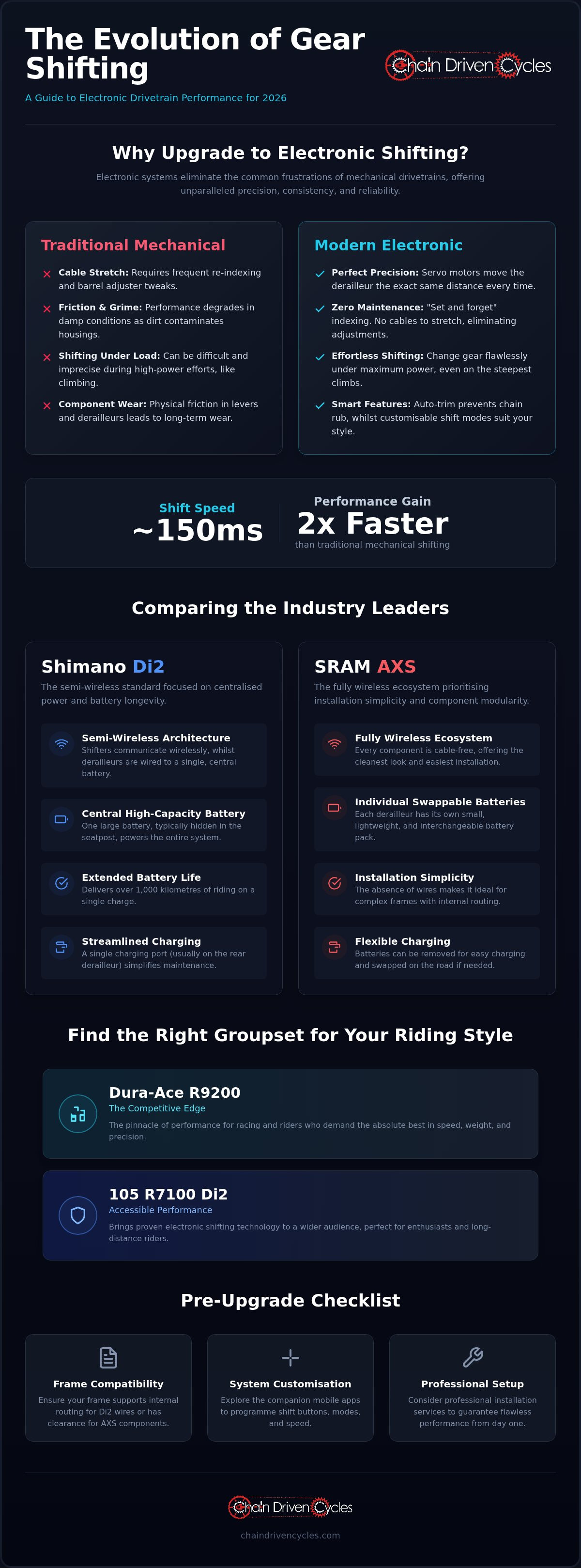
What if your drivetrain never required a barrel adjuster or a cable tension tweak ever again? Most cyclists have experienced the frustration of a missed shift during a high-torque climb or the tedious process of re-indexing gears after mechanical cables have stretched. These minor irritations can detract from the pure enjoyment of the sport. By upgrading to electronic shifting, you effectively remove the human error and mechanical fatigue associated with traditional setups. Modern systems like Shimano Di2 and SRAM AXS deliver shift speeds of approximately 150 milliseconds, which is twice as fast as manual alternatives, ensuring your performance remains consistent regardless of the terrain.
We understand that choosing the right components is a significant decision. You want a system that offers reliability in damp Irish conditions and simplifies the complexity of modern internal cable routing. This guide provides a comprehensive look at the 2026 groupset landscape, from the race-ready Dura-Ace R9200 to the accessible performance of the 105 R7100 Di2. You will discover how these technologies provide near-instant gear changes, low-maintenance longevity, and customised logic via mobile apps to help you select the perfect electronic groupset for your specific needs.
Key Takeaways
- Understand why moving to electronic shifting eliminates common mechanical frustrations like cable stretch and the need for constant derailleur indexing.
- Learn the technical distinctions between Shimano’s semi-wireless Di2 architecture and SRAM’s fully wireless AXS ecosystem to match a system to your frame.
- Identify the right groupset for your specific riding style, from the accessible precision of 105 Di2 to the competitive edge of Dura-Ace.
- Discover practical tips for managing battery life and checking frame compatibility to ensure your drivetrain upgrade is both straightforward and durable.
- Explore how professional setup services and flexible payment plans can help you access pro-level performance for your 2026 cycling season.
The Evolution of Gear Shifting: Why Choose Electronic Shifting?
Electronic shifting is a motor-driven drivetrain system. It represents the most significant leap in cycling technology since the move to integrated brake and gear levers. Whilst mechanical systems rely on the physical tension of a steel cable to pull a derailleur into place, electronic systems use precise servo motors. This shift from analogue to digital has transformed how we interact with our bikes. It is remarkably precise.
Looking back at the history of electronic shifting, the primary goal was always to remove human error and mechanical inconsistency. Traditional cables are prone to stretch as they bed in, necessitating frequent barrel adjuster tweaks to keep the indexing crisp. With these systems, once the setup is complete, it stays set. The derailleur moves to the exact same millimetre every single time, regardless of whether the bike is clean or covered in grit.
For those tackling steep Irish gradients, the ability to shift under load is a game changer. Mechanical systems often protest when you try to drop to the small ring whilst putting out high power. Electronic motors have the torque to move the chain across the cassette or chainrings effortlessly, even when you're out of the saddle. This reliability is bolstered by auto-trimming technology. The front derailleur automatically adjusts its position based on the rear gear selection, preventing that annoying chain rub in every possible gear combination.
Precision and Consistency in Every Shift
Digital signals ensure 100% accuracy because they don't suffer from the friction or ghost shifting found in worn mechanical housings. Riders can also customise their experience through programmable shifting modes. Synchronised shifting allows the system to manage front derailleur changes automatically as you move through the cassette, whilst Semi-Synchronised shifting adjusts the rear derailleur to maintain a steady cadence during a front chainring swap. You can also utilise multi-shift functions, allowing you to sweep across the entire cassette simply by holding down a button. Because the derailleur moves with such calculated precision, the chain engages the teeth of the cassette more cleanly, reducing micro-grinding and extending the life of your components.
Reduced Maintenance and Long-Term Reliability
By removing traditional gear cables, you eliminate the main entry point for grit and grime to enter your system. In the damp Irish climate, mechanical cables often become sluggish as contaminants build up inside the housing. Electronic systems are sealed against the elements. This reliability offers several long-term benefits:
- Reduced wear: The lack of mechanical friction inside the shifters means internal parts don't wear down over time.
- Weatherproofing: Sealed units prevent water ingress during winter rides or heavy cleaning.
- Consistency: The system doesn't require "re-indexing" after the initial setup.
You aren't forcing a lever against a heavy spring; you're simply clicking a button. This ensures your controls feel as sharp in year five as they did on day one, providing a dependable performance level that mechanical setups struggle to match over long periods of use.
Shimano Di2 vs SRAM AXS: Comparing the Industry Leaders
Shimano and SRAM dominate the electronic shifting market, yet they approach drivetrain architecture from two distinct philosophies. Choosing between them often comes down to your preference for battery management and installation simplicity. Before committing to an upgrade, it's helpful to understand everything you need to know about how these systems differ in real-world use. Shimano relies on a semi-wireless platform, whilst SRAM has pioneered a completely cable-free ecosystem. Both offer the reliability needed for the demanding Irish climate, but their day-to-day operation varies significantly.
Shimano Di2: The Wired and Semi-Wireless Standard
Shimano's latest 12-speed Di2 groupsets utilise a semi-wireless setup. The shifters communicate wirelessly with the derailleurs, but both derailleurs are physically connected to a single high-capacity battery hidden within the seat post. This configuration offers a significant advantage in battery longevity, often lasting over 1,000 kilometres on a single charge. Because there is only one charging point, maintenance is streamlined. This architecture is particularly well-suited to high-end frames like Wilier Road Bikes Ireland riders often choose, or Bottecchia models where internal routing is designed for a central power source. Our expert team provides setup services for these systems, and you can take advantage of our 10-month payment plan to spread the cost of a full groupset upgrade.
SRAM AXS: The Fully Wireless Ecosystem
SRAM AXS is a completely wireless system. There are no cables or wires connecting any components, making it the simplest system to install on modern frames. Each derailleur has its own dedicated battery. These units are interchangeable, meaning if your rear battery dies mid-ride, you can swap it with the front one to ensure you have access to your full cassette for the journey home. The AXS ecosystem is also highly compatible, allowing you to mix road shifters with mountain bike derailleurs for "mullet" builds. It pairs perfectly with Assioma Power Meter Pedals to provide a data-rich riding experience without the clutter of extra wires.
The ergonomic experience also differs. Shimano hoods are generally slimmer, whilst SRAM hoods are slightly larger to accommodate the hydraulic internals and wireless hardware. Shifting logic is another key separator. Shimano uses two buttons per lever, mimicking traditional mechanical feel. SRAM uses a "paddle" system: the right lever shifts up, the left shifts down, and pressing both together moves the front derailleur. Both brands offer robust mobile apps, Shimano E-TUBE and SRAM AXS Mobile, for firmware updates and logic customisation. These apps allow you to adjust shift speeds or enable sequential shifting modes that manage your front chainring changes automatically. If you're ready to modernise your ride, you can explore our range of electronic shifting products to find the best fit for your frame.
Choosing the Right Groupset for Your Riding Style
Selecting a groupset requires balancing weight, performance features, and your specific riding environment. Whilst the core benefits of electronic shifting remain consistent across tiers, each level is engineered for a different type of cyclist. Whether you are a weekend enthusiast or a dedicated racer, the 2026 market offers tailored solutions that can be easily integrated into your current setup.
Road Performance: 105, Ultegra, and Dura-Ace Di2
For road enthusiasts, the Shimano 105 Di2 R7100 series is the standout choice. It delivers the same 150-millisecond shift speed as the top-tier kits but uses slightly heavier materials to ensure affordability. This makes it the ideal entry point for endurance riders who value precision and low maintenance over marginal weight gains. It's a reliable workhorse that brings pro-level technology to the everyday rider.
Moving up to Ultegra R8100 and Dura-Ace R9200 introduces Hyperglide+ technology. This refined cassette tooth profile allows for near-seamless gear changes even whilst you are sprinting or climbing out of the saddle. Dura-Ace remains the preferred option for competitive racing, providing the lightest weight and most aerodynamic hood profiles. Ultegra provides nearly identical performance for those seeking the best value in a high-end build. To help you access this technology, we offer a 10-month payment plan on all full groupsets.
Gravel and Off-Road: Shimano GRX Di2
Gravel riding presents unique challenges that mechanical systems often struggle with. Mud, dust, and constant vibration can degrade cable performance over a single long ride. Shimano GRX Di2 addresses this with textured hoods for better grip in damp conditions and derailleurs featuring a chain-stabilising clutch. This prevents the chain from slapping against the frame on bumpy descents.
The digital signal is immune to the ghost shifting often caused by frame flex on rough terrain. You can find the latest Shimano Di2 and electronic shifting components in our collection, including gravel-specific configurations designed for both 1x and 2x setups. These components are built to withstand the rigours of the trail whilst maintaining the same crisp shifting logic found on road-specific groupsets.
SRAM provides a similar hierarchy with Rival, Force, and Red AXS. Rival AXS has successfully democratised wireless technology, bringing it to a much broader price bracket. Since its 2025 update, Force AXS has adopted many of the weight-saving features of the flagship Red AXS E1, making it a popular choice for custom builds. One significant advantage for gravel riders is the ability to create "mullet" builds, pairing road shifters with mountain bike derailleurs for an ultra-wide gear range. Because SRAM batteries are interchangeable, they are a favourite amongst those who enjoy multi-day adventures where charging opportunities might be scarce.
Key Considerations Before Upgrading Your Drivetrain
Upgrading to electronic shifting is a transformative experience, but it requires a different approach to maintenance than traditional mechanical systems. One of the most common questions we hear involves weatherproofing. In the damp Irish climate, mechanical cables are often the first point of failure as grit and water penetrate the housings. Electronic systems are inherently more resilient because they're sealed against the elements. Whether you're riding through a coastal mist or a heavy downpour, the digital signal remains unaffected. However, you must still ensure that charging ports are kept clean and that battery seals are intact to maintain this level of reliability over several seasons.
Battery Life and Charging Management
Managing your power source is simpler than you might expect. A Shimano Di2 system typically offers a range of approximately 1000km on a single charge of its internal seat post battery. SRAM AXS components, which use individual batteries for each derailleur, provide about 60 hours of active riding time. Most modern GPS head units can pair directly with your drivetrain to display real-time battery percentages. This integration means you'll receive a low-battery warning long before you're at risk of being stuck in a single gear. During the colder winter months, it's wise to charge your system more frequently. Extreme cold can affect the discharge rate of lithium-ion batteries, though they remain perfectly functional for winter training.
Professional Setup and Maintenance
While electronic systems require less day-to-day adjustment, the initial installation is critical. Frame compatibility is the first hurdle. Most modern frames are designed for electronic wires, but older models may require a fully wireless SRAM setup to avoid messy external routing. Beyond the physical build, firmware updates are essential. These updates often improve battery efficiency or add new shifting logic modes. Our professional bike repair experts handle these technical configurations to ensure your investment performs at its peak from day one. To get the most out of your new setup, you should train with a power meter alongside electronic gears to find your most efficient cadence and power zones. If you're ready to make the switch, you can explore our bicycle repair services to schedule your professional groupset installation.
Premium Electronic Shifting Solutions at Chain Driven Cycles
At Chain Driven Cycles, we bridge the gap between technical theory and real-world performance. Our curated range of 37 electronic shifting products ensures that every rider finds a system compatible with their frame and budget. We don't just sell components; we offer the necessary expertise to maintain and enjoy them for years to come. Whether you are looking for a full groupset for a new Wilier Road Bike or a specific derailleur upgrade, our team provides the authoritative guidance you need to make an informed choice. We take pride in being a trusted specialist for the Irish cycling community, ensuring that your transition to digital gears is seamless and reliable.
Standout Products in Our Collection
Our selection focuses on the most dependable technology currently available. The Shimano 105 R7170 Di2 groupset remains our most popular recommendation for those seeking the best value. It serves as the perfect entry point to pro-level performance, offering the same 12-speed precision found in the professional peloton. For serious enthusiasts who demand faster shift speeds and refined ergonomics, the Shimano Ultegra R8170 Di2 provides a competitive edge without the extreme cost of Dura-Ace. If you prefer a cable-free aesthetic and the ability to customise your gear range for gravel adventures, the SRAM Force AXS system offers wireless simplicity that is remarkably easy to install and maintain.
Flexible Payment Plans for Performance Upgrades
We understand that upgrading to a modern electronic shifting system is a significant investment. High-end groupsets often represent a financial barrier that can delay your performance goals. To address this, we provide a 10-month payment plan that allows you to spread the cost of your upgrade into manageable monthly instalments. This means you can begin enjoying the benefits of near-instant gear changes and reduced maintenance immediately, without the burden of a large upfront payment. Our application process is straightforward, designed to get you back on the road with the best possible equipment as quickly as possible.
Every order from our collection includes free delivery across Ireland, ensuring your new components arrive safely at your door. Beyond the sale, our bicycle repair services are available to handle the intricate firmware updates and indexing required for a perfect setup. We position ourselves as your knowledgeable partner in this journey, offering both the premium hardware and the technical support to keep it running perfectly in all conditions. Browse our full Electronic Shifting collection today to find the ideal drivetrain solution for your 2026 season.
Elevate Your Performance for the 2026 Season
Transitioning to electronic shifting is no longer a luxury reserved for the professional peloton; it's a practical upgrade for any cyclist seeking reliability and precision. By removing the inconsistencies of mechanical cables, you ensure that every gear change is crisp and immediate, regardless of the weather or terrain. Whether you choose the semi-wireless endurance of Shimano Di2 or the fully wireless flexibility of SRAM AXS, you're investing in a more consistent and enjoyable riding experience. We've explored how these systems handle the Irish elements and how accessible tiers like 105 Di2 bring pro-level tech to every enthusiast.
At Chain Driven Cycles, we're an authorised premium brand dealer dedicated to helping you find the perfect drivetrain configuration. We offer expert guidance to ensure frame compatibility and professional setup for long-term performance. To make this technology more accessible, we provide free delivery across Ireland and a flexible 10-month payment plan to help you spread the cost of your components. Take the next step in your cycling journey and experience the benefits of a modern, digital drivetrain. Upgrade your ride with the latest Shimano Di2 and SRAM AXS components at chaindrivencycles.com today.
Frequently Asked Questions
What happens if my electronic shifting battery dies during a ride?
If your battery levels drop critically low, the system enters a protection mode where the front derailleur stops functioning first. This preserves the remaining power for the rear derailleur, allowing you to shift through your cassette to get home safely. SRAM AXS users can physically swap the front and rear batteries if the rear one fails. Shimano systems provide clear low-battery alerts on your paired GPS head unit long before power is fully depleted.
Can I upgrade my mechanical bike to electronic shifting?
You can upgrade most modern mechanical bikes to electronic shifting, though the ease of installation depends on your frame's internal cable routing. Frames with dedicated ports are ideal for the wired components of a Shimano Di2 setup. If your frame lacks these ports, a fully wireless system like SRAM AXS is the best solution as it requires no internal wires. We recommend a professional assessment to ensure your hub and bottom bracket are compatible.
Is Shimano Di2 better than SRAM AXS for Irish weather?
Both systems are highly resilient, but Shimano Di2 is often favoured for the damp Irish climate due to its semi-wireless architecture. Having a single internal battery protected within the seat post reduces the number of exposed electrical contact points. SRAM AXS is also fully sealed against water ingress and performs reliably in heavy rain. The lack of traditional cables in both systems prevents the sluggish shifting typically caused by grit and road salt.
How often do I need to charge my electronic gears?
Charging frequency depends on your shifting habits, but a Shimano Di2 battery typically lasts for approximately 1,000 kilometres of riding. SRAM AXS batteries generally require a recharge every 60 hours of active use. It's a good habit to check your levels via the mobile app or your paired head unit once a week. Cold weather can slightly reduce battery life, so more frequent checks are advisable during the peak of winter training.
Do I need a special frame for electronic shifting?
You don't strictly need a special frame, but "electronic-ready" frames make the installation of wired systems much cleaner. These frames include specific ports for E-Tube wires and internal mounts for the battery. If you have an older frame without these features, wireless groupsets are the perfect alternative. They eliminate the need for internal routing entirely, allowing you to enjoy modern electronic shifting performance on almost any high-quality road or gravel bicycle.
Can I mix and match Shimano and SRAM electronic components?
You cannot mix and match Shimano and SRAM electronic components because they use proprietary wireless protocols and different voltage requirements. A Shimano shifter will not communicate with a SRAM derailleur, and their cassettes require specific freehub bodies like HG or XDR. To ensure 100% accuracy and system stability, you must stick to a single manufacturer's ecosystem for your shifters, derailleurs, and battery management systems to avoid technical conflicts.
How do I update the firmware on my Di2 or AXS system?
Updating firmware is a straightforward process handled via dedicated smartphone apps. For Shimano systems, you use the E-TUBE Project app, whilst SRAM users utilise the AXS Mobile app. Simply pair your components to your phone via Bluetooth and follow the prompts to download the latest software. These updates are vital for maintaining battery efficiency and accessing new features. Our bicycle repair services also include comprehensive system diagnostics and firmware management during routine servicing.
Is electronic shifting more expensive to maintain than mechanical?
While the initial investment is higher, electronic systems are often less expensive to maintain over time. You won't need to replace stretched gear cables or pay for frequent derailleur indexing. The main costs involve standard drivetrain wear, such as replacing the chain and cassette. Because the motors move the chain with perfect precision every time, you may actually experience less micro-wear on your components compared to a poorly tuned mechanical setup.